Concept
The Seven-Headed Dragon of Revelation
the great red dragon, seven headed dragon revelation, what does the seven headed dragon represent, dragon in revelation 12, seven heads and ten horns, is the dragon in revelation literal, Revelation 12 dragon meaning, seven heads seven mountains seven kingsIntro
In Revelation 12, John sees "a great red dragon, having seven heads and ten horns, and upon his heads seven diadems" (Revelation 12:3). Who is it? The Bible answers that directly a few verses later: the dragon is "the old serpent, he that is called the Devil and Satan, the deceiver of the whole world" (12:9). The same snake from the garden of Eden, now shown at full size.
The harder question is what the seven heads mean, and here honest readers differ. Revelation never explains the dragon's heads in chapter 12. But in chapter 17 an angel explains the seven heads of a beast that looks just like the dragon: "The seven heads are seven mountains ... and they are seven kings" (17:9-10). So most readers agree the heads point to earthly ruling powers that Satan works through. Whether those are Roman emperors, a chain of world empires, or a picture of all anti-God power through history is the question this page lays out. And no, the dragon is not a literal reptile. John calls it a "sign" (12:3), the same way Jesus appears as a Lamb (5:6) without being a sheep. Satan is real; the dragon is how the vision shows him.
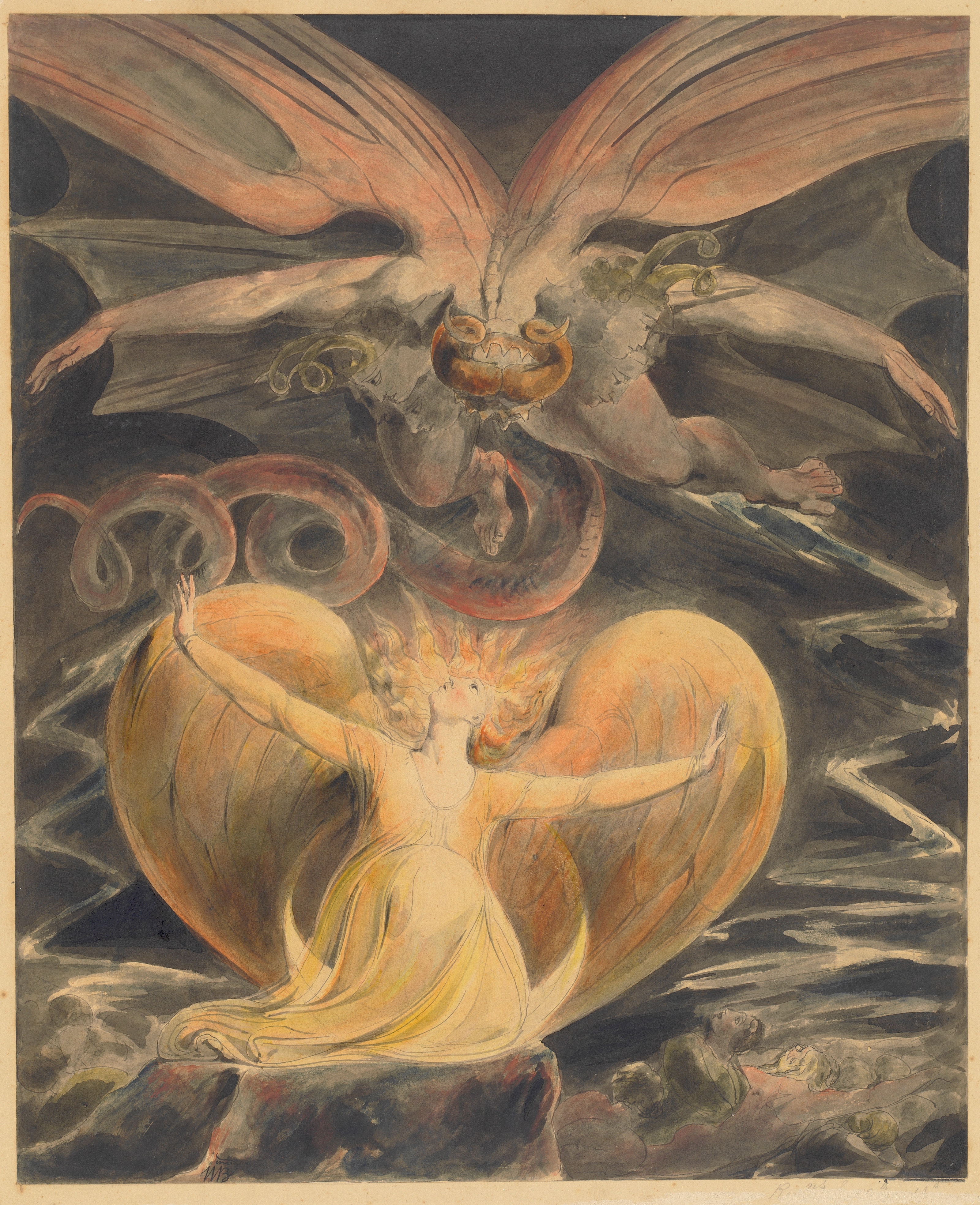
The Great Red Dragon and the Woman Clothed with the Sun, by William Blake, c. 1805 (Revelation 12:1-4). Image: CC0, National Gallery of Art, via Wikimedia Commons.

See this page's graph and discover linked topics
In full
The dragon (drakōn, Strong's G1404) of Revelation 12 is identified by the text itself as Satan (12:9; 20:2), and is introduced as a "sign" (sēmeion, G4592) in heaven (12:3), the second of a pair after the woman clothed with the sun (12:1). Its attributes, seven heads, ten horns and seven diadems, are not interpreted in chapter 12. They recur in the sea-beast of 13:1, which has ten diadems on its horns rather than seven on its heads and receives the dragon's "power, and his throne, and great authority" (13:2), and in the scarlet beast of chapter 17, whose heads and horns the angel interprets as seven mountains, seven kings and ten kings (17:9-12). The dragon's heads are therefore best read through the beast's: they signify the political powers through which Satan exercises his opposition to God, while the identification of those powers is disputed. Three main readings are held: a preterist reading that sees Rome's seven hills and a sequence of first-century emperors; a historicist or futurist reading that sees successive world empires culminating in a final one; and an idealist reading, most fully argued by G. K. Beale, that takes seven as a figure for the completeness of anti-God power across history. The imagery draws on Daniel 7, whose four beasts together bear seven heads and ten horns, and on the Old Testament sea-monster Leviathan, whose "heads" God crushes (Psalm 74:13-14; Isaiah 27:1).
What the text settles
- The dragon is Satan. "The great dragon ... the old serpent, he that is called the Devil and Satan" (12:9); repeated in 20:2. This is not an interpretation; it is the text's own identification. See Satan and The Devil.
- It is a sign, not a zoological report. "There was seen another sign in heaven" (12:3). The book opens by saying God "sent and signified it by his angel" (1:1), and the Greek verb (esēmanen) is the verb of signs. The Lamb "having seven horns, and seven eyes" (5:6) is read the same way.
- The dragon empowers the beast. "The dragon gave him his power, and his throne, and great authority" (13:2), and people "worshipped the dragon, because he gave his authority unto the beast" (13:4).
- Heads and horns are interpreted as rulers, in chapter 17. "The seven heads are seven mountains, on which the woman sitteth: and they are seven kings; the five are fallen, the one is, the other is not yet come" (17:9-10). "The ten horns ... are ten kings" (17:12).
- The dragon loses. He is "cast down" (12:9), overcome "because of the blood of the Lamb" (12:11), bound (20:2) and finally "cast into the lake of fire" (20:10).
What the text does not settle
- Which seven kings. Revelation 17:10 says five have fallen, one is, and one is yet to come, but it names none of them.
- Whether the dragon's heads are the same seven as the beast's. The matching imagery shows a close relationship; the text does not state identity.
- What the third of the stars are. "His tail draweth the third part of the stars of heaven, and did cast them to the earth" (12:4). Many read these as angels who fell with Satan, since 12:7-9 speaks of "the dragon and his angels." Others read Daniel 8:10 behind it, where a horn "cast down some of the host and of the stars," which in Daniel signifies persecution of God's people. Revelation does not say that a third of all angels followed Satan; that is an inference.
- When the casting down happens. See the timing section below.
The seven heads, three readings
| Reading | The seven heads / kings are | Main textual support | Representative advocates |
|---|---|---|---|
| Preterist (Roman) | Rome, the city on seven hills, and a line of Roman emperors, with the sixth reigning when John wrote | "Seven mountains, on which the woman sitteth" (17:9); "the great city, which reigneth over the kings of the earth" (17:18); Rome was proverbially the city of seven hills | Kenneth Gentry (Before Jerusalem Fell, 1989) counts from Julius Caesar with Nero sixth; others count from Augustus and differ over which short reigns to include |
| Historicist / futurist (world empires) | Successive world powers that oppressed God's people, often Egypt, Assyria, Babylon, Persia, Greece, Rome, and a final empire still to come | "Five are fallen, one is, the other is not yet come" (17:10) read as a span of history; Daniel 7:17, 23, where beasts are "kings" and "kingdoms" | Common in historicist and dispensational commentary; the specific list varies by interpreter |
| Idealist (symbolic completeness) | The fullness of anti-God political power across the whole age, seven being Revelation's number of completeness | Revelation's pervasive symbolic sevens (churches, seals, trumpets, bowls); the Lamb's seven horns (5:6) as a counter-image | G. K. Beale (The Book of Revelation, NIGTC 1999); Richard Bauckham (The Climax of Prophecy, 1993) on John's symbolic numbers |
Each reading has a strength and a pressure point. The preterist reading fits "seven mountains" and "the one is" most concretely, but must decide which emperors to count, and that choice is tied to the debated date of Revelation. The world-empire reading fits the long sweep of Daniel 7, but the list is supplied by the interpreter, not the text. The idealist reading fits Revelation's symbolic numbers, but has to account for the specific "five fallen, one is" sequence. The codex presents the three without ruling between them. See Nero Redivivus Legend for the "beast that was, and is not" (17:8, 11) and its first-century background, and Rapture Timing Comparison for how wider eschatological systems frame Revelation.
The Old Testament background
- Daniel 7. Daniel sees four beasts: a lion, a bear, a leopard with "four heads," and a fourth beast with "ten horns" (Daniel 7:4-7). Count the heads and you get seven; the horns are ten. Revelation's sea-beast is "like unto a leopard ... the feet of a bear ... the mouth of a lion" (13:2), Daniel's first three beasts in reverse order, with the fourth beast's ten horns. Daniel's angel interprets the beasts as "kings" and "a fourth kingdom" (7:17, 23). Revelation's seven heads and ten horns gather all of Daniel's empires into one figure.
- Leviathan. "Thou brakest the heads of leviathan in pieces" (Psalm 74:14); "Jehovah ... will punish leviathan the swift serpent ... and he will slay the monster that is in the sea" (Isaiah 27:1). The many-headed sea-serpent is Scripture's picture of chaos and evil that God alone subdues. Outside Scripture, the Ugaritic Baal texts describe Lotan as a seven-headed sea-serpent (KTU 1.5 i 1-3), which shows the image was known in the region; Revelation uses it to say that the ancient enemy is Satan and that the Lamb has defeated him.
- Genesis 3:15. "The old serpent" (Revelation 12:9) ties the dragon to Eden, and the war on "the woman" and "the rest of her seed" (12:17) echoes the enmity "between thy seed and her seed" (Genesis 3:15).
Crowns on the heads, crowns on the horns
The dragon wears "seven diadems" on his heads (12:3). The sea-beast wears "ten diadems" on its horns and "names of blasphemy" on its heads (13:1). The text does not explain the difference. One suggestion is that the dragon's crowns express his claim to rule, while the beast's crowns on the horns tie royal authority to the ten kings of 17:12 through whom the beast acts. This is an interpretive observation, not a stated meaning.
When is the dragon cast down?
Three readings of Revelation 12:7-12 are held:
- A primeval fall. The war in heaven describes Satan's original rebellion before human history, a reading common in popular tradition.
- Christ's victory. The immediate context is the birth of the "man child, who is to rule all the nations with a rod of iron" (12:5, echoing Psalm 2:9) and his being "caught up unto God." The heavenly voice then says, "Now is come the salvation ... and the authority of his Christ: for the accuser of our brethren is cast down" (12:10), and the saints overcome "because of the blood of the Lamb" (12:11). Jesus' own words point the same way: "now shall the prince of this world be cast out" (John 12:31); "I beheld Satan fallen as lightning from heaven" (Luke 10:18).
- A future, end-time expulsion. Futurist readers place the event in a coming tribulation, linked to the "time, and times, and half a time" of 12:14.
Many interpreters combine readings, seeing the cross as the decisive defeat that the end of history completes. What all agree on is the outcome: the dragon is cast down, his time is short (12:12), and his end is the lake of fire (20:10).
Is the dragon literal?
No, and the text says so by calling it a sign. A symbol can describe a real being. Jesus is "a Lamb standing, as though it had been slain" (5:6); no one infers that Jesus is livestock. Satan is called the dragon; no one should infer that he is a reptile. The reality of the person and the symbolism of the vision are two different things, and Revelation affirms both: Satan is a real, personal adversary (12:9-10), and the seven-headed dragon is the image God chose to show what he is like and what he does.
Scholarship
Published academic works this page draws on, each matched to a publisher, index or library catalog record.
- Richard Bauckham, The climax of prophecy: studies on the book of Revelation (1993). Open Library
- G. K. Beale, The book of Revelation (1998). Open Library
- Kenneth L. Gentry Jr, Before Jerusalem Fell (1989). Open Library
See also
- Satan, the person the dragon signifies
- The Devil, names, works and end of the adversary
- Nero Redivivus Legend, the beast that "was, and is not"
- Eschatology, the wider study of last things
- Rapture Timing Comparison, how eschatological systems read Revelation
- Daniel 7, the four beasts behind Revelation's imagery
- Richard Bauckham, on Revelation's symbolic numbers
Common questions this page answers
Q: What does the seven-headed dragon in Revelation represent?
The dragon is Satan; Revelation says so outright: "the great dragon ... the old serpent, he that is called the Devil and Satan" (Revelation 12:9). Its seven heads and ten horns point to the earthly ruling powers through which he opposes God, since Revelation 17:9-12 interprets the matching heads and horns of the beast as mountains and kings.
Q: What do the seven heads of the dragon mean?
Revelation does not explain the dragon's heads in chapter 12, but it explains the matching heads of the beast in chapter 17: "seven mountains" and "seven kings; the five are fallen, the one is, the other is not yet come" (17:9-10). Readers identify these as Roman emperors on Rome's seven hills, as a succession of world empires, or as a symbol of the completeness of anti-God power through history.
Q: Is the dragon in Revelation a literal dragon?
No. John introduces it as "another sign in heaven" (Revelation 12:3), and the book says God "signified" its message by an angel (1:1). Just as Jesus appears as a Lamb (5:6) without being a sheep, Satan appears as a dragon without being a reptile. He is a real being shown through a symbol.
Q: What are the seven heads and ten horns in Revelation?
The dragon (12:3), the sea-beast (13:1) and the scarlet beast (17:3) all have seven heads and ten horns. The angel says the ten horns "are ten kings" (17:12). The imagery comes from Daniel 7, where four beasts together have seven heads and ten horns and stand for kings and kingdoms.
Q: What are the third of the stars the dragon swept down?
Revelation 12:4 says the dragon's tail drew "the third part of the stars of heaven" to the earth. Many read them as angels who fell with Satan, since verses 7-9 mention "the dragon and his angels." Others hear Daniel 8:10, where casting down stars pictures the persecution of God's people. The text does not specify.