Argument
The Problem of Perfect Good
Ris3n Paradox of Perfect Good, Inverted Problem of Evil, Problem of Continuous Good, Paradox of Perfect Good, Problem of Perfect Good, What if God only allowed good, Why didn't God make a world with only goodIntro
The problem of evil says: if God were all-powerful and all-good, He would have made a world with only good in it. Evil exists, so there is no such God.
The Problem of Perfect Good grants the critic that world and then looks around inside it. Picture life "as in heaven, so on earth" (Matthew 6:10). No murder, no cancer, no injustice, no funerals. Now ask one question: in that world, does everyone believe in God?
If everyone believes, was the belief free or forced? Forced belief cannot be love, and a person who was never allowed to say no has lost something the critic himself prizes. If some people still refuse to believe, the critic's complaint turns around: "An all-powerful God would let me choose something other than this good." Now God is blamed for the absence of evil's possibility. The problem of evil has become a problem of perfect good.
Either way, the critic still has a charge against God, and that charge rests on a moral judgment about what God owes us. The existence of evil, on its own, never proves that God contradicts Himself. The critic has to prove something more: that God could not possibly have a good enough reason to allow evil. That extra premise is the whole debate, and the critic has to carry it.
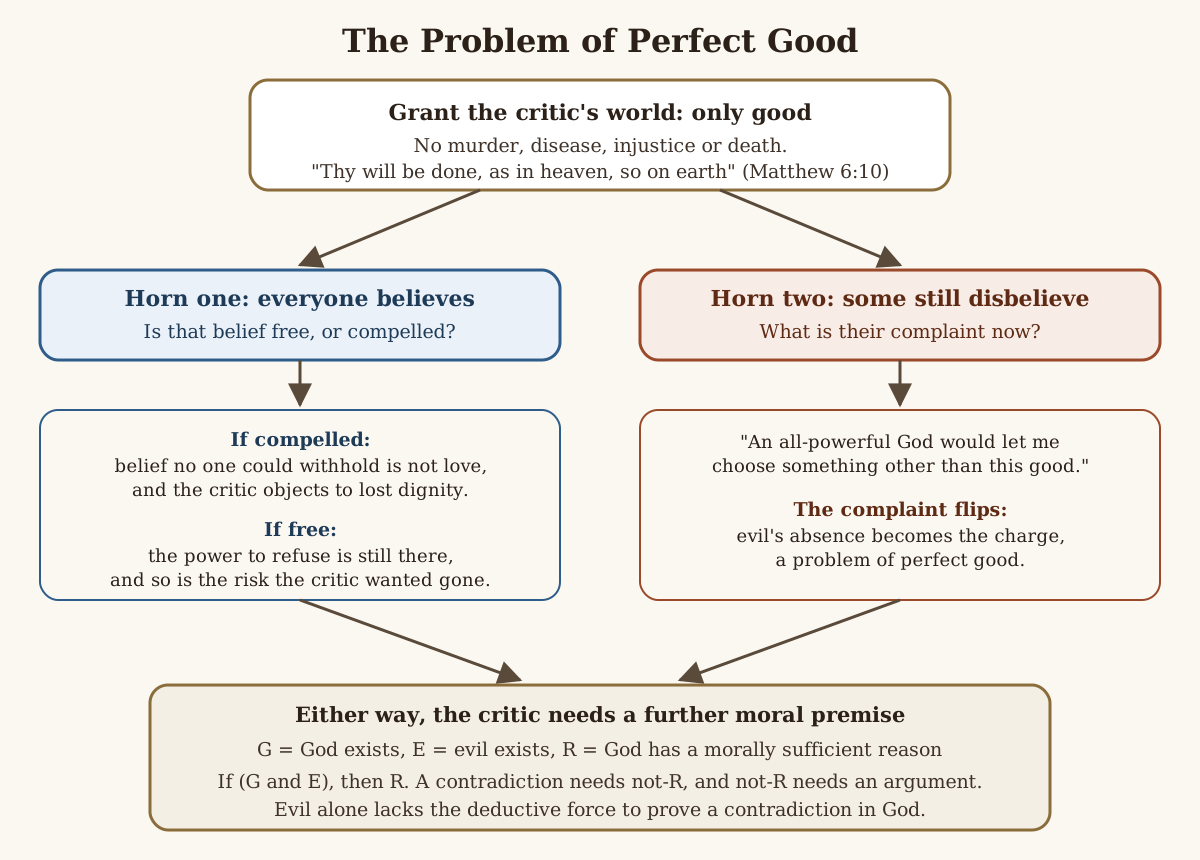
The two horns of the Problem of Perfect Good, and the premise both of them expose. Diagram drawn for the codex.
See this page's graph and discover linked topics
In full
The Problem of Perfect Good is a conditional reductio against the logical problem of evil. Let G be "an omnipotent, omnibenevolent God exists," E be "evil exists," and R be "God has a morally sufficient reason to permit the evil there is." The logical problem asserts that G and E are jointly inconsistent. A perfectly good being permits evil only with a morally sufficient reason, so the principle in play is (G and E) implies R; the conjunction becomes contradictory only if the critic adds not-R as a necessary truth. The argument shows that the critic's own moral demands cannot supply not-R from evil's existence alone. It grants the critic a world of unbroken good (W) and divides it by belief. Horn one: if belief is universal, it is either compelled, in which case the critic's commitments to autonomy, dignity and love as freely given consent ground a fresh charge against God, or free, in which case the power to refuse remains and so does the possibility the critic wanted removed. Horn two: if unbelief persists, the critic's complaint becomes that an omnipotent God withholds alternatives to the good, which inverts the original charge. On every branch the verdict against God rests on a substantive and contestable premise about which goods God is bound to secure, and the critic who demands both the elimination of evil and the preservation of a libertarian freedom to choose it is demanding a jointly unsatisfiable pair. The conclusion is deductive but narrow: evil's existence lacks the deductive force to show a contradiction in God's nature, and the burden of proving not-R lies with the critic. The argument does not touch the evidential problem of evil, and its two horns are not exhaustive against a critic who holds that God could have made free creatures who always choose the good; both limits are faced in the defeater gate.
Format note
This argument is built as a braided case: a valid deductive spine, each premise held up by an inductive strand, an abductive strand and a convergence note, a knot that checks the strands are independent, a likelihood ledger, and a defeater gate that answers the strongest objection. Here the spine is a constructive dilemma, and the ledger weighs how expected each datum is if a morally sufficient reason for evil is possible against how expected it is if evil alone entails that God does not exist.
The spine
| # | Premise |
|---|---|
| P1 | The grant and the fork. Suppose God makes a world containing only good. In that world, either everyone believes in God, or some do not. |
| P2 | Horn one, universal belief. If everyone believes, the belief is either compelled or free. If compelled, the critic's own values (autonomy, dignity, love as freely given) ground a new charge against God. If free, the power to refuse remains, and with it the possibility of rejecting the good, which is the possibility the critic asked God to remove. |
| P3 | Horn two, persistent unbelief. If some do not believe, the critic's charge becomes that an all-powerful God withholds the freedom to choose otherwise. The complaint now targets the absence of evil's possibility, and the critic is demanding both the elimination of evil and the preservation of the freedom to choose it. |
| P4 | The missing premise. A perfectly good God permits evil only for a morally sufficient reason: (G and E) implies R. A contradiction between God and evil therefore requires not-R, the claim that no such reason is even possible, and on both horns the critic's verdict depends on a moral premise of exactly that kind, not on the bare fact of evil. |
| C | Therefore the existence of evil, by itself, lacks the deductive force to show a contradiction in God's nature. The critic must supply and defend not-R. |
Validity. P1 sets up an exhaustive disjunction about belief within the granted world. P2 and P3 show that each disjunct leaves the critic with a charge against God that depends on a further moral premise. That is a constructive dilemma: either branch yields the same result, so the result holds. P4 identifies that further premise with not-R and shows the logical problem needs it, so C follows.
Strength of the conclusion. Deductive, and deliberately narrow. The argument proves that the logical problem of evil is incomplete without not-R. It does not prove that God has a reason for every evil, and it does not answer the evidential problem, which asks whether the evil we see makes God less probable.
P1, The grant and the fork
Inductive strand
- The critic's own picture. Mackie's challenge was that God could have made a world in which beings "always freely choose the good" (J. L. Mackie, "Evil and Omnipotence," Mind 64, 1955). The granted world is the critic's ideal, taken at face value.
- Christianity already describes such a world. Scripture promises a creation where God "shall wipe away every tear from their eyes; and death shall be no more" (Revelation 21:4, ASV) and "there shall be no curse any more" (Revelation 22:3, ASV). The thought experiment borrows the Christian destination; it does not invent a straw world.
- Belief does not follow automatically from goodness. In the actual world, people who enjoy great goods (health, wealth, beauty, love) still differ on God. Goodness received is not the same as God acknowledged (Romans 1:21).
Abductive strand
| Explanation of the fork | Explanatory power | Scope | Simplicity | Ad hoc? |
|---|---|---|---|---|
| Belief is a response of persons, so an all-good world still leaves belief open (the Christian picture of persons) | Explains why belief varies among the blessed | Covers present life and the biblical account of the fall of angels | One posit | No |
| An all-good world would make belief automatic | Would explain universal belief | Fails on the observed data that blessings do not produce belief | Simple | Yes: needs a mechanism no one has described |
| Belief is irrelevant to the problem of evil | Avoids the fork | Leaves the critic unable to say why removing evil would settle the God question | Simple | Yes: drops the critic's own aim |
Convergence
The disjunction in P1 is a law of logic (either everyone believes or not everyone does), so no evidence can unsettle it. What the strands add is that both branches are live: philosophy of religion (Mackie, Plantinga), Scripture's account of a sinless creation, and ordinary experience of grateful and ungrateful people all treat belief as something persons give or withhold.
Objections and rebuttals
- "In a perfectly good world God would simply be obvious, so the question would not arise." Rebuttal. Obviousness settles the question only if obvious evidence compels assent. That is exactly horn one's question: is assent to overwhelming evidence free, or is it caused in a way that bypasses the person? Either answer keeps the argument moving.
- "You are importing heaven, which is a religious idea." Rebuttal. The critic proposed the evil-free world first. Matthew 6:10 just names the request. The argument works with any world in which every condition of life is good.
P2, Horn one: universal belief
Inductive strand
- Critics prize autonomy even in a world with no suffering. Thomas Nagel wrote that he hoped there is no God: "I don't want there to be a God; I don't want the universe to be like that" (The Last Word, Oxford, 1997, pp. 130-131). Guy Kahane, "Should We Want God to Exist?" (Philosophy and Phenomenological Research 82.3, 2011, 674-696), weighs the view that God's existence would be bad for privacy, independence and the meaning of a life. Neither complaint concerns suffering. Christopher Hitchens regularly compared life under God to a celestial North Korea, a charge aimed at the reign of God itself.
- Compelled love is a contradiction in ordinary moral language. Courts void contracts signed under duress, and nobody calls a love potion's effect love. Human practice treats consent that could not be withheld as no consent.
- Scripture frames love toward God as given. "We love, because he first loved us" (1 John 4:19, ASV): our love is a response, and Scripture repeatedly sets the choice before people (Deuteronomy 30:19; Joshua 24:15).
Abductive strand
| What universal belief in W would be | Does it satisfy the critic? | Does it keep love and dignity? | Result for the argument |
|---|---|---|---|
| Compelled (God makes unbelief impossible by causing the belief directly) | No: the critic's autonomy objection returns | No: consent never given | New charge against God; evil's absence settles nothing |
| Free (people see overwhelming goodness and evidence and freely assent) | Partly | Yes | The power to refuse remains, so the possibility of rejecting the good is still in the world |
| Mixed (some caused, some free) | No | Partly | Inherits both problems |
Convergence
Moral philosophy (consent and duress), the philosophy of love (love as a gift that could be withheld), law, and Christian theology of the covenant all reach the same point: love and trust that were installed rather than given lack something that love and trust given freely have.
Objections and rebuttals
- "Being convinced by overwhelming evidence is not being forced. Nobody says I am forced to believe the sun is hot." Rebuttal. Agreed, and the argument depends on that distinction. Being convinced by evidence is free assent, which places it on the free branch. On that branch the person who sees the evidence can still refuse to love or obey the God it reveals, as Scripture says "the demons also believe, and shudder" (James 2:19, ASV). Belief that God exists is not yet love of God. So the free branch keeps the possibility of rejecting the good.
- "Love could exist without choice. God loves necessarily, and His love is real." Rebuttal. This is the strongest objection to horn one, and it is answered in full in the defeater gate below. In short: the ability to do evil is not necessary for love (God proves it), but a creature's love toward God must be the creature's own response. Love that God installs in a creature with no route of its own originates in God alone.
P3, Horn two: persistent unbelief
Inductive strand
- The objection already exists. The skeptic who asks why heaven's saints cannot sin, and treats an inability to sin as a loss of freedom, is making horn two's complaint today (James F. Sennett, "Is There Freedom in Heaven?", Faith and Philosophy 16.1, 1999, names it the problem of heavenly freedom). See Freedom in Heaven Objection Defeater.
- Divine hiddenness shows the complaint survives the removal of suffering. J. L. Schellenberg's hiddenness argument does not rest on suffering at all; it charges God over the conditions of belief. A world of only good would leave that kind of charge standing. See Divine Hiddenness Objection Defeater.
- Libertarian freedom is defined by alternatives. On the libertarian view the critic usually adopts against God, a free act is one where the agent could have done otherwise (Libertarian Free Will). A world where no one can choose against the good removes that power.
Abductive strand
| The unbeliever in W says | What it assumes | What it concedes |
|---|---|---|
| "God should let me choose something other than this good." | That freedom to choose otherwise is a good God must protect | That a world without the possibility of evil lacks a real good |
| "God should both remove evil and keep my freedom to choose it." | Both demands are binding | Two obligations that cannot both be met under libertarian freedom |
| "God should make me always freely choose good." | That God can strongly actualize free choices | The very premise contested in All-Do-Good World POE Defeater |
Convergence
The free will defense (Augustine, Plantinga), the literature on heavenly freedom (Sennett, Pawl and Timpe), and the hiddenness debate (Schellenberg) are three independent bodies of work. Each shows critics raising charges against God that are about freedom and the conditions of belief, not about suffering. Horn two names the pattern.
Objections and rebuttals
- "No atheist actually says God should let him choose evil." Rebuttal. The argument does not need any atheist to say those words. It needs only that the critic who values libertarian freedom is committed to them. If he values freedom to choose otherwise, he values a power that includes choosing against the good.
- "I would not complain. I would be happy in that world." Rebuttal. Then this critic is on horn one, and the question returns: was your happy belief free or caused? And if a world with the possibility of evil can be justified by the goods of freedom, you have granted that R is possible.
P4, The missing premise
Inductive strand
- Ordinary moral practice permits harm for sufficient reasons. A surgeon allows pain to heal, a parent allows a child to fall while learning to walk. Permitting harm is not by itself wrongdoing. The principle "a good being prevents every evil it can" is false in every case we can check.
- Mackie's own argument needed added premises. Mackie acknowledged that the contradiction appears only with "additional premises," such as that good always eliminates evil as far as it can and that there are no limits to what an omnipotent thing can do ("Evil and Omnipotence," 1955).
- The field moved after Plantinga. Plantinga's free will defense (God, Freedom, and Evil, 1974) argued that it is possible God could not actualize a world of free creatures who never sin. Many philosophers, including atheists such as William Rowe, came to treat the logical problem as answered and turned to the evidential problem. See Problem of Evil, Free Will Defense.
Abductive strand
| Reading of "God and evil cannot both exist" | Needs not-R? | Defensible? |
|---|---|---|
| God's goodness requires preventing every evil He can (no exceptions) | Implicitly | No: refuted by ordinary permitted harms |
| God could have no possible reason for permitting evil | Yes, explicitly | Requires knowledge of every possible good and how it connects to evil |
| God has no reason that I can see | No | Changes the subject to the evidential problem |
Convergence
Logic (the form of the inconsistency claim), ethics (the moral standing of permitted harm) and the history of the debate (Mackie, then Plantinga, then the shift to evidential arguments) all reach P4 independently: the logical problem is complete only with not-R.
Objections and rebuttals
- "Not-R is obvious. No reason could justify the Holocaust." Rebuttal. That is a strong moral intuition, and it deserves a hearing on the evidential side. As a necessary truth, it would need a survey of all possible goods and all their connections to evil, which no finite mind can do. See Skeptical Theism.
- "You are just shifting the burden of proof." Rebuttal. The burden lies with whoever claims a contradiction. Claiming that two propositions cannot both be true is the stronger claim, so it carries the heavier load.
The knot
The strands are independent. P1 rests on logic and on the critic's stated ideal. P2 draws on the ethics of consent and on published atheist writing about autonomy (Nagel, Kahane). P3 draws on the heavenly-freedom and hiddenness literatures, which were developed by different authors for different purposes. P4 draws on the history of the logical problem and on ordinary moral practice. One overlap is counted once: the heaven case appears in P1 (as the picture) and P3 (as the objection), but the datum is the same, so the ledger rates it once.
The ledger
Prior-agnostic: the ledger does not assume theism is likely or unlikely in advance. It asks how expected each datum is on two readings: theism with a possible morally sufficient reason (G and R), and the incompatibility thesis (evil alone entails that God does not exist). Ratings are reasoned judgments from the sections above, not measurements.
| Datum | How expected if a morally sufficient reason is possible | How expected on the incompatibility thesis | Favours | Why | Independent of the rows above? |
|---|---|---|---|---|---|
| Ordinary morality treats some permitted harms as justified | High | Low | Compatibility, clearly | The thesis needs an exceptionless principle that ordinary cases refute | Yes |
| Critics raise charges against God that have nothing to do with suffering (autonomy, hiddenness) | High | Moderate | Compatibility, modestly | The charges show the verdict rides on moral premises, not on evil alone | Yes |
| Love and trust given freely are valued above love installed | High | Moderate | Compatibility, modestly | Supplies a candidate good that may require risk | Yes |
| Mackie's argument needed added premises | High | Low to moderate | Compatibility | A self-standing contradiction would need none | Yes |
| Post-Plantinga shift of atheist philosophers to the evidential problem | High | Low | Compatibility, as a sign of where the field judged the burden to lie | Expert judgment, not proof | Partly overlaps the row above |
| Scripture promises an evil-free end reached through history | High | Moderate | Roughly even to slight | Fits a God with reasons; the critic can call it unexplained | Yes |
Net. No row proves R. Together they show that the logical problem's key premise, not-R, is neither self-evident nor supported by the existence of evil, and that the critic's own moral commitments do not supply it. That is the narrow conclusion the spine claims and no more.
The defeater gate
The strongest objections to the whole argument, steel-manned and answered.
1. "The horns are not exhaustive. God could have made free creatures who always choose the good." This is Mackie's own move, sharpened by compatibilists and by the heaven case: the saints in heaven are free and never sin, so a world of free, sinless creatures is possible, and then neither horn bites. The reply has three parts.
- Strong and weak actualization. God can directly cause anything that does not involve a free creature's choice. A free choice must come from the creature, so God can only weakly actualize it: He sets the conditions and the creature chooses. Plantinga argued that it is possible every feasible world of significantly free creatures contains some sin (transworld depravity). The logical possibility of a world of free saints does not make it a world God can guarantee. Full treatment: All-Do-Good World POE Defeater.
- Heaven is the end of the road. The saints in heaven cannot sin because of a character they freely formed through history, grace and redemption. Augustine called that freedom greater than Adam's, "no longer able to sin" (City of God XXII.30). A freely formed character cannot be created ready-made, so heaven shows that a sinless end is possible. It does not show that a sinless start is. Full treatment: Freedom in Heaven Objection Defeater.
- The compatibilist critic. If the critic is a compatibilist, freedom needs no alternatives, and the dilemma loses most of its grip on him. The argument concedes that. But P4 still stands: the compatibilist critic has to show that God could have no reason to prefer a world of freely given, uncaused-by-God love to a world of God-determined love. That is not-R again, now in a new form.
2. "Love could exist without choice. God loves necessarily, and the Father and Son love each other eternally (John 17:24)." Steel-manned: God cannot do evil, yet His love is real, so the power to do evil is not necessary for love. Then God could have made creatures who necessarily love Him, and the free will defense loses its foundation.
- Grant the premise. The ability to sin is not a condition of love. God is love (1 John 4:8) and cannot sin. The Problem of Perfect Good never claims otherwise.
- The difference is origin. God's necessary love comes from His own nature; nothing outside Him causes it. A creature that God programs to love Him has a love whose whole source is God. That is God loving Himself through an instrument. A creature's love for God becomes its own gift only when it comes from the creature as a response (1 John 4:19).
- The faithful spouse. A husband who stays faithful for fifty years could have betrayed and did not. His fidelity is a gift because it was his to give. A husband drugged into fidelity has given nothing. Freely given consent is what turns faithfulness into love.
- Convinced versus caused. Being convinced by overwhelming evidence is free: the mind follows reasons. Being caused to believe bypasses reasons altogether. The first keeps dignity and the second removes it. The first also keeps the power to refuse, which is horn one's point.
3. "Even if all this works, the amount and kind of suffering in our world is still evidence against God." Correct, and the argument does not claim otherwise. It defeats the logical problem only. The evidential problem (gratuitous suffering, animal pain, the horrors of history) needs its own answer: skeptical theism, positive theodicies, and the cross. See Evidential Problem of Evil Defeater.
What the gate concedes. The dilemma is strongest against a critic who holds libertarian freedom and demands both an evil-free world and the freedom to choose otherwise. Against a compatibilist it reduces to P4. In every case the argument establishes the narrow conclusion and nothing wider.
Concessions
- Grant: God could have made a world with only good in it, in the abstract. Now collect: "could" is about power, and the critic needs "should." Ability does not create obligation.
- Grant: love does not require the ability to do evil, since God loves and cannot sin. Now collect: then the critic's case cannot rest on the claim that God should have made us like Himself. A creature with a borrowed nature is a different thing from God, and the critic must explain why God may not value love that comes from the creature as its own response.
- Grant: the two horns are not exhaustive against every theory of freedom. Now collect: on the remaining theory, the critic still owes not-R, which is the only premise that ever mattered.
Cheatsheet
The 30-second version (read aloud). You say a good God would have made a world with only good in it. Fine, I grant it. Now in that world, does everyone believe in God? If they do, was it free or forced? Forced belief is not love, and you would be the first to call it tyranny. If some still don't believe, you would complain that an all-powerful God won't let you choose anything but good. So whether God allows evil or removes it, you have a case against Him. That tells me your argument was never about evil alone. It rests on a claim you haven't proved: that God could not possibly have a good reason to allow evil. Prove that, and we can talk.
Fast facts:
- The logical problem of evil needs the premise that no morally sufficient reason is possible: (G and E) implies R, so a contradiction needs not-R.
- J. L. Mackie (Mind, 1955) admitted the contradiction appears only with "additional premises."
- Alvin Plantinga's free will defense (God, Freedom, and Evil, 1974) is widely judged to have answered the logical problem; debate moved to the evidential problem.
- Thomas Nagel (The Last Word, 1997): "I don't want there to be a God." The objection to God survives the removal of suffering.
- Augustine (City of God XXII.30): heaven's freedom, no longer able to sin, is greater than Adam's freedom.
The closing line. If God is guilty whether He allows evil or removes it, the problem was never evil.
Cross-examination
Round 1, The grant
- Q: If God made a world with only good, would that satisfy you?
- If they say yes: then ask whether everyone in that world believes, and whether their belief is free.
- If they say no: then your objection to God was never only about evil. What is it about?
Round 2, Horn one
- Q: If God made everyone believe and love Him, with no possibility of refusing, would that love be real?
- If they say yes: then you value love that was never given. Would you want a spouse who was drugged into loving you?
- If they say no: then you agree God has a reason to make love refusable, and refusable love brings the possibility of refusal.
Round 3, Horn two
- Q: Do you value the freedom to choose otherwise?
- If they say yes: then you value a freedom that includes choosing against the good. Which obligation wins: removing every evil, or keeping that freedom?
- If they say no: then you are a compatibilist, and you still owe the premise that God could have no reason to prefer freely given love.
Round 4, The burden
- Q: Can you show that no possible reason could justify God in permitting evil?
- If they say yes: ask for the argument, not the example.
- If they say no: then you have a moral objection, which we can discuss, and no logical contradiction.
Dodge table
| Dodge | What it concedes | Reply |
|---|---|---|
| "God could make free people who always choose good." | Freedom matters | "Free choices come from the chooser. God can offer that world; He cannot guarantee it without overriding the freedom." |
| "Heaven proves it." | Sinless freedom is good | "Heaven is the end of a road walked freely. It proves a sinless finish, not a sinless start." |
| "Love doesn't need choice. God loves necessarily." | Love is real without the power to sin | "God's love comes from His own nature. Yours would come from His programming. That is His love, not yours." |
| "I'm not making the logical argument, just the evidential one." | The logical problem is dropped | "Then we agree evil does not disprove God. Let's talk about probabilities." |
| "This is just a word game." | The structure holds | "Then point to the premise that fails." |
Live-cite kit
Scripture (ASV):
- Matthew 6:10: Thy kingdom come. Thy will be done, as in heaven, so on earth. (Matthew 6:10, ASV)
- Revelation 21:4: and he shall wipe away every tear from their eyes; and death shall be no more; neither shall there be mourning, nor crying, nor pain, any more: the first things are passed away. (Revelation 21:4, ASV)
- 1 John 4:19: We love, because he first loved us. (1 John 4:19, ASV)
- Deuteronomy 30:19: I have set before thee life and death, the blessing and the curse: therefore choose life (Deuteronomy 30:19, ASV)
- Genesis 50:20: And as for you, ye meant evil against me; but God meant it for good (Genesis 50:20, ASV)
Scholarly:
- J. L. Mackie, "Evil and Omnipotence," Mind 64 (1955): the logical problem, and his concession that it needs additional premises.
- Alvin Plantinga, God, Freedom, and Evil (1974): the free will defense, strong and weak actualization, transworld depravity.
- Augustine, City of God XXII.30: the freedom of heaven as the inability to sin.
- Thomas Nagel, The Last Word (1997), pp. 130-131: "I don't want there to be a God."
Aphorism: "Guilty for allowing evil, guilty for removing it: then the charge was never about evil."
Connection to Scripture
- Matthew 6:10, the prayer that names the critic's ideal world, a world where God's will is done on earth as in heaven.
- Genesis 50:20, a case of God permitting evil for a reason the sufferer could not see at the time.
- Revelation 21:4 and Revelation 22:3, the evil-free world Christianity promises at the end of history.
- 1 John 4:8 and 1 John 4:19, love as God's nature and our love as response.
- Deuteronomy 30:19 and Joshua 24:15, love and loyalty set before people as a choice.
The gospel close
The Christian answer to evil does not stop at a logical point. The world the critic asked for is coming. God "shall wipe away every tear from their eyes; and death shall be no more" (Revelation 21:4, ASV), and "there shall be no curse any more: and the throne of God and of the Lamb shall be therein" (Revelation 22:3, ASV). What stands between this world and that one is a cross and an empty tomb. "God commendeth his own love toward us, in that, while we were yet sinners, Christ died for us" (Romans 5:8, ASV). God did not watch evil from a distance. He entered it, bore it, and rose from the dead, "the firstfruits of them that are asleep" (1 Corinthians 15:20, ASV). The resurrection is God's promise that evil does not get the last word, and the invitation to that world is open now, offered and never forced.
Scholarship
Published academic works this page draws on, each matched to a publisher, index or library catalog record.
- Guy Kahane, "Should We Want God to Exist?" Philosophy and Phenomenological Research 82 (2011). doi:10.1111/j.1933-1592.2010.00426.x
- Alvin Plantinga, God, freedom, and evil (1974). Open Library
- James F. Sennett, "Is There Freedom In Heaven?" Faith and Philosophy 16 (1999). doi:10.5840/faithphil19991617 open access
See also
- Ris3n Arguments, the hub of ris3n's original arguments
- Problem of Evil, the master hub on the problem and its answers
- All-Do-Good World POE Defeater, why God cannot simply make a world of free beings who never sin
- Freedom in Heaven Objection Defeater, whether the saints in heaven are free
- Evidential Problem of Evil Defeater, the probabilistic problem this argument leaves to its own page
- Problem of Evil, Free Will Defense, Plantinga's defense, which this argument presupposes
- Evil as Privation of Good, what evil is
- Free Will Argument from Love, why love calls for freedom
- Libertarian Free Will and Compatibilism, the two theories of freedom the dilemma divides
- Divine Hiddenness Objection Defeater, a charge against God that survives the removal of suffering
- Skeptical Theism, why the critic cannot easily prove that no reason exists
- Heaven, the world the thought experiment borrows
- Alvin Plantinga, J.L. Mackie and Augustine, the background voices
- Arguments, the master index
Common questions this page answers
Q: Why didn't God just make a world with only good in it?
God could have made such a world in the abstract, but the question is whether He was obligated to. In a world of only good, people would either all believe in God, freely or by force, or some would still refuse. Forced belief is not love, and free belief keeps the power to refuse. The critic still needs to show God could have no good reason for the world He made.
Q: What is the Problem of Perfect Good?
It is an argument by ris3n that turns the problem of evil around. Grant the critic a world with only good, and the critic would still have a complaint: either God forced everyone to believe, or He refused to let unbelievers choose anything but good. So the problem of evil rests on an unproved moral premise, not on evil alone.
Q: Does the existence of evil prove that God does not exist?
Not by logic alone. A good God would permit evil only for a morally sufficient reason. To prove a contradiction, the critic must show that no such reason is even possible, and evil's existence does not show that.
Q: Could love exist without choice?
The ability to do evil is not needed for love, since God loves perfectly and cannot sin. But a creature's love for God has to come from the creature as its response. Love that God simply programmed into a creature would be God's own love running through an instrument, the way fidelity produced by a drug is no gift from the spouse.
Q: Doesn't heaven prove God could have made free people who never sin?
Heaven shows a sinless end, not a sinless start. On the Christian view the saints cannot sin because of character they freely formed through history and grace, and a freely formed character cannot be created ready-made.
Q: Does this argument solve the evidential problem of evil?
No. It answers only the claim that God and evil logically contradict each other. Whether the amount and kind of suffering make God less probable is a separate question with its own answers.