Argument
The Me, Myself and I Argument
Me Myself and I Argument, me myself and I, the argument from self-consciousness, argument from the reflexive self, can science explain the self, who is the I that knows me, self-knowledge argument for God, the I and the meIntro
Think about the simple sentence "I know myself." It sounds ordinary, but look at what it says. There is an "I" doing the knowing. There is a "me" being known. And there is the word "myself," which says the knower and the known are the same person. One person stands on both sides of the act of knowing, and knows that it is so.
Nothing else we know of in nature does this. A camera can film a mirror that shows the camera, but the camera does not know that the picture is of itself. A computer can store a file about the computer, but the file is just more data. Every account of the self that science offers either builds a model of the self (and then cannot say who recognizes the model as "me") or decides the self is an illusion (and then cannot say who is having the illusion).
The Bible opens with a God who says "I AM THAT I AM," the one being who knows himself perfectly, and who made human beings in his image. If that is true, creatures who can say "me, myself and I" are exactly what you would expect. The Me, Myself and I Argument says the self that knows itself points beyond nature to the God who knows himself.
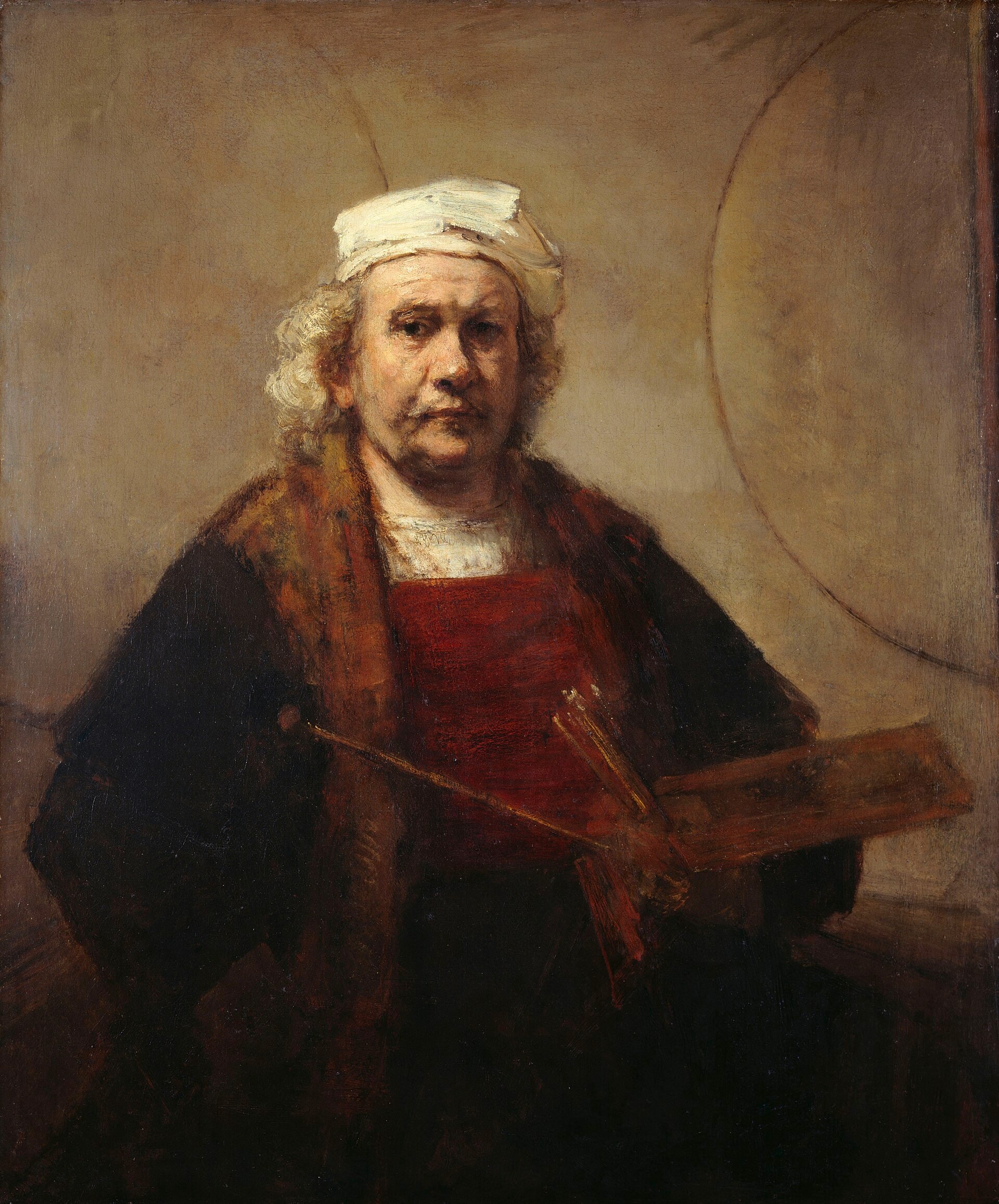
Rembrandt, Self-Portrait with Two Circles (about 1665-1669), Kenwood House, London. The painter is the one looking, the one painted, and the one who knows the face on the canvas is his own. Public domain (Wikimedia Commons), resized.

See this page's graph and discover linked topics
In full
The Me, Myself and I Argument is a braided argument from the structure of self-consciousness. The explanandum is reflexive self-knowledge: a single subject is at once the knower ("I," the subject-use of the first person), the known ("me," the object-use) and is aware of the identity of the two ("myself"), and this awareness is immune to error through misidentification (Shoemaker 1968), presupposed by every other act of knowing (Kant's transcendental unity of apperception, B131-132) and resistant to translation into third-person description (Perry 1979). The spine first runs a dilemma. Every naturalistic account either explains self-consciousness as a system's representation of itself (a self-model, a feedback loop, a narrative), or eliminates the self as an illusion (Hume's bundle, Metzinger's "no one," Dennett's center of narrative gravity). The reflection horn faces the circle that Dieter Henrich traced in Fichte: a representation of X counts as self-knowledge only if the representer already knows that it is X, so the model presupposes the very acquaintance it was meant to explain. The elimination horn is self-undermining, since an illusion is a way things seem to a subject, and the argument for elimination must itself be followed by one unified reasoner. The spine then closes with a likelihood comparison: an irreducible, self-knowing subject is far more expected if the ground of being is itself a self-knowing personal God (Exodus 3:14; in Augustine's reading, a God whose self-knowledge is his Word and whose self-love is his Spirit) than if the ground is impersonal matter, and somewhat more expected on Trinitarian theism, where divine self-knowledge is itself personal, than on unipersonal theism. The conclusion is confirmatory. It is distinct from the Argument from Consciousness, which concerns felt experience in general; from the Argument from Personal Identity, which concerns sameness over time; and from The Three Persons of Grammar Argument, which concerns the I-you relation between persons.
Format note
This page is a braided case: a valid spine, each premise supported by evidence (the inductive strand), a comparison of rival explanations (the abductive strand) and agreement across fields (convergence), followed by a knot against double counting, a likelihood ledger and a defeater gate. Four fields are braided. Philosophy of mind supplies the logical peculiarities of the first person. Phenomenology supplies the finding that self-awareness is built into experience before any act of reflection. Neuroscience supplies the brain correlates of self-reference, and the limit of what correlates can show. Theology supplies a God whose own being is self-knowledge. Other arguments in this format are listed at Ris3n Arguments.
The spine
| # | Premise |
|---|---|
| P1 | The reflexive self is real. Human beings know themselves as one subject that is knower and known at once, aware of the identity, and immune to mistaking whose thought it is. |
| P2 | The naturalist dilemma. On naturalism the self is either a system representing itself (reflection) or an illusion (elimination). |
| P3 | Reflection is circular. A self-representation is self-knowledge only if the system already knows the representation is of itself, so reflection presupposes what it explains. |
| P4 | Elimination is self-undermining. An illusion of a self needs a subject to whom it appears, and the argument for elimination needs one unified reasoner to follow it. |
| P5 | The hypotheses. An irreducible, self-knowing subject is far more expected if the ground of being is a self-knowing personal God than if it is impersonal matter. |
| P6 | The likelihood principle. Evidence far more expected on one hypothesis than another confirms the first over the second. |
| C | Therefore the reflexive self is not explained by naturalism, and it confirms theism, and modestly Trinitarian theism, over naturalism. |
Validity. P1 fixes the datum. P2 to P4 run a constructive dilemma: both naturalist options fail to deliver P1, so naturalism has no account of it. P5 and P6 turn that explanatory gap into comparative confirmation by modus ponens.
Strength of the conclusion. The first half (naturalism does not explain the reflexive self) is deductive, given P1 to P4. The second half (theism is confirmed) is comparative and confirmatory. The argument does not prove the Trinity; it shows that a self that knows itself fits a God who knows himself.
P1, The reflexive self is real
Inductive strand
- The first person has two uses. Ludwig Wittgenstein, The Blue and Brown Books (dictated 1933-1935, published 1958), distinguished the "use as object" of "I" ("I have a bump on my forehead," where I could be wrong about whose head it is) from the "use as subject" ("I have toothache," where that mistake is impossible). The "me" of the body can be misidentified; the "I" of the thinker cannot.
- Immunity to error through misidentification. Sydney Shoemaker, "Self-Reference and Self-Awareness," Journal of Philosophy 65 (1968), named and defended this feature: when I judge "I am in pain" from the inside, I can be wrong about the pain, but I cannot be right that someone is in pain and wrong that it is me.
- The essential indexical. John Perry, "The Problem of the Essential Indexical," Noûs 13 (1979), described following a trail of spilled sugar around a supermarket looking for the shopper making the mess, until he realised "I am making a mess." No third-person description of the shopper captured what he learned; only "I" did.
- The self that accompanies every thought. Immanuel Kant, Critique of Pure Reason (2nd ed., 1787), B131-132: "It must be possible for the 'I think' to accompany all my representations." Every experience comes already owned by a single subject that unifies it.
- The certainty no doubt can reach. Augustine, City of God XI.26, argued that the skeptic's challenge confirms the self: "if I am mistaken, I am." René Descartes, Meditations II (1641), made the same point the foundation of his philosophy.
Abductive strand
| Explanation of P1's data | Explanatory power | Scope | Simplicity | Ad hoc? |
|---|---|---|---|---|
| A real, unified subject knows itself directly | Accounts for both uses of "I," the immunity, and the unifying role | Every human knower | One posit | No |
| Self-awareness is a linguistic habit of the word "I" | Explains the grammar and leaves the experience it reports untouched; pre-linguistic infants and aphasic patients keep a point of view | Partial | Simple | Yes, it redescribes the datum |
| Self-awareness is an illusion produced by the brain | Must explain who is deceived (see P4) | Claims all | Looks simple | Shifts the datum without removing it |
Convergence
Analytic philosophy of language (Wittgenstein, Shoemaker, Perry), German idealism and its critics (Kant, Fichte, Henrich), and phenomenology (Husserl, Zahavi) reach P1 by unrelated methods: the logic of a pronoun, the conditions of knowledge, and careful description of experience. They disagree about almost everything else, which makes their agreement on the reflexive structure of the self more telling.
Objections and rebuttals
- "This is just how the word 'I' works. It is grammar, not metaphysics." Rebuttal. The grammar reports a datum that was there first. Every language has a first person because every speaker has a point of view, and patients who lose language entirely do not lose the sense of being the one who is suffering.
- "Animals pass the mirror test, so self-awareness is nothing special." Rebuttal. Recognising one's body in a mirror is the "me" (the object-use). P1 is about the "I" knowing itself as the one who recognises, which the mirror test does not measure. See Argument from the Mirror-Recognition Convergence for what the mirror data do show.
P2, The naturalist dilemma
Inductive strand
- The reflection family. Most scientific accounts treat self-consciousness as a higher-order representation: the brain models its own states. Higher-order theories in philosophy of mind, the "self-model" of Thomas Metzinger, and Douglas Hofstadter's "strange loop" in I Am a Strange Loop (2007) all belong here.
- The elimination family. David Hume, A Treatise of Human Nature 1.4.6 (1739): "I never can catch myself at any time without a perception, and never can observe any thing but the perception." He concluded the self is a "bundle" of perceptions. Thomas Metzinger, Being No One (MIT Press, 2003), opens with the claim that nobody ever was or had a self. Daniel Dennett, "The Self as a Center of Narrative Gravity" (1992), treats the self as a useful fiction like a center of gravity.
- Correlates are not explanations. Brain imaging locates self-referential processing in cortical midline structures (Georg Northoff and colleagues, "Self-referential processing in our brain: A meta-analysis of imaging studies on the self," NeuroImage 31, 2006). This shows where the brain is active when people think about themselves, which both families already grant. It does not say how a firing pattern becomes someone knowing that the pattern is theirs.
Abductive strand
| Option for the naturalist | What it must deliver | Where it stands |
|---|---|---|
| Reflection (the self is a self-model) | A model that its owner knows is of itself | Faces the circle (P3) |
| Elimination (there is no self) | An appearance of a self with no one it appears to | Faces self-reference (P4) |
| A third option (a basic, irreducible subject) | Granted by dualists, emergentists like William Hasker, and theists | Leaves strict naturalism, since the subject is not built from physical parts |
Convergence
Naturalists themselves sort their options this way. Metzinger defends elimination because he judges that a real self cannot be fitted into the scientific picture; Hofstadter defends a loop because he judges that elimination is too costly. Each side's critique of the other is the strongest evidence for P3 and P4.
Objections and rebuttals
- "Emergence is a third naturalist option." Rebuttal. If the emerging subject is a new, irreducible unit with its own first-person knowledge, that is the third row of the table, which is what dualists and Substance Dualism's neighbours claim. If it is only a pattern of physical parts, it falls back into reflection or elimination.
- "Future neuroscience may find a fourth option." Rebuttal. Possibly, but the dilemma is logical: any account either posits a subject that knows itself, which is the datum, or it does not, in which case it must say the subject is constructed or illusory. A dilemma stays a dilemma until someone names the missing option.
P3, Reflection is circular
Inductive strand
- Henrich's circle. Dieter Henrich, "Fichte's Original Insight" (1967; English trans. in Contemporary German Philosophy 1, 1982), showed that the reflection theory runs in a circle. If I know myself by turning back on myself and finding a representation, I must already know that what I found is me; otherwise it is just a representation of someone. The self-knowledge the theory is meant to produce has to be present at the start.
- Fichte's version. J.G. Fichte reached the same point in the 1790s: the self cannot first exist and then reflect on itself to learn that it is itself, because the reflecting would need an "I" that already knew itself to recognise the result.
- Pre-reflective self-awareness. Dan Zahavi, Subjectivity and Selfhood (MIT Press, 2005), drawing on Husserl, argues that experience is self-aware before any reflection: every experience is lived through as mine. Reflection presupposes this first-person givenness; it does not create it.
- The camera and the mirror. A system that stores a representation of itself has a model with a label. The label "this is me" is only knowledge if someone understands it; for the system, it is one more symbol.
Abductive strand
| Explanation of self-knowledge | Circular? | Notes |
|---|---|---|
| Self-knowledge is a model plus a label | Yes, the label needs an interpreter who already knows it is the one labelled | Recursion moves the problem up a level without solving it |
| Self-knowledge is a feedback loop (Hofstadter) | Yes, a loop has no point at which it knows it is a loop | Explains self-reference in a system and leaves acquaintance by a subject unexplained |
| Self-knowledge is basic acquaintance of a subject with itself | No | The datum is taken as basic, which is what P5 asks to be explained |
Convergence
Henrich worked in German idealism, Zahavi in phenomenology, Shoemaker in analytic philosophy. Shoemaker independently argued that self-knowledge cannot be based on identifying oneself by some feature, because one would need to know the feature was one's own. Three traditions, the same circle.
Objections and rebuttals
- "The system does not need to know the model is of itself; it just uses it." Rebuttal. Then the system has self-reference without self-knowledge, which is a thermostat with a sensor on itself. That changes the subject: P1 is about a knower who knows the known is himself.
- "Infinite regress is fine if each level is simple." Rebuttal. A regress of models that each need an interpreter never reaches one that understands. Adding levels adds machinery and still no knower.
P4, Elimination is self-undermining
Inductive strand
- An illusion needs a viewer. An illusion is something seeming to be the case to someone. If the self is an illusion, there must be someone to whom it seems, which is the self. Augustine's "if I am mistaken, I am" applies directly.
- Reasoning needs one reasoner. Kant argued that combining premises into a conclusion requires one subject who holds all of them together; a bundle of separate perceptions does not follow an argument. Hume himself conceded in the Appendix to the Treatise (1740) that he could not explain what unites the bundle and called his account of personal identity a "labyrinth."
- The unity of consciousness. William Hasker, The Emergent Self (Cornell University Press, 1999), developed the unity-of-consciousness argument: a single experience of seeing a red ball while hearing a bell is had by one subject, and no arrangement of separate physical parts, each processing a piece, adds up to that one having of it.
- Metzinger's own language. Being No One argues the self is a "phenomenal self-model" that the system cannot recognise as a model. Recognising, seeming and appearing are all first-person words; the account describes how things appear to a subject while denying that one exists.
Abductive strand
| Explanation of the appearance of a self | Coherent? | Cost |
|---|---|---|
| The appearance is of a real subject | Yes | Requires a real subject |
| The appearance is an illusion with no subject | Strained, since an appearance is to someone | Undercuts the scientist's own standing as a knower |
| The self is a useful fiction (Dennett) | A fiction must be told to and believed by someone | Moves the subject to the audience |
Convergence
The objection is ancient (Augustine), early modern (Descartes, Kant), and contemporary (Hasker, Moreland, and the critics of Metzinger in philosophy of mind). It is also the line taken by Alvin Plantinga-style arguments that naturalism undercuts the reliability of the very reasoning used to defend it; see Argument from Reason.
Objections and rebuttals
- "Saying the self is an illusion just means it is not what it seems, not that nothing is there." Rebuttal. Then something is there that has experiences, knows them as its own and reasons. That is all P1 claims. The disagreement has become one about what the self is made of, which P5 addresses.
- "You are just appealing to intuition." Rebuttal. The appeal is to presupposition: the eliminativist must presuppose a unified reasoner to argue at all. That is a logical cost, and it falls on the eliminativist's own argument.
P5, The hypotheses
Inductive strand
- God names himself as the self-knowing one. "And God said unto Moses, I AM THAT I AM" (Exodus 3:14, ASV). Jesus takes the same name: "Before Abraham was born, I am" (John 8:58, ASV).
- God knows himself, and only God fully. "Even so the things of God none knoweth, save the Spirit of God" (1 Corinthians 2:11, ASV). Paul's comparison is to the human spirit, which alone knows "the things of a man."
- Humans are made in his image. "Let us make man in our image, after our likeness" (Genesis 1:26, ASV). The Christian tradition has long located the image partly in the rational, self-knowing soul.
- Augustine's analogy. Augustine, De Trinitate IX-X (about 400-420), argued that the human mind remembers itself, understands itself and loves itself, one mind in three acts, and offered this as an image of the Father, meant to illustrate the doctrine,, the Son as the Father's self-knowledge or Word, and the Spirit as their love. Anselm, Monologion (1076), developed the same thought: the supreme spirit understands itself and so speaks itself in its Word.
Abductive strand
| Hypothesis | Is a self-knowing subject expected? | Why |
|---|---|---|
| Trinitarian theism | High | The ground of being is self-knowing, and its self-knowledge is personal (the Word); creatures in its image would share a reflexive structure |
| Unipersonal theism | Moderate to high | The ground is a self-knowing person, though his self-knowledge is not itself a person |
| Naturalism | Low | The ground is impersonal; a subject that is knower and known at once must be built from parts that know nothing |
Convergence
Philosophers who are not arguing for Christianity have drawn the same link between irreducible subjects and a non-physical ground: Thomas Nagel, Mind and Cosmos (Oxford, 2012), argued that mind is unlikely to be a cosmic accident on a materialist view, while declining theism. J.P. Moreland, Consciousness and the Existence of God (Routledge, 2008), and Richard Swinburne, The Evolution of the Soul (Oxford, 1986), argue from consciousness and the soul to God.
Objections and rebuttals
- "Theism just says God made it so. That explains nothing." Rebuttal. It explains by kind: a self-knowing cause producing self-knowing effects is the ordinary pattern of explanation, like producing like. Naturalism must get a knower from what knows nothing.
- "Why the Trinity, rather than just God?" Rebuttal. The argument's main claim is theism over naturalism. The Trinitarian refinement is modest: on Augustine's reading, God's self-knowledge is the Son and his self-love is the Spirit, so the I-me-myself structure in us mirrors a structure in God that is itself personal. The doctrine comes from revelation; this is a fit that the doctrine already supplies, and the argument rests nothing on deriving it.
P6, The likelihood principle
Inductive strand
- Evidence E confirms H1 over H2 when E is more probable given H1 than given H2. This is standard in Bayesian confirmation theory and is used across the sciences.
Abductive strand
The principle is the formal statement of inference to the better explanation; rejecting it would undercut ordinary scientific reasoning.
Convergence
The likelihood principle is shared by statisticians, philosophers of science and the other braided cases at Ris3n Arguments.
Objections and rebuttals
- "Theism's prior is too low for any likelihood to matter." Rebuttal. The ledger is prior-agnostic. It reports which way the self points, and the prior question is argued elsewhere, for example in the Cumulative Case for Christian Theism.
The knot
The strands are independent in method: logical analysis of a pronoun (Wittgenstein, Shoemaker, Perry), transcendental argument (Kant), historical critique of a theory (Henrich on Fichte), phenomenological description (Zahavi) and brain imaging (Northoff). One overlap is counted once: P3 (reflection is circular) and P4 (elimination is self-undermining) both rest on the same datum, the reality of the first-person subject in P1, so the ledger gives them one row about the failure of naturalist accounts.
The ledger
Prior-agnostic: the ledger does not assume theism is likely or unlikely in advance. It asks only how expected each datum is under each hypothesis. Ranges are qualitative judgments, argued in the premise sections, not measurements.
| Datum | How expected on theism | How expected on naturalism | Likelihood ratio (theism : naturalism) | Why | Independent of the rows above? |
|---|---|---|---|---|---|
| A unified subject who is knower and known at once (P1) | High | Low | Favours theism, roughly 3:1 to 10:1 | Like from like: a self-knowing ground expects self-knowing creatures | Yes |
| Naturalist accounts either circle or self-undermine (P3, P4) | High | Low to moderate | Favours theism, roughly 2:1 to 5:1 | On naturalism a working reduction should be available; its absence after centuries of trying is mildly surprising | Partly, counted once with the row above |
| Self-knowledge is presupposed by all reasoning, including science (Kant) | High | Moderate | Modestly favours theism, roughly 1.5:1 to 3:1 | Theism makes rational subjects central; naturalism makes them late and local | Yes |
| The self's reflexive structure fits a God whose self-knowledge is personal (Augustine) | Moderate to high on Trinitarian theism | Low | Modestly favours Trinitarian over unipersonal theism, roughly 1.5:1 to 2:1 | The doctrine supplies the structure; the mind fits it | Yes |
Net. The rows jointly show that the reflexive self is substantially more expected on theism than on naturalism, and slightly more on Trinitarian than unipersonal theism. They do not settle the existence of God by themselves; they add a weighty strand to the cumulative case.
The defeater gate
The strongest objection: the self-model theory. Thomas Metzinger's Being No One (2003) is the most developed naturalist account. The brain builds a model of the organism; the model is "transparent," meaning the system cannot see it as a model, so it experiences itself as a self directly in contact with the world. On this view there is no circle: nothing needs to recognise the model as its own, because the transparency produces the sense of ownership automatically.
Reply.
- Transparency describes how things seem, and seeming is the datum. For the model to be transparent, it must be the case that it appears as a self to something. Metzinger's theory explains why the appearance has the content it has. It does not explain why there is an appearing at all, or to whom.
- The circle returns at the point of ownership. Even granting transparency, there is still the fact that I know this experience is mine, immune to misidentification. A model can contain the content "this is me"; only a subject can know it is true.
- The theory cannot be held by no one. Metzinger believes his theory, reasons to it, and expects readers to follow. Each of those is the act of a unified knower. The theory is offered by a self to selves.
What survives the objection. The self-model theory is a serious account of the content of self-experience, and the codex can grant much of its neuroscience. What it does not deliver is the knower. The argument's conclusion stands at the strength the ledger gives it.
Concessions
- Grant: the brain is deeply involved in self-awareness, and damage to it changes how people experience themselves. Now collect: the evidence shows dependence, and the objector needs identity. A damaged radio changes the music without showing the radio composed it. See Humans Have No Soul Objection Defeater.
- Grant: many animals have bodily self-recognition and some self-modelling. Now collect: that is the "me." The objector must still show a system in which the "I" knows the "me" is itself, and no animal study measures that.
- Grant: the Trinity cannot be deduced from the structure of the mind. Now collect: then the objector should grant the weaker claim, that the mind's structure fits a self-knowing God better than an impersonal cosmos, which is all P5 needs.
Cheatsheet
The 30-second version (read aloud). When you say "I know myself," one person is on both sides: the I that knows and the me that is known, and the word "myself" says they are the same. Naturalism has two options. Either the self is a model the brain makes of itself, but then someone has to already know the model is them, which is a circle. Or the self is an illusion, but an illusion has to fool someone, which is the self. The Bible starts with a God who says "I AM," who knows himself perfectly, and who made us in his image. A self that knows itself is what you expect from him, and what you cannot get from matter that knows nothing.
Fast facts:
- Shoemaker (1968): first-person self-knowledge is "immune to error through misidentification." You can be wrong about the pain; you cannot be wrong that it is you who feels it.
- Kant (1787): "It must be possible for the 'I think' to accompany all my representations." Every thought already has an owner.
- Henrich (1967): explaining self-knowledge as reflection is circular, because you must already know the reflection is you.
- Hume (1739) could not find a self among his perceptions, then admitted in the Appendix (1740) that he could not explain what unites them.
- Metzinger (2003) concludes that nobody ever was or had a self; the book was written, and is read, by someone.
The closing line. If there is no "I," who is reading this?
Cross-examination
Round 1, Who knows?
- Q: When you think "I am tired," could you be right that someone is tired and wrong that it is you?
- If they say: "No." Then: So your self-knowledge is not based on identifying a body or a brain by its features. What is it based on?
Round 2, The model
- Q: If the self is a model in the brain, what knows the model is a model of itself?
- If they say: "Nothing needs to; it just works." Then: Then you have self-reference without self-knowledge, like a thermostat measuring itself. Do you think your own self-knowledge is like that?
Round 3, The illusion
- Q: If the self is an illusion, who is fooled?
- If they say: "The brain." Then: Is the brain a single subject that experiences being fooled? If yes, you have a self. If no, there is no illusion, only neurons firing.
Dodge table
| Dodge | What it concedes | Reply |
|---|---|---|
| "It is just language" | That every language reports a point of view | Grammar reports the datum, which comes first |
| "Science will explain it later" | That it is not explained now | Name the third option, or the dilemma stands |
| "Animals have selves too" | That selves exist | Then explain the subject, in animals or humans, without circle or elimination |
| "God is a bigger mystery" | That the self is a mystery for naturalism | A self-knowing cause explaining self-knowing effects is the ordinary like-from-like pattern |
Live-cite kit
Scripture (ASV):
- Exodus 3:14: And God said unto Moses, I AM THAT I AM: and he said, Thus shalt thou say unto the children of Israel, I AM hath sent me unto you. (Exodus 3:14, ASV)
- 1 Corinthians 2:11: For who among men knoweth the things of a man, save the spirit of the man, which is in him? even so the things of God none knoweth, save the Spirit of God. (1 Corinthians 2:11, ASV)
- Proverbs 20:27: The spirit of man is the lamp of Jehovah, Searching all his innermost parts. (Proverbs 20:27, ASV)
- Psalm 139:1: O Jehovah, thou hast searched me, and known me. (Psalm 139:1, ASV)
- 1 Corinthians 13:12: now I know in part; but then shall I know fully even as also I was fully known. (1 Corinthians 13:12, ASV)
Scholarly:
- Sydney Shoemaker, "Self-Reference and Self-Awareness" (1968): first-person self-knowledge is immune to error through misidentification.
- Dieter Henrich, "Fichte's Original Insight" (1967): the reflection theory of self-consciousness is circular.
- Dan Zahavi, Subjectivity and Selfhood (2005): experience is self-aware before any reflection.
- William Hasker, The Emergent Self (1999): the unity of consciousness cannot be assembled from separate physical parts.
Aphorism: "A mirror can show a face; only a self can say, that is me."
Connection to Scripture
- Exodus 3:14 and John 8:58, God names himself as the one who simply is, and Jesus takes the name.
- 1 Corinthians 2:11, the human spirit knows its own depths as the Spirit knows God's; Paul draws the analogy this argument uses.
- Genesis 1:26 and Genesis 1:27, humans are made in the image of God; see Imago Dei.
- Proverbs 20:27 and Job 32:8, the human spirit as God's lamp and breath, the inner light by which a person sees himself.
- Psalm 139:1-6 and Jeremiah 17:9-10, the self is known fully only by God, who searches the heart that we cannot fully read.
- 1 Corinthians 13:12, self-knowledge is completed in being known by God: "even as also I was fully known."
- John 17:24, the Father loved the Son before the foundation of the world, personal knowledge and love within God before any creature.
Scholarship
Published academic works this page draws on, each matched to a publisher, index or library catalog record.
- William Hasker, The emergent self (1999). Open Library
- Douglas R. Hofstadter, I Am a Strange Loop (Basic Books, 2007). Open Library
- Thomas Metzinger, Being No One: The Self-Model Theory of Subjectivity (The MIT Press, 2003). doi:10.7551/mitpress/1551.001.0001
- J. P. Moreland, Consciousness and the Existence of God (2008). Open Library
- Thomas Nagel, Mind and Cosmos: Why the Materialist Neo-Darwinian Conception of Nature is Almost Certainly False (Oxford University Press, 2012). doi:10.1093/acprof:oso/9780199919758.001.0001
- Georg Northoff et al., "Self-referential processing in our brain: A meta-analysis of imaging studies on the self," NeuroImage 31 (2006). doi:10.1016/j.neuroimage.2005.12.002 PubMed 16466680
- John Perry, "The Problem of the Essential Indexical," Noûs 13 (1979). doi:10.2307/2214792
- Sydney S. Shoemaker, "Self-Reference and Self-Awareness," The Journal of Philosophy 65 (1968). doi:10.2307/2024121
- Richard Swinburne, The evolution of the soul (1986). Open Library
- Dan Zahavi, Subjectivity and Selfhood: Investigating the First-Person Perspective (The MIT Press, 2005). doi:10.7551/mitpress/6541.001.0001
See also
- Arguments, the master index
- Ris3n Arguments, the hub of ris3n's original arguments
- The Three Persons of Grammar Argument, the sister argument about I and you between persons; this page is about the I within one person
- Argument from Consciousness, felt experience in general
- Argument from Personal Identity, what makes you the same person over time
- Argument from the Mirror-Recognition Convergence, bodily self-recognition, the "me" this page builds on
- Argument from the Narrative-Identity Convergence and Argument from the Memory-Continuity Convergence, the self as story and as memory
- The Designed Mind, ris3n's paper on the mind and design
- Humans Have No Soul Objection Defeater, the neuroscience objection answered
- Argument from Reason, why reasoning needs a real reasoner
- Soul, Substance Dualism and Imago Dei, the doctrine behind P5
- Trinity and Augustine, the psychological analogy
- Cumulative Case for Christian Theism, where this argument contributes
Common questions this page answers
Q: What is the Me, Myself and I Argument?
It is an argument for God from self-consciousness. When you know yourself, one person is the knower (I), the known (me), and knows they are the same (myself). Naturalism can only model that loop, which is circular, or call it an illusion, which needs someone to be fooled. A God who eternally knows himself and made us in his image explains it.
Q: Can science explain the self?
Science can map the brain activity that goes with thinking about yourself, and it can model how a system represents itself. What it has not explained is the knower: how a pattern of activity becomes someone who knows the pattern is theirs. Philosophers from Kant to Henrich and Zahavi argue that every model of the self already presupposes a self.
Q: Isn't the self just an illusion created by the brain?
Thinkers like Hume, Dennett and Metzinger have said so. The difficulty is that an illusion is something that seems true to someone. If the self is an illusion, someone must be having it, and that someone is the self. Augustine put it in four words: "if I am mistaken, I am."
Q: What does "immune to error through misidentification" mean?
It is Sydney Shoemaker's phrase for a feature of first-person knowledge. When you feel pain, you can be wrong about what kind of pain it is, but you cannot be right that someone is in pain and wrong that it is you. That kind of self-knowledge does not come from identifying yourself by any feature, which is why a self-model cannot supply it.
Q: How does this argument connect to the Trinity?
Augustine noticed that the mind remembers, understands and loves itself, one mind in three acts, and offered it as an image of the Father, the Son as the Father's self-knowledge or Word, and the Spirit as their love. The argument's main claim is God over naturalism; the Trinitarian link is a fit that adds modest support, since the doctrine itself comes from revelation.
Q: Do animals have a self in this sense?
Some animals recognise their bodies in mirrors and model their own states, which is the "me." Whether any animal has an "I" that knows the "me" is itself is not something the mirror test measures. The argument does not depend on denying animals inner lives; it asks how any subject, animal or human, could be built from parts that know nothing.