Argument
The Lawful Chance Argument
Lawful Chance Argument, does God play dice, quantum randomness and God, Born rule argument for God, argument from quantum probability, who governs chance, Proverbs 16:33 and quantum mechanics, is quantum mechanics random, can God control random eventsIntro
Picture a game board at a science museum: a tall glass box full of pegs, with a funnel at the top. Drop in a thousand little beads. Each one bounces off peg after peg, left or right, and nobody can say where any single bead will land. Yet every time you run it, the beads pile up in the same shape at the bottom: a tall heap in the middle, sloping off to the sides. The single bead looks random. The crowd of beads follows a rule.
In that box, each bounce is really set by tiny causes: the bead's spin, a speck of dust, the exact angle it hits. We simply cannot track them. Physics has found something stranger at the bottom of the world. When a single atom decays, or a single particle of light lands on a screen, the best experiments we have indicate that nothing in the past sets exactly when or where. On the most widely held readings of quantum mechanics, the single event is truly open.
And yet, count millions of those open events, and they keep an exact mathematical rule, called the Born rule, which physicists have tested in thousands of experiments for a century. Every chip in your phone was designed using it. The single case is not pushed by any cause, and the whole crowd of cases keeps the rule anyway.
That raises a real question. If no physical cause decides each case, what holds all the cases to the rule? A rule written on paper does not make anything happen. Something has to govern the outcomes without forcing any one of them.
The Lawful Chance Argument says that what governs is a will: God, who rules the world faithfully without pushing every bead. Long before physics, a proverb said exactly this about the dice of its day: "The lot is cast into the lap; But the whole disposing thereof is of Jehovah" (Proverbs 16:33, ASV). The argument does not say that a mind makes particles behave, or that quantum physics is mystical. It says that open events keeping an exact law is just what you would expect from a God who governs, and it has no account at all if nothing does.
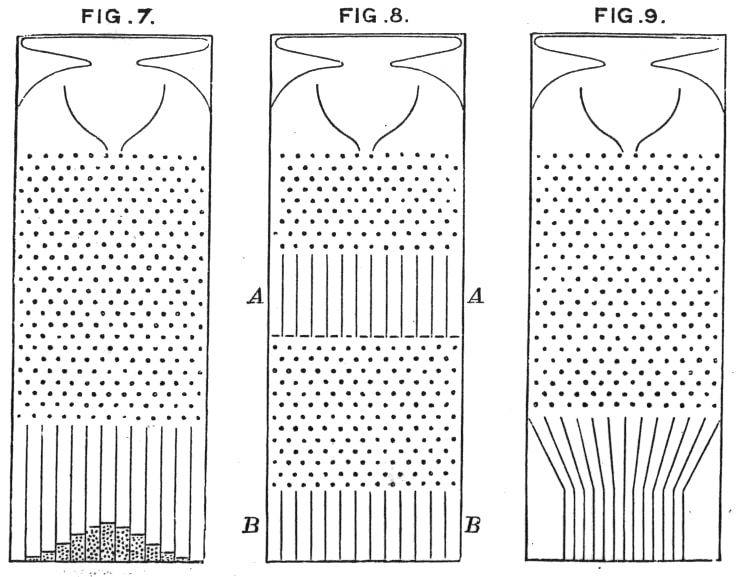
Francis Galton's drawings of his bead board, from Natural Inheritance (1889). In the left figure the beads, each bouncing unpredictably, settle into the same bell-shaped heap. Image: public domain, via Wikimedia Commons.

The short version:
- A single quantum event is not decided by anything that happened before it.
- Yet millions of those events together keep an exact mathematical rule.
- A rule about chances never decides any single event, so something besides earlier physical causes must hold the events to the rule.
- The rule really governs the events; it does more than describe them after the fact.
- The only thing that can govern events without forcing them is a will.
- So the order of chance comes from a governing will: God, who rules the lot without loading the dice.
See this page's graph and discover linked topics
In full
On the indeterministic readings of quantum mechanics, which include the standard textbook account and the objective-collapse theories (Ghirardi, Rimini and Weber 1986), the outcome of an individual measurement is not fixed by any prior physical state; Bell's theorem (1964), the Kochen-Specker theorem (1967) and the loophole-free Bell tests of 2015 (Hensen; Giustina; Shalm) rule out local hidden variables and non-contextual pre-existing values that would fix it, and Bell violations can certify that outputs were not determined in advance by anything available to the devices (Pironio et al. 2010). Yet the outcomes conform to the Born rule, including the joint statistics of space-like separated measurements, to the precision every test has reached. A probability measure over outcomes entails no single outcome, so if open cases are held to an exact measure, what holds them is no prior physical state. The argument then takes up the metaphysics of laws. On Lewis's Humean account (1994) the Born rule is part of the best summary of the actual pattern and governs nothing, at the cost, pressed by Armstrong (1983) and Maudlin (2007), of leaving explanation and inductive prediction without a ground; if laws do govern, a primitive governing law with no source names the governing without accounting for it. The remaining candidate, which classical theism calls providence acting with and through secondary causes (Aquinas, Summa Theologiae I q.22 a.4), is a will, the one kind of cause known to order outcomes without necessitating each. If the premises hold, the conclusion follows validly: the order of quantum chance is the ordinance of a governing will. The argument is strongest on the indeterministic readings. On deterministic Bohmian mechanics the Born statistics arise from a special typical initial configuration (Dürr, Goldstein and Zanghì 1992), and on Everettian mechanics the derivation of probability is contested (Saunders et al. 2010); on both, the question of where the order comes from moves rather than disappears.
The argument
| # | Premise |
|---|---|
| P1 | On the indeterministic readings of quantum mechanics, no prior physical state fixes the outcome of a single quantum event. |
| P2 | Yet quantum outcomes, taken together, keep an exact law (the Born rule), including exact correlations between outcomes in separated laboratories. |
| P3 | A probability law entails no single outcome; so if open single cases are held to an exact law, something other than prior physical states holds them to it. |
| P4 | The law really governs the cases: it explains them and grounds prediction, beyond summarizing what happens. |
| P5 | The only adequate account of an order that governs events without any physical cause fixing them is a governing will. |
| C | Therefore the order of quantum chance is the ordinance of a governing will: God, who governs the lot without forcing it. |
Why the conclusion follows. P1 and P2 give the datum: open single cases, an exact law. P3 says that what holds the cases to the law is no prior physical state. P4 says something really does hold them. P5 says the only adequate candidate is a will. So a will governs the order of chance.
How strong the conclusion is. Deductive in form: if the premises are true, the conclusion is true. P1 holds on the indeterministic readings, which most physicists accept, and it is the premise a defender of Bohmian or many-worlds mechanics will reject; on those readings, as the P1 section shows, the same question returns as a question about the universe's starting conditions or the meaning of probability. P2 is as secure as anything in physics. P3 follows from what a probability law is. P4 and P5 are philosophical premises about laws, defended below as the better account. The conclusion should be held with the confidence those two premises earn.
Grammar and hermeneutics
- The lot. In Proverbs 16:33 the "lot" is goral (H1486), the stone or token cast to decide a matter, the ancient picture of pure chance.
- "The whole disposing." The word translated "disposing" is mishpat (H4941), the ordinary word for a judgment or decision. The proverb says the lot is thrown by human hands, and its decision, every one of them, is from the LORD. See mishpat.
- A lot used with prayer. In Acts 1:24-26 the apostles pray first, "show of these two the one whom thou hast chosen," and then cast lots. They treat the lot's outcome as open to human eyes and governed by God.
- All things held together. Colossians 1:17 says that in Christ "all things consist." The verb is synistēmi (G4921), to stand together or hold together. The text speaks of a continuing upholding of all things, which Hebrews 1:3 also states: "upholding all things by the word of his power."
- Not a physics text. These verses do not describe quantum mechanics, and the argument does not claim they do. They state, long before physics, the doctrine the argument tests: that chance events are open to us and governed by God.
P1, The single case is open
The evidence
- Born's rule was probabilistic from the start. Max Born, "Zur Quantenmechanik der Stoßvorgänge" (Zeitschrift für Physik 37, 1926), read the wavefunction as giving the probability of an outcome, not the outcome itself. He received the 1954 Nobel Prize in Physics for the statistical interpretation.
- Einstein's resistance shows what was at stake. Writing to Born on 4 December 1926, Einstein granted that quantum mechanics was impressive but said an inner voice told him it was "not yet the real thing," and that he was convinced the Old One was not playing dice (translations of that line vary). Einstein wanted a deeper determinism under the dice.
- Bell showed the price of that determinism. John S. Bell, "On the Einstein Podolsky Rosen Paradox" (Physics 1, 1964), proved that any theory with local hidden variables must satisfy inequalities that quantum mechanics violates.
- Three loophole-free tests in one year. Hensen et al. (Nature 526, 2015), with electron spins 1.3 kilometres apart in Delft, and two photon experiments, Giustina et al. (Physical Review Letters 115, 250401) in Vienna and Shalm et al. (Physical Review Letters 115, 250402) at NIST in Boulder, closed the main loopholes. The 2022 Nobel Prize in Physics went to Alain Aspect, John Clauser and Anton Zeilinger for experiments establishing the violation of Bell inequalities.
- No values waiting to be read. The Kochen-Specker theorem (Journal of Mathematics and Mechanics 17, 1967) proves that in systems of three or more dimensions no assignment of pre-existing values to all measurable quantities can be independent of what else is measured alongside them.
- The openness can be certified. Pironio et al., "Random numbers certified by Bell's theorem" (Nature 464, 2010), showed that an observed Bell violation guarantees, assuming signals do not travel faster than light, that the outputs were not fixed in advance by anything available to the devices.
- Collapse theories make the openness physical. The objective-collapse model of Ghirardi, Rimini and Weber (Physical Review D 34, 1986) builds genuine chance into the dynamics, with no observer involved.
The best explanation
| Reading of P1's data | Fits? | Comment |
|---|---|---|
| Genuine indeterminism (standard readings, collapse theories) | Yes | Explains Bell violations and certified randomness directly |
| Nonlocal determinism (Bohmian mechanics) | Yes | Reproduces the predictions with hidden particle positions; the Born statistics then come from a special starting configuration (see P5) |
| Local determinism (Einstein's hope) | No | Ruled out by Bell plus experiment, short of superdeterminism |
Independent confirmation
Mathematics (Kochen and Specker), theoretical physics (Born, Bell), experimental physics (Delft, Vienna, Boulder, the 2022 Nobel work) and quantum information science (Pironio's certified randomness) reach P1 by different methods. Information scientists use the openness as a working resource, which is strong evidence that it is a physical fact.
Objections and rebuttals
- "Bohmian mechanics is deterministic, so P1 is false." Rebuttal. P1 is stated for the indeterministic readings. On Bohmian mechanics, Dürr, Goldstein and Zanghì (1992) derive Born statistics from the claim that the universe's initial configuration is typical with respect to the squared-amplitude measure. The order of chance is then built into the beginning, and the question of what set it there remains. See Fine-Tuning Argument.
- "Unpredictable is not the same as uncaused." Rebuttal. Agreed, and the argument relies on that distinction. P1 says no prior physical state fixes the outcome. It leaves open whether something non-physical governs it, which is the question the argument asks. See Quantum Fluctuations Are Uncaused Objection Defeater.
- "Superdeterminism escapes Bell: the settings and the particles were correlated from the start." Rebuttal. Experimenters have pushed the setting choices as far from the particles as they can. The BIG Bell Test Collaboration (Nature 557, 2018) let about 100,000 volunteers choose settings, and Handsteiner et al. (Physical Review Letters 118, 2017) chose them from the color of light that left Milky Way stars about 600 and 1,900 years earlier. The violation held. Superdeterminism must say the whole history of the universe was arranged so that stars and volunteers pick exactly the settings that mimic quantum statistics, which is itself a striking order needing an account, and it would undercut every randomized experiment in science, a cost Abner Shimony, John Clauser and Michael Horne pressed in their exchange with Bell.
P2, The whole keeps an exact law
The evidence
- The most used rule in physics. Every quantum prediction of relative frequencies, from atomic spectra to semiconductor devices, runs through the Born rule.
- Direct tests of its form. Sinha et al., "Ruling out multi-order interference in quantum mechanics" (Science 329, 2010), used single photons and three slits to bound any departure from the Born rule's pairwise interference structure to less than about one percent of the expected two-path term; later work has refined and debated the method.
- The rule is exact in form. The probability of an outcome is the squared magnitude of an amplitude: a precise measure over outcomes.
- The correlations are exact too. Bell experiments measure the joint statistics of paired outcomes in separated laboratories, and those correlations match the quantum prediction beyond the bound any local theory allows, in every loophole-free test.
- The form is forced, if there is a measure at all. Andrew Gleason (Journal of Mathematics and Mechanics 6, 1957) proved that in three or more dimensions the only consistent way to assign probabilities to quantum outcomes has the Born form.
The best explanation
| Reading of P2's data | Fits? | Comment |
|---|---|---|
| A real law governs the frequencies | Yes | Explains why the pattern holds in every lab and keeps predicting new cases |
| Lucky frequencies with no law | No | Predicts the pattern should fail; it has not |
Independent confirmation
Mathematics (Gleason), experimental physics and engineering (devices designed on Born statistics that work) converge on P2. Critics of the theistic reading accept P2 without reservation.
Objections and rebuttals
- "That is just the law of large numbers." Rebuttal. The law of large numbers says frequencies approach the probabilities if the events are governed by those probabilities. It does not say why the world's events have the probabilities the Born rule assigns, or any at all.
- "Any finite run of data fits many rules." Rebuttal. The Born rule has predicted correctly in new regimes for a century: new atoms, new materials, entangled pairs over kilometres. A rule that keeps succeeding where it was never fitted is the mark of a real law.
P3, A chance law decides no single case
The evidence
- What a probability is. A probability measure assigns weights to outcomes. No weight entails that a given outcome occurs. A fair coin's probability of one half does not make this toss land heads.
- Coordination with no signal. In a Bell experiment the two outcomes are each open, the labs are far enough apart that no light-speed signal can pass between the measurements, and quantum theory's no-signalling theorem guarantees that neither side can be used to send a message. Yet the paired outcomes keep the exact quantum correlation.
The best explanation
| What holds open cases to an exact law | Is it a prior physical state? |
|---|---|
| The particles' earlier states | No, by P1 |
| A signal between the labs | No, none passes |
| Something else | This is what P4 and P5 examine |
Independent confirmation
Probability theory (a measure entails no outcome), the no-signalling theorem and the Bell experiments agree on P3.
Objections and rebuttals
- "Gleason's theorem explains the law, so nothing else is needed." Rebuttal. Gleason explains why the measure takes this shape if outcomes follow a measure. It does not make any open outcome conform to it. Gleason fixes which law; the question of what holds open cases to the law remains, and his result makes the law more exact, which sharpens the question.
P4, The law really governs
The evidence
- Physics uses laws to explain. Physicists say a pattern of photon hits looks as it does because of the Born rule, and they predict the next experiment from it. That is governing language.
- The regularity view cannot ground prediction. David Armstrong, What Is a Law of Nature? (Cambridge, 1983), argued that if laws are only regularities in what happens, inferring from observed cases to unobserved ones has no rational basis, since nothing connects the cases. Tim Maudlin, The Metaphysics Within Physics (Oxford, 2007), likewise defends laws as governing and irreducible to the pattern they produce. Neither argues for God.
- Lewis's alternative, and its cost. On David Lewis's best-system account, chances are whatever the simplest and strongest summary of the actual pattern says they are ("Humean Supervenience Debugged," Mind 103, 1994). Nothing makes the pattern hold; the pattern simply is the chance. On that view the Born rule explains no outcome, and the success of every future prediction is a continuation the past gave no reason to expect.
The best explanation
| View of the Born rule | Explains outcomes? | Grounds prediction? |
|---|---|---|
| Governing law | Yes | Yes |
| Humean summary (Lewis) | No: it restates the pattern | No: nothing connects past runs to the next |
Independent confirmation
Scientific practice (explanation and prediction from laws), and naturalist-friendly philosophers of science (Armstrong, Maudlin), reach P4 without any theistic motive.
Objections and rebuttals
- "Laws need nothing behind them." Rebuttal. That is the Humean claim, and its cost is that laws then explain nothing, because they are only summaries of what happens. See Laws of the Universe as Witness to Design.
P5, Only a will governs without forcing
P5 is the hinge of the argument.
The evidence
- The candidates. If no physical state fixes each case (P1, P3) and yet something governs the whole (P4), the governor is either a primitive law with no source, or the ordinance of a will.
- A primitive law names the governing. To say "a basic law just makes open cases keep the measure" is to say that there is governing without saying what governs. It gives the datum a title.
- A will is the one known cause that orders without necessitating. A person can keep a promise across a thousand separate occasions without any one occasion forcing the next; a teacher can grade fairly without each grade being fixed by the last. Purpose can order a whole while leaving each part open to every other cause. Thomas Aquinas taught that providence provides necessary causes for some effects and contingent causes for others (Summa Theologiae I, q.22, a.4), and that one effect can be wholly from God and wholly from the natural agent at different levels (Summa contra Gentiles III.70). See Divine Providence.
- One governor spans the labs. In a Bell experiment a single order holds outcomes in places no signal links. One will that upholds all things at once accounts for that; a separate brute connection for each pair of labs does not.
- Theologians proposed this at the quantum level. William G. Pollard, a physicist and Episcopal priest, argued in Chance and Providence (Scribner, 1958) that quantum indeterminacy is where God governs nature without breaking physical law. Peter van Inwagen, "The Place of Chance in a World Sustained by God" (in Thomas V. Morris, ed., Divine and Human Action, Cornell, 1988), argued that God sustains the world and its powers while some outcomes are not individually decreed. The argument needs only what both share: the law of chance itself is God's ordinance.
The best explanation
| Account of lawful chance | Explains open single cases? | Explains the exact whole? | Explains coordination across distance? |
|---|---|---|---|
| A governing will (providence acting through secondary causes) | Yes | Yes | Yes, one governor of all |
| Primitive governing law with no source | Yes | By stipulation | By stipulation |
| Humean summary | Yes | No: describes only | No |
| Special initial conditions (Bohm) | No open cases | Yes, from a special start | Yes, from the start; the start itself needs an account |
| Branching worlds (Everett) | Every outcome occurs | Contested | Contested |
Independent confirmation
Classical theology (Aquinas), Hebrew wisdom (Proverbs), modern physics-and-theology (Pollard) and analytic philosophy of religion (van Inwagen) reach the same picture by separate routes, and the oldest of them long predates the physics.
Objections and rebuttals
- "If God picks every outcome, chance is fake." Rebuttal. Chance in physics means that no prior physical state fixes the outcome. A will that is not a prior physical state leaves the openness real and explains why it is lawful. On van Inwagen's model, God does not pick every outcome at all; He ordains the law.
- "This is a God of the gaps." Rebuttal. A gap argument rests on what physics does not know. This one rests on what physics has established, Bell violations and Born statistics, and on the difference between describing an order and governing it, which more physics does not remove.
- "Does God then decide every evil accident?" Rebuttal. That is the problem of evil, treated at Problem of Evil and Divine Sovereignty. The argument establishes governance of the law of chance and leaves the theory of particular evils to those pages.
- "Theism could fit any data." Rebuttal. The theism tested here is specific: a faithful God who binds Himself to the regularity of nature (Genesis 8:22; Jeremiah 33:25) and governs the lot (Proverbs 16:33). That God rules out a world of lawless chance, so the view could have failed and did not.
Taken together
Each fact alone has an easy reply. Open single outcomes fit either worldview. A lawful world can be taken as basic. A will behind the law can be called an extra.
Together they show single outcomes that no earlier physical state fixes, in laboratories over a kilometre apart with no signal between them, jointly keeping the exact Born correlations in Delft, Vienna and Boulder, and again when the settings were chosen by volunteers and by starlight. Mathematics rules out values sitting in the system waiting to be read, and mathematics fixes the law's form exactly. A skeptic who wants to reject the conclusion has to say what holds undetermined cases to an exact measure across distance, or accept the Humean price that the Born rule explains nothing, or adopt a deterministic reading and explain the special start it requires.
Weighing the evidence
| Fact | How expected if a will governs | How expected if nothing does | Leans |
|---|---|---|---|
| A lawful, mathematical world at all | High | Moderate to low | Toward a governor |
| Single outcomes not fixed by prior physical states | Moderate | Moderate | Even |
| Open single cases that keep an exact law | High | Low to moderate | Clearly toward a governor |
| Separated outcomes, with no signal between them, that keep exact joint correlations | High | Low | Clearly toward a governor |
| On Bohmian mechanics, Born statistics from a special typical start | High | Moderate | Toward a governor |
Net. On the indeterministic readings, lawful chance points clearly to a governing will. On Bohmian mechanics the question becomes one about the universe's starting conditions; on Everett it moves into the derivation of probability itself. On every reading the order of chance needs a source. These are qualitative judgments argued in the sections above, not measurements.
The strongest objection
"The argument assumes laws must govern. On the Humean view defended by David Lewis, a law of nature, chancy laws included, is just part of the simplest true summary of the whole pattern of events. Nothing stands behind it or makes it hold. There is no governing gap, because there is nothing to govern: the world is a mosaic of facts, and the Born rule is a compact description of how the mosaic happens to look."
Reply.
- On Humeanism, the Born rule explains nothing. If the rule is only a summary of the frequencies, saying "the pattern looks like this because of the Born rule" is saying the frequencies hold because the frequencies hold.
- Humeanism makes every successful prediction a coincidence. If nothing makes the future match the summary of the past, every successful quantum prediction is a continuation the past gave no reason to expect. Armstrong's point applies: the confidence every experimenter places in the next run is unearned.
- The coordination across distance is left as luck. The Humean must say the correlated outcomes in two separated labs simply happen to fall, run after run, into the exact pattern the summary later records.
- The non-Humean naturalist faces P5 directly. If laws really govern, the question returns: what governs undetermined cases into an exact measure? A governing law with no source is governing with no governor.
Concessions
- Grant: quantum mechanics does not settle its own interpretation. Now collect: every interpretation must say where the order of chance comes from, and none can say "nowhere" without giving up explanation.
- Grant: Bohmian mechanics is deterministic and fits the data. Now collect: it places the Born statistics in a special starting measure, a fine-tuned beginning that a Creator explains.
- Grant: Einstein was wrong about local hidden variables. Now collect: his sense that the dice need explaining survives; a law of dice still needs more than a description.
Cheatsheet
The 30-second version (read aloud). "Einstein said God does not play dice. Experiments since then say the single quantum event really is open: no hidden gear inside decides it. But billions of those open events add up to an exact rule that every phone chip is built on. A rule about chances never decides any single case, so what holds all the open cases to the rule? A description can't hold anything. A will can: it can keep an order across a thousand cases without forcing any one. The Bible said it long ago: the lot is cast into the lap, but the whole disposing of it is of the Lord."
Fast facts:
- Born (1926): quantum mechanics gives probabilities of outcomes, not outcomes.
- Bell (1964) and the 2015 loophole-free tests: no local hidden variables fix the results.
- Pironio and colleagues (Nature, 2010): Bell violations certify that outputs were not fixed in advance.
- Gleason (1957): the Born form is the only consistent probability rule for quantum outcomes.
- Dürr, Goldstein and Zanghì (1992): even deterministic Bohmian mechanics gets Born statistics only from a special, typical start.
The closing line. "Chance that keeps a law is government."
Cross-examination
Round 1, Is the single case open?
- Q: Do you accept that loophole-free Bell tests rule out local hidden variables?
- If they say: "Yes." Then: Then either outcomes are open, or determinism is nonlocal and depends on a special start. Which do you hold?
Round 2, Does a law govern?
- Q: When a physicist says the Born rule explains a pattern of photon hits, is that a real explanation?
- If they say: "Yes." Then: Then something governs undetermined events. What is it?
- If they say: "No, it's only a summary." Then: Then every successful quantum prediction is a coincidence you must accept.
Round 3, The relocation
- Q: If you prefer Bohm or Everett, where does the Born measure come from?
- If they say: "From the initial conditions." Then: Then the order of chance was set into the start. What set it?
Dodge table
| Dodge | What it concedes | Reply |
|---|---|---|
| "It's just random." | Single cases are open | "Random and lawful at once. What keeps the randomness to the rule?" |
| "That's just how nature is." | No account is offered | "That is a description. I am asking what governs." |
| "Quantum mysticism." | Nothing about the data | "I have not said a mind collapses anything. I said open outcomes keep an exact law." |
| "Bohm fixes it." | The order is in the start | "Then the start was set to the Born measure. Who set it?" |
Live-cite kit
Scripture (ASV):
- The lot is cast into the lap; But the whole disposing thereof is of Jehovah. (Proverbs 16:33, ASV)
- Are not two sparrows sold for a penny? and not one of them shall fall on the ground without your Father: but the very hairs of your head are all numbered. (Matthew 10:29-30, ASV)
- show of these two the one whom thou hast chosen (Acts 1:24, ASV)
- and he is before all things, and in him all things consist. (Colossians 1:17, ASV)
- While the earth remaineth, seedtime and harvest, and cold and heat, and summer and winter, and day and night shall not cease. (Genesis 8:22, ASV)
Scholarly:
- Max Born, Zeitschrift für Physik 37 (1926): the wavefunction gives probabilities.
- John S. Bell, Physics 1 (1964): local hidden variables cannot reproduce quantum predictions.
- B. Hensen and colleagues, Nature 526 (2015): a loophole-free Bell violation.
- David Armstrong, What Is a Law of Nature? (1983): regularities alone cannot ground prediction.
- Thomas Aquinas, Summa Theologiae I, q.22, a.4: providence provides contingent causes for contingent effects.
Aphorism: "God does not need to load the dice. He wrote the rule they keep."
Connection to Scripture
- Proverbs 16:33, the lot, the ancient image of chance, governed in its every decision.
- Matthew 10:29-30, the single sparrow and the counted hairs: providence reaches the single case and the full count.
- Acts 1:24-26, the apostles pray, then cast lots.
- Colossians 1:17 and Hebrews 1:3, all things held together and upheld.
- Genesis 8:22, Jeremiah 31:35 and Jeremiah 33:25, the ordinances of heaven and earth, kept by covenant.
Scholarship
Published academic works this page draws on, each matched to a publisher, index or library catalog record.
- D. M. Armstrong, What is a Law of Nature? (Cambridge University Press, 1983). doi:10.1017/cbo9781139171700
- The BIG Bell Test Collaboration, "Challenging local realism with human choices," Nature 557 (2018). doi:10.1038/s41586-018-0085-3 PubMed 29743691 open access
- G. C. Ghirardi, A. Rimini and T. Weber, "Unified dynamics for microscopic and macroscopic systems," Physical Review D 34 (1986). doi:10.1103/physrevd.34.470 PubMed 9957165
- Marissa Giustina et al., "Significant-Loophole-Free Test of Bell’s Theorem with Entangled Photons," Physical Review Letters 115 (2015). doi:10.1103/physrevlett.115.250401 PubMed 26722905
- Johannes Handsteiner et al., "Cosmic Bell Test: Measurement Settings from Milky Way Stars," Physical Review Letters 118 (2017). doi:10.1103/physrevlett.118.060401 PubMed 28234500 open access
- B. Hensen et al., "Loophole-free Bell inequality violation using electron spins separated by 1.3 kilometres," Nature 526 (2015). doi:10.1038/nature15759 PubMed 26503041 open access
- Tim Maudlin, The Metaphysics Within Physics (Oxford University Press, 2007). doi:10.1093/acprof:oso/9780199218219.001.0001
- Thomas V. Morris, Divine and Human Action (1988). Open Library
- S. Pironio et al., "Random numbers certified by Bell’s theorem," Nature 464 (2010). doi:10.1038/nature09008 PubMed 20393558 open access
- William Grosvenor Pollard, Chance and providence (Scribner, 1958). Open Library
- William G. Pollard, Chance and Providence Gods Action in a World Governed by Scientific Law (1958). Open Library
- Lynden K. Shalm et al., "Strong Loophole-Free Test of Local Realism," Physical Review Letters 115 (2015). doi:10.1103/physrevlett.115.250402 PubMed 26722906 open access
- Urbasi Sinha et al., "Ruling Out Multi-Order Interference in Quantum Mechanics," Science 329 (2010). doi:10.1126/science.1190545 PubMed 20651147 open access
See also
- Arguments, the master index
- Ris3n Arguments, the hub for ris3n's original arguments
- Argument from the Observer-Demand Convergence, a different quantum argument, from observation and definiteness; this one does not depend on observers and works on collapse theories with no observer
- Divine Providence, preservation, concurrence and government
- Divine Sovereignty, how God's rule relates to secondary causes
- Quantum Fluctuations Are Uncaused Objection Defeater, why indeterminism does not mean something from nothing
- Laws of the Universe as Witness to Design, the general argument from law
- Mathematical Intelligibility of Nature, why the world obeys mathematics at all
- Free Will and Determinism, the parallel question about human choices
- Fine-Tuning Argument, the relocated question on Bohmian mechanics
- Cumulative Case for Christian Theism
Common questions this page answers
Q: Does quantum randomness disprove God?
No. Quantum randomness means no prior physical state fixes a single outcome. It does not mean nothing governs the outcome. The single events are open, yet together they keep an exact probability law, and a law that governs without forcing fits a governing God far better than it fits nothing at all.
Q: Is quantum mechanics really random?
On the most widely held readings, yes: experiments testing Bell's theorem, including three loophole-free tests in 2015, rule out local hidden causes that would decide each outcome. Some physicists prefer deterministic readings such as Bohmian mechanics, which accept nonlocal hidden variables and place the order of chance in the universe's starting conditions.
Q: What did Einstein mean when he said God does not play dice?
In a 1926 letter to Max Born, Einstein said quantum mechanics was impressive but "not yet the real thing," and that he did not believe the Old One plays dice. He hoped a deeper deterministic theory lay underneath. Bell's theorem and later experiments showed that no local theory of that kind can match the results.
Q: What does Proverbs 16:33 have to do with quantum physics?
Proverbs 16:33 says the lot is cast into the lap, but its whole decision is from the Lord. A lot is the ancient picture of pure chance. The verse is not a physics text, and it states the doctrine this argument tests: outcomes no human cause fixes can still fall within an order God governs.
Q: Is this argument quantum mysticism?
No. It makes no claim that consciousness causes collapse or that minds shape particles. It uses two established results, open single outcomes and exact Born statistics, and asks what accounts for a law that governs events no physical cause fixes.
Q: Can God govern events that are truly random?
Classical theology says yes. Aquinas taught that providence provides contingent causes for contingent effects, so some events are truly not necessitated by their causes and still fall under God's governance. A person can keep an order across many free occasions without forcing any one of them, and providence works in a similar way.