Argument
The Inalienable Argument
Inalienable Argument, argument from inalienable rights, where do human rights come from, human rights argument for God, endowed by their Creator argument, can atheism ground human rights, argument from natural rights, who gives us our rights, can the government take away human rightsIntro
Picture a game of pickup basketball at the park. Someone says, "New rule: no dunking." Everyone agrees, so it is a rule. Ten minutes later someone says, "Never mind, dunking is fine again." Everyone agrees, and the rule is gone. Rules that people make, people can unmake. That is fine for a basketball game.
Now think about what we say about human rights. We say that every person has a right not to be tortured, enslaved or killed for no reason. We say this is true of the rich and the poor, the newborn and the elderly, the genius and the person with severe disabilities, all equally. And we say no government, king or vote can take these rights away. A dictator who tortures prisoners does not cancel their rights; he violates them. That is what "inalienable" means: the right cannot be sold, surrendered, voted away or revoked.
That raises a hard question. Who gave us these rights? If a government gave them, a government can take them back, like the dunking rule. If a majority voted for them, a majority can vote again. If they come from how smart or strong or aware we are, then people who are less smart or strong or aware would have fewer rights, and some would have none. None of those answers gives rights that are equal and that no one can take away.
The American founders gave a different answer: people are "endowed by their Creator" with rights. The Inalienable Argument says that answer is the one that fits. A right no human authority can take away must come from above every human authority, and a right every human has equally must rest on something every human has equally. A Creator who made every person in His image gives exactly that. So if human rights are real, so is the One who gave them.
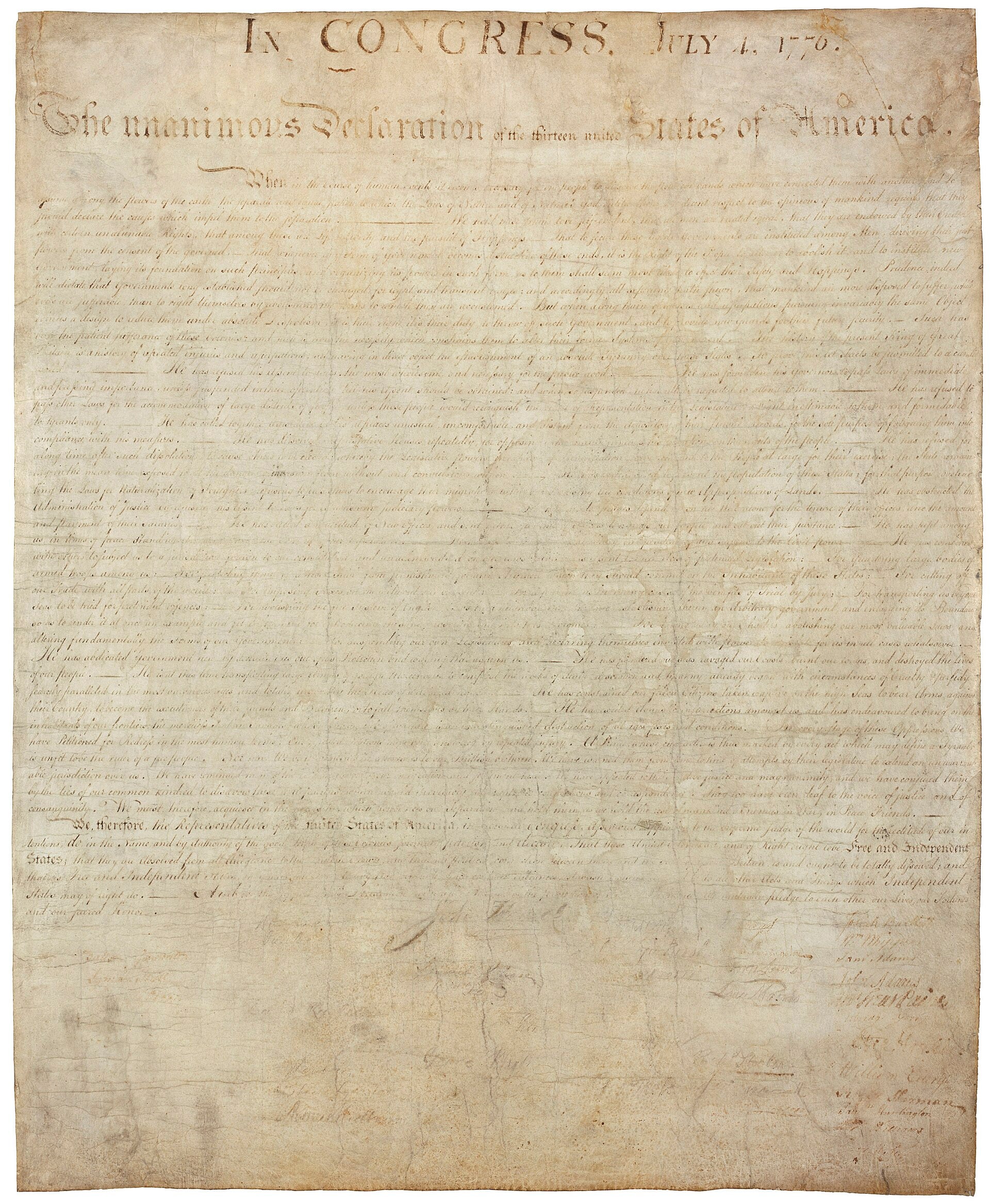
The engrossed copy of the Declaration of Independence (1776), which says all men are "endowed by their Creator with certain unalienable Rights." Image: U.S. National Archives, public domain, via Wikimedia Commons.

The short version:
- Every human has basic rights that are equal and that no government or vote can take away.
- What people give, people can take back, so rights no one can take away were not given by people.
- Rights everyone has equally must rest on something everyone has equally.
- Abilities like intelligence come in degrees, and laws and agreements are made by people.
- The one thing every human has equally, that no human gave, is being made by God in His image.
- So human rights come from a Creator, and the Creator is real.
See this page's graph and discover linked topics
In full
The modern rights tradition, including its secular declarations, ascribes four properties to core human rights: universality (every human has them), equality (none has more than another), inherence (they are had in virtue of being human, not conferred) and inalienability (no state, majority or bearer can revoke them). The argument holds that rights with these properties set two conditions on their ground. A standing that binds every human authority cannot have been conferred by any human authority, since conferral by a will entails revocability by a will (Bentham drew the corollary from the other side: "Right is the child of law"). And a standing had equally by all must rest on a property had equally by all, which excludes every capacity that comes in degrees. Positive law and social contract fail the first condition; capacity accounts (rationality, sentience, autonomy) fail the second, as Singer's argument about newborns, Rawls's appeal to a threshold "range property" and Waldron's treatment of profound disability each show; bare species membership meets the conditions only by stipulation, since on naturalism a species is a population with blurred edges; and robust non-natural realism (Wielenberg 2014) affirms the rights without supplying a ground that explains their equal distribution. A worth bestowed by a Creator on each human made in His image (Genesis 1:27; 9:6), defended in its strongest current form by Wolterstorff (2008), is had by every human, admits no degrees, and is conferred by no human authority. If that is the only ground meeting both conditions, the conclusion follows validly: human rights are endowed by a Creator. Historical work by Tierney, Siedentop and Holland shows that the concept was developed in canon law and Christian moral theology, and the reformers who extended rights most widely appealed to their divine ground; that history confirms the analysis without carrying it. The honest secular rivals concede the point from the other side: Bentham and MacIntyre deny natural rights exist.
The argument
| # | Premise |
|---|---|
| P1 | Every human being has basic rights (not to be tortured, enslaved or killed at whim) that are equal, and that no state, majority or person can take away. |
| P2 | What a human authority confers, a human authority can withdraw; so a right that no human authority can withdraw was not conferred by any human authority. |
| P3 | A right that every human has equally must rest on something that every human has equally, without degrees. |
| P4 | The only ground that every human has, equally, and that no human authority confers, is the standing given by a Creator who makes every human in His image. |
| C | Therefore human rights are endowed by a Creator: there is a God who has made every person in His image. |
Why the conclusion follows. By P1 the rights exist. By P2 their ground is not a human gift. By P3 their ground is had equally by all. By P4 only one ground meets both conditions, the Creator's image. So the rights rest on that ground, and a ground that is a Creator's gift requires a Creator.
How strong the conclusion is. Deductive: if the four premises are true, the conclusion is true. P2 follows from what conferring is, and P3 from what equality is. P1 is believed by nearly everyone and denied by a few honest skeptics, Bentham and MacIntyre among them. P4 is the hinge: a skeptic who grants P1 and rejects the conclusion has to name another ground that every human has equally and no human gave. The P4 section examines each candidate on offer.
Grammar and hermeneutics
- The image, three times "created." Genesis 1:27 uses bara (H1254), "created," three times, and tselem (H6754), "image," twice. The object is 'adam (H120), humankind, and the verse adds "male and female created he them": the image is given to the human kind as made, to both sexes alike.
- The image survives sin. Genesis 9:6 comes after the Fall and the Flood, and it still grounds the protection of human life in the image: "for in the image of God made he man." The ground does not depend on the person's goodness or ability, so it is not lost by wrongdoing or weakness.
- Any human, no qualification. "Whoso sheddeth man's blood" uses the same generic 'adam (H120). The text names no class of human who falls outside the protection.
- Master and slave from one Maker. In Job 31:13-15 Job says he could not answer God if he had despised the cause of his servants, because "Did not he that made me in the womb make him?" Equal standing is grounded in common creation, and applied in the text to the one with the least power.
- "Respect of persons." In James 2:1 the word is prosōpolēmpsia (G4382), built from the words for "face" and "receive": favoring someone because of how they appear. James calls it sin and the partial "transgressors" (James 2:9).
P1, Human rights are equal and cannot be taken away
The evidence
- The founding documents say so. The Declaration of Independence (1776) calls the rights of all men "unalienable" and says they are "endowed by their Creator." The Universal Declaration of Human Rights (1948) opens with "recognition of the inherent dignity and of the equal and inalienable rights of all members of the human family," and Article 1 says all human beings "are born free and equal in dignity and rights."
- The rights are held against the state. Every serious charge against a regime (torture, slavery, genocide) presupposes that the victims had the rights the regime denied. If rights were whatever the law said, a law permitting slavery would make slavery no violation.
- The reformers argued from inherent rights. Martin Luther King Jr., in the "Letter from Birmingham Jail" (1963), wrote: "I would agree with St. Augustine that 'an unjust law is no law at all,'" and "To put it in the terms of St. Thomas Aquinas: An unjust law is a human law that is not rooted in eternal law and natural law." Frederick Douglass, in "What to the Slave Is the Fourth of July?" (1852), declined to argue that the slave is entitled to liberty, because "There is not a man beneath the canopy of heaven that does not know that slavery is wrong for him."
- A positivist changed his mind. Gustav Radbruch, a leading German legal positivist before the war, concluded in 1946 ("Statutory Lawlessness and Supra-Statutory Law") that a statute whose injustice reaches an intolerable degree loses its claim to be law. After the Nazi period, a thinker well placed to defend "law is whatever is enacted" judged that some rights stand above enactment, and German courts later applied his formula.
The best explanation
| Explanation of P1's data | Fits? | Comment |
|---|---|---|
| Inherent rights are real and the conviction tracks them | Yes | Explains the declarations, the reformers' arguments and the judgment that lawful atrocities are violations |
| Rights are useful fictions (Bentham's line) | Partly | Explains why societies adopt rights language; cannot explain why we judge lawful atrocities as violations |
| Rights are products of the modern West | Weakly | The victims of other cultures' atrocities are judged wronged too |
Independent confirmation
Legal history (the declarations, Radbruch), moral philosophy (the "unjust law is no law" tradition from Augustine through Aquinas to King) and ordinary moral experience reach P1 by different routes. Most critics of theism accept P1, which is why the argument is aimed at them.
Objections and rebuttals
- "Rights are just what we agree to treat as rights." Rebuttal. Then a society that agrees to treat some humans as property has violated no one's rights. That is the conclusion the abolitionists and the civil rights movement denied, and nearly everyone now agrees they were right.
- "Our rights intuitions are evolved feelings, so they track nothing." Rebuttal. Evolved social feeling favors kin and tribe, and the rights judgment runs against it, extending equal standing to strangers and enemies. A judgment that overrides the bias selection installed is poorly explained as that bias. And the debunking argument, applied evenly, would also undercut the reasoning used to make it.
- "Some rights are plainly legal." Rebuttal. Agreed. P1 concerns the core human rights declared inherent and inalienable, not the right to a driving license.
P2, What people give, people can take back
The evidence
- Conferral and revocation go together. A gift of standing from a will is a decision, and a later decision of the same authority, or a higher one, can reverse it. That is what makes a law a law and a contract a contract.
- The honest skeptic says the same. Jeremy Bentham, Anarchical Fallacies (written 1796): "Right, the substantive right, is the child of law: from real laws come real rights; but from imaginary laws, from laws of nature... come imaginary rights." He concluded that natural rights are "simple nonsense," and "natural and imprescriptible rights" are "nonsense upon stilts."
- No one gives what he does not have. To confer a standing that binds every human authority, the giver must stand above every human authority. A state cannot bestow a standing that limits all states, and a majority cannot bestow a standing that binds all future majorities.
The best explanation
| Reading of "inalienable" | Fits? | Comment |
|---|---|---|
| The right has a source above every human will | Yes | Explains why no state or vote can revoke it |
| "Inalienable" is rhetoric | Poorly | Gives up the property the declarations insist on |
Independent confirmation
Legal theory (the positivist link between law and rights), Bentham's critique and the reformers' practice of appealing over the law to a higher standard all assume P2.
Objections and rebuttals
- "Inalienable only means the holder cannot waive or sell the right." Rebuttal. If no holder can waive it and no state can revoke it, then no human will is its source, since what a human will creates a human will can undo. The legal meaning, followed through, gives P2.
- "Equality is a political decision." Rebuttal. Then it is alienable by another political decision, and the rights are not the rights P1 describes.
P3, Equal rights need an equal ground
The evidence
- Equality needs a ground without degrees. If the ground came in more and less, so would the right. Intelligence, rationality, sentience, autonomy and usefulness all come in degrees.
- The drafters knew the ground was missing. Jacques Maritain, introducing the UNESCO inquiry that fed the 1948 Declaration, reported that delegates from opposed philosophies could agree on a list of rights only on condition that no one asked them why; the disagreement began with the justification.
- The best secular theorists name the problem. John Rawls, A Theory of Justice (1971, section 77), tried to ground equality in a "range property": everyone above a threshold of capacity for moral personality counts equally, however far above it they are. The threshold is itself a capacity, so those below it are left out. Jeremy Waldron, a secular legal philosopher, devoted One Another's Equals (2017) to grounding basic equality and treated the profoundly disabled as the hardest case for any account.
The best explanation
| Reading of equality | Fits? | Comment |
|---|---|---|
| Equal rights rest on a ground had equally | Yes | Explains why no human counts for more |
| Equal rights are a useful policy over unequal grounds | Poorly | Makes equality a decision, which P2 shows is revocable |
Independent confirmation
Rights theorists who disagree about God agree that a ground must explain equality. Wolterstorff makes the requirement explicit (Justice: Rights and Wrongs, Princeton, 2008); Bentham and MacIntyre accept it and conclude that no ground exists.
Objections and rebuttals
- "Combine the grounds: capacity for most, something else for the rest." Rebuttal. A patchwork gives different humans different grounds, so their rights rest on different things and can differ in strength. Equality needs one ground all share.
P4, Only the Creator's image meets both conditions
The evidence
- Positive law fails P2. If rights come from law, they end where the law ends, which is Bentham's conclusion.
- Social contract fails P3. A right born of agreement belongs to those who can agree or bargain. Infants, the comatose, the severely impaired and future generations cannot contract, so their standing is borrowed.
- Capacities fail P3. Peter Singer follows the logic openly: in Practical Ethics (1979) he argues that newborn infants lack the capacities that make someone a person in his sense, so that killing a newborn is not equivalent to killing a person. Wolterstorff argues that every capacity-based account, worked out fully, either excludes some humans or makes their worth unequal.
- The candid verdict. Alasdair MacIntyre, After Virtue (1981, chapter 6): "the truth is plain: there are no such rights, and belief in them is one with belief in witches and in unicorns." He held that every attempt to give good reasons for natural rights had failed.
- The Creator's image meets both. "And God created man in his own image" (Genesis 1:27, ASV). The image is given to every human, with no grades, and the giver stands above every human authority. Wolterstorff argues that what grounds human rights is the worth bestowed on each human by being loved by God equally and permanently.
- The ground produced equal regard for the weakest. The Didache, an early Christian manual usually dated to the late first or early second century, forbids killing a child by abortion or killing one that is born (Didache 2.2), in a world where Roman custom permitted the exposure of unwanted infants.
The best explanation
| Ground | Every human? | Equally? | Not conferred by humans? |
|---|---|---|---|
| Positive law | Only where enacted | Only where enacted | No |
| Social contract | No: excludes non-contractors | Varies with bargaining power | No |
| Capacities (rationality, sentience, autonomy) | No: varies across life | No: degrees | Yes |
| Species membership as a bare biological fact | Yes | Yes | Yes, though on naturalism a biological category carries no moral weight of its own, which is Singer's charge of "speciesism" |
| Brute moral facts (Wielenberg) | Asserted | Asserted | Yes, with no account of why they attach equally (see The strongest objection) |
| The Creator's image and equal regard | Yes | Yes | Yes |
Independent confirmation
The failure of each secular ground is argued by its own users: Bentham against natural rights, MacIntyre against Enlightenment rights, Singer against species equality. These are three naturalist witnesses, from utilitarian, virtue-ethical and preference-utilitarian directions, who reach the same point without any theistic motive. The image doctrine (Imago Dei), Wolterstorff's analytic theory and the natural-law tradition from Aquinas to King reach the theistic side independently. See Biblical Dignity.
Objections and rebuttals
- "Use the capacity of the kind, not the individual: humans are the rational kind." Rebuttal. That is a good answer, and it is a teleological one. On naturalism a species is a population with fuzzy edges, not a kind with a nature; the "rational nature" reply borrows the essentialism that theism supplies and naturalism disowns.
- "Kant grounded equal dignity in rational nature without God." Rebuttal. Kant's ground is the capacity for rational autonomy, which infants and the severely impaired lack, so it meets P3 only by the kind-based move answered above. Kant himself held that the moral life requires postulating God and immortality (Critique of Practical Reason, 1788).
- "A God-given right is just a right God can revoke." Rebuttal. P2 concerns human authorities. The ground is God's settled character and His creation of the kind, and God, who does not lie, does not contradict His own image.
- "The image of God is just reason or dominion, which also come in degrees." Rebuttal. Genesis 9:6 grounds the protection of life in the image without naming any ability, and Genesis 1:27 gives it to humankind as created, before any capacity is exercised. Capacities are ways the image is lived out; the image itself is a status God gives.
- "The Bible was used to defend slavery." Rebuttal. It was, and the abolitionists answered from the same book, from the image and from Christ dying for slave and master alike. The argument concerns what grounds rights, not whether every Christian honored them. See Biblical Slavery Objection Defeater and Christian Abolitionist Movement.
- "Maybe a better secular ground will be found." Rebuttal. Perhaps, and the argument is open to it. But the debate is two centuries old, and the most candid secular voices (Bentham, MacIntyre, Singer) concluded that the inherent equal right does not exist, not that its ground is coming.
Where the idea came from
This history confirms the analysis without carrying it. If inherent rights depend on a theistic ground, they should have emerged where that ground was believed.
- The vocabulary came from canon law. Brian Tierney, The Idea of Natural Rights (1997), argues that twelfth- and thirteenth-century canonists developed a language of natural rights that a person has, well before the Enlightenment.
- The moral individual. Larry Siedentop, Inventing the Individual (2014), argues that the moral equality of individuals was worked out through Christian moral theology and canon law rather than inherited from Greece and Rome.
- The secular West still runs on the inheritance. Tom Holland, Dominion (2019), argues that the assumptions secular humanists take as self-evident, the dignity of the weak and the equal worth of every person, are Christian in origin. See Tom Holland and Secular Humanism.
- A different timeline for the movement. The historian Samuel Moyn, The Last Utopia (2010), argues that international human rights as a political movement date only from the 1970s. That concerns the movement and its institutions; the concept of natural rights is centuries older.
- The reformers appealed to the ground. King cited Augustine and Aquinas; Douglass said that slavery's "crimes against God and man must be proclaimed and denounced." See Frederick Douglass.
Taken together
Each piece alone has an easy reply. The conviction that rights exist is a belief, and a naturalist can explain a belief as useful without granting that it is true. The conditions on a ground are a puzzle, which a robust realist can answer by calling the rights brute moral facts. The history shows where an idea came from, and origin does not settle truth.
Together they show rights that are universal, equal, inherent and inalienable, whose shape demands a ground every human has equally and no human gave, whose secular grounds fail by the admission of their own users, and which were first worked out, and later most bravely defended, by people who believed every human bears the image of God. A skeptic who wants to reject the conclusion has to name a ground that every human has, equally, and that no human gave, or give up the rights as the tradition states them, as Bentham and MacIntyre did.
Weighing the evidence
| Fact | How expected if a Creator made every human in His image | How expected on naturalism | Leans |
|---|---|---|---|
| Humans have universal, equal, inalienable rights (if P1 is true) | High | Low | Clearly toward a Creator |
| A strong, near-universal conviction that such rights exist | High | Moderate | Modestly toward a Creator |
| Capacity grounds yield unequal worth (Singer, Rawls's threshold) | High | High | Even; it supports P4 |
| The concept was developed in canon law and Christian theology | High | Moderate | Modestly toward a Creator |
| Honest secular theorists deny inherent equal rights (Bentham, MacIntyre) | Moderate | High | Expected on naturalism; it supports P4 |
Net. The weight sits on the first row: if inherent equal rights are real, a Creator is much better placed than any naturalist ground to explain them. The historical rows add modest confirmation. These are qualitative judgments argued in the sections above, not measurements.
The strongest objection
"Erik Wielenberg, Robust Ethics (Oxford, 2014), argues that basic ethical facts are necessary, objective and brute: they depend on nothing, God included, and they supervene on natural properties. 'Every human has an inalienable right not to be tortured for fun' can be one of those necessary truths. No legislator conferred it, so none can revoke it. The theist's demand for a ground is answered: bedrock is bedrock, and theism has its own brute fact in God."
Reply.
- Brute necessity does not explain equality. Wielenberg's facts supervene on natural properties. Which property? If it is a capacity, the rights inherit its degrees and absences. If it is bare membership in the human species, the realist must say why a biological category carries equal and absolute moral weight when, on naturalism, species are populations with blurred edges. Asserting that the right attaches to every human equally is a description of the datum.
- The theist's bedrock can do the work. Every view stops somewhere. A personal Creator who makes and loves each human is the kind of thing that confers standing; an impersonal necessary fact that happens to track species membership is not.
- Parity cuts the other way. Theism has one ultimate fact, God, and from it come the image, the equal regard and the duties of justice. Robust realism needs a separate brute fact for each basic right, and a further one for why they fall equally on a biologically varied species. See Atheist Moral Realism Defeater.
Concessions
- Grant: atheists believe in human rights and often defend them bravely. Now collect: the question is what makes the belief true; a shared conviction is a shared clue.
- Grant: Christians have violated human rights, sometimes in Christ's name. Now collect: the charge is made in the name of rights that are inherent and equal, the very ground this argument names.
- Grant: the origin of an idea does not prove it true. Now collect: the argument does not rest on the history; the history only confirms what the analysis predicts. See Genetic Fallacy.
- Grant: "endowed by their Creator" was written by men who held slaves. Now collect: Douglass and King held the founders to that very sentence; it condemned its authors because its ground was above them.
Cheatsheet
The 30-second version (read aloud). "You believe every person has rights no government can take away, the newborn and the disabled as much as the genius. Good. Where do those rights come from? If the state gave them, the state can take them. If a vote gave them, another vote can remove them. If they come from abilities, people with fewer abilities get fewer rights. Bentham called natural rights 'nonsense upon stilts,' and on his view he was being consistent. The only source that gives every human the same rights, which no human power can revoke, is a Creator who made every person in His image. If the rights are real, so is the Giver."
Fast facts:
- Declaration of Independence (1776): rights "endowed by their Creator" and "unalienable."
- UDHR (1948): "the equal and inalienable rights of all members of the human family," with no ground named.
- Bentham, Anarchical Fallacies: natural rights are "nonsense upon stilts."
- MacIntyre, After Virtue (1981): belief in such rights "is one with belief in witches and in unicorns."
- Genesis 9:6: the protection of human life grounded in the image, after the Fall and the Flood.
- King (1963): "an unjust law is a human law that is not rooted in eternal law and natural law."
The closing line. "A right that a human gave, a human can take; an inalienable right needs a Giver no human can overrule."
Cross-examination
Round 1, Do they hold P1?
- Q: Did the slaves in the American South have a right to liberty, even though the law said otherwise?
- If they say: "Yes." Then: Then rights do not come from law. Where do they come from?
- If they say: "No." Then: Then you have joined Bentham and given up the rights themselves.
Round 2, The ground
- Q: What is it about every human, equally, that gives them these rights?
- If they say: "Rationality or sentience." Then: Does a newborn have more of it than an adult chimpanzee? If not, whose rights are greater?
- If they say: "Being human." Then: Why, on your view, is membership in a species morally decisive?
Round 3, Revocability
- Q: If a future world government voted unanimously to remove a right, would the right be gone?
- If they say: "No." Then: Then the right has a source above every human vote. Name it.
Dodge table
| Dodge | What it concedes | Reply |
|---|---|---|
| "Rights are a useful social invention." | They are alienable | "Then the regimes that abolished them violated nothing. Is that what you believe?" |
| "Empathy is enough." | No equal ground | "Empathy is strongest for those like us; rights protect those we do not feel for." |
| "Evolution made us value each other." | It explains the valuing | "Evolution also made us tribal. Which output is the true one, and by what standard?" |
| "It's just a basic moral fact." | The rights are real | "Then why does it fall equally on every member of a species whose every natural trait varies?" |
Live-cite kit
Scripture (ASV):
- And God created man in his own image, in the image of God created he him; male and female created he them. (Genesis 1:27, ASV)
- Whoso sheddeth man's blood, by man shall his blood be shed: for in the image of God made he man. (Genesis 9:6, ASV)
- Did not he that made me in the womb make him? And did not one fashion us in the womb? (Job 31:15, ASV)
- Have we not all one father? hath not one God created us? (Malachi 2:10, ASV)
- Open thy mouth for the dumb, In the cause of all such as are left desolate. (Proverbs 31:8, ASV)
- and he made of one every nation of men to dwell on all the face of the earth (Acts 17:26, ASV)
Scholarly:
- Nicholas Wolterstorff, Justice: Rights and Wrongs (Princeton, 2008): capacity accounts cannot ground equal human rights; being loved by God can.
- Brian Tierney, The Idea of Natural Rights (1997): natural rights language began with the medieval canonists.
- Alasdair MacIntyre, After Virtue (1981), chapter 6: the candid denial.
- Jeremy Waldron, One Another's Equals (2017): the problem of basic equality, stated by a secular legal philosopher.
Aphorism: "What a human gave, a human can take back. An unalienable right was never a human gift."
Connection to Scripture
- Genesis 1:27, the image given to every human, the ground with no degrees.
- Genesis 9:6, the protection of human life grounded in the image, after the Fall.
- Job 31:13-15, master and servant made by one God.
- Malachi 2:10, "hath not one God created us?"
- James 2:1-9, partiality condemned as sin.
- Proverbs 31:8-9, rights create duties to speak for those who cannot.
- Acts 17:26, every nation made "of one."
- Galatians 3:28, the equal standing of every believer in Christ, a root of the reformers' arguments.
Scholarship
Published academic works this page draws on, each matched to a publisher, index or library catalog record.
- Tom Holland, Dominion (2019). Open Library
- Alasdair C. MacIntyre, After virtue (1981). Open Library
- Samuel Moyn, The Last Utopia (2010). Open Library
- John Rawls, A Theory of Justice: Original Edition (Harvard University Press, 1971). doi:10.4159/9780674042605
- Larry Siedentop, Inventing the Individual (2014). Open Library
- Peter Singer, Practical ethics (1979). Open Library
- Brian Tierney, The idea of natural rights (1997). Open Library
- Jeremy Waldron, One Another’s Equals: The Basis of Human Equality (Harvard University Press, 2017). doi:10.4159/9780674978867
- Erik J. Wielenberg, Robust Ethics: The Metaphysics and Epistemology of Godless Normative Realism (Oxford University Press, 2014). doi:10.1093/acprof:oso/9780198714323.001.0001
- Nicholas Wolterstorff, Justice: Rights and Wrongs (Princeton University Press, 2008). doi:10.1515/9781400828715
See also
- Ris3n Arguments, the hub for ris3n's original arguments
- Arguments, the master index
- Moral Argument, the broader case from objective obligation; this page isolates the grounding of rights
- Argument from Justice, the case from the demand that justice be done
- The Ought-Owe Argument, obligation as debt
- Imago Dei and Biblical Dignity, the ground in P4
- Argument from Human Exceptionalism, the case from human distinctiveness
- Secular Humanism, the worldview that affirms the rights and lacks the ground
- Atheist Moral Realism Defeater, the wider reply to godless moral realism
- Tom Holland, Frederick Douglass and Christian Abolitionist Movement, the history
- Cumulative Case for Christian Theism
Common questions this page answers
Q: Where do human rights come from if there is no God?
The main secular answers are law, social agreement, human abilities, or basic moral facts. Each struggles to give rights that are equal for every human and that no human authority can revoke. The Inalienable Argument says a Creator who makes every person in His image is the one source with both properties.
Q: Can an atheist believe in human rights?
Yes, and many defend them well. The question is what makes the belief true. Philosophers such as Bentham and MacIntyre, who did not ground rights in God, concluded that natural rights do not exist.
Q: What does inalienable mean?
An inalienable right cannot be sold, surrendered, voted away or revoked by any government. A tyrant can violate it, but he cannot cancel it. That property is what makes the question of its source so pressing.
Q: Why did the Declaration of Independence say rights come from a Creator?
A right given by a government could be taken back by a government. Grounding rights in the Creator placed them above every human authority, which made them usable against unjust laws, as Frederick Douglass and Martin Luther King Jr. later showed.
Q: Did human rights come from Christianity?
Historians such as Brian Tierney and Larry Siedentop argue that the language of natural rights and the idea of the morally equal individual were developed in medieval canon law and Christian moral theology, and Tom Holland argues the modern West still lives on that inheritance. Samuel Moyn dates the international human rights movement to the 1970s, a claim about the movement rather than the idea.
Q: Why can't human rights be based on intelligence or the ability to feel pain?
Those abilities come in degrees and are absent at some stages of life, so rights based on them would be unequal and some humans would have none. Peter Singer accepts this and argues that killing a newborn is not equivalent to killing a person, which shows where ability-based grounds lead.