Argument
The Experience Machine Argument
Experience Machine Argument, would you plug into the experience machine, Nozick experience machine and God, love of truth argument, why do we want reality over pleasure, argument from the desire for reality, made by truth for truth, why do people want the truth even when it hurts, would you rather know the truth or be happyIntro
Imagine your best friend throws you a surprise party, and it is the best night of your life. A year later you find out the truth: she paid every guest to come. None of them really knew you. Nothing about that night has changed. You still remember the laughter and the cake. Yet it hurts, and it hurts a lot. You had the feeling, and you still have the memory. What you lost was the fact that it was real.
The philosopher Robert Nozick turned that into a famous test in 1974. Picture a machine that could give you any life you want. You would feel that you were falling in love, writing a great book, winning the championship, being admired. You would float in a tank with wires on your head and never know. From the inside it would be perfect, better than your real life. Would you plug in for good? Most people say no. In one careful study only about three in ten chose the classic machine. People want their friends to be real friends and their achievements to be real achievements, even when the truth is harder than the dream.
That is a strange thing to want if all that matters is how life feels. And most of us think it is right. A person who chose the fake life would be missing something important, even if they never noticed. Truth and reality are worth wanting for their own sake.
Here is the question. If our minds were shaped only by what helped our ancestors survive, they were shaped to want what works. Wanting reality when a perfect illusion would cost nothing never helped anyone survive. So where did this love of reality come from, and why is it right? If we were made by a God who is Truth, for a life in the truth, it makes sense: our hearts were fitted to what is really worth wanting. Jesus said, "ye shall know the truth, and the truth shall make you free" (John 8:32, ASV).
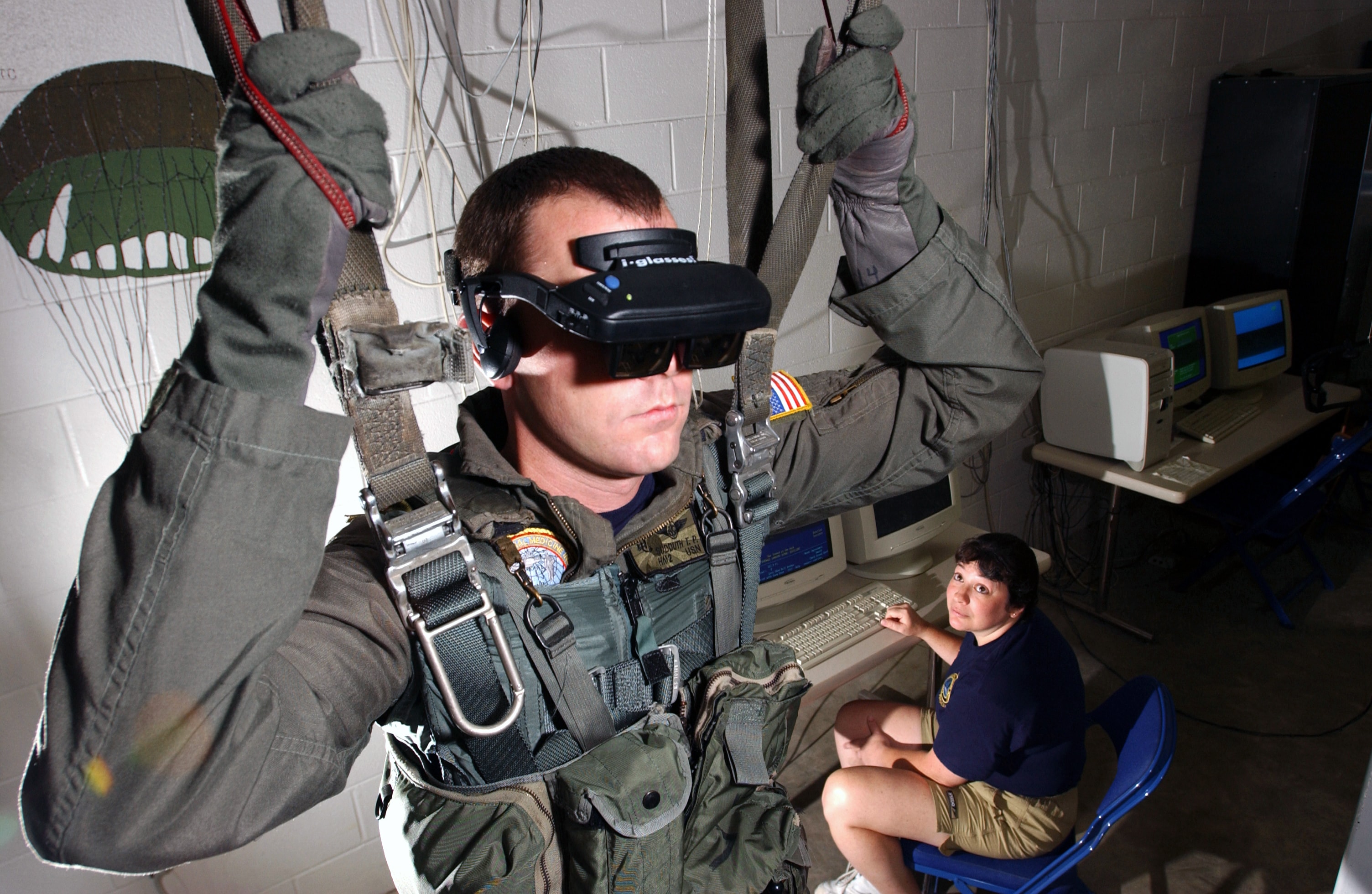
A U.S. Navy virtual reality parachute trainer: the student hangs in a harness indoors while the headset shows him a descent through open sky. Photo: Chris Desmond, U.S. Navy, public domain, via Wikimedia Commons.

The short version:
- Truth and reality are worth wanting for their own sake, and we are right to want them that way.
- If we are right about that, and not just lucky, something made our hearts fit the real worth of truth.
- Survival can only shape us to want what works, and wanting reality when illusion is free and better never worked for anyone.
- Our love of truth is no lucky accident: we rely on it every time we try to find out what is true.
- So something beyond nature made us to love the truth: the God who is Truth.
See this page's graph and discover linked topics
In full
Robert Nozick's experience machine (Anarchy, State, and Utopia, 1974) isolates a value: offered experiences identical to or better than real life, with no difference from the inside, most people refuse, and they treat discovered deception as a loss even when it cost them nothing in experience. The empirical record confirms and qualifies the response: De Brigard (2010) showed that status quo bias drives part of it, Weijers (2014) built less biased versions with mixed results, and Hindriks and Douven (2018) found that only 29 percent chose the classic machine while about half would take a more realistic experience pill. The argument does not rest on a head count. Its first premise is normative: truth and contact with reality are worth wanting for their own sake, and the person who refuses the machine values them correctly, a judgment Nozick, Bernard Williams (Truth and Truthfulness, 2002) and the ancient tradition (Aristotle, Augustine) share, and one the naturalist exhibits whenever he wants his own view to be true rather than merely useful. If that valuation is correct and not by accident, something fitted our desires to the worth of truth. On naturalism the only process that fits human desires to anything is natural selection, with its by-products, and selection is sensitive to a desire only through the behaviour it produces, so it can favour wanting true beliefs where truth pays but has no grip on wanting reality when illusion would be free and better, which naturalists such as Patricia Churchland and Stephen Stich concede when they say selection does not aim at truth as such. A by-product of a drive selected for usefulness that happens to coincide with the real worth of truth coincides by accident. Granting that our love of truth is not merely lucky, it follows validly that naturalism is false and that our desires were fitted to the worth of truth by a source beyond nature, which Christian theism identifies as the God who is Truth and made human beings to know Him. Christian theism also predicts the other half of the human record, the flight from unwelcome truth that Golman, Hagmann and Loewenstein (2017) document, as the corruption of that design under moral threat (John 3:19). The strongest rival is the curiosity by-product account (Loewenstein, 1994), answered below.
The argument
| # | Premise |
|---|---|
| P1 | Truth is worth wanting. Truth and contact with reality are worth wanting for their own sake, and those who want them that way, refusing a free and better illusion, value them correctly. |
| P2 | Fit needs a fitter. If our valuing truth for its own sake is correct and not a lucky accident, something fitted our desires to the real worth of truth. |
| P3 | What nature can fit. If naturalism is true, nothing fitted our desires to the worth of truth: selection shapes desires only through the behaviour they produce, and wanting reality when illusion is free and better changes nothing it can reward. |
| P4 | No lucky accident. Our love of truth is not merely a lucky accident; every serious inquiry, including the inquiry into whether naturalism is true, relies on it being apt. |
| C | Therefore naturalism is false, and our love of reality was fitted to the worth of reality by a source beyond nature, who made us for the truth. |
Why the conclusion follows. By P1 and P4 our love of truth is correct and not by accident. By P2 something fitted it to the worth of truth. By P3, if naturalism were true, nothing could have. So naturalism is false, and the fitting came from beyond nature.
How strong the conclusion is. If the four premises are true, the conclusion must be. P2 is a general principle, and P4 is one the objector uses in the act of objecting. The contest is over P1, which an error theorist about value rejects, and P3, which the by-product account rejects; both are defended below. The conclusion is a source beyond nature that made us for truth. Christian theism names that source the God who is Truth (John 14:6), a reading the premises support and Scripture supplies.
P1, Truth is worth wanting
The evidence
- Nozick's thought experiment. Robert Nozick, Anarchy, State, and Utopia (1974), pp. 42-45, asks: "Would you plug in? What else can matter to us, other than how our lives feel from the inside?" He answers that we want to actually do things, to actually be a certain kind of person, and to be in contact with a deeper reality than one people construct.
- Most refuse the classic machine. Frank Hindriks and Igor Douven ("Nozick's experience machine: An empirical study," Philosophical Psychology 31, 2018) found that only 29 percent chose to plug into the classic machine, while about half would take an "experience pill" in a more realistic variant. The preference for reality is real, widespread and sensitive to framing.
- Grief at discovered deception. People who learn that a friendship was paid for, that praise was flattery or that a life's work was a fraud count it a loss, though the pleasant experience is already in the past. Only its reality has changed.
- A secular philosopher's verdict. Bernard Williams, Truth and Truthfulness (2002), argued that the virtues of truth, Accuracy and Sincerity, cannot be sustained if they are valued only for what they deliver, and that they must be valued for their own sake. Williams wrote as a non-believer.
- The ancient testimony. Aristotle opens the Metaphysics (I.1) with "All men by nature desire to know." Augustine wrote that he had met many who wanted to deceive, but no one who wanted to be deceived, and that the happy life is joy in the truth (Confessions X.23).
- The objector shares it. No one defends naturalism on the ground that believing it is pleasant. He wants it to be true, and he would want to know if it were false.
The best explanation
| What explains the preference for reality | Fits? | Comment |
|---|---|---|
| Truth and reality are worth wanting for their own sake, and we see it | Yes | Explains refusal, grief at deception and the testimony of believers and unbelievers alike |
| Status quo bias (De Brigard) | Partly | Real, and explains part of the machine response; not grief at deception in ordinary life |
| Distrust of the machine | Partly | The scenario stipulates reliability |
Independent confirmation
Philosophy (Nozick, Williams, Aristotle, Augustine), experimental philosophy (Hindriks and Douven) and the ordinary experience of betrayal reach P1. The experimental work also marks its limits, so P1 is stated as a judgment about what is worth wanting, supported by a widespread preference, rather than a claim that everyone always shares it.
Objections and rebuttals
- "De Brigard showed it is only status quo bias." (Felipe De Brigard, "If you like it, does it matter if it's real?" Philosophical Psychology 23, 2010.) Rebuttal. His reversed scenario, in which people are told they are already in a machine, did shift answers, and the argument grants that bias explains part of the response. It does not explain grief at discovered deception, where no status quo favours the truth.
- "Weijers found the intuitions are mixed." (Dan Weijers, "Nozick's experience machine is dead, long live the experience machine!" Philosophical Psychology 27, 2014.) Rebuttal. That tells against P1 only as a universal head count, which P1 never claims. P1 is a judgment about what is worth wanting, and reflection on the surprise-party case shows why the refusers are right.
- "Values are only preferences, so nothing is 'worth wanting' at all." Rebuttal. Then the naturalist's preference for true beliefs over comfortable ones is no better than anyone's preference for comfort, including in the debate about naturalism.
P2, Fit needs a fitter
The evidence
- Non-accidental correctness has a ground. A compass points north reliably because something magnetized it. A stopped clock that happens to show the right time is right by accident. Whenever a faculty or disposition is correct and not by luck, something fitted it to what it gets right.
- The same holds for desires. A child who loves what is good because she was raised to see its worth loves it rightly and not by accident. A desire that happens to match the good, while being shaped by something blind to the good, matches it by luck.
The best explanation
P2 is a general principle of explanation. Its rival, that a disposition can be correct non-accidentally with nothing accounting for the match, gives up the difference between being right and being lucky.
Independent confirmation
Epistemology (the anti-luck condition on knowledge since Gettier), ethics (the difference between right action and accidentally right action) and engineering (calibration) all use P2.
Objections and rebuttals
- "Maybe the match is simply brute." Rebuttal. Then it is luck, and P4 says it is not.
P3, What nature can fit
The evidence
- Selection sees behaviour. Natural selection acts on what an organism does. Two desires that lead to the same behaviour are invisible to it.
- Naturalists say so. Patricia Churchland, "Epistemology in the Age of Neuroscience" (Journal of Philosophy 84, 1987), wrote that the principal chore of nervous systems is to get the body parts where they should be so the organism may survive, and that truth "definitely takes the hindmost." Stephen Stich, The Fragmentation of Reason (1990), argued that selection does not guarantee true belief and may favour systems that err in useful ways.
- Fitness beats truth, in models. Chetan Prakash, Kyle Stephens, Donald Hoffman, Manish Singh and Chris Fields ("Fitness Beats Truth in the Evolution of Perception," Acta Biotheoretica 69, 2021) argue that perceptual strategies tuned to fitness generally outcompete strategies tuned to truth. Their models are contested; P3 needs only the weaker point every party accepts, that selection aims at fitness. See Fitness Beats Truth Argument and Donald Hoffman.
- Reality as such has no cue. Selection can install a liking for a useful thing by attaching the liking to a cue the senses can detect, as with sweetness. The experience machine reproduces every cue perfectly. A desire that responds to the bare fact that the world behind the experience is real responds to something no cue signals and no behaviour differs on.
- Plantinga's version. Alvin Plantinga, Where the Conflict Really Lies (2011), argues that natural selection rewards adaptive behaviour and that on naturalism our faculties have no reason to be aimed at truth as such. See Argument from Reason.
The best explanation
| What a fitness-only history would fit our desires to | Fits the data? |
|---|---|
| Useful beliefs, true or not | Fits information avoidance; fits the machine refusal poorly |
| True beliefs where truth pays | Fits ordinary curiosity; not refusing a free, better illusion |
| Truth and reality for their own sake | Not fitted at all; present only as a by-product, matching truth's worth by accident |
Independent confirmation
Evolutionary biology (selection acts on behaviour), neurophilosophy (Churchland), naturalist epistemology (Stich), evolutionary game theory (Hoffman and colleagues) and analytic philosophy of religion (Plantinga) reach P3 from opposite directions.
Objections and rebuttals
- "Truth-tracking is usually fitter, so evolution favours it." Rebuttal. Then it favours truth where truth is fitter. That fits an instrumental love of truth, and leaves the love of reality when illusion is free and better unfitted.
- "Selection can install intrinsic desires for things that were once useful." Rebuttal. It can, by tying the desire to a detectable cue. Reality as such has no cue the machine does not copy, so a desire for it is either fitted by something other than selection or matches truth's worth by accident.
P4, No lucky accident
The evidence
- Inquiry relies on it. Every serious inquirer wants the answer to be true, and treats that want as apt, as the reason to check, test and correct. Science runs on it.
- The naturalist relies on it. To argue that naturalism is true, and to want others to believe it because it is true, is to treat the love of truth as correct. If that love were a misfiring by-product, the naturalist's own commitment to truth would be a misfire too.
- Williams's point. Williams argued that a culture keeps its truthfulness only by valuing truth intrinsically. If that valuing is merely a lucky leftover, nothing supports keeping it once it costs.
The best explanation
P4 is presupposed by every party to the debate. Denying it means holding that our deepest commitment in inquiry is right only by chance.
Independent confirmation
Philosophy of science (the aims of inquiry), ethics of belief, and Williams's genealogy of truthfulness converge on P4.
Objections and rebuttals
- "We can rely on a lucky disposition without explaining it." Rebuttal. We can rely on it; we cannot also claim it is right and not by luck, which is what every inquirer claims about his love of truth.
Taken together
Each piece alone can be shrugged off. That people refuse the machine is a survey result. That truth is worth wanting is a value judgment. That selection aims at fitness is biology. That inquiry depends on loving truth is a point about method. Together they close a gap. We love reality for its own sake, rightly, and not by luck, in exactly the place where survival had nothing to reward. Something fitted our hearts to the worth of truth, and on naturalism nothing could have. The same picture explains the other half of the human record: people also run from truth, above all where it threatens them, which Scripture describes as men loving "the darkness rather than the light; for their works were evil" (John 3:19, ASV). A love of truth that belongs to our design, and a flight from it under moral threat, is the shape Christian theism predicts. A skeptic who wants to reject the conclusion must say that the person who refuses the machine is no more right than the one who plugs in, or that our love of truth is correct only by accident.
Weighing the evidence
The table weighs the independent facts behind the premises. Each row is a distinct fact.
| Fact | Expected if we were made for truth | Expected on naturalism | Leans |
|---|---|---|---|
| Most refuse the classic experience machine | High | Moderate (bias explains part) | Modestly toward design |
| Grief at discovered deception in ordinary life | High | Moderate (betrayal is socially costly) | Slightly toward design |
| Wanting reality when illusion is free and better | High | Low | Toward design |
| Avoidance of threatening truth (Golman and colleagues) | High (as corruption) | High (as comfort-seeking) | Even |
| Non-theist thinkers judge truth worth valuing for itself (Williams) | High | Moderate | Slightly toward design |
Net. The third row carries the weight. These are qualitative judgments argued above, not measurements.
The strongest objection
The curiosity by-product. A general drive for information is adaptive. George Loewenstein's information-gap theory ("The Psychology of Curiosity: A Review and Reinterpretation," Psychological Bulletin 116, 1994) treats curiosity as a drive aroused by gaps in knowledge. A creature that cannot predict which truths will matter does better if it wants truth in general, and that general want spills over into cases where truth has no payoff, including the experience machine. On this view the love of truth is a by-product of an adaptive drive, and nothing beyond nature is needed.
Reply. The account is a good explanation of curiosity, and the argument accepts it as a description of how a drive for information arose. It fails at three points. First, it predicts the wrong object: a drive to close information gaps is satisfied by the machine, which closes every gap with a perfect falsehood; refusing the machine is wanting reality, a different object. Second, a by-product can be correct only by accident. If the love of truth is a spillover from a drive selected for usefulness, its agreement with the real worth of truth is a coincidence, and P4 says it is not. Third, parity: the same spillover governs the naturalist's own desire that his conclusions be true, so if it is merely an accident, his commitment to truth is too. This is Plantinga's point, discussed at Argument from the Reliability of Reason. A view that wants its own conclusions to be true for their own sake relies on the very fit it cannot explain.
Concessions
- Grant: status quo bias shapes answers to the machine question. Now collect: it does not explain grief at discovered deception or the patient who asks for the true diagnosis.
- Grant: people avoid unwelcome truth constantly. Now collect: Scripture says the same and ties it to moral threat, which is the pattern the economists find.
- Grant: Hoffman's models are disputed. Now collect: the argument needs only the point every party accepts, that selection aims at fitness.
- Grant: curiosity is adaptive. Now collect: curiosity wants information; the machine refusal wants reality.
Cheatsheet
The 30-second version (read aloud). "Imagine a machine that gives you a perfect life, all of it fake, and you'd never know. Would you plug in? Most people say no, and they're right: a fake life is missing something even if it feels perfect. But if our minds were shaped only to survive, why would we love reality when a perfect illusion costs nothing? Survival can't reward that. Yet we're right to love it, and not by luck. Something made our hearts fit the worth of truth. Jesus said, 'I am the truth.' We were made by Truth, for truth."
Fast facts:
- Nozick (1974): "Would you plug in? What else can matter to us, other than how our lives feel from the inside?"
- Hindriks and Douven (2018): 29 percent chose the classic experience machine; about half would take an experience pill.
- De Brigard (2010): status quo bias explains part of the refusal, and the argument grants it.
- Williams (2002), a non-believer: truthfulness must be valued for its own sake.
- Churchland (1987), a naturalist: in the nervous system's business of survival, truth "definitely takes the hindmost."
The closing line. "A mind built only to survive would take the machine. We refuse it, because we were made for what is real."
Cross-examination
Round 1, Would you plug in?
- Q: If the machine were perfectly reliable and the experiences better than your life, would you plug in for good?
- If they say no: Why not, if how life feels is all that matters?
- If they say yes: Would you want to know if a loved one had already plugged you in?
Round 2, Is the refusal right?
- Q: Is the person who refuses the machine making a mistake?
- If they say no: Then truth is worth wanting for its own sake. What fitted us to see that?
- If they say yes: Then your own wish that your beliefs be true is the same mistake.
Round 3, Parity
- Q: Do you want naturalism to be true, or just useful to believe?
- If they say true: Then you share the love of truth that survival alone does not fit.
Dodge table
| Dodge | What it concedes | Reply |
|---|---|---|
| "It's just status quo bias." | Part of the data | Then why grieve a deception you lived inside for years? |
| "Truth usually pays." | Truth is valued where it pays | The machine is the case where it doesn't. You still want it. |
| "People avoid truth too." | Both tendencies are real | Yes, and Scripture predicts both: the love of truth and the flight from it. |
| "Evolution explains everything." | Selection aims at fitness | Then it explains a love of useful beliefs. I'm pointing to a love of true ones. |
Live-cite kit
Scripture (ASV):
- John 14:6: Jesus saith unto him, I am the way, and the truth, and the life: no one cometh unto the Father, but by me. (John 14:6, ASV)
- John 8:32: and ye shall know the truth, and the truth shall make you free. (John 8:32, ASV)
- John 18:37: To this end have I been born, and to this end am I come into the world, that I should bear witness unto the truth. Every one that is of the truth heareth my voice. (John 18:37, ASV)
- Proverbs 23:23: Buy the truth, and sell it not; Yea, wisdom, and instruction, and understanding. (Proverbs 23:23, ASV)
- Psalm 51:6: Behold, thou desirest truth in the inward parts (Psalm 51:6, ASV)
- John 3:19: And this is the judgment, that the light is come into the world, and men loved the darkness rather than the light; for their works were evil. (John 3:19, ASV)
- 2 Thessalonians 2:10: because they received not the love of the truth, that they might be saved. (2 Thessalonians 2:10, ASV)
Scholarly:
- Robert Nozick, Anarchy, State, and Utopia (1974), pp. 42-45.
- Frank Hindriks and Igor Douven, Philosophical Psychology 31 (2018).
- Bernard Williams, Truth and Truthfulness (2002).
- Russell Golman, David Hagmann and George Loewenstein, Journal of Economic Literature 55 (2017): information avoidance.
Aphorism: "We were made to be real, and to love what is real."
Connection to Scripture
- John 14:6, the Truth is a Person, so the love of truth is finally love of Him.
- John 18:37-38, Pilate's question, "What is truth?", asked of the One who came to bear witness to it.
- John 8:32, truth frees; the machine imprisons pleasantly.
- Proverbs 23:23, truth is worth buying and never selling.
- Psalm 51:6, God desires truth in the inward parts.
- John 3:19, Romans 1:18 and 2 Thessalonians 2:10, the flight from truth, tied to moral threat.
Scholarship
Published academic works this page draws on, each matched to a publisher, index or library catalog record.
- Patricia Smith Churchland and Journal of Philosophy Inc, "Epistemology in the Age of Neuroscience," Journal of Philosophy 84 (1987). doi:10.5840/jphil1987841026
- Felipe De Brigard, "If you like it, does it matter if it's real?" Philosophical Psychology 23 (2010). doi:10.1080/09515080903532290
- Frank Hindriks and Igor Douven, "Nozick’s experience machine: An empirical study," Philosophical Psychology 31 (2018). doi:10.1080/09515089.2017.1406600
- George Loewenstein, "The psychology of curiosity: A review and reinterpretation," Psychological Bulletin 116 (1994). doi:10.1037/0033-2909.116.1.75
- Robert Nozick, Anarchy, State, and Utopia (Basic Books, 1974). Open Library
- Alvin Plantinga, Where the Conflict Really Lies (2011). Open Library
- Stephen P. Stich, The fragmentation of reason (MIT Press, 1990). Open Library
- Dan Weijers, "Nozick's experience machine is dead, long live the experience machine!" Philosophical Psychology 27 (2014). doi:10.1080/09515089.2012.757889
See also
- Arguments, the master index
- Ris3n Arguments, the hub of ris3n's original arguments
- Argument from Perception, whether perception can be about a world; this page asks why we rightly want contact with it
- Fitness Beats Truth Argument and Donald Hoffman, the evolutionary results behind P3
- Argument from Reason and Argument from the Reliability of Reason, the parity point
- The Lock and Key Argument, where the same evolutionary point is used for a different fact
- Well-Being Cannot Ground Morality Defeater, where the experience machine answers a theory of morality
- Argument from Desire, a sister argument from a longing no illusion satisfies
- Theories of Truth, what truth is
- Cartesian Skepticism, the worry that we might already be in a machine
- Imago Dei, made in the image of the God who is Truth
- Cumulative Case for Christian Theism
Common questions this page answers
Q: What is Nozick's experience machine?
It is a thought experiment from Robert Nozick's Anarchy, State, and Utopia (1974). A machine could give you any experiences you wanted, all simulated, while you float in a tank, and you would not know. Nozick asked whether you would plug in for life, and argued that most people would not, because we care about more than how life feels.
Q: Would most people plug into the experience machine?
In one study by Frank Hindriks and Igor Douven, only 29 percent chose the classic machine, though about half would take a more realistic "experience pill," and status quo bias explains part of the response. The preference for reality is widespread but not universal.
Q: What does the experience machine have to do with God?
Survival can only shape us to want what works, and wanting reality when a perfect illusion is free never worked for anyone. Yet we are right to love reality for its own sake, and not by luck. The argument says something beyond nature fitted our hearts to the worth of truth: the God who is Truth.
Q: Would you rather know the truth or be happy?
Most people, on reflection, choose the truth, even when it hurts, and count a discovered deception as a real loss. The Experience Machine Argument takes that choice as correct and asks what made human beings the kind of creatures who rightly make it.
Q: If humans love truth, why do so many avoid it?
Economists and psychologists document widespread information avoidance, such as skipping medical tests. Scripture predicts both sides: we are made to love the truth, and we also love darkness rather than light when the truth threatens us (John 3:19).
Q: Is this the same as the evolutionary argument against naturalism?
It uses the same insight, that natural selection aims at survival and not at truth as such. Its evidence is different: it asks why we rightly want our beliefs to be true and our lives to be real.