Argument
The Error Argument
Error Argument, argument from the possibility of error, Royce's argument from error, what does it mean to be wrong, can we be wrong without God, argument from scientific self-correction, truth needs a knower, does truth need a mind, is there objective truth without GodIntro
You drive to a friend's birthday party, completely sure it is at 14 Elm Street. You knock, and a stranger answers. The party was at 14 Oak Street. You were wrong.
Think about what it took to be wrong. Your belief was about your friend's party, and it missed. For that to happen there had to be a fact about where the party was, a fact you did not have, sitting there the whole time you were driving. Being wrong is like an arrow missing a target. You cannot miss a target that is not there.
Now scale that up. For about two hundred years, the best scientists in the world used Isaac Newton's law of gravity, and it worked beautifully. But the planet Mercury drifted very slightly off the path Newton's law predicted, by a tiny angle each century. In 1915 Albert Einstein's new theory explained the drift exactly, and in 1919 astronomers photographed a total eclipse of the sun and found that starlight bent around it by the amount Einstein predicted, about twice what Newton's law gave. Newton's law was wrong in a precise, measurable way, and the measure was a truth about gravity that nobody alive had yet grasped. Every correction in the history of science works like that: one theory is measured against something bigger than all our theories.
So there is a complete truth, about every party, every planet and everything else, against which every mistake is measured. It is all connected: each truth fits with every other. And it is far bigger than any human mind. The American philosopher Josiah Royce noticed that a complete, connected whole of truths that measures every mind looks exactly like what a mind holds when it knows everything. The Bible says the same about God: "God is greater than our heart, and knoweth all things" (1 John 3:20, ASV).
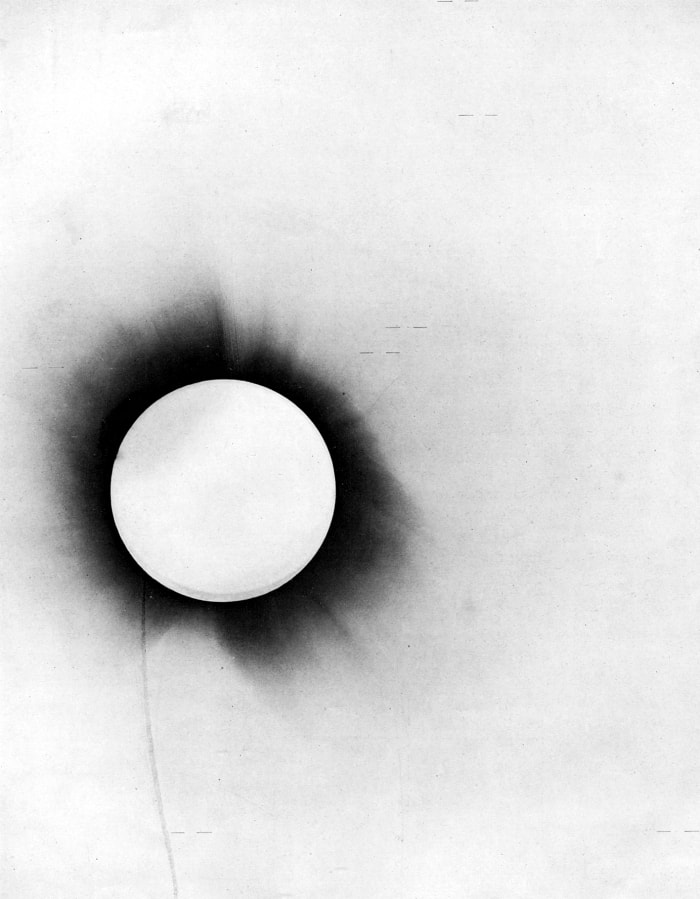
The total solar eclipse of 29 May 1919, photographed by the expedition of Frank Dyson, Arthur Eddington and Charles Davidson to test whether starlight bends around the sun. Image: public domain, via Wikimedia Commons.

The short version:
- People, and whole sciences, are sometimes wrong, and we can find out.
- To be wrong, a belief has to miss a real truth about its subject.
- Every belief is measured against the complete truth, which no human mind holds.
- The complete truth is made of meanings that point at things, and meanings like that live in minds.
- The complete truth is one connected whole, so it is held as a whole by one mind.
- So there is a Mind that knows all truth, the measure of every human mistake.
See this page's graph and discover linked topics
In full
Developed from Josiah Royce's argument in The Religious Aspect of Philosophy (1885), chapter 11, "The Possibility of Error," and landing in Christian theism where Royce landed in absolute idealism, the Error Argument starts from the reality and structure of error. Some judgments are false and some of their falsity is discovered; a judgment is false only if it is about its object and fails to fit how that object is; and the standard of fit is supplied neither by the judgment nor by any finite fact about the judge, as Kripke's rule-following argument shows from the other end of the history of philosophy. Inquiry, from the brain's error-related negativity to the replication crisis and the correction of Newtonian gravitation by general relativity, is organized around a determinate standard that no present state of inquiry holds, and even Laudan's pessimistic meta-induction presupposes a truth past theories missed. That standard is the complete truth. Its constituents are propositions, which are representational and so, by the premise defended at length in The Babel Argument, are thoughts of a mind or depend on one; and it is a single, consistent, inferentially connected whole, so that whether any judgment is correct depends on its relations to the rest, which is Royce's point that judgment and object must fall within one inclusive thought that compares them. If those premises are true, it follows validly that there is a Mind whose thought includes the complete truth: an omniscient Knower. Plantinga's "How to Be an Anti-Realist" (1982) reaches the same result from the anti-realist side, identifying truth with what God believes. The Christian reading keeps Royce's insight and rejects his monism: God knows all truth, and finite minds are creatures distinct from Him, which is why their errors are really theirs. The rivals each give up something. Pragmatism (Peirce, James) relocates the standard to the end of inquiry or loses the difference between being wrong and being outvoted; deflationism explains the word "true" and leaves the standard untouched; and brute-fact realism keeps the standard but must say that a complete, unified system of representational contents exists with no mind to which it belongs, which is the premise the argument contests most directly.
The argument
| # | Premise |
|---|---|
| P1 | Error is real. Some judgments are false, and some of their falsity is discovered. |
| P2 | Error needs a standard. A judgment is in error only if it is about some subject and fails to fit a determinate truth about that subject. |
| P3 | The standard is the complete truth. Every judgment is measured against the complete truth about its subject, which is determinate now and outruns every finite mind and every stage of inquiry. |
| P4 | Truth is made of thoughts. The truths that make up that standard are propositions, which are about things, and whatever is about something is a thought in a mind or depends on a mind for being about it. |
| P5 | Truth is one. The complete truth is a single connected whole, in which each truth's standing depends on its relations to the rest, so the mind on which it depends holds it as one whole. |
| C | Therefore there is a Mind that knows the complete truth, the standard against which every human error is measured. |
Why the conclusion follows. By P1 and P2 there is a determinate truth that erring judgments fail to fit. By P3 that standard is the complete truth, beyond every finite mind. By P4 its truths are thoughts of a mind, or depend on one. By P5 the mind on which the complete truth depends holds it as one whole. So there is a Mind that knows all of it, and since by P3 no finite mind does, that Mind is not finite.
How strong the conclusion is. If the five premises are true, the conclusion must be. P1 and P2 are almost universally granted, and P3 is presupposed even by anti-realist philosophers of science. The argument stands or falls on P4 and P5: P4 is denied by the metaphysical realist who holds that truth needs no knower, and P5 by anyone who thinks the whole truth could be scattered across many minds. Both are defended below, and P4 is defended at greater length on The Babel Argument. The Knower reached is omniscient; Scripture names Him the God who "knoweth all things."
P1, Error is real
The evidence
- Ordinary life. People are corrected by calendars, street signs, scales and other people every day. The concept of a mistake is among the first that children learn.
- Even the sceptic presupposes it. "You might be wrong" is meaningful only if being wrong is possible. A thoroughgoing denial of error ("every belief is true for the one who holds it") is itself a belief its critics think false, and so refutes itself. See Self-refutation.
- Science's record. Ptolemaic astronomy, phlogiston chemistry, the luminiferous ether and Newtonian gravitation as an exact theory were each held by the best minds of their age and each corrected.
- Error found by method. The Open Science Collaboration ("Estimating the Reproducibility of Psychological Science," Science 349, 2015) repeated 100 published psychology studies and obtained statistically significant results in only about a third of them. Science treated this as the discovery of error, which presupposes a fact the original studies got wrong.
The best explanation
| What explains mistakes and their discovery | Fits? | Comment |
|---|---|---|
| A determinate truth that judgments can fail to fit | Yes | Explains mistakes and their correction in every domain |
| Relativism: truth is relative to the believer | No | Self-refuting; cannot explain discovering one's own mistake |
Independent confirmation
Common sense, logic (the self-refutation of relativism), the history of science and the methods of modern research all reach P1. No serious rival denies it outright.
Objections and rebuttals
- "Error is just disagreement." Rebuttal. Then Ignaz Semmelweis, who urged doctors in the 1840s to wash their hands and was dismissed by his colleagues, was in error until the others agreed. Almost everyone now says he was right all along.
P2, Error needs a standard
The evidence
- Royce's argument. Josiah Royce, The Religious Aspect of Philosophy (1885), chapter 11, argued that a judgment can be in error only if it means the very object it gets wrong; yet a judgment taken alone cannot both include its object and fail to fit it. So judgment and object must both fall within a wider thought that compares them.
- Truth above the mind. Augustine, On Free Choice of the Will, book II, argued that the truths of number and wisdom are common to every mind, unchangeable and above our minds, since we judge by them rather than judging them.
- No finite facts fix correctness. Saul Kripke, Wittgenstein on Rules and Private Language (Harvard, 1982), argued that no fact about a person's past behaviour or dispositions settles whether he meant addition or some deviant function that agrees with addition on every case he has computed. Whatever the answer to Kripke's puzzle, the standard of correct application is not supplied by the finite facts about the judge.
- The brain's own error signal. William Gehring and colleagues ("A Neural System for Error Detection and Compensation," Psychological Science 4, 1993) and Michael Falkenstein and colleagues (Electroencephalography and Clinical Neurophysiology 78, 1991) identified the error-related negativity, a brain response within a fraction of a second of a mistaken action, larger when accuracy matters. At the level of the neuron as at the level of the theory, error is registered against a standard.
The best explanation
| What explains how a judgment can be about something and miss it | Fits? | Comment |
|---|---|---|
| A determinate truth beyond the judgment, against which it is measured | Yes | Explains aboutness and failure together |
| Error as mismatch with an internal goal only | Partly | Explains the neural signal; not error about matters no one has a goal for |
Independent confirmation
Classical idealism (Royce), patristic philosophy (Augustine), analytic philosophy of language (Kripke) and cognitive neuroscience (Gehring, Falkenstein) reach P2 by different routes. See Intentionality.
Objections and rebuttals
- "Aboutness is just a causal relation." Rebuttal. Causal theories of content struggle with error itself: if a belief is about whatever causes it, then a mistaken belief is about its actual cause and is not mistaken. This is the familiar disjunction problem.
- "Jerry Fodor's asymmetric-dependence theory (A Theory of Content, 1990) solves that problem." Rebuttal. It locates correctness in facts about which laws would hold under counterfactual conditions. Those facts are a determinate standard beyond every actual judgment, so the theory restates P2 and leaves the question of what grounds the standard where P4 takes it up.
P3, The standard is the complete truth
The evidence
- The history of correction. Copernicus and Kepler corrected Ptolemy; Lavoisier's oxygen chemistry replaced phlogiston in the 1770s and 1780s; the Michelson-Morley experiment (1887) and special relativity (1905) removed the ether; general relativity (1915) explained the anomaly in Mercury's orbit, about 43 seconds of arc per century, that Newton's theory could not.
- Successors predict what predecessors could not. General relativity predicted that starlight passing the sun would bend by twice the amount a Newtonian calculation gives, and the eclipse expeditions of 1919 organized by Frank Dyson and Arthur Eddington reported the larger value.
- The pessimistic meta-induction. Larry Laudan, "A Confutation of Convergent Realism" (Philosophy of Science 48, 1981), argued from the record of successful but false past theories that our current theories are probably false too. Whatever one makes of the conclusion, the argument presupposes exactly what P3 claims: a determinate truth that successive theories fall short of.
- Everything is connected. Whether "the party is at 14 Elm" is true depends on facts about streets, numbering, time and your friend's plans, and each of those depends on more. The standard any single judgment answers to reaches, step by step, into the whole truth.
The best explanation
| What explains correction toward a standard no theory holds | Fits? | Comment |
|---|---|---|
| A fixed, complete truth that inquiry approaches | Yes | Explains correction, progress and the meta-induction alike |
| Pragmatism: truth is what inquiry would agree on in the long run (Peirce) | Partly | Requires a determinate limit now, which is the standard by another name |
| Kuhnian incommensurability: paradigms are only different | Weakly | Cannot explain why later theories predict what earlier ones could not |
Independent confirmation
History of science, philosophy of science from both realist and anti-realist sides (Laudan is an anti-realist), and the psychology of metacognition reach P3. The anti-realist's best argument uses it.
Objections and rebuttals
- "Truth is what all investigators would finally agree on." Rebuttal. Charles Sanders Peirce wrote that "the opinion which is fated to be ultimately agreed to by all who investigate, is what we mean by the truth" ("How to Make Our Ideas Clear," 1878). That fated opinion must already be determinate now, or present inquiry could not be wrong relative to it. Peirce relocated the complete truth to the end of inquiry, and it is still there.
- "The true is only the expedient." Rebuttal. William James wrote that "the true" is "only the expedient in the way of our thinking" (Pragmatism, 1907). Then a useful falsehood is true and an inconvenient truth is false, and the difference between being wrong and being outvoted disappears. Peirce himself rejected that consequence.
- "Thomas Kuhn showed there is no neutral standard between paradigms." Rebuttal. Later theories recover the successes of earlier ones as special cases, as Newtonian mechanics reappears in relativity at low speeds, and predict new phenomena, as with the bending of starlight. Progress measured that way is progress toward a standard both theories answer to.
P4, Truth is made of thoughts
The evidence
- Truths are propositions. What is true or false is the content a sentence expresses, the same content in every language that can state it. See The Babel Argument.
- Propositions are about things. The proposition that the party is on Oak Street points at a party and a street. Aboutness is the mark of the mental, and every case of aboutness whose source we understand is a thought or a sign that a mind made mean something. See Intentionality.
- Plantinga's anti-realism. Alvin Plantinga, "How to Be an Anti-Realist" (Proceedings and Addresses of the American Philosophical Association 56, 1982), argued that the anti-realist insight, that truth is tied to what an ideal knower would believe, is best honoured by theism: truth is what God believes. That keeps the link between truth and knowing without making truth depend on human minds. See Alvin Plantinga.
The best explanation
| What the bearers of truth are | Fits? | Comment |
|---|---|---|
| Thoughts of a Mind | Yes | Explains their aboutness, their truth and our ability to grasp them |
| Mind-independent abstract objects | Weakly | Representation with no representer |
| Sentences of human languages | No | Too few, and none before humans |
Independent confirmation
Philosophy of mind (intentionality), philosophy of language (propositions as shared contents) and philosophical theology (Augustine, Plantinga, and Lorraine Keller's argument from intentionality) converge on P4.
Objections and rebuttals
- "Truth needs no knower. Snow is white whether or not anyone knows it." Rebuttal. Agreed for human knowers, which is why the argument does not make truth depend on us. The question is what the bearers of truth are, and contents that point at snow are the kind of thing that exists in a mind. See The strongest objection.
- "'True' is just a device for agreeing; it names no property." Rebuttal. Paul Horwich (Truth, 1990) may be right about the word. The argument concerns what "snow is white" is answerable to and what the whole system of such truths is made of. Deflationism is neutral on that.
P5, Truth is one
The evidence
- Truths form a system. True propositions are consistent with one another, entail one another and fit together: a new truth about the chemistry of the stars has to fit what is true about their light, their age and the physics of atoms.
- Royce's inclusive thought. Royce's central point was that judging an error means holding the judgment and its object together and comparing them, so the standard of all judgment is a single thought that includes every object and every judgment about it.
- Truth is fitted to be known. Einstein called the comprehensibility of the world its eternal mystery ("Physics and Reality," 1936). A whole of truth that finite minds can progressively grasp and correct themselves against has the shape of one mind's knowledge, partly shared with other minds.
The best explanation
| What explains the unity of truth | Fits? | Comment |
|---|---|---|
| One Mind's knowledge of all things | Yes | Explains consistency, interconnection and intelligibility together |
| Many separate minds, each holding a part | Weakly | Leaves the logical relations between their parts, which every truth depends on, held by no one |
| Royce's Absolute, of which finite minds are parts | Partly | Explains unity; makes every error the Absolute's own |
Independent confirmation
Logic (consistency and entailment), the practice of science (every new finding must fit the rest) and the idealist and theistic traditions (Royce, Augustine, Plantinga) agree that truth is a single connected whole.
Objections and rebuttals
- "If God knows all truth, how can we know anything?" Rebuttal. The way a student knows a theorem the teacher knows better: partially, really and correctably. Royce's monism, which made finite minds parts of the Absolute, had this problem; Christian theism, which makes them creatures distinct from God, does not. See Idealism and Pantheism.
- "There is no set of all truths (Patrick Grim, The Incomplete Universe, 1991), so there can be no complete Knower." Rebuttal. Grim's Cantorian argument shows at most that the truths do not form a set. Knowing them all requires no such set; logic itself speaks of all propositions without collecting them into one. Plantinga pressed this in his published exchange with Grim (Philosophical Studies 71, 1993).
Taken together
Each piece alone can be shrugged off. That people make mistakes is ordinary. That a mistake misses a real truth is common sense. That science corrects itself toward a truth it has not reached is history. That truths are thought-like contents is a thesis in philosophy of language. That truth is a connected whole is logic. Together they close in on one point: every human judgment, from your street address to the theory of gravity, is measured against one complete, connected truth that no human holds, made of the kind of thing that exists only in a mind. A skeptic who wants to reject the conclusion has to say that the complete truth is a system of meanings with no mind to which it belongs, or give up the difference between being wrong and being outvoted.
Weighing the evidence
The table weighs the independent facts behind the premises. Each row is a distinct fact.
| Fact | Expected if an omniscient Mind holds the truth | Expected if no such Mind exists | Leans |
|---|---|---|---|
| Error is real and discoverable | High | High | Even |
| Cognition registers error against a standard (the ERN) | High | High | Even |
| Inquiry corrects toward a standard no state of inquiry holds | High | Moderate | Slightly toward the Mind |
| The bearers of truth are about things | High | Low (non-mental representation is unexplained) | Toward the Mind |
| The whole truth is consistent, connected and intelligible | High | Low to moderate | Toward the Mind |
Net. The first rows establish the data, and a realist naturalist accepts them too. The weight sits on the last two. These are qualitative judgments argued above, not measurements.
The strongest objection
Truth without a knower. The metaphysical realist says the argument confuses truth with knowledge. Reality is a certain way; a judgment is true when it matches that way and false when it does not; and the complete truth is simply the complete way reality is, which needs no one to know it. On this view P3 is right and P4 and P5 are wrong: the standard of error is reality itself, and reality is not a mind.
Reply. The realist is right that the standard is not any human mind, and the argument agrees. The question is what the standard is made of. A judgment is true or false by matching a proposition, the content "the party is on Oak Street," and that content points at a party and a street, which is the mark of thought. Reality's being a certain way is the state of affairs; the truth about it is a content that represents it, and the realist's "complete truth" is a complete system of such contents. A complete, consistent, connected system of representations that exists with no mind to which it belongs is the very thing in question. The realist can hold it as a brute fact; the theist explains it as the knowledge of God, which also explains why finite minds can grasp part of it and be corrected by the rest.
Concessions
- Grant: Royce was an absolute idealist, and Christians should not follow him there. Now collect: his insight, that error needs one complete standard, survives without his monism.
- Grant: the error signal in the brain is about tasks. Now collect: it shows error is measured against a standard at every level, which is P2.
- Grant: Laudan may be right that current theories are false. Now collect: then there is a truth they are false about, which is P3.
Cheatsheet
The 30-second version (read aloud). "To be wrong, you have to aim at the truth and miss. You can't miss a target that isn't there. Science has been wrong again and again, and every correction measures a theory against a truth none of our theories fully holds. So there is a complete truth, connected in every part, that every mind falls short of. And truth is made of meanings, things that point at other things, which is what thoughts do. A complete, connected whole of thoughts is what a mind holds when it knows everything. The Bible says God knows all things, and Jesus said, 'I am the truth.'"
Fast facts:
- Royce (1885), "The Possibility of Error": error implies a thought that compares judgment and object.
- Gehring and colleagues (Psychological Science, 1993): the brain produces an error signal within a fraction of a second of a mistake.
- 1919: the eclipse expeditions found starlight bending about twice the Newtonian amount, as Einstein predicted.
- Peirce (1878): truth is "the opinion which is fated to be ultimately agreed to by all who investigate."
- Plantinga (1982): the way to be an anti-realist is to be a theist: truth is what God believes.
The closing line. "Every mistake is a small confession that there is a truth bigger than the one who made it."
Cross-examination
Round 1, Can you be wrong?
- Q: Have you ever been wrong about something you were sure of?
- If they say yes: Then there was a truth your belief failed to fit. Where was that truth while you were wrong?
Round 2, Science
- Q: Was Newton wrong about gravity, or just different?
- If they say wrong: Then there is a fixed truth that theories approach and miss.
- If they say different: Then why did Einstein's theory predict the 1919 eclipse and Newton's could not?
Round 3, The standard
- Q: Is the complete truth one consistent, connected whole?
- If they say yes: Then what kind of thing is a connected whole of meanings, if it belongs to no mind?
- If they say it is just brute fact: Then why is it the kind of thing minds can understand and be corrected by?
Dodge table
| Dodge | What it concedes | Reply |
|---|---|---|
| "Truth is what works." | We distinguish working from failing | Then a useful lie is true. Do you believe that? |
| "Truth is consensus." | Consensus can be measured | Then Semmelweis was wrong until everyone agreed. |
| "'True' is just a word." | We use it correctly | The word, yes. I'm asking what our beliefs are answerable to. |
| "Science never reaches truth." | Science corrects itself | Correction toward what? |
Live-cite kit
Scripture (ASV):
- Psalm 139:1-2, 6: O Jehovah, thou hast searched me, and known me. Thou knowest my downsitting and mine uprising; Thou understandest my thought afar off ... Such knowledge is too wonderful for me; It is high, I cannot attain unto it. (Psalm 139:1-2, 6, ASV)
- Psalm 147:5: Great is our Lord, and mighty in power; His understanding is infinite. (Psalm 147:5, ASV)
- 1 John 3:20: because if our heart condemn us, God is greater than our heart, and knoweth all things. (1 John 3:20, ASV)
- John 14:6: Jesus saith unto him, I am the way, and the truth, and the life: no one cometh unto the Father, but by me. (John 14:6, ASV)
- 1 Corinthians 13:12: For now we see in a mirror, darkly; but then face to face: now I know in part; but then shall I know fully even as also I was fully known. (1 Corinthians 13:12, ASV)
- Romans 3:4: yea, let God be found true, but every man a liar (Romans 3:4, ASV)
Scholarly:
- Josiah Royce, The Religious Aspect of Philosophy (1885), chapter 11: the possibility of error implies a complete thought.
- Augustine, On Free Choice of the Will, book II: truth is above our minds and common to all.
- Alvin Plantinga, "How to Be an Anti-Realist" (1982): truth is what God believes.
- William Gehring and colleagues, Psychological Science 4 (1993): the error-related negativity.
Aphorism: "You cannot miss a target that is not there."
Connection to Scripture
- Psalm 139:1-6, God's knowledge is complete where ours is "too wonderful," the standard against which we are known.
- Psalm 147:5, an understanding without limit.
- 1 John 3:20, "God is greater than our heart": even our self-judgment can err, and God's does not.
- John 14:6 and John 18:37-38, Christ claims to be the truth, and Pilate asks what truth is.
- 1 Corinthians 13:12, partial knowledge now, full knowledge later: inquiry approaching a truth already known.
- Isaiah 55:8-9, God's thoughts higher than ours.
Scholarship
Published academic works this page draws on, each matched to a publisher, index or library catalog record.
- Open Science Collaboration, "Estimating the reproducibility of psychological science," Science 349 (2015). doi:10.1126/science.aac4716 PubMed 26315443 open access
- Albert Einstein, "Physics and reality," Journal of the Franklin Institute 221 (1936). doi:10.1016/s0016-0032(36)91047-5
- Jerry A. Fodor, A theory of content and other essays (MIT Press, 1990). Open Library
- William J. Gehring et al., "A Neural System for Error Detection and Compensation," Psychological Science 4 (1993). doi:10.1111/j.1467-9280.1993.tb00586.x
- Patrick Grim, The incomplete universe (MIT Press, 1991). Open Library
- William James, Pragmatism: A new name for some old ways of thinking (Longmans, Green and Co, 1907). doi:10.1037/10851-000
- Saul A. Kripke, Wittgenstein on Rules and Private Language (Harvard University Press, 1982). Open Library
- Thomas Kuhn, The Structure of Scientific Revolutions (1962). Open Library
- Larry Laudan, "A Confutation of Convergent Realism," Philosophy of Science 48 (1981). doi:10.1086/288975
- Alvin Plantinga, "How to be an Anti-Realist," Proceedings and Addresses of the American Philosophical Association 56 (1982). doi:10.2307/3131293
- Alvin Plantinga and Patrick Grim, "Truth, omniscience, and Cantorian arguments: An exchange," Philosophical Studies 71 (1993). doi:10.1007/bf00989730
- Josiah Royce, The religious aspect of philosophy: A critique of the bases of conduct and of faith (Houghton, Mifflin and Company, 1885). doi:10.1037/12799-000
See also
- Ris3n Arguments, the hub of ris3n's original arguments
- Arguments, the master index
- The Babel Argument, propositions as thoughts, the case behind P4
- Theories of Truth, correspondence, coherence and pragmatism compared
- Coherentism, the coherence rival
- Idealism, Royce's tradition, and why this argument does not follow it into monism
- William James, Royce's great opponent on truth
- Argument from Perception, perception's capacity for error
- Anyone Who Affirms Universals Must Affirm God, abstract objects and the divine mind
- Argument from Intelligibility, a world built to be understood
- Alvin Plantinga, the anti-realist argument for theism
- Self-refutation, why denying error refutes itself
- Cumulative Case for Christian Theism
Common questions this page answers
Q: What is Josiah Royce's argument from error?
In The Religious Aspect of Philosophy (1885), Royce argued that to be wrong, a judgment must be about its object and fail to fit it, and that this is possible only if judgment and object both fall within a wider, complete thought that compares them. He concluded there is an all-knowing Absolute. The Error Argument keeps his insight but lands in Christian theism, where God knows all truth and finite minds are distinct creatures.
Q: Does being wrong prove there is objective truth?
It shows that error is measured against a standard beyond the mistaken belief. Even the claim "you might be wrong" assumes there is a truth you might miss. Denying all objective truth refutes itself, since the denial is offered as true.
Q: Does truth need a mind?
The Error Argument says the complete truth does. Truths are meanings that point at things, which is what thoughts do, and the whole truth is one connected system, so it is best understood as the knowledge of one Mind. Alvin Plantinga reached a similar conclusion: truth is what God believes.
Q: What does the history of science say about truth?
Science has repeatedly corrected itself: Copernicus over Ptolemy, oxygen over phlogiston, relativity over Newton's exact theory of gravity. Even philosophers who think current theories are probably false, like Larry Laudan, assume there is a truth those theories fall short of.
Q: Does the brain detect its own mistakes?
Yes. Researchers in the early 1990s identified the error-related negativity, a brain signal that appears within a fraction of a second after a mistaken action. It shows that cognition measures itself against a standard, though by itself it says nothing about God.
Q: Isn't truth just what works, as pragmatists say?
William James said the true is "only the expedient in the way of our thinking," but that makes a useful falsehood true. Charles Peirce defined truth as what all investigators would finally agree on, but that final opinion must already be fixed now for present beliefs to be wrong relative to it, which is the standard the argument describes.