Person
The Egyptian (Acts 21)
The Egyptian, The Egyptian false prophet, The Egyptian prophet, The Egyptian of Acts 21Intro
"The Egyptian" was a self-proclaimed prophet who, in the 50s AD, gathered a large following in the wilderness and led them to the Mount of Olives, promising that at his command the walls of Jerusalem would fall. The Roman governor Felix attacked with cavalry and infantry; many followers were killed or captured, but the Egyptian himself escaped and was never found.
He appears in Acts when Paul is arrested in the temple. The Roman commander, hearing Paul speak Greek, asks in surprise: "Art thou not then the Egyptian, who before these days stirred up to sedition and led out into the wilderness the four thousand men of the Assassins?" (Acts 21:38, ASV). The Jewish historian Josephus describes the same man twice.
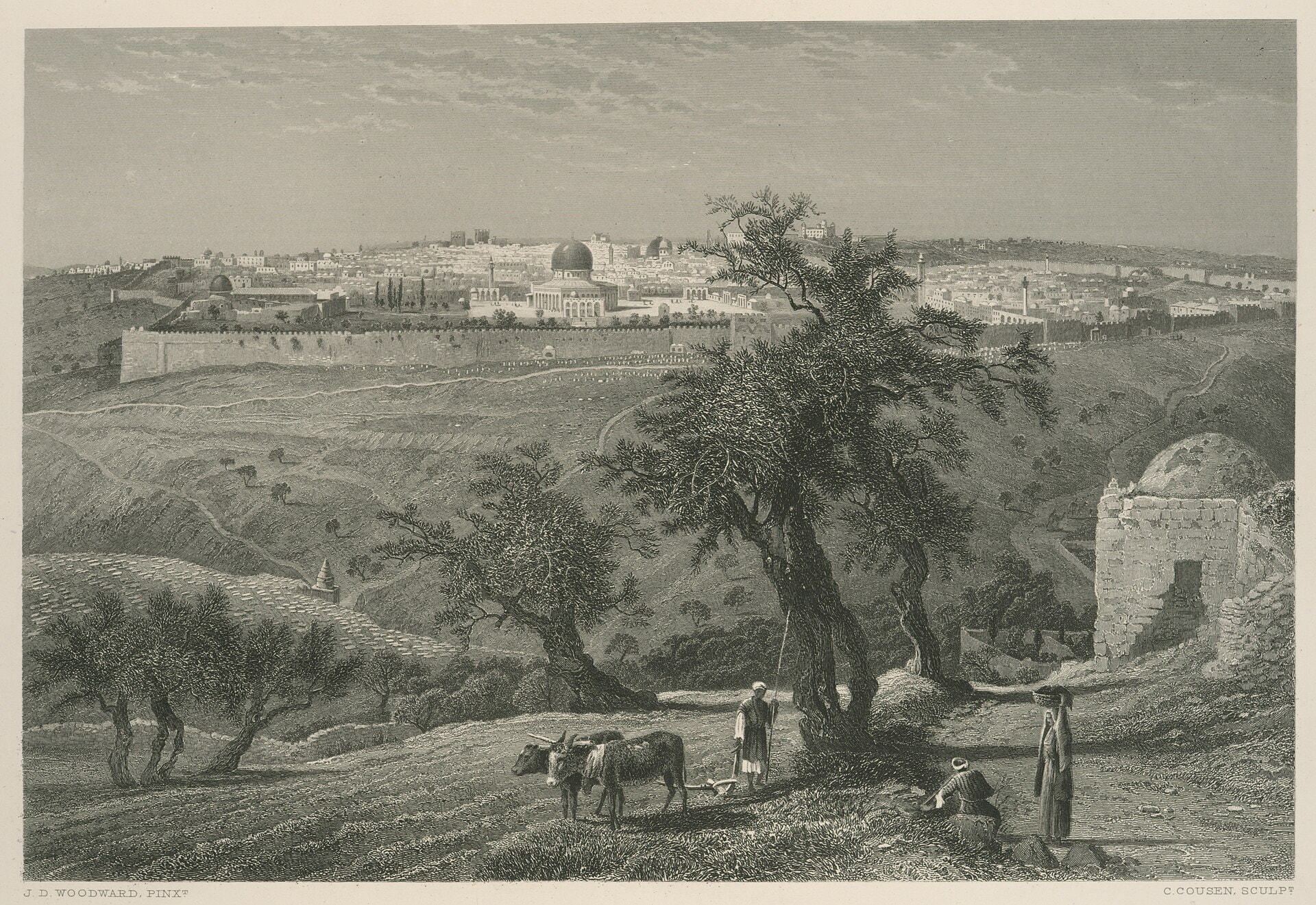
Jerusalem from the Mount of Olives, engraving by C. Cousen after J. D. Woodward, from Picturesque Palestine (1881), ed. Charles Wilson. The Egyptian promised his followers that from this hill they would watch the city walls fall. Public domain, via Wikimedia Commons, New York Public Library scan, resized.

The 30-second version:
The Egyptian was a would-be prophet who led a crowd from the wilderness to the Mount of Olives in the 50s AD, promising Jerusalem's walls would collapse at his word. Felix's troops routed them and he vanished. When Paul was arrested a few years later, the Roman commander first took him for this fugitive. Josephus independently tells the story, naming him only "the Egyptian," exactly as Acts does.
See this page's graph and discover linked topics
In full
The man's name is unknown; both Acts and Josephus call him only "the Egyptian," which may describe his origin or that of his family, or perhaps a Jew from Egypt. During the procuratorship of Antonius Felix (c. AD 52-59), probably in the mid-50s, he claimed to be a prophet, gathered followers in the wilderness and marched them to the Mount of Olives, opposite the temple, promising a sign: the walls of Jerusalem would fall so that they could enter and overthrow the Roman garrison. Felix attacked. Josephus' Antiquities gives 400 killed and 200 captured (20.169-172); his Jewish War inflates the following to 30,000 (2.261-263). The Egyptian escaped. When the tribune Claudius Lysias arrested Paul around AD 57, he suspected him of being the Egyptian returned (Acts 21:37-38). Acts' figure of 4,000 and its link to the Sicarii, or "Assassins," fit what Josephus says about the violent groups active under Felix.
In the Bible
- Acts 21:37-39. As Paul is carried into the Antonia fortress, he asks the commander, "May I say something unto thee?" The commander answers, "Dost thou know Greek? Art thou not then the Egyptian...?" (ASV). Paul replies that he is "a Jew, of Tarsus in Cilicia, a citizen of no mean city" (21:39, ASV).
- The Assassins. The ASV's "the four thousand men of the Assassins" translates the Greek sikarioi, from Latin sicarius, "dagger-man." Josephus describes the Sicarii who, under Felix, murdered opponents in the crowds at festivals with short daggers hidden in their clothes (War 2.254-257).
- Jesus' warning. "If therefore they shall say unto you, Behold, he is in the wilderness; go not forth" (Matthew 24:26, ASV). The Egyptian's wilderness gathering is one of the clearest historical examples of the kind of figure the warning describes. See Olivet Discourse and AD 70.
Family and lineage
Nothing is known of his family, name or origin beyond the label "the Egyptian."
Historical and archaeological evidence
Josephus, Jewish War 2.261-263
But there was an Egyptian false prophet that did the Jews more mischief than the former; for he was a cheat, and pretended to be a prophet also, and got together thirty thousand men that were deluded by him: these he led round about from the wilderness to the mount which was called the Mount of Olives, and was ready to break into Jerusalem by force from that place. (Josephus, War 2.261-262, Whiston)
Felix met him with Roman soldiers, "while all the people assisted him in his attack upon them, insomuch that when it came to a battle, the Egyptian ran away, with a few others" (War 2.263, Whiston).
Josephus, Antiquities 20.169-172
"There came out of Egypt, about this time, to Jerusalem, one that said he was a prophet; and advised the multitude of the common people to go along with him to the mount of olives." He said "that he would shew them from hence how, at his command, the walls of Jerusalem would fall down." Felix "slew four hundred of them, and took two hundred alive. But the Egyptian himself escaped out of the fight; but did not appear any more" (Ant. 20.169-172, Whiston).
What it confirms. The unnamed "Egyptian," the wilderness, the Mount of Olives, the time under Felix, the rout and his escape, and so the plausibility of a Roman officer in Jerusalem suspecting a troublemaker of being him a few years later.
No artifact. None is expected for a fugitive agitator.
Grade. Very strong. Mykytiuk counts "the unnamed Egyptian" among the 30 confirmed New Testament persons on the testimony of Josephus (see Biblical Figures Confirmed by Archaeology).
Scholarly consensus
- Identity. Scholars agree that Acts and Josephus describe the same man.
- The numbers. Acts' 4,000 is generally judged more realistic than War's 30,000; Josephus' own Antiquities figures (400 killed, 200 captured) suggest a following in the low thousands. Commentators often note that Luke's figure, placed in the mouth of the Roman officer, is the more sober one.
- Wilderness and Mount of Olives. The order differs slightly: Josephus has the Egyptian bring people from the wilderness to the Mount of Olives; Acts says he "led out into the wilderness." Many scholars think the movement began with a gathering in the wilderness, as Josephus also says of other prophets under Felix (War 2.259; Ant. 20.167-168).
- "Dost thou know Greek?" Interpreters disagree whether the commander assumed the Egyptian could not speak Greek, or was simply surprised that a man taken in a temple riot addressed him in educated Greek. Either way the exchange fits a Roman officer's perspective.
- Sicarii. Josephus treats the Sicarii and the prophetic agitators as related but distinct groups. Acts' phrase may reflect the officer's loose association of the Egyptian's following with the political assassins of the time.
Theological significance
- A sign that failed. The Egyptian staged a new Joshua: a march from the wilderness, a promise that the walls would fall at a command, on the hill where Zechariah 14:4 placed the LORD's coming. The walls stood, the crowd died, and he disappeared. The pattern sets the claims of Jesus, who refused to perform signs on demand and entered Jerusalem to die rather than to conquer, in sharp relief.
- Gamaliel's test again. Like Theudas and Judas of Galilee, the Egyptian's movement scattered when it met Roman force. See Messiahs Before Jesus Objection Defeater.
- Paul mistaken for a rebel. Acts shows Roman officials repeatedly finding no political crime in Paul (Acts 23:29; 25:25; 26:31-32). Being mistaken for the Egyptian is the first step in that series.
Church Fathers
- Eusebius quotes Josephus' War 2.261-263 on "the Egyptian false prophet" in a chapter titled "The Egyptian, who is mentioned also in the Acts of the Apostles," and adds that the episode matches Acts 21:38 (Church History 2.21, NPNF translation).
See also
- Judas of Galilee, an earlier rebel named in Acts
- Gamaliel, whose test of failed movements applies here too
- Messiahs Before Jesus Objection Defeater, the would-be deliverers of the first century
- Paul the Apostle, whom the Roman commander mistook for the Egyptian
- Olivet Discourse and AD 70, Jesus' warning about false prophets in the wilderness
- Josephus, the historian who describes him
- Acts as History (Ramsay's Verification), Luke's checkable details
- Biblical Figures Confirmed by Archaeology, where the Egyptian stands on Mykytiuk's list
- People of the Bible, every person on the list, by book of first mention
Common questions this page answers
Q: Who was the Egyptian in Acts 21:38?
He was a self-styled prophet who, in the 50s AD under the governor Felix, led followers from the wilderness to the Mount of Olives, promising Jerusalem's walls would fall at his command. Felix's troops routed them, and he escaped. The Roman commander who arrested Paul thought Paul might be him.
Q: Does Josephus mention the Egyptian?
Yes, twice. In Jewish War 2.261-263 and Antiquities 20.169-172 Josephus describes an Egyptian false prophet who led a crowd to the Mount of Olives, was attacked by Felix, and escaped, never to appear again.
Q: Why does Acts say 4,000 and Josephus 30,000?
Josephus' Jewish War likely exaggerates; his own Antiquities reports only 400 killed and 200 captured. Most scholars consider Acts' 4,000 the more realistic figure.
Q: Who were the Assassins in Acts 21:38?
The Greek word is sikarioi, "dagger-men." Josephus describes them as rebels who killed opponents in festival crowds with hidden daggers during Felix's governorship.