Argument
The Bible Was Written in Babylon Objection Defeater
bible was written in babylon, bible written during the exile, old testament written in babylon, hebrew bible written late, torah written in exile, the Bible was invented in the Babylonian exile, Jews wrote the Bible in Babylon, Old Testament was written in the Persian period, Genesis copied the Enuma Elish in Babylon, Abraham and Moses were invented in the exileIntro
A claim you will hear in debates and comment sections goes like this. "The Old Testament wasn't written when it says. The Jews wrote it down while they were captives in Babylon, after 586 BC, or even later under the Persians. That's why Genesis sounds like Babylonian myths such as the Enuma Elish. Abraham, Moses and even Yahweh are a story the exiles made up to give themselves a past."
Part of this is true, and the page says so plainly. Many scholars, including careful conservative ones, agree that some books of the Hebrew Bible were collected, edited or finished during and after the exile. But think about a family cookbook. Grandma's recipes might be typed up and printed in 2024, and some of them were first cooked in 1950. The print date tells you when the book was finished. It tells you nothing about how old the recipes are. To show the recipes were invented in 2024, you need evidence about the recipes, and the date on the cover cannot supply it.
The evidence about the "recipes" of the Hebrew Bible points backward, well before Babylon. Yahweh's name is carved on a Moabite king's monument around 840 BC. Israelites were naming their children after Yahweh for centuries before the exile. A blessing from the book of Numbers was engraved on two tiny silver scrolls in Jerusalem before the Babylonians burned the city. The Hebrew of the books themselves shows older and later layers, and the older layer is the language of the monarchy. And the Enuma Elish and Genesis 1 tell opposite stories about God, the world and human beings.
So the question to ask is simple. "You've shown some books were edited late. Where is the evidence that Israel's God and Israel's stories were invented late?"
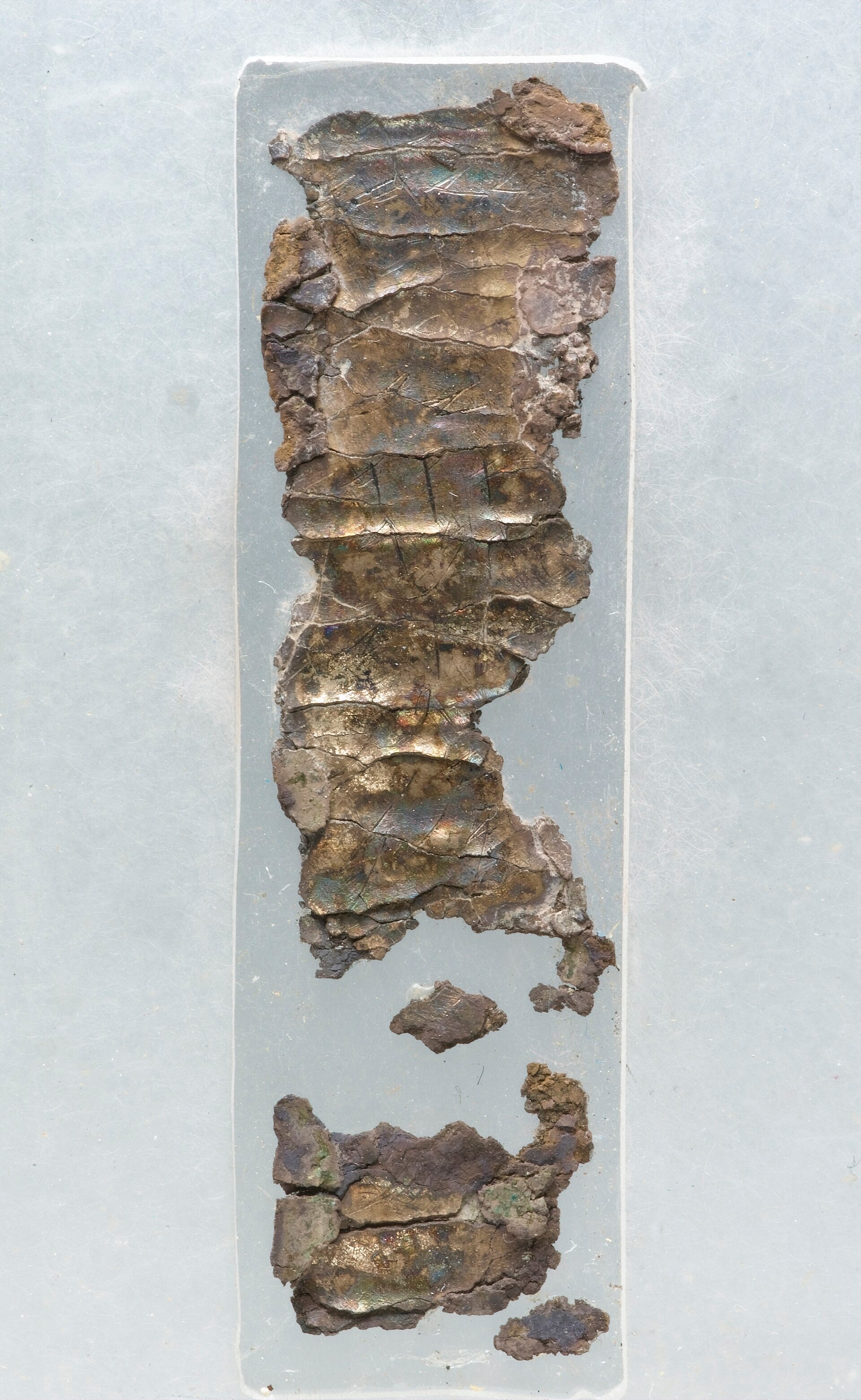
The smaller Ketef Hinnom silver scroll (KH2), engraved with the priestly blessing of Numbers 6, from a burial cave outside Jerusalem, about 600 BC. Image: public domain, via Wikimedia Commons, resized.

See this page's graph and discover linked topics
In full
Defeater for the objection: "The Hebrew Bible, including the Torah's accounts of the patriarchs, the exodus, Moses and the covenant with Yahweh, was composed during the Babylonian exile (after 586 BC) or in the Persian and Hellenistic periods that followed. Its authors were centuries removed from the events they describe, and they built Israel's national religion out of Mesopotamian materials, above all the Babylonian creation epic Enuma Elish. Therefore the biblical picture of ancient Israel and its God is a late invention, and it tells us about the exiles, not about Israel's past."
What the mainstream scholarly position actually is. The honest concession has to be stated precisely, because the objection borrows its authority from it. The prevailing critical view holds that the Pentateuch reached its final form in the Persian period, combining earlier sources; that the history from Joshua to Kings received its finished shape in the exile (Documentary Hypothesis; Martin Noth, 1943); and that many prophetic books gathered pre-exilic oracles into later collections. Many critical scholars also assign Genesis 1 to the Priestly source and date it to the exile or after. A minority school, often called "minimalist" (Philip R. Davies, In Search of 'Ancient Israel', 1992; Thomas L. Thompson, The Mythic Past, 1999; Niels Peter Lemche), goes much further and treats the biblical "Israel" as largely a Persian or Hellenistic literary construction. Israel Finkelstein and Neil Asher Silberman (The Bible Unearthed, 2001) place the decisive shaping in the seventh century under Josiah, which is answered separately at Josiah Wrote the Bible Objection Defeater. The popular slogan "the Bible was written in Babylon" takes the mainstream claim about final editing and attaches the minimalist conclusion about invention to it.
The defeat structure is six-pronged. (1) A story has four dates: when events happened, when they were first told, when they were first written, and when the written account reached its final form; evidence for the fourth date says nothing by itself about the first three. (2) Israel and Yahweh are in the pre-exilic record: Egyptian, Moabite, Aramean, Israelite, Judean and Babylonian inscriptions name Israel, the house of David, Yahweh, Yahwistic personal names and Judean kings from the thirteenth century to the sixth. (3) Biblical texts and traditions are attested before the exile: the Ketef Hinnom amulets carry the priestly blessing of Numbers 6:24-26, and the eighth-century prophets presuppose the exodus, Moses and a written law. (4) The Hebrew language has a history, and the books sit at different points on it: Classical Biblical Hebrew, the language of the monarchic inscriptions, differs from the Late Biblical Hebrew of Chronicles, Ezra, Nehemiah and Esther, and archaic poems such as Exodus 15 and Judges 5 are older still on the standard analysis. (5) Babylonian influence is a claim about imagery; the objection needs a claim about origin: the Enuma Elish predates the exile by centuries, and Genesis 1 answers it point by point. (6) The exile cannot account for what it supposedly produced: a Yahweh temple in Egypt already standing before 525 BC, post-exilic books that read the Torah as an old and binding text, and a national literature that indicts its own ancestors.
Honest limits. This page does not claim that every book of the Hebrew Bible was finished before the exile, or that no editing, updating or collecting happened in Babylon and Persian-period Judah. Conservative scholars grant much of that. Nor does it claim that pre-exilic inscriptions prove the historicity of every patriarchal or exodus narrative; inscriptions corroborate names, peoples, kings and worship, and the historical case for specific events is made on other pages. The claim is narrower and harder to escape: the evidence that some books were completed late does not support the conclusion that Israel's God, Israel's traditions and Israel's Scriptures were invented late, and a wide range of independent evidence shows they were not.
Argument structure
| # | Premise |
|---|---|
| P1 | The date at which a book reached its final form is distinct from the dates of the events, traditions and earlier written sources it contains; evidence for late final editing does not by itself establish late origin. |
| P2 | Inscriptions from Egypt, Moab, Aram, Israel, Judah and Babylon attest Israel, the house of David, Yahweh as Israel's God, Yahwistic personal names and Judean kings centuries before the exile. |
| P3 | Biblical wording and biblical traditions are attested before the exile: the Ketef Hinnom amulets carry the priestly blessing, and the eighth-century prophets presuppose the exodus, Moses, the covenant and a written law. |
| P4 | Biblical Hebrew shows datable layers; the Torah and the Former Prophets are written in Classical Biblical Hebrew, the language of pre-exilic inscriptions, while the books that are post-exilic by their own content show Late Biblical Hebrew. |
| P5 | The Enuma Elish was composed centuries before the exile, and Genesis 1 shares imagery with the ancient Near East while contradicting the epic's theology point by point; influence on imagery does not establish exilic origin. |
| P6 | Exilic invention cannot explain a pre-525 BC Yahweh temple in Egypt, post-exilic books that treat the Torah as old and authoritative, or a national literature that condemns its own ancestors. |
| C | Therefore the claim that the Hebrew Bible and its God were invented in Babylon fails. At most the evidence shows that older traditions and texts were collected, edited and completed during and after the exile, which conservative and critical scholars both affirm. |
Form
Defensive (a defeater) built from premise exposure (P1: the objection's inference from final form to origin), independent corroboration (P2 and P3: datable evidence from outside the biblical text), internal linguistic evidence (P4: the language of the books), comparative analysis (P5: the Enuma Elish read side by side with Genesis 1) and reductio (P6: what an exilic invention would predict, set against what the texts and the archaeology show). Each premise carries a reciprocal concession: the true part of the objection is granted, and a larger concession is collected that undercuts the objector's conclusion. Soundness is contemporary: the case rests on twentieth- and twenty-first-century epigraphy, archaeology and historical linguistics, and it engages the current scholarly debate on its own terms.
Cheatsheet
The 30-second reply. Some Old Testament books were collected and finished during or after the exile; most scholars agree on that, and so do I. But a book's finishing date and the age of what is in it are two separate questions. We have Yahweh's name carved by a Moabite king around 840 BC. We have "the house of David" on an Aramean victory monument. We have Israelites naming their kids after Yahweh for centuries, and a Judean king's own seal from Hezekiah's reign. We have a verse from Numbers engraved on silver in Jerusalem before Babylon burned it. And the Enuma Elish has warring gods and humans made as slaves, while Genesis has one God who speaks and makes humans in His image. Babylon may have shaped some of the imagery. It did not invent Israel's God.
The 6 fast facts:
- Israel, 1208 BC. Pharaoh Merneptah's victory stele names a people called Israel in Canaan about six centuries before the exile (Merneptah Stele).
- Yahweh, about 840 BC. King Mesha of Moab boasts that he took the vessels of YHWH from an Israelite town and dragged them before his god Chemosh (Mesha Stele).
- The house of David, ninth century BC. An Aramean king, probably Hazael, claims victory over a king of Israel and a king of the "house of David" (Tel Dan Stele).
- Hezekiah's own seal, about 700 BC. A clay seal impression reading "belonging to Hezekiah [son of] Ahaz, king of Judah" was found in Eilat Mazar's Ophel excavation, announced in 2015 (Hezekiahs Bulla).
- Scripture on silver, about 600 BC. The Ketef Hinnom amulets carry the blessing of Numbers 6:24-26, "Jehovah bless thee, and keep thee" (ASV), and were dated by Gabriel Barkay's team in 2004 to the end of the seventh or start of the sixth century BC (Ketef Hinnom Silver Scrolls).
- A Yahweh temple in Egypt before 525 BC. The Jews of Elephantine wrote in 407 BC that their fathers had built their temple of YHW under Egypt's native kings, and that Cambyses found it standing when he conquered Egypt (Elephantine Papyri).
The 3 strongest counter-moves:
- "Which date are you talking about?" Ask whether the objector means when the events happened, when the stories began, when they were first written, or when the books were finished. Evidence for the last does not reach the first three.
- "Show me the invention." Grant late editing, then ask for one piece of evidence that Yahweh, Israel or the exodus tradition began in the exile. Every datable witness points the other way.
- "Read the two creation stories aloud." Put the Enuma Elish beside Genesis 1. Shared images, opposite claims. Ask whether opposite claims count as copying.
Reciprocal concessions (grant the small point, then collect a bigger one):
- Grant: the Torah and the Former Prophets reached their final form in the exile or the Persian period. Now collect: final form presupposes earlier material to finish, and the critical theories themselves (the Documentary Hypothesis, Noth's Deuteronomistic History) posit older sources behind the final text; so the objector's own scholarship rejects "invented in Babylon."
- Grant: Genesis 1 may be addressing Babylonian ideas. Now collect: if it is, it is arguing against them; a text that strips the sea, the sun and the moon of divinity and makes humanity royal is a rebuttal of Babylon's theology, and a rebuttal presupposes a faith already held.
- Grant: the Tel Dan and Mesha inscriptions are royal propaganda. Now collect: propaganda boasts of defeating real enemies; a Moabite king and an Aramean king both treat Israel, its God and the house of David as realities worth boasting over in the ninth century BC.
The closing line. Babylon is where some of these books were finished. Israel had met its God centuries earlier, and that meeting is already carved in stone in Moab, painted on jars in the Sinai, pressed into the seals of Judah's kings and engraved on silver in Jerusalem before Babylon ever arrived.
Grammar and hermeneutics
The objection makes claims about the language and content of the text, so it can be tested on linguistic and literary grounds before any theology is invoked. Word distributions below are counts of Strong's tags in the King James text with Strong's numbers (Old Testament only); they are a rough index, and the specialist studies cited do the full work.
-
Hebrew changed over time, and the change is visible. Avi Hurvitz and others distinguish Classical (sometimes "Standard") Biblical Hebrew, the language of the monarchy, from Late Biblical Hebrew, the language of books whose content places them after the exile: Chronicles, Ezra, Nehemiah, Esther and Daniel (Robert Polzin, Late Biblical Hebrew, 1976; Hurvitz and colleagues, A Concise Lexicon of Late Biblical Hebrew, 2014). Pre-exilic inscriptions such as the Siloam inscription (about 700 BC) and the Lachish Letters (about 588 BC) are written in the classical type.
-
Three sample markers.
- Iggeret, "letter" (H107), a word scholars associate with the Persian chancery: 10 occurrences, all in 2 Chronicles, Nehemiah and Esther, none from Genesis to Kings.
- Dat, "decree, law" (H1881), a Persian loanword: 20 of its 22 tagged occurrences are in Esther, one in Ezra. The only Pentateuch occurrence is tagged in Deuteronomy 33:2, "a fiery law," a phrase whose text and meaning have long been disputed, so it is no secure counter-example.
- Malkut (H4438) beside mamlakah (H4467), both "kingdom": Samuel and Kings use mamlakah 29 times and malkut twice; Chronicles uses malkut 28 times, Esther 26 and Daniel 16. Where Chronicles retells Samuel and Kings, it often shifts to the later word.
If the Torah and the Former Prophets had been composed in Persian-period Judah, they should show the Persian-period vocabulary their parallel books show. On these markers they do not.
-
The Priestly material is classical. Hurvitz argued that the Priestly source, the layer critical scholars most often date to the exile or later, is written in Classical Biblical Hebrew and is linguistically earlier than Ezekiel, the exilic priest-prophet (Avi Hurvitz, A Linguistic Study of the Relationship between the Priestly Source and the Book of Ezekiel, 1982). Ronald Hendel and Jan Joosten defend the broader framework in How Old Is the Hebrew Bible? (2018).
-
Archaic poetry. Frank Moore Cross and David Noel Freedman (Studies in Ancient Yahwistic Poetry, 1950) identified the Song of the Sea (Exodus 15) and the Song of Deborah (Judges 5) among the oldest poems in the Bible on grammatical and orthographic grounds. One visible marker is the old relative pronoun zu (H2098), "that": "the people that thou hast redeemed" (Exodus 15:13, ASV) and "the people... that thou hast purchased" (15:16). Outside these two verses it appears only in poetry (Psalms, Isaiah, Habakkuk); prose uses the ordinary relative. Both poems already center on Yahweh: "Jehovah is a man of war: Jehovah is his name" (Exodus 15:3, ASV), and "Jehovah, when thou wentest forth out of Seir... Even yon Sinai at the presence of Jehovah, the God of Israel" (Judges 5:4-5, ASV).
-
The scholarly critique, stated fairly. Ian Young, Robert Rezetko and Martin Ehrensvärd (Linguistic Dating of Biblical Texts, 2008) argue that Early and Late Biblical Hebrew are better explained as coexisting styles than as successive periods, that scribes updated and archaized texts in transmission, and that linguistic dating therefore cannot fix the date of a book, early or late. Rezetko has questioned specific markers, including iggeret, which also occurs in Old Aramaic. This is a serious position held by competent scholars. Two points hold against it. First, the critique cuts both ways: if language cannot date a book early, it cannot date one late either, and the objector then has no linguistic case for exilic composition. Second, defenders of the diachronic model, including Hendel and Joosten (2018), reply that the classical type matches dated pre-exilic inscriptions while the late type matches dated post-exilic sources, which is what a real change in the language over time predicts.
-
Genesis 1 on its own terms. The grammar of Genesis 1 undercuts the borrowing claim directly.
- The "deep" of Genesis 1:2 is tehom (H8415), a common noun without the article, also used of ordinary seas and springs. It is a place for the Spirit of God to move over. It is never a person or a rival. Alexander Heidel argued on philological grounds that tehom is not derived from the name Tiamat (The Babylonian Genesis, 1942), and many scholars now trace both words to a common Semitic root meaning the deep; some still hear an echo of Tiamat in tehom, but an echo of a shared word is not a borrowed god.
- The sun and moon are not named. Genesis 1:16 calls them "the greater light" and "the lesser light" (H3974, ma'or, "light, lamp"), and the usual words for sun (H8121) and moon (H3394) are absent from the whole chapter, though common elsewhere. In a world where Shamash and Sin were gods, the text calls them lamps.
- The sea monsters are made. "God created the great sea-monsters" (Genesis 1:21, ASV) uses bara (H1254), the verb reserved for God's creating, with tanninim (H8577), the word elsewhere used for the chaos-monster imagery of Psalm 74:13 and Isaiah 51:9. In Genesis 1 they are creatures.
- Humanity is royal. "God created man in his own image" (Genesis 1:27, ASV), where the Enuma Elish makes humans to carry the gods' labor.
None of this dates a book by itself. It shows that the objection's two textual claims, that the Torah reads like an exilic composition and that Genesis 1 reads like the Enuma Elish, are contradicted by the text itself.
Logical fallacies in the objection
1. Conflating compilation with origin (equivocation on "written")
What it is. Equivocation uses one word in two senses inside a single argument. Here the word is "written," which can mean "first composed" or "brought into final form."
Where the objection commits it. The premise that can be supported is "the books were written (finished, edited, collected) in the exilic and Persian periods." The conclusion drawn is "the stories were written (made up) then." The argument slides from the first sense to the second.
Reductio. Homer's Iliad was given its standard written text by Alexandrian scholars in the Hellenistic period. By the same reasoning the Trojan War tradition was invented in Ptolemaic Egypt, five centuries after the Greeks were already quoting Homer. No classicist draws that conclusion, because the date of an edition is not taken as the date of what it edits.
2. The genetic fallacy
What it is. Judging a claim true or false by where or how it arose, instead of by the evidence for it.
Where the objection commits it. "It was written down by exiles with an agenda, so it is invention." Even if a text took shape among exiles who needed a national identity, that origin does not show its contents are false. Authors with motives can record true things, and the question of whether they did is settled by evidence.
Reductio. The objection itself is often drawn from modern scholars with academic and ideological commitments. If the circumstances of a text's writing settled its truth, the objector's sources would fall to the same test, and so would every history ever written by a people about itself.
3. Argument from silence
What it is. Concluding that something did not exist because no evidence of it survives, when its survival would not be expected.
Where the objection commits it. "We have no manuscript of Genesis older than the Dead Sea Scrolls, so Genesis did not exist earlier." Texts in ancient Judah were written on papyrus and leather, which rot in the region's climate outside a few dry caves, and Jerusalem was burned in 586 BC. The survival of pre-exilic biblical manuscripts would be surprising, so their absence is weak evidence.
Reductio. By the same rule the Enuma Elish was composed in the seventh century BC, because its best-known copies come from Ashurbanipal's library at Nineveh; but Assyriologists date its composition centuries earlier on internal grounds. The objection needs the epic to be old so that Genesis can borrow from it, and the same reasoning that makes the epic old protects the Torah.
4. Affirming the consequent (parallel, therefore borrowing)
What it is. Reasoning "if A, then B; B; therefore A." If Genesis copied Babylon, there would be similarities; there are similarities; therefore Genesis copied Babylon.
Where the objection commits it. Shared images (primeval waters, a divided sea, an ordered cosmos) are produced by several causes: direct borrowing, a common cultural stock, independent observation of the same world, or deliberate polemic. Similarity alone cannot pick among them.
Reductio. Genesis and the Enuma Elish both mention light, sky, dry land and humans. So do the creation accounts of peoples who never met. If shared features prove copying, every creation story on earth copied every other.
5. Special pleading (the double standard)
What it is. Applying a standard to an opponent's evidence that you exempt your own evidence from.
Where the objection commits it. Babylonian texts are dated by their internal features and the history of their tradition, earlier than their surviving copies. Biblical texts are dated by their latest editorial layer, with every older feature explained as a later imitation or insertion. The Tel Dan and Mesha inscriptions are dismissed as "propaganda," while the minimalist reconstruction built on silence is treated as fact.
Reductio. Apply the objector's rule for the Bible to the Babylonian epic, and the Enuma Elish becomes a seventh-century Assyrian library product, too late to explain anything. Apply the objector's rule for the epic to the Bible, and the archaic poems, the classical Hebrew and the pre-exilic inscriptions date the traditions to the monarchy or earlier. Either rule, applied consistently, sinks the objection.
P1, A story has four dates
Affirmative case
- Four distinct questions. Every biblical narrative has (a) the date of the events it describes, (b) the date people began telling it, (c) the date it was first written, and (d) the date the written account reached the form we have. These can lie centuries apart.
- The critical theories assume this. The Documentary Hypothesis posits sources (J, E, D, P) older than the final Pentateuch; Noth's Deuteronomistic History is a compilation from earlier records; the books themselves cite older written sources such as "the book of the Wars of Jehovah" (Numbers 21:14, ASV) and the book of the chronicles of the kings of Judah. A theory that the Pentateuch was finished in the Persian period is a theory about stage (d).
- The objection supplies evidence for (d) and concludes (a) to (c). Evidence that editors worked in Babylon or Persian-period Jerusalem does not reach back to when the traditions began.
- Proximity matters, and it is one factor among several. The objector is right that witnesses close to events generally have an advantage. But proximity is measured to the source material, not to the final edition, and it is weighed alongside corroboration, linguistic data and transmission history.
Anticipated objections
- "You can't prove the older sources existed. They're hypothetical."
- "Oral tradition over centuries is unreliable, so even if older traditions existed they'd be unrecognizable."
Rebuttals
- Then the objector has given up the Documentary Hypothesis, and with it the critical case for late editing. The late dating of the final form and the existence of earlier sources come from the same body of scholarship. And much of the earlier material is physically attested: P2 to P4 give inscriptions, an engraved biblical text and linguistic layers that are physically or grammatically datable. Failure-mode: accepting the scholarly conclusion while rejecting the evidence it rests on.
- Reliability of transmission is an evidential question, and the evidence is testable. Where outside sources check the biblical record (the kings of Israel and Judah named in Assyrian, Moabite, Aramean and Babylonian texts), the names, sequences and events match closely. That is a measured result, and it is the opposite of what centuries of free invention would produce. Failure-mode: assuming unreliability instead of testing it.
Reciprocal concession
- Grant: the books as we have them were finished in or after the exile. Now collect: the objector must then argue for invention separately, with evidence, because the scholarship that dates the final form also affirms older sources inside it.
Tactical notes
- Open every exchange on this topic by separating the four dates. Most of the objection's force comes from running them together.
- Do not defend the claim that every book was finished before the exile. It is unnecessary and harder to defend.
P2, Israel and Yahweh are in the pre-exilic record
Affirmative case
- The evidence, dated.
| Evidence | Date | What it shows |
|---|---|---|
| Soleb temple list of Amenhotep III, "land of the Shasu of Yhw" | 14th century BC | A name matching Yahweh's attested among southern nomads, centuries before Israel's monarchy |
| Merneptah Stele | about 1208 BC | A people called Israel already in Canaan |
| Mesha Stele | about 840 BC | A Moabite king names YHWH as Israel's God and names Omri, king of Israel |
| Tel Dan Stele | 9th century BC | An Aramean king names a king of Israel and the "house of David" |
| Kuntillet Ajrud inscriptions | about 800 BC | Blessings in the name of "Yahweh of Samaria" and "Yahweh of Teman" |
| Hebrew seals, bullae and letters with -yahu and yeho- names | 8th to 6th century BC | Israelites and Judeans naming children after Yahweh |
| Hezekiahs Bulla | late 8th century BC | The royal seal of "Hezekiah [son of] Ahaz, king of Judah" |
| Hezekiahs Tunnel and Siloam Inscription | about 700 BC | Classical Hebrew prose in Jerusalem; the tunnel matches 2 Kings 20:20 |
| Lachish Letters | about 588 BC | Judean officers swear by YHWH on the eve of the Babylonian conquest |
| Babylonian Chronicle and the Capture of Jerusalem and the Jehoiachin Ration Tablets | 597 BC and after | Babylon's own records of taking Jerusalem and feeding "Yaukin, king of Judah," a king with a Yahweh name |
- The names tell the story. Jeffrey Tigay surveyed the personal names in Israelite and Judean inscriptions and found Yahwistic names in the great majority, with names honoring other gods rare (You Shall Have No Other Gods, 1986). Personal names record what ordinary parents chose, outside any literary program. A god whose name fills the family names of Judah for two centuries before the exile was worshipped long before it.
- Babylon itself names a Yahwistic king. The Babylonian ration tablets list provisions for Jehoiachin under the name Yaukin. The exiles arrived in Babylon with a king whose name already honored Yahweh (2 Kings 25:27).
- The enemies confirm the people. Moab and Aram had no interest in validating Israel's story. Their kings mention Israel's God, Israel's kings and David's dynasty because those were the realities they fought.
Anticipated objections
- "The Tel Dan and Mesha stelae are royal propaganda."
- "Kuntillet Ajrud shows Yahweh with a consort, so the biblical Yahweh is a later, edited version."
- "The Soleb reference is uncertain."
Rebuttals
- Propaganda exaggerates victories over real enemies. Grant the genre and its distortions. A boast of defeating the house of David presupposes a house of David, and Mesha's boast of seizing YHWH's vessels presupposes Israelite worship of YHWH in Moab's borderland. For this page's question, which is whether Yahweh and Israel existed before the exile, the inscriptions answer on any reading. Failure-mode: treating a genre label as a refutation.
- That is a different objection, and it concedes this one. Kuntillet Ajrud shows popular, mixed worship of Yahweh around 800 BC, which the prophets condemned. However it is read, it puts Yahweh's worship in the ninth or eighth century, three centuries before the exile. The polytheism question is answered at OT Polytheism Objection Defeater and Yahweh Is a Canaanite God Objection Defeater.
- Granted, and it is not load-bearing. The identification of Yhw at Soleb with Yahweh is widely accepted and still debated. Remove it, and the Mesha Stele, Kuntillet Ajrud, the seals and the letters still put Yahweh in the record from the ninth century on.
Reciprocal concession
- Grant: inscriptions corroborate peoples, kings and worship, and they do not by themselves prove any particular narrative. Now collect: the objection as stated, that Israel's God and national identity were invented in the exile, is refuted by them outright, and a history that gets ninth- and eighth-century kings and dynasties right was built on records older than the exile.
Tactical notes
- Lead with the Mesha Stele. It is the hardest for an objector to dismiss: an enemy king, in stone, naming YHWH around 840 BC.
- Do not claim the inscriptions prove the exodus. Claim what they show.
P3, Biblical wording and traditions are attested before the exile
Affirmative case
- The Ketef Hinnom amulets. Found by Gabriel Barkay in 1979 in a burial cave above the Hinnom Valley, the two silver amulets carry a blessing parallel to Numbers 6:24-26: "Jehovah bless thee, and keep thee: Jehovah make his face to shine upon thee, and be gracious unto thee: Jehovah lift up his countenance upon thee, and give thee peace" (ASV). A new edition using advanced imaging (Barkay, Vaughn, Lundberg and Zuckerman, Bulletin of the American Schools of Oriental Research 334, 2004) confirmed the readings and the date at the end of the seventh or start of the sixth century BC, before the Babylonian destruction. The editors drew a careful conclusion: the find does not date the Priestly source as a whole, but it shows that a blessing now part of it was in use in the First Temple period.
- The eighth-century prophets presuppose the Torah's story. "I brought you up out of the land of Egypt, and led you forty years in the wilderness" (Amos 2:10, ASV). "When Israel was a child, then I loved him, and called my son out of Egypt" (Hosea 11:1, ASV). "I sent before thee Moses, Aaron, and Miriam" (Micah 6:4, ASV). "I wrote for him the ten thousand things of my law" (Hosea 8:12, ASV). These prophets worked about two centuries before the exile, and their audiences were expected to recognize the exodus, the wilderness, Moses and a written law.
- Writing in early Judah. The Ketef Hinnom Silver Scrolls, the Siloam inscription, the Lachish and Arad ostraca, and hundreds of bullae show a literate scribal culture in Judah well before the exile. The Khirbet Qeiyafa ostracon, from a fortified site above the Elah Valley dated to around 1000 BC, shows that writing was in use in the region even earlier. Its language is disputed: Haggai Misgav and Brian Donnelly-Lewis (2022) read it as an early form of Hebrew, while Christopher Rollston holds that it cannot be securely identified as Hebrew, and Gershon Galil's full translation is regarded by many as speculative. Its value here is modest and secure: alphabetic writing existed in the area at the dawn of the monarchy.
Anticipated objections
- "Nadav Na'aman dated the Ketef Hinnom amulets to the early Second Temple period."
- "A blessing could be older than the book; that doesn't put Numbers before the exile."
- "The prophetic references to the exodus could be later insertions."
Rebuttals
- A real dissent, and a minority one. Na'aman ("A New Appraisal of the Silver Amulets from Ketef Hinnom," Israel Exploration Journal 61, 2011) argued for a date soon after the Second Temple was built. His paper drew a published rejoinder defending the earlier date, and most specialists continue to follow the 2004 edition. Even on Na'aman's date, the amulets show the blessing already used as a sacred formula within a generation or two of the return, which leaves no room for the minimalist claim of Hellenistic invention.
- Correct, and stated above. The amulets do not by themselves prove that the book of Numbers existed in the seventh century. They show that the wording of the priestly blessing, assigned by classical source criticism to a late source, was in personal devotional use in Jerusalem before the exile. That is a datable piece of the Torah's content in the period the objection says it did not yet exist.
- Some lines may be; the pattern holds. Critical scholars do treat a few lines (such as the Judah oracle of Amos 2:4-5) as later additions. The exodus, wilderness and Moses references run across Amos, Hosea and Micah in passages not generally assigned to later editors. Removing every one of them as an insertion assumes the late date it is meant to prove. Failure-mode: circular dating.
Reciprocal concession
- Grant: the amulets attest one passage, not a whole book. Now collect: then the objector has no physical evidence for exilic invention, while the defense has a physical, dated witness to Torah wording before the exile; the burden now sits with the side that has none.
Tactical notes
- State the Ketef Hinnom dating debate before the objector does. Naming Na'aman and the 2004 edition shows command of the evidence.
- Present the Qeiyafa ostracon as debated. Overstating it gives the objector an easy correction.
P4, The language of the books has a history
Affirmative case
- Datable layers. Classical Biblical Hebrew matches the language of pre-exilic inscriptions; Late Biblical Hebrew matches the post-exilic books and later Hebrew and Aramaic sources (Polzin, 1976; Hurvitz, 1982; Hurvitz and colleagues, 2014; Hendel and Joosten, 2018). See the Grammar and hermeneutics section for sample markers.
- The Torah and the Former Prophets sit in the classical layer. If they had been composed in the exile or the Persian period, they would be expected to share the vocabulary of Chronicles, Ezra, Nehemiah and Esther, written in the same era. On the standard markers, they do not.
- Archaic poetry sits earlier still. Cross and Freedman (1950) placed Exodus 15 and Judges 5 among the oldest Hebrew poems on linguistic grounds. Both celebrate Yahweh as Israel's God, which puts Yahweh at the oldest stratum of Israel's literature.
- Chronicles retells Kings in later Hebrew. Where the two overlap, Chronicles regularly substitutes later forms. That is direct evidence that Kings' language is older than that of a known post-exilic book.
Anticipated objections
- "Young, Rezetko and Ehrensvärd showed that linguistic dating doesn't work."
- "Scribes could archaize, writing in old-fashioned Hebrew to make a late text look old."
Rebuttals
- Then it does not work for the late date either. Their thesis is that language cannot date biblical books in either direction. Granting it removes linguistic evidence from both sides, leaving the inscriptions, the amulets and the prophets of P2 and P3 untouched. And the thesis remains contested: Hendel and Joosten (2018) and others argue that the correlation between the biblical layers and dated outside sources is too strong to be chance. Failure-mode: using a skeptical argument selectively.
- Archaizing leaves tracks. Late writers who imitate older Hebrew tend to slip into late forms; Chronicles and the Hebrew of the Dead Sea Scrolls are studied partly for this reason. A whole Torah and a whole history from Joshua to Kings written by Persian-period scribes without consistent late slips would be an unexampled feat, and positing it is an assumption the evidence does not require.
Reciprocal concession
- Grant: linguistic dating is debated, and no single word dates a book. Now collect: the objector then has no linguistic case for exilic composition, which is the one kind of internal evidence the slogan seemed to need.
Tactical notes
- Use one concrete example (the malkut and mamlakah split) instead of a list. It is easy to say and easy to check.
- Never assert a parsing or a word history you cannot ground. The scholarly debate is strong enough on its own.
P5, Babylonian influence and Babylonian origin
Affirmative case
- The epic is far older than the exile. The Enuma Elish glorifies Marduk of Babylon. W. G. Lambert dated its composition to the late second millennium BC, plausibly the reign of Nebuchadnezzar I (about 1125 to 1104 BC), and other scholars date it earlier still, and copies circulated in Assyria long before Babylon took Jerusalem; the best-known tablets come from Ashurbanipal's seventh-century library at Nineveh. Contact between Israel and Mesopotamian literature was possible at any point in the monarchy, so the epic's influence, if any, does not require the exile.
- The theology is reversed. The Enuma Elish begins with gods born from mingled waters, narrates their war, makes the world from the slain body of Tiamat, and creates humanity from a rebel god's blood to relieve the gods of labor. Genesis 1 begins with one God who exists before creation, creates by command, faces no rival, calls the sun and moon "lights," makes the sea monsters as creatures, and creates humanity in His image to rule the earth.
- Specialists reject direct dependence. Lambert ("A New Look at the Babylonian Background of Genesis," Journal of Theological Studies 16, 1965) argued that Genesis 1 cannot be shown to depend on the Enuma Elish, and Heidel (The Babylonian Genesis, 1942) argued the same on linguistic grounds. The theory of dependence goes back largely to Hermann Gunkel (Schöpfung und Chaos, 1895), whose case rested on the tehom and Tiamat link that Heidel challenged.
- Where Genesis engages Babylon, it argues. Gerhard Hasel ("The Polemic Nature of the Genesis Cosmology," Evangelical Quarterly, 1974) read Genesis 1 as a deliberate refutation of the ancient Near Eastern cosmologies. A polemic presupposes a convinced author with a prior faith, which is the opposite of a religion assembled from Babylonian parts.
- The broader case on Genesis and ancient Near Eastern myth, including the flood stories, is at Genesis ANE Myth Borrowing Objection Defeater.
Anticipated objections
- "Genesis 1 is the Priestly source, and the Priestly source is exilic, so Genesis 1 was written in Babylon."
- "The divided waters of Genesis 1:6-7 are Marduk splitting Tiamat."
- "Psalm 74 and Isaiah 51 have God fighting sea monsters, so Israel had a combat myth too."
Rebuttals
- Grant the dating for argument's sake, and the conclusion still fails. If Genesis 1 was given its present form in the exile, then an exilic author wrote a creation account that denies every distinctive claim of Babylonian religion. That shows the author's faith resisting Babylon, and it presupposes the faith already existed. And on Hurvitz's analysis the Priestly Hebrew is classical, which tells against an exilic date in the first place (P4).
- The image is shared; the act is opposite. Dividing the waters to make room for the world is a common ancient image. In the epic it is the dismemberment of a goddess in war; in Genesis it is a command obeyed by matter. Genesis keeps the picture and replaces the theology.
- Yes, and Genesis 1 demythologizes it. Psalm 74:13 and Isaiah 51:9 use the poetic imagery of God subduing the sea-monsters and Rahab, which shows Israel knew the imagery long before any exilic editing. Genesis 1:21 then uses the same word, tanninim, for creatures God made and called good. The contrast shows a writer deliberately stripping the imagery of rival powers.
Reciprocal concession
- Grant: Genesis 1 shares imagery with the ancient Near East and may address Babylonian claims. Now collect: shared imagery is evidence that Israel lived in the ancient world, and opposition to Babylon's theology is evidence of a faith formed before contact with it, so neither supports exilic invention.
Tactical notes
- Read the four-line comparison aloud: many gods or one; war or command; the world from a corpse or from a word; humans as slaves or as image-bearers.
- Do not deny all contact. Contact is plausible and costs nothing.
P6, What an exilic invention cannot explain
Affirmative case
- Yahweh in Egypt before the Persians. The Jewish colony at Elephantine on the Nile wrote in 407 BC to Bagohi, governor of Judah, that their fathers had built their temple of YHW in the days of Egypt's native kings and that Cambyses found it standing when he conquered Egypt (525 BC). A Yahweh temple was standing in southern Egypt within a few decades of the exile, built by Judeans who had not gone to Babylon. The worship of Yahweh did not need the exile to begin (Elephantine Papyri).
- The exile mourned a faith it already had. "By the rivers of Babylon, There we sat down, yea, we wept, When we remembered Zion" (Psalm 137:1, ASV). Jeremiah sent a letter "from Jerusalem unto the residue of the elders of the captivity" (Jeremiah 29:1, ASV). The exilic literature looks back to a temple, a city, a priesthood and a prophetic tradition already in place.
- Post-exilic books read the Torah as an old book. At the water gate the people ask Ezra "to bring the book of the law of Moses, which Jehovah had commanded to Israel" (Nehemiah 8:1, ASV). The post-exilic community treats the Torah as an existing authority to be read and obeyed, and does not present it as a new composition.
- National myths flatter; these books indict. The history from Judges to Kings records that Israel "forsook Jehovah, the God of their fathers, who brought them out of the land of Egypt, and followed other gods" (Judges 2:12, ASV), and explains the fall of the northern kingdom "because the children of Israel had sinned against Jehovah their God" (2 Kings 17:7, ASV). Exiles inventing an identity to sustain themselves would not be expected to make their ancestors the villains of their own story.
Anticipated objections
- "Elephantine shows a syncretistic religion with other deities, so it can't represent biblical Yahwism."
- "Self-criticism was the point: the exiles blamed their ancestors to explain the disaster."
Rebuttals
- Granted, and that strengthens the point. Elephantine's religion was mixed, as Jeremiah 44 says the religion of Judeans in Egypt was. But a syncretistic Yahwism with its own temple, older than 525 BC, proves that Yahweh's worship long preceded the exile; a god invented in Babylon would not already have a temple on the Nile. See OT Polytheism Objection Defeater.
- That explains the theme; it does not explain the sources. The explanation of the exile as judgment is a theological reading of history, and it could be applied to remembered history or to invented history. The independent evidence of P2 to P4 shows the history was remembered: the kings, the dynasty, the worship of Yahweh and the prophets' language were all in place before the exile.
Reciprocal concession
- Grant: the exile was a decisive time for collecting and interpreting Israel's Scriptures. Now collect: it was decisive because there was something to collect, as the exilic and post-exilic books themselves say, and as Elephantine shows from outside Babylon.
Tactical notes
- Elephantine is underused in debate. It is the cleanest outside witness that Yahweh worship did not depend on the Babylonian community.
- Keep the self-indictment point as a supporting argument; it shows the literature's character but does not date it.
Master objections to the defeater
MO1: "Finkelstein and Silberman showed the Bible's story was written in Josiah's court, not in Moses' day."
- That is a different thesis, a seventh-century shaping of older traditions, and it places the work before the exile. It is answered at Josiah Wrote the Bible Objection Defeater. Note what it concedes for this page: on Finkelstein and Silberman's reconstruction, Yahweh, Israel and the national epic all predate Babylon.
MO2: "The minimalists (Davies, Thompson, Lemche) argue the Bible is a Persian or Hellenistic creation."
- Minimalism is a serious school and a minority one. It must explain the Ketef Hinnom amulets, the classical Hebrew of the Torah and the Former Prophets, the archaic poetry, the Yahwistic names of the monarchy, the Elephantine temple and the external confirmation of ninth- and eighth-century kings. Most of the field, critical and conservative, finds those data incompatible with wholesale late invention.
MO3: "The oldest manuscripts are the Dead Sea Scrolls. Everything before that is speculation."
- The Dead Sea Scrolls are the oldest manuscripts of whole biblical books, and by around 250 to 100 BC they already show multiple copies of the Torah treated as Scripture, which itself requires a long prior history. Before them come the Ketef Hinnom amulets, the inscriptions of P2 and the linguistic evidence of P4. The demand for a pre-exilic scroll is an argument from silence (see the fallacies section).
MO4: "Abraham and Moses still aren't proved by any inscription."
- Correct, and this page does not claim they are. The objection asserted that the traditions about them were invented in the exile. The prophets of the eighth century already knew Moses and the exodus (P3), and the patriarchal traditions carry features that critical and conservative scholars alike have weighed as early; the historical case for those figures is made on other pages, including Mosaic Authorship of the Pentateuch.
MO5: "Yahweh started as a Canaanite or Edomite storm god and only became the God of the Bible in the exile."
- The first half is a claim about Yahweh's prehistory; the second is a claim about late monotheism. Both are answered at Yahweh Is a Canaanite God Objection Defeater and OT Polytheism Objection Defeater. For this page it is enough that every version of the theory places Yahweh's worship in Israel centuries before Babylon.
Tactical opening / closing
Opening. Before we argue about Babylon, let's agree on what "written" means. Do you mean when these books were finished, or when the stories in them began? Because I'll grant the first and show you the evidence on the second.
Closing. You've shown me that some books were completed in or after the exile. I agreed with that at the start. What you haven't shown me is one piece of evidence that Israel's God or Israel's story began there. Meanwhile we have Yahweh in Moabite stone, the house of David in Aramaic, Hezekiah's own seal, Judean children named for Yahweh, a verse of Numbers on silver from before the fall of Jerusalem, and a temple of Yahweh on the Nile older than the Persian conquest of Egypt. Babylon is where some of these books were finished. Israel's faith was already old when they got there.
Live-cite kit
Scripture:
- Exodus 15:3, "Jehovah is a man of war: Jehovah is his name." (ASV), from one of the oldest poems in the Bible
- Judges 5:5, "Even yon Sinai at the presence of Jehovah, the God of Israel." (ASV)
- Numbers 6:24, "Jehovah bless thee, and keep thee" (ASV), the line on the Ketef Hinnom silver
- Hosea 8:12, "I wrote for him the ten thousand things of my law" (ASV), eighth century BC
- Micah 6:4, "I sent before thee Moses, Aaron, and Miriam." (ASV)
- Psalm 137:1, "By the rivers of Babylon, There we sat down, yea, we wept, When we remembered Zion." (ASV)
- Nehemiah 8:1, "the book of the law of Moses, which Jehovah had commanded to Israel" (ASV)
- Genesis 1:27, "And God created man in his own image" (ASV)
Scholarly (the objection, stated fairly): Martin Noth (1943) on the exilic Deuteronomistic History; Philip R. Davies, In Search of 'Ancient Israel' (1992); Thomas L. Thompson, The Mythic Past (1999); Ian Young, Robert Rezetko and Martin Ehrensvärd, Linguistic Dating of Biblical Texts (2008); Nadav Na'aman, Israel Exploration Journal 61 (2011), on a later date for the amulets; Hermann Gunkel, Schöpfung und Chaos (1895).
Scholarly (the reply): Gabriel Barkay, Andrew Vaughn, Marilyn Lundberg and Bruce Zuckerman, BASOR 334 (2004); Avi Hurvitz (1982); Ronald Hendel and Jan Joosten, How Old Is the Hebrew Bible? (2018); Frank Moore Cross and David Noel Freedman (1950); Jeffrey Tigay, You Shall Have No Other Gods (1986); W. G. Lambert, Journal of Theological Studies 16 (1965); Alexander Heidel, The Babylonian Genesis (1942); Gerhard Hasel, Evangelical Quarterly (1974); Kenneth Kitchen, On the Reliability of the Old Testament (2003).
Archaeological: Merneptah Stele, Mesha Stele, Tel Dan Stele, Kuntillet Ajrud, Hezekiahs Bulla, Hezekiahs Tunnel and Siloam Inscription, Lachish Letters, Ketef Hinnom Silver Scrolls, Babylonian Chronicle and the Capture of Jerusalem, Jehoiachin Ration Tablets, Elephantine Papyri.
Aphorism: "The date on the cover tells you when the cookbook was printed. The recipes are older."
Aphorism: "Babylon is where some of the books were finished. Israel's faith was already old when they got there."
Connection to Scripture
- Exodus 15 and Judges 5, archaic Yahwistic poetry.
- Numbers 6:24-26, the priestly blessing of the Ketef Hinnom amulets.
- Genesis 1, creation by one God's word, set against the Enuma Elish.
- Amos 2:10, Hosea 11:1, Hosea 8:12 and Micah 6:4, eighth-century witnesses to the exodus, Moses and written law.
- Psalm 137:1 and Jeremiah 29:1, the exile remembering a faith already held.
- Nehemiah 8:1, the post-exilic community reading the Torah as Moses' law.
- Judges 2:12 and 2 Kings 17:7, the history's indictment of Israel's own idolatry.
Scholarship
Published academic works this page draws on, each matched to a publisher, index or library catalog record.
- Frank Moore Cross, Studies in ancient Yahwistic poetry (1950). Open Library
- Philip R. Davies, In Search of 'Ancient Israel' (JSOT Press, 1992). Open Library
- Israel Finkelstein and Neil Asher Silberman, The Bible unearthed (Free Press, 2001). Open Library
- Jeffrey H Tigay, You Shall Have No Other Gods: Israelite Religion in the Light of Hebrew Inscriptions (Brill, 1986). doi:10.1163/9789004360440
- Gerhard F. Hasel, "The Polemic Nature of the Genesis Cosmology," Evangelical Quarterly: An International Review of Bible and Theology 46 (1974). doi:10.1163/27725472-04602004
- Alexander Heidel, The Babylonian Genesis (1942). Open Library
- Avi Hurvitz, A linguistic study of the relationship between the priestly source and the Book of Ezekiel (1982). Open Library
- Avi Hurvitz, A Concise Lexicon of Late Biblical Hebrew: Linguistic Innovations in the Writings of the Second Temple Period (Brill, 2014). doi:10.1163/9789004266438
- K. A. Kitchen, On the Reliability of the Old Testament (2003). Open Library
- W. G. Lambert, "A New Look At The Babylonian Background Of Genesis1," The Journal of Theological Studies XVI (1965). doi:10.1093/jts/xvi.2.287
- Robert Polzin, Late Biblical Hebrew: Toward an Historical Typology of Biblical Hebrew Prose (Brill, 1976). doi:10.1163/9789004386709
- Thomas L. Thompson, The Mythic Past (1999). Open Library
- Ian Young and Robert Rezetko, Linguistic dating of biblical texts (2008). Open Library
See also
- Josiah Wrote the Bible Objection Defeater, the seventh-century form of the late-composition claim.
- Yahweh Is a Canaanite God Objection Defeater, on the origins of Yahweh worship.
- OT Polytheism Objection Defeater, on early Israelite polytheism and monotheism.
- Genesis ANE Myth Borrowing Objection Defeater, the fuller treatment of Genesis and ancient Near Eastern myth.
- Israel Emerged From Within Canaan Objection Defeater, the settlement archaeology.
- Moses Did Not Write the Torah Objection Defeater, the parent defeater on the authorship of the Torah.
- Daniel Was Written in the 2nd Century Objection Defeater, a companion late-dating defeater.
- Documentary Hypothesis, the source theory behind late final dating.
- Ketef Hinnom Silver Scrolls, the oldest known text of a biblical passage.
- Kuntillet Ajrud, Yahweh blessings around 800 BC.
- Babylonian Chronicle and the Capture of Jerusalem, Babylon's own account of 597 BC.
- Biblical Archaeology, the archaeology hub.
Common questions this page answers
Q: Was the Bible written during the Babylonian exile?
Some books of the Hebrew Bible were collected, edited or finished during and after the exile, and most scholars agree on that. But the traditions inside them are older. Inscriptions name Israel, Yahweh and the house of David centuries before the exile, and a blessing from Numbers was engraved on silver in Jerusalem before the Babylonians destroyed the city.
Q: Did the Jews copy Genesis from the Enuma Elish?
The two share some ancient imagery, such as primeval waters, but they tell opposite stories. The Enuma Elish has many warring gods, makes the world from a slain goddess and creates humans as servants of the gods; Genesis 1 has one God who creates by command and makes humanity in His image. Leading Assyriologists such as W. G. Lambert argued that Genesis 1 cannot be shown to depend on the epic.
Q: What is the oldest evidence for the Old Testament?
The oldest known text of a biblical passage is on the Ketef Hinnom silver amulets from Jerusalem, dated by their editors to about 600 BC, before the exile. They carry the priestly blessing of Numbers 6:24-26. Older inscriptions, such as the Mesha Stele (about 840 BC) and the Tel Dan Stele, name Yahweh, Israel's kings and the house of David.
Q: When was the Torah written?
Critical scholars generally hold that the Torah reached its final form in the Persian period, combining older sources; conservative scholars place its core much earlier, with Moses. Both sides agree that the material in it is older than its final edition. The Hebrew of the Torah is the classical Hebrew of the monarchy, and some of its poems, such as the Song of the Sea in Exodus 15, are among the oldest texts in the Bible.
Q: Was Yahweh invented in Babylon?
No. Yahweh is named as Israel's God on the Moabite Mesha Stele around 840 BC, in blessings at Kuntillet Ajrud around 800 BC, and in hundreds of Israelite and Judean personal names ending in -yahu. A Jewish temple of Yahweh stood at Elephantine in Egypt before the Persian conquest of 525 BC.
Q: Can scholars tell the age of biblical books from their Hebrew?
Many scholars, following Avi Hurvitz, distinguish an earlier Classical Biblical Hebrew from a Late Biblical Hebrew found in Chronicles, Ezra, Nehemiah and Esther, and they place the Torah and the books from Joshua to Kings in the classical layer. Ian Young, Robert Rezetko and Martin Ehrensvärd argue that the differences are styles rather than periods. If they are right, language cannot date the books late either.
Q: Is the Tel Dan Stele just propaganda?
It is a royal victory inscription, and its boasts should be read critically. But propaganda boasts about real enemies. An Aramean king of the ninth century BC claimed victory over a king of Israel and the "house of David," which shows that both were realities long before the exile.