Person
Tattenai
Tatnai, Tattenai governor beyond the River, Tattannu, Tattenai the governor, Ta-at-tan-niIntro
Tattenai was the Persian governor of the province "Beyond the River," the lands west of the Euphrates that included Judah, in the reign of Darius I. When the Jews who had returned from exile began rebuilding the Temple in Jerusalem, Tattenai came to ask who had authorized it. He did not stop the work. He wrote to the king, and when Darius confirmed the old decree of Cyrus, Tattenai carried out the king's orders "with all diligence."
For centuries Tattenai was known only from the book of Ezra. Then a Babylonian clay tablet dated to 502 BC turned up naming Tattannu, governor of Beyond-the-River. He is one of the clearest cases of a minor biblical official confirmed by an independent document.
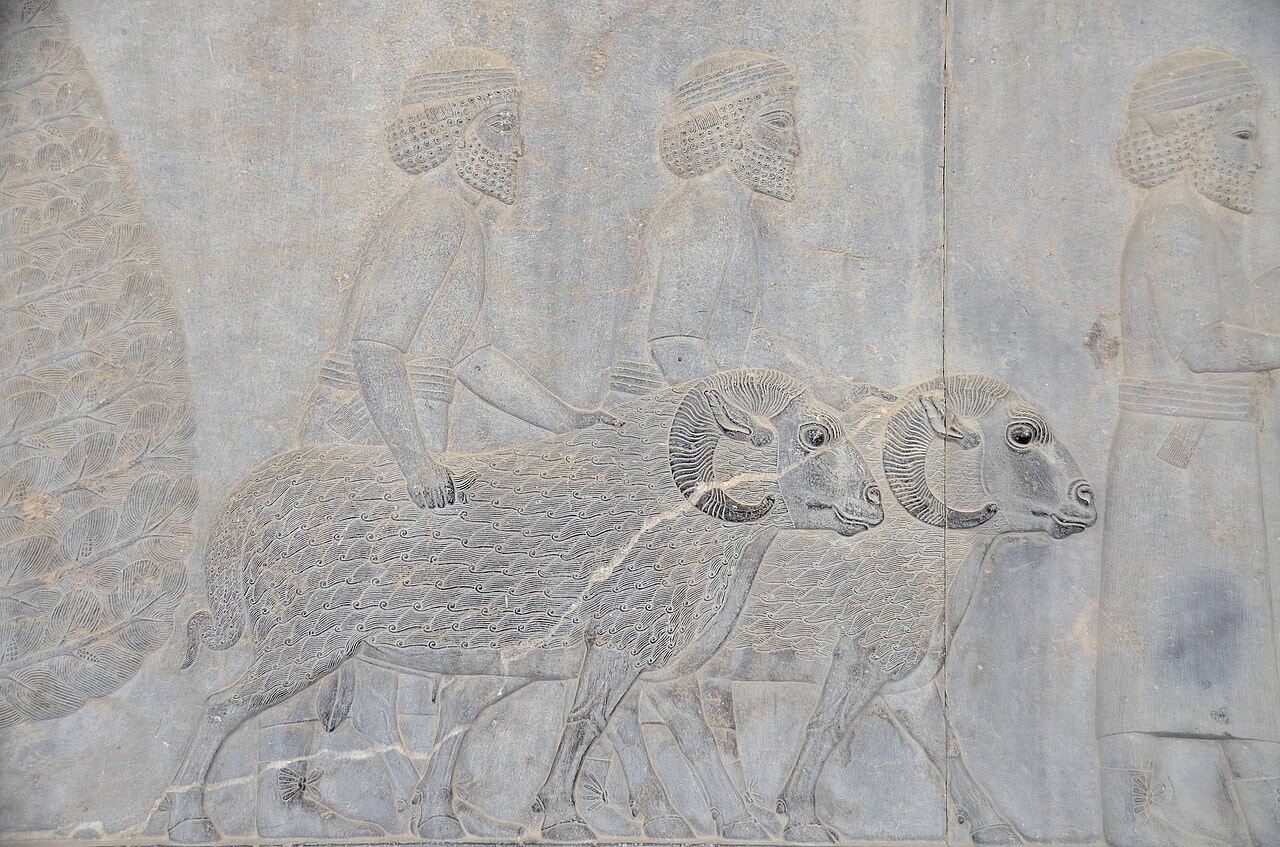
A delegation from Syria, part of the lands Beyond-the-River, bringing rams as tribute to the Persian king, on the eastern stairway of the Apadana at Persepolis, Iran, carved in the reigns of Darius I and Xerxes I. Photo: Carole Raddato, CC BY-SA 2.0, via Wikimedia Commons, resized.

See this page's graph and discover linked topics
In full
In Ezra 5-6, written in Aramaic, Tattenai, "governor beyond the River" (Aramaic paḥat 'abar-naharah), together with Shethar-bozenai and their colleagues, visits Jerusalem in about 520 BC, asks the elders who gave them a decree to build, takes their names, and lets the work continue while he writes to Darius I. His letter (Ezra 5:6-17) reports the elders' answer that Cyrus the Great had authorized the house, and asks the king to have the archives searched. Darius's reply (Ezra 6:6-12) orders Tattenai to keep away, to let the work proceed, and to pay its expenses from the provincial tribute. "Then Tattenai, the governor beyond the River, Shethar-bozenai, and their companions, because that Darius the king had sent, did accordingly with all diligence" (Ezra 6:13, ASV).
Outside the Bible, a Babylonian promissory note in the Vorderasiatisches Museum in Berlin, first drawn by Arthur Ungnad and published by A. T. Olmstead in 1944, names "Tattannu, governor of Across-the-River" (Akkadian Ebir-nari) among the parties. It is dated to the twentieth year of Darius I, which Lawrence Mykytiuk gives as exactly 5 June 502 BC. Mykytiuk added Tattenai to his list in 2017 ("Archaeology Confirms 3 More Bible People," BAR 43:3), on the grounds that the name, the office and the reign all match.
In the Bible
- Ezra 5:3. "At the same time came to them Tattenai, the governor beyond the River, and Shethar-bozenai, and their companions, and said thus unto them, Who gave you a decree to build this house, and to finish this wall?" (ASV).
- Ezra 5:5. "But the eye of their God was upon the elders of the Jews, and they did not make them cease, till the matter should come to Darius."
- Ezra 5:6-17. Tattenai's letter to Darius, asking for a search of the archives.
- Ezra 6:6-7. Darius's reply: "Now therefore, Tattenai, governor beyond the River, Shethar-bozenai, and your companions the Apharsachites, who are beyond the River, be ye far from thence: let the work of this house of God alone" (ASV).
- Ezra 6:13. Tattenai complies "with all diligence."
Family and lineage
Nothing is known of Tattenai's family. The name is generally analyzed as Babylonian or Akkadian, but its etymology is uncertain. In the administrative hierarchy he stood below the satrap of Babylon and Beyond-the-River, who in 520 BC was Ushtani (Greek Hystanes) according to Babylonian documents, and above the local governor of Judah, Zerubbabel.
Historical and archaeological evidence
| Item | What it says | Date | Location | Grade |
|---|---|---|---|---|
| Babylonian promissory note | Names Tattannu, governor of Across-the-River (Ebir-nari), in a business transaction | 20th year of Darius I; 5 June 502 BC | Vorderasiatisches Museum, Berlin (hand copy by Arthur Ungnad) | Very strong: name, title and reign match; Mykytiuk no. 50 |
- Publication. A. T. Olmstead, "Tattenai, Governor of 'Across the River'," Journal of Near Eastern Studies 3 (1944), p. 46; David E. Suiter, "Tattenai," Anchor Bible Dictionary vol. 6 (1992), p. 336; Mykytiuk, BAR 43:3 (2017).
- Why the grade is very strong rather than direct. The tablet is not his own seal or inscription, and it falls about eighteen years after the events of Ezra 5. A governor serving that long is plausible, and Mykytiuk judges the identification secure, but the gap is worth stating.
Scholarly consensus
- Identification. Accepted by Olmstead, Mykytiuk and standard reference works; the matching office in the same reign makes coincidence unlikely.
- The Ezra correspondence. Many scholars, among them H. G. M. Williamson, regard the Aramaic letters of Ezra 4-6 as reflecting authentic Persian administrative style, including the investigative report and the request for a search of archives. Others, for example Lester Grabbe, think the letters were edited or composed later. Tattenai's attestation does not settle the authenticity of the letters, but it confirms that the official named in them held that office under that king.
- Characterization. Commentators widely note that Ezra presents Tattenai fairly: an official doing his job, who investigates, reports and then obeys.
Theological significance
- Opposition that becomes provision. Tattenai's inquiry could have stopped the work. Instead it led to the rediscovery of Cyrus's decree and to royal funding of the Temple. Ezra frames the outcome theologically: "the eye of their God was upon the elders of the Jews" (Ezra 5:5).
- A fair portrait of an outsider. Ezra does not cast Tattenai as a villain. The book's interest is in God's governance of events through the ordinary machinery of empire.
- Credible minor detail. A governor's name, his colleague's name, his title and his reign are details a later writer would struggle to get right. The tablet shows Ezra recorded them correctly.
Church Fathers
No patristic commentary focused on Tattenai has been located.
Scholarship
Published academic works this page draws on, each matched to a publisher, index or library catalog record.
- A. T. Olmstead, "Tattenai, Governor of 'Across the River'," Journal of Near Eastern Studies 3 (1944). doi:10.1086/370700
See also
- People of the Bible, every person in the codex's biblical-figures series, grouped by book of first mention
- Darius I, the king he wrote to
- Cyrus the Great, whose decree was found in the archives
- Cyrus Cylinder, the Persian policy toward local sanctuaries
- Biblical Figures Confirmed by Archaeology, Mykytiuk's list, to which Tattenai was added in 2017
- Lawrence Mykytiuk, whose criteria the grade follows
- Ezra, the book's passages
Common questions this page answers
Q: Who was Tattenai in the Bible?
He was the Persian governor of Beyond-the-River, the province west of the Euphrates that included Judah, under Darius I. In Ezra 5-6 he questioned the rebuilding of the Temple, wrote to the king, and then carried out Darius's order to let the work go on.
Q: Has archaeology confirmed Tattenai?
Yes. A Babylonian tablet dated to the twentieth year of Darius I (502 BC) names Tattannu, governor of Across-the-River. Lawrence Mykytiuk added him to his list of confirmed biblical persons in 2017.
Q: Was Tattenai an enemy of the Jews?
Not in Ezra's account. He investigated and reported to the king but did not stop the work while waiting for an answer, and when Darius confirmed the decree he obeyed "with all diligence" (Ezra 6:13).