Person
Taharqa
Tirhakah, Taharqo, Taharka, Tarqu, Tirhakah king of Ethiopia, Pharaoh TaharqaIntro
Taharqa was a king from Kush, the African kingdom on the Nile in what is now Sudan, who ruled both Kush and Egypt from 690 to 664 BC. He belonged to the Twenty-fifth Dynasty, the line of Kushite kings often called the "Black Pharaohs." The Bible names him: when the Assyrian king Sennacherib was threatening Jerusalem in the days of King Hezekiah, he heard that "Tirhakah king of Ethiopia" was marching out to fight him (2 Kings 19:9; Isaiah 37:9, KJV).
Taharqa is one of the best documented people the Bible mentions. His own inscriptions, his temples in Sudan and Egypt, his pyramid at Nuri, and the records of his Assyrian enemies all survive. He is a clear case of an African king who appears in Scripture and in the archaeological record together.
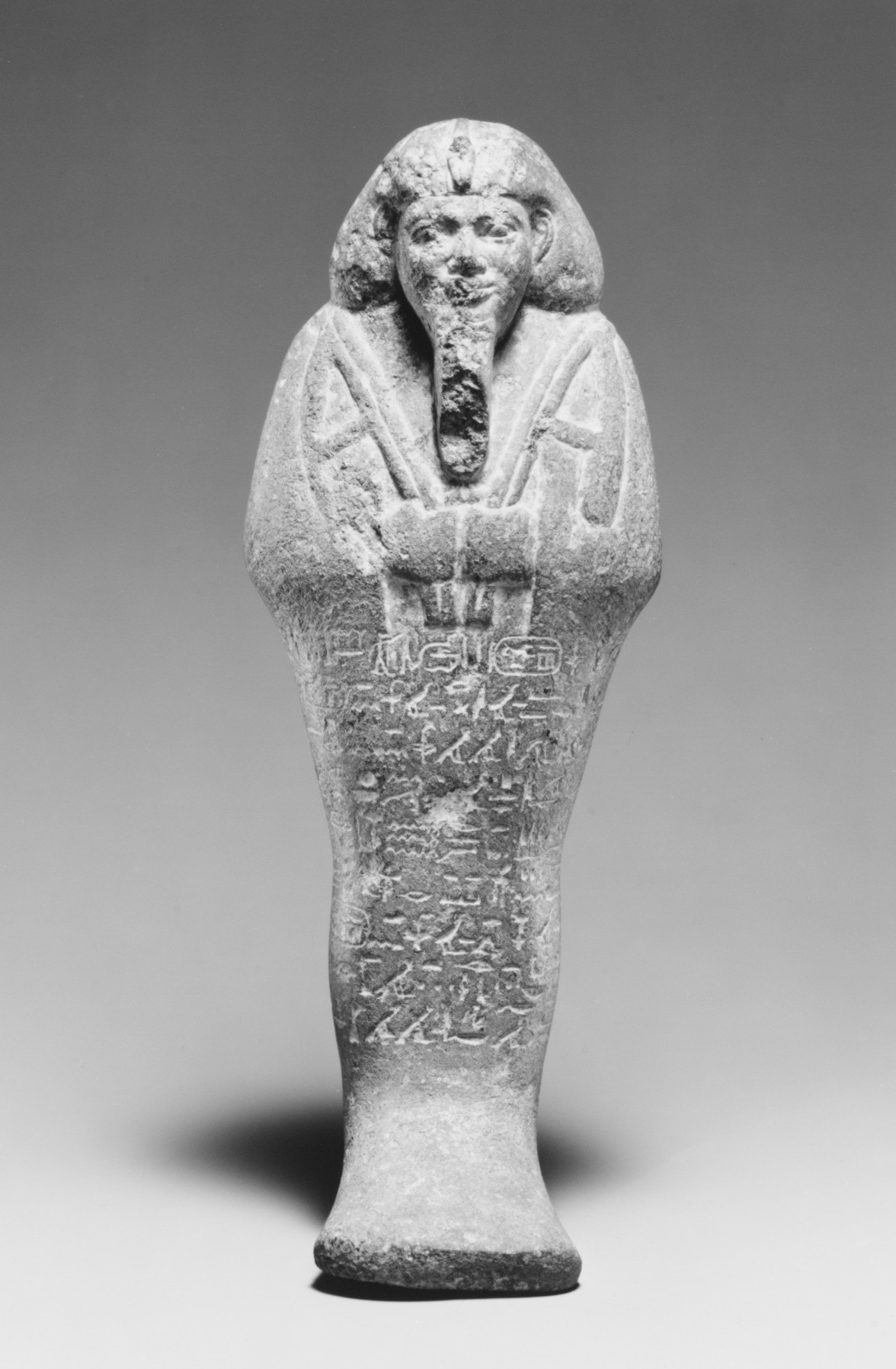 Shabti (funerary figure) of King Taharqa, Kushite, Twenty-fifth Dynasty, reign of Taharqa (690-664 BC), Metropolitan Museum of Art. CC0 public domain (Wikimedia Commons), resized.

See this page's graph and discover linked topics
In full
Taharqa (Egyptian Taharqa, Assyrian Tarqû, Hebrew Tirhaqah) was a son of Piye, the Kushite king who conquered Egypt around 728 BC. He came north to Egypt as a young man with the reigning king, and he was crowned at Memphis in 690 BC after his predecessor's death. For twenty-six years he ruled a "double kingdom" stretching from the Fourth Cataract of the Nile to the Mediterranean, built on a scale not seen in Egypt for centuries, and fought the Assyrian Empire for control of Egypt. He was driven out of Lower Egypt by Esarhaddon in 671 BC and again by Ashurbanipal, and he died in 664 BC. He was buried at Nuri in Kush and succeeded by Tantamani.
In the Bible he appears once, in the parallel accounts of Sennacherib's campaign against Judah in 701 BC: Sennacherib "heard say of Tirhakah king of Ethiopia, Behold, he is come out to fight against thee" (2 Kings 19:9, KJV; Isaiah 37:9). The Hebrew calls him melek Kush, king of Cush.
The Kushite dynasty and Judah
- Kush before Taharqa. The kingdom centred at Napata, below the holy mountain of Gebel Barkal, worshipped Amun and saw itself as the true guardian of Egyptian tradition. Piye's victory stela records his conquest of Egypt in the late eighth century BC.
- Judah looks south. As Assyria advanced, Judah's kings and parties looked to Egypt and Kush for help. Isaiah 18 addresses "the land shadowing with wings, which is beyond the rivers of Ethiopia" (Isaiah 18:1, KJV), describing a tall, smooth-skinned people feared far and near, very probably Kushite envoys. Isaiah 20 warns against trusting Egypt and Cush after Assyria took Ashdod (711 BC). Sennacherib's officer mocks Egypt as "this bruised reed" (2 Kings 18:21, KJV).
- 701 BC. Sennacherib's own annals record that "the kings of Egypt" and the bowmen, chariots and horses of "the king of Meluhha" (the Assyrian term here for Kush) came to help the rebels, and that he fought them at Eltekeh. See Sennacherib Prism, Sennacheribs Siege Ramp at Lachish and Hezekiahs Tunnel and Siloam Inscription.
The 701 BC chronology question
Taharqa became king in 690 BC, eleven years after Sennacherib's campaign of 701. How could he be "king of Cush" in 701?
- Prince-commander, titled as king (most common view). K. A. Kitchen and others hold that Taharqa led the Kushite-Egyptian army in 701 as a prince under the reigning king, and the biblical writer, composing after his accession, called him by the title he later held, as we speak of "President Lincoln" in his years as a lawyer. Taharqa's own Kawa stela says he came north as a young man of twenty with the king's army, which fits a role as commander in this period. Jeremy Pope's study of his reign (2014) also allows that he could have commanded as a subordinate in 701.
- Two campaigns. John Bright and others proposed that the Bible merges Sennacherib's campaign of 701 with a second, later one (c. 688), when Taharqa was already king. No Assyrian record of a second campaign against Judah has been found, and most scholars have abandoned this view.
- Anachronism. Some critical scholars regard the reference as a later writer's mistake.
The first view explains the text without forcing it and fits the Egyptian evidence. See also Isaiah the Prophet.
Henry T. Aubin (The Rescue of Jerusalem, 2002) argued that the Kushite army's intervention, not only plague or divine action, explains why Sennacherib withdrew without taking Jerusalem. The Bible attributes the deliverance to the angel of the LORD (2 Kings 19:35), and Sennacherib's annals boast of shutting Hezekiah up "like a bird in a cage" without claiming the city's capture. Aubin's thesis has drawn interest and strong criticism; it is best treated as one historical reconstruction among several.
Archaeology
| Site or object | What it is | What it shows |
|---|---|---|
| Kawa stelae | Large granite stelae from the temple of Amun at Kawa (ancient Gematon), Sudan, excavated by an Oxford expedition in the 1930s | Taharqa's own account: his journey north at twenty with the king's army, his coronation at Memphis, the exceptionally high Nile and abundant harvest of his sixth year, and his rebuilding of the Kawa temple |
| Shrine and sphinx from Kawa | A sandstone shrine (now in the Ashmolean Museum, Oxford) and a granite sphinx of Taharqa (British Museum) | His portrait as a lion-bodied king with distinctly Kushite features and the double uraeus of the Kushite kings |
| Sanam | Temple built by Taharqa near Napata, excavated by F. Ll. Griffith in 1912-13 | Inscribed lists of peoples he claimed to rule or defeat |
| Gebel Barkal | Temples to Amun at the holy mountain of Napata, enlarged by Taharqa | The religious centre of the Kushite monarchy |
| Karnak and Thebes | Colonnades, gateways and the Edifice of Taharqa by the sacred lake | Building on a pharaonic scale in Egypt itself |
| Nuri pyramid (Nu. 1) | His tomb, the largest pyramid of the Nuri royal cemetery, excavated by George Reisner (1916-18) | More than a thousand shabti figures were found in it, like the one pictured above |
| Esarhaddon's stela from Zincirli | Assyrian victory stela (now in Berlin) | Shows Esarhaddon holding captives on cords; the kneeling figure in Egyptian dress is usually identified as Taharqa's son, the crown prince Ushanahuru, captured at Memphis in 671 BC |
| Assyrian and Babylonian chronicles | Annals of Esarhaddon and Ashurbanipal; the Babylonian Chronicle | Esarhaddon's defeat in Egypt in 674 BC, his capture of Memphis and Taharqa's family in 671, and Ashurbanipal's campaigns that drove Taharqa south |
Why he matters
- An African king in the biblical record. Taharqa's appearance in 2 Kings and Isaiah, confirmed by his own monuments and his enemies' annals, is a firm point where Scripture's Cush and the archaeology of Sudan meet.
- Kush as a world power. The Bible's Cush is not a distant fringe. For a time it ruled Egypt and contested the ancient Near East with Assyria. This is the world behind the Cushite figures of the prophets, such as Ebed-melech.
- The historical reliability of Kings and Isaiah. The accounts name the right king of the right nation in the right conflict, consistent with the Assyrian evidence. See Sennacherib Prism.
- Background to African Christianity. The same Nile lands later became Christian Nubia, and the "Ethiopia" of the Kandake in Acts 8 is the successor kingdom of Meroe. See Ethiopian Eunuch and Christian Nubia.
Scholarship
Published academic works this page draws on, each matched to a publisher, index or library catalog record.
- Henry Trocme Aubin, The Rescue of Jerusalem: the alliance between Hebrews and Africans in 701 BC (2002). Open Library
See also
- Africans in Scripture Argument, the cumulative case for African presence in Scripture
- Africa in the Table of Nations, where Cush first appears
- Sennacherib Prism, the Assyrian account of the 701 BC campaign
- Sennacheribs Siege Ramp at Lachish, archaeology of the same campaign
- Isaiah the Prophet, whose book names Tirhakah
- Ebed-melech, a Cushite at the Judean court a century later
- Christian Nubia, the later Christian kingdoms of the same land
- Africa and Christianity
Common questions this page answers
Q: Who was Tirhakah in the Bible?
Tirhakah is the biblical name of Taharqa, a Kushite king who ruled Kush and Egypt from 690 to 664 BC. 2 Kings 19:9 and Isaiah 37:9 say Sennacherib heard that "Tirhakah king of Ethiopia" was coming out to fight him.
Q: Was Taharqa a Black pharaoh?
Yes. He was a king from Kush, in today's Sudan, and belonged to the Twenty-fifth Dynasty of Kushite rulers who governed Egypt, often called the Black Pharaohs.
Q: How could Tirhakah be king in 701 BC if he began to reign in 690 BC?
The most common view is that he commanded the Kushite army as a prince in 701 and the biblical writer used the royal title he later held. His own Kawa stela says he came north with the army as a young man.
Q: Where is Taharqa buried?
At Nuri in northern Sudan, in the largest pyramid of the royal cemetery there. George Reisner excavated it and found more than a thousand funerary figurines of the king.
Q: Is there archaeological evidence for Taharqa?
A great deal: his stelae and temple at Kawa, the temples at Sanam and Gebel Barkal, buildings at Karnak, his pyramid at Nuri, statues and sphinxes, and Assyrian records of his wars with Esarhaddon and Ashurbanipal.
Q: Did the Kushite army save Jerusalem from Sennacherib?
Sennacherib's annals confirm that a Kushite-Egyptian force came against him in 701 BC. The Bible credits Jerusalem's deliverance to the angel of the LORD. Henry Aubin argued the Kushites were decisive, but that reconstruction is debated.