Concept
Stoicism
Stoic, Stoics, Stoic philosophy, the Stoa, Stoic ethics, apatheia, Stoic apatheia, Stoic logos, is virtue sufficient for happiness, Stoicism vs Christianity, Christian critique of Stoicism, modern StoicismIntro
Stoicism is a school of philosophy founded in Athens around 300 BC. It teaches that the only true good is a good character, and that a wise person stays calm because he judges everything correctly. Its best-known teachers are Seneca, Epictetus and the Roman emperor Marcus Aurelius, and their books are popular again today as guides to discipline and self-control.
Christians have always found a lot to admire here: courage, self-control, duty, contentment, and the idea that the universe is ordered by reason. Paul met Stoic philosophers in Athens and quoted a line from their tradition. Early Christian writers borrowed Stoic words freely.
The disagreements are just as deep. Stoicism says virtue alone is enough for a happy life. Christianity says people were made for love and for God, and that virtue is the road toward that goal, while the goal itself lies beyond any human achievement. Stoicism's "Logos" is the reason built into the material world. John's Logos is a Person who made the world and then became flesh. And the Stoic sage tries to rise above grief, while Jesus stood at his friend's grave and wept.
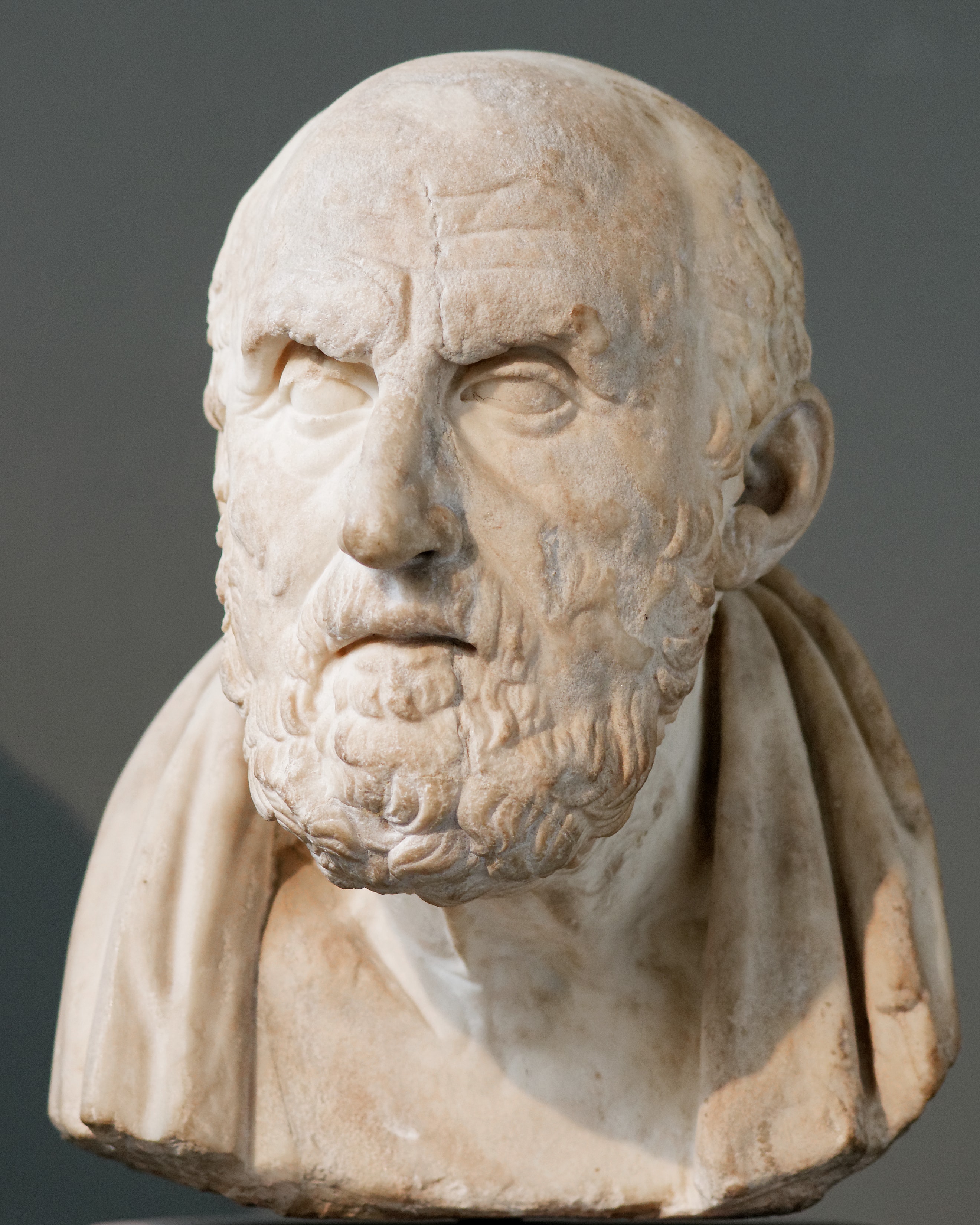
Chrysippus of Soli (c. 279-206 BC), the "second founder" of Stoicism. Roman marble copy after a Hellenistic original, British Museum. Photograph by Marie-Lan Nguyen, public domain, via Wikimedia Commons.
See this page's graph and discover linked topics
In full
Stoicism is a Hellenistic system with three parts: logic, physics and ethics. Its physics is a materialist pantheism: the cosmos is a single living body pervaded by an active rational principle (logos, also called pneuma, fire, Zeus, providence, fate), so that God and the ordered universe are one. Its ethics is eudaimonist: the human end (telos) is "living in agreement with nature" (Zeno, reported by Diogenes Laertius VII.87), which means living by right reason. Virtue is the only good and vice the only evil. Health, wealth, reputation, friends and life itself are "indifferents" (adiaphora), some "preferred" and some "dispreferred", but none contributes to happiness. Because the passions (pathē) are false judgments that something indifferent is good or evil, the sage is free of them (apatheia), though he does feel three "good feelings" (eupatheiai): joy, caution and rational wishing (Diogenes Laertius VII.116).
The Christian assessment, from the Apologists to Augustine and Aquinas, is one of qualified appropriation. Christianity shares the Stoic confidence in a rationally ordered cosmos, a natural moral law, the cardinal virtues, and contentment under providence. It rejects four Stoic theses: that virtue is sufficient for flourishing; that an impersonal, immanent logos can ground moral obligation; that God is identical with the material cosmos; and that the passions as such are diseases to be extirpated. The strongest line of attack is the sufficiency of virtue, because it targets a defining doctrine, avoids the caricature that Stoics are emotionless, and moves the debate onto the question of what human beings are for.
The school in brief
| Period | Figures | Notes |
|---|---|---|
| Early Stoa (Athens) | Zeno of Citium (c. 334-262 BC), Cleanthes (c. 330-230 BC), Chrysippus (c. 279-206 BC) | Named after the Stoa Poikilē, the Painted Porch where Zeno taught. Cleanthes wrote the Hymn to Zeus. Chrysippus systematized the logic and physics. |
| Middle Stoa | Panaetius (c. 185-110 BC), Posidonius (c. 135-51 BC) | Brought Stoicism to Rome; softened some early doctrines. |
| Roman Stoa | Seneca (c. 4 BC-AD 65), Musonius Rufus, Epictetus (c. AD 50-135), Marcus Aurelius (AD 121-180) | Mostly practical ethics: letters, discourses, private notebooks (Meditations). |
Almost all early Stoic writing is lost. What survives comes through later reporters such as Diogenes Laertius (book VII), Cicero (On Ends, Tusculan Disputations, On the Nature of the Gods), Seneca, Plutarch and Sextus Empiricus.
Core doctrines
- The dichotomy of control. Some things are up to us (our judgments, impulses, desires and aversions) and some are not (body, property, reputation, office). Peace comes from caring only about the first (Epictetus, Enchiridion 1).
- Judgments, not events, disturb us. People are troubled by their opinions about things rather than by the things themselves (Enchiridion 5).
- Virtue is the only good. Wisdom, justice, courage and moderation are one unified excellence of reason. Everything else is indifferent.
- Live according to nature. Nature is rational, so following nature means following reason, both the cosmic reason and your own share of it.
- The logos and providence. One divine reason pervades and governs all things. Whatever happens is fated, and the wise person accepts it willingly.
- Corporealism and pantheism. Only bodies act and are acted upon, so God is a body: a fiery, intelligent breath (pneuma) mixed through all matter. The cosmos periodically dissolves into fire (ekpyrōsis) and is reborn, repeating the same history.
- Apatheia and the good feelings. The four passions (distress, pleasure, fear, appetite) are mistaken judgments. The sage replaces them with joy, caution and wishing.
- Cosmopolitanism. All rational beings are citizens of one world-city, an idea that fed into later natural-law thought.
Points of real overlap with Christianity
- Order and reason in the world. Both hold that the cosmos is intelligible because reason stands behind it. See Logos Christology.
- Natural moral law. The Stoic idea of a law of right reason binding all people anticipates Romans 2:14-15 and the later natural-law tradition of Thomas Aquinas.
- The cardinal virtues. Prudence, justice, fortitude and temperance passed from Plato and the Stoics into Christian moral theology. See Virtue Ethics.
- Contentment under providence. Paul says, "I have learned, in whatsoever state I am, therein to be content" (Philippians 4:11, ASV). The word is autarkēs, "self-sufficient," a Stoic watchword. Paul then relocates its source: "I can do all things in him that strengtheneth me" (Philippians 4:13, ASV). Stoic self-sufficiency becomes Christ-sufficiency.
- Early Christian appreciation. Justin Martyr said the Stoics taught admirably in ethics because a seed of the Word was implanted in every race of men (Second Apology 8). Tertullian could call Seneca "often our own" (On the Soul 20). A forged correspondence between Seneca and Paul circulated from the fourth century, a sign of how close the two seemed.
Paul and the Stoics at Athens
Acts records that "certain also of the Epicurean and Stoic philosophers encountered him. And some said, What would this babbler say? others, He seemeth to be a setter forth of strange gods: because he preached Jesus and the resurrection" (Acts 17:18, ASV).
Paul's speech on the Areopagus (Acts 17:22-31) is a model of engagement with Stoics:
- He builds on shared ground. God gives life and breath to all and is not far from any of us: "for in him we live, and move, and have our being; as certain even of your own poets have said, For we are also his offspring" (Acts 17:28, ASV). The second line is usually traced to Aratus of Soli (Phaenomena 5), a poet shaped by Stoic thought; a close parallel stands in Cleanthes' Hymn to Zeus.
- He corrects the pantheism. God is "The God that made the world and all things therein" (Acts 17:24, ASV), the Creator, distinct from what he made, who does not live in temples.
- He breaks the cycle. Against an endlessly repeating cosmos, Paul announces a fixed day of judgment and a man raised from the dead (17:31). The resurrection is what drew mockery (17:32), because a body raised to everlasting life fits neither the Stoic cycle of conflagration nor the Platonist hope of escape from the body.
See also Pantheism vs the Christian God.
The Christian critique
1. Is virtue sufficient for flourishing?
This is the primary defeater.
- The Stoic claim. Virtue is the only good and is sufficient for eudaimonia. A wise person on the rack is happy.
- The test case. Imagine someone with perfect courage and wisdom who is permanently cut off from everyone he loves. The Stoic must say his flourishing is untouched. Most people, Stoics in their unguarded moments included, judge that something good has been lost.
- The deeper issue is axiology, the theory of value. Does virtue exhaust intrinsic human good, or do love, friendship and communion carry value of their own? If persons are relational by nature, a life of excellent conduct that lacks communion is incomplete.
- The Christian claim. The human end is communion with God: "this is life eternal, that they should know thee the only true God, and him whom thou didst send, even Jesus Christ" (John 17:3, ASV). The great commandment is love of God and neighbor (Matthew 22:37-40). Virtue matters because it fits us for that communion; it is the road, and God is the destination. Augustine makes this argument against the philosophers in City of God XIX.4: they located the supreme good in this life and in themselves.
Syllogism (modus ponens):
- If human flourishing necessarily includes communion with God, then virtue alone is insufficient for complete human flourishing.
- Human flourishing necessarily includes communion with God.
- Therefore, virtue alone is insufficient for complete human flourishing.
The form is valid (Modus Ponens). The weight sits on premise 2, which the Christian must defend, for example from the restlessness that no achievement satisfies (see Argument from Restlessness) and from the irreducible value people place on love (see Argument from Love). An analogy helps: a car with perfect brakes, steering and tires is in excellent condition, but its condition does not tell you where it is going. Self-control perfects how a person acts. It does not settle what a person is for.
2. What grounds the authority of nature?
- The Stoic claim. Living according to nature is living rightly.
- The problem. Nature contains cooperation and also predation, parasitism and decay. Nature taken as a whole does not tell us which behaviors to imitate. A description of how things work does not by itself yield how we ought to act. This is the gap David Hume pressed in the Treatise (3.1.1). See Is-Ought Fallacy.
- The Stoic reply, steel-manned. The Stoic does not mean "imitate whatever happens." He means "follow your rational and social nature." Reason is the governing part of a human being, so acting by reason is acting well.
- The rejoinder. Why does rational nature carry authority, so that departing from it is a fault and not merely a different way of functioning? If the logos is an impersonal, material principle, its "commands" are only descriptions of how the cosmos tends to go. Obligation is something one person owes another. A personal, good Creator who made human nature for an end can ground that obligation; a fiery breath mixed through matter has no evident standing to bind anyone. See Moral Argument.
Syllogism:
- A description of how nature operates does not, by itself, establish how rational agents ought to act.
- A description of rational human nature, without further normative premises, describes how humans function.
- Therefore, a description of rational human nature cannot by itself establish moral obligations.
The Stoic can add premises linking rationality, flourishing and virtue. The follow-up question is what makes those added premises objectively binding.
3. Pantheist logos versus the personal Logos
- Stoic logos: immanent, material, impersonal, identical with God-and-cosmos, subject to the cycle of conflagration.
- Johannine Logos: "In the beginning was the Word, and the Word was with God, and the Word was God. ... All things were made through him" (John 1:1, 3, ASV). The Logos is eternal, personal, distinct from creation as its maker, and "the Word became flesh, and dwelt among us" (John 1:14, ASV).
John took up a word his Greek readers knew and filled it with Hebrew content: the creative word of God in Genesis 1 and the personified Wisdom of Proverbs 8. The Stoic could say the world is rational. Only the Christian can say why reason is there at all: the world was spoken into being by a Mind. The Stoic system also faces a question it cannot answer from inside: if the logos is identical with the material universe, what explains why that universe exists? See Logos Christology, Argument from the Pre-Given Logos and Contingency Argument.
4. Jesus wept: grief and apatheia
- Fairness first. Stoics did not teach that one should feel nothing. They allowed joy, caution and rational wishing, and Seneca allowed the tears that come unbidden at a loss while forbidding prolonged lament (Moral Letters 63). Calling Stoics "emotionless" is a caricature.
- The real difference. For the Stoic, grief is a judgment that something evil has happened. Since only vice is evil, the death of a friend is not an evil, and grief is a mistake that the sage has outgrown. Epictetus advises that when you kiss your child you should remind yourself that it is mortal, so that its death will not disturb you (Enchiridion 3).
- The Christian datum. At the tomb of Lazarus, "Jesus wept" (John 11:35, ASV). He "groaned in the spirit, and was troubled" (John 11:33, ASV), knowing he was about to raise him. Jesus was angry at hardness of heart (Mark 3:5) and was "a man of sorrows" (Isaiah 53:3). He is the sinless one, "yet without sin" (Hebrews 4:15, ASV). If the one perfect human being grieved, grief at real loss is not a defect of wisdom.
- The argument. If grief can be the fitting response of love to the loss of something truly valuable, then eliminating all grief is not a moral improvement. It would mean loving less or valuing less. Paul does not tell the Thessalonians not to grieve. He tells them not to grieve "even as the rest, who have no hope" (1 Thessalonians 4:13, ASV). Scripture commands: "weep with them that weep" (Romans 12:15, ASV).
- Augustine's verdict. In City of God IX.4-5 Augustine argues that what matters about an emotion is its cause and its aim: a rightly ordered will has rightly ordered emotions, and compassion is a virtue. In XIV.9 he points to the grief and anger of Christ and concludes that, in this life, a total absence of feeling would be a worse condition than the passions it removes.
The grieving father. A father whose child has died keeps his self-control, treats others kindly and carries on with his duties, and he grieves deeply. Does his grief show a failure of virtue? The Christian says it shows what the relationship was worth. The Stoic must explain why a father who did not grieve would be wiser.
See Can God Have Lackful Emotions for the related doctrine of divine impassibility, which concerns God's nature and is a separate question from the human emotions of the incarnate Son.
5. Eternal recurrence and hope
Stoic physics has the cosmos dissolve into fire and repeat the same history. That leaves no final purpose for history and no personal future beyond it. Christianity offers a linear history with a beginning, a resurrection and a new creation. The comparison matters most at a graveside, which is where Stoic consolation and Christian hope part ways.
Cross-examination questions
- "If virtue is sufficient for complete flourishing, why should communion with other people have any value that virtue lacks?"
- "What gives rational nature moral authority, as opposed to simply describing what human beings can do?"
- "If a person grieves for someone they love in proportion to that person's worth, what makes the grief a defect?"
- "If the cosmic logos is identical with the material universe, what explains why that universe exists at all?"
- "Can Stoicism establish the highest purpose of human life without first assuming its own account of nature and the good?"
The first four target central doctrines. The fifth tests whether the system's foundations are argued for or simply assumed.
A short debate statement: "Stoicism teaches real virtues: courage, discipline, self-control. I question its account of the highest good. Why should virtue alone be enough for a complete human life? Why does nature carry moral authority? And why is grief over a loved one a failure of wisdom? Christianity gives a different account. Our moral capacities serve a purpose given by a personal God, and our highest good is communion with Him. The burden is on the Stoic to demonstrate that virtue alone is sufficient."
Modern Stoicism
Popular modern Stoicism, the "dichotomy of control" as a tool for resilience, is close to cognitive behavioral therapy, whose founders acknowledged a debt to Epictetus. Most modern adopters keep the ethics and drop the physics: no fiery logos, no providence, no cyclical cosmos. That raises the grounding question in a sharper form. Without the providential logos, why should the universe deserve calm acceptance, and why is virtue the only good? Christians can use Stoic practices with gratitude (attention to judgments, freedom from slavery to circumstances) while placing them inside a larger account in which the circumstances are governed by a Father who loves. See Philippians 4.11.
Scholarship
Published academic works this page draws on, each matched to a publisher, index or library catalog record.
- Marcia L. Colish, The Stoic Tradition from Antiquity to Early Middle Ages (Brill, 1985). doi:10.1163/9789004615618
- John Sellars, Stoicism (Acumen Publishing Limited, 2006). doi:10.1017/upo9781844653720
See also
- Logos Christology, the Greek and Hebrew background of John's Logos, including the Stoic logos
- Pantheism and Pantheism vs the Christian God, the metaphysics underneath Stoic physics
- Virtue Ethics, the tradition Stoicism belongs to and how Christianity took it up
- Is-Ought Fallacy, the gap between describing nature and binding the will
- Can God Have Lackful Emotions, divine impassibility, a separate question from Christ's human grief
- Argument from Restlessness, why no finite good satisfies
- Justin Martyr, the seed of the Word in pagan philosophy
- Augustine, the most thorough early Christian critic of Stoic passions
- Paul the Apostle, who debated Stoics at Athens
- The Unknown God, the Athenian altar Paul used to open his speech to the Stoics and Epicureans
Common questions this page answers
Q: What is Stoicism in simple terms?
Stoicism is an ancient Greek and Roman philosophy that says the only true good is a virtuous character and that peace comes from caring only about what is in your control: your own judgments and choices. Its famous teachers are Zeno, Seneca, Epictetus and Marcus Aurelius.
Q: Is Stoicism compatible with Christianity?
Partly. Christians share the Stoic emphasis on self-control, courage, duty and contentment, and early Christian writers borrowed Stoic vocabulary. But Stoicism teaches that virtue alone is enough for happiness, that God is the rational fire running through the material world, and that grief is a mistake. Christianity teaches that our highest good is communion with a personal Creator, who is distinct from the world, and that grief can be a fitting expression of love.
Q: What is the strongest Christian argument against Stoicism?
The sufficiency of virtue. Stoicism claims that virtue alone guarantees a flourishing life, even for someone who loses everyone they love. Christianity argues that human beings are made for communion with God and others, so virtue is necessary for flourishing but cannot complete it.
Q: Did Paul meet Stoics?
Yes. Acts 17:18 says Epicurean and Stoic philosophers in Athens debated Paul and brought him to the Areopagus. In his speech he quoted a line from their poetic tradition, "For we are also his offspring," and then corrected their pantheism by calling God the maker of the world and announcing the resurrection.
Q: Did Jesus contradict Stoic apatheia?
On grief, yes. The Stoic sage regards grief as a false judgment that something evil has happened. At Lazarus's tomb "Jesus wept" (John 11:35) and was deeply troubled, without sin. If the perfect human being grieved, grief at real loss is not a moral defect. Augustine made this argument in City of God XIV.9.
Q: Is the Stoic logos the same as the Logos in John 1?
No. The Stoic logos is an impersonal, material reason identical with the cosmos. John's Logos is eternal, personal, distinct from creation as the one through whom all things were made, and became flesh in Jesus. John used a familiar word and gave it Hebrew content from Genesis 1 and the personified Wisdom of Proverbs 8.