Argument
Spacetime Means the Universe Is Eternal Objection Defeater
Universe Is Spacetime So It Is Eternal Objection, The Universe Is Eternal Objection Defeater, Eternal Universe Objection Defeater, Universe Has No Beginning Objection Defeater, Finite but No Beginning Objection Defeater, Time Is Like a Sphere Objection Defeater, the universe always existed, is the universe eternal, infinite past needs no causeIntro
"The universe is spacetime. Time is part of the universe. So there was never a time when the universe didn't exist. It's eternal, and an eternal universe doesn't need a God."
You hear this in debates and comment threads, often with Stephen Hawking's name attached. It sounds airtight because it is short. It actually hides three slips.
First, the conclusion does not follow. Having time as one of your dimensions tells you nothing about how much time there has been. A ruler has length, and a ruler can still be twelve inches long. Spacetime can have a finite past just as easily as an infinite one.
Second, the word "eternal" is doing too many jobs. It can mean "an infinite past," "goes on forever," or "outside of time." Those are different claims. Something can begin and then go on forever, the way counting starts at 1 and never ends.
Third, even if the universe had no first moment, that would not explain why it exists. A chain with no first link still has to hang from something. A universe with no starting point is still a universe that might not have existed, and it still needs a reason to be there. Hawking himself said, in a 1996 lecture, that in the real time we live in, the universe still has a beginning.
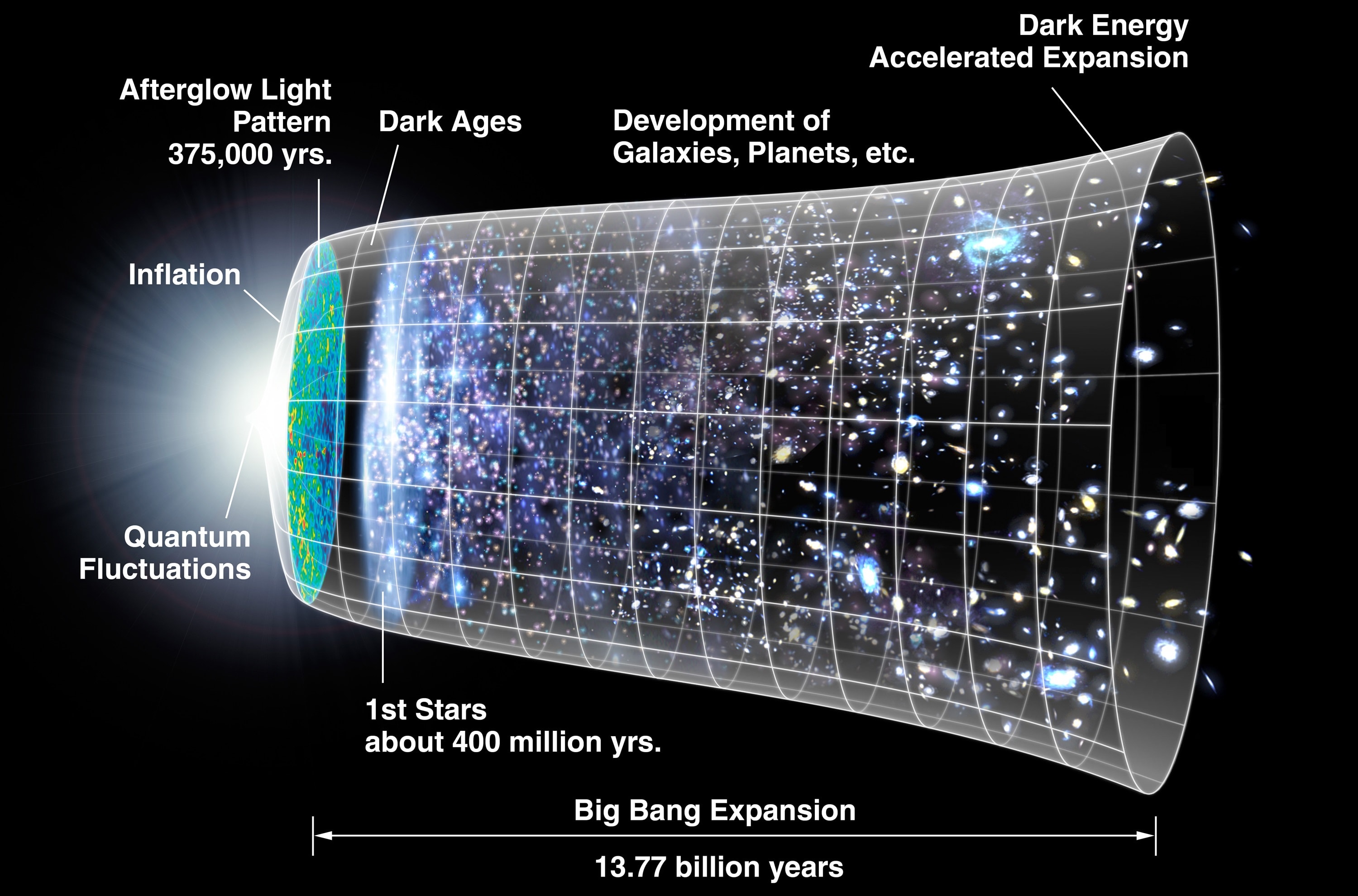
NASA's timeline of the universe, from inflation and the afterglow light at about 375,000 years through the first stars to today's accelerating expansion, over 13.77 billion years. Image: public domain, via Wikimedia Commons.
See this page's graph and discover linked topics
Cheatsheet
The 30-second reply:
Spacetime having a time dimension tells you there is time, and says nothing about how much. A finite past fits spacetime perfectly well, and the evidence points that way: Hawking himself said that in real time the universe still has a beginning. And suppose you were right that there was no first moment. A universe with no first moment is still a universe that could have failed to exist. Removing the first event does not remove the need for an explanation. So which do you mean: that time has no first moment, or that the universe needs no cause? Those are two different claims, and you have argued for neither.
The 5 fast facts:
- Hawking, 1996. "One would still expect some sort of Big Bang singularity in real time. So real time would still have a beginning." And: "The conclusion of this lecture is that the universe has not existed forever" (The Beginning of Time).
- The sphere analogy is about imaginary time. Hawking's "finite in extent, but without boundary" describes "space and imaginary time together," a mathematical device. See Hartle-Hawking No-Boundary Proposal.
- Expansion history. Our observable universe traces back about 13.8 billion years. The Borde-Guth-Vilenkin Theorem (2003) shows that a universe that has been expanding on average has a past boundary.
- Eternal-universe models are proposals. The steady-state universe (Bondi, Gold, Hoyle, 1948) was abandoned after the discovery of the cosmic microwave background. Aguirre and Gratton's "Inflation without a beginning" (Physical Review D, 2003) and Penrose's conformal cyclic cosmology (Cycles of Time, 2010) are theoretical proposals without observational confirmation.
- Beginning and dependence are separate questions. Classical theism holds that the world depends on God for its existence at every moment, so a beginningless world would depend on Him too (Colossians 1:17, Hebrews 1:3).
The 3 strongest counter-moves:
- "Does having a time dimension tell you how much time there has been?" No. So "spacetime" cannot by itself deliver "eternal."
- "Which eternal do you mean: infinite past, endless future, or timeless?" Each needs its own argument, and only the first is even in play.
- "Suppose there is no first moment. Why does this beginningless spacetime exist rather than nothing?" That question survives every answer about the shape of time.
Concessions to make freely:
- Yes, an infinite past with no first member is mathematically describable, like the negative numbers running back without end.
- Yes, a finite stretch of time with no first instant is mathematically describable, like the interval 0 < t ≤ 10.
- Yes, physicists have published past-eternal models. Now collect: a model is a proposal. The question is what the evidence and the best physics support, and Hawking's own answer in real time was a beginning.
What NOT to defend:
- Do not say spacetime "proves" a beginning by definition. That is the same definitional move the objector made, run backwards.
- Do not stake the whole case on the claim that an actual infinite is a mathematical contradiction. Mathematicians use coherent infinite sets every day. The Kalam's actual-infinite premise concerns concrete reality, and it is argued on its own page (Argument from the Impossibility of an Actual Infinite Past).
- Do not say "everything has a cause." The correct principles are that whatever begins to exist has a cause, and whatever exists contingently has an explanation. See Causal Principle.
The closing line: "Take away the first moment if you like. You still owe me a reason why there is a spacetime at all."
In full
Defeater for the objection: "The universe just is spacetime. Since time is a constituent of the universe, there was no time before the universe, so the universe has always existed. An eternal universe needs no cause, and so no God." A variant appeals to Stephen Hawking's no-boundary proposal: time is finite but has no beginning, as the surface of a sphere is finite but has no edge, so the universe has no first moment and no need of a creator.
The objection compresses three inferences, each of which fails independently. (1) Spacetime to infinite past: being four-dimensional entails that time is a constituent of the physical world, and says nothing about the measure of the past; a finite past is fully compatible with spacetime, so the inference is a non sequitur, and when defended "by definition" it begs the question. (2) "Always existed" to "past-eternal": the true and trivial reading (there is no time at which the universe does not exist, since times are internal to it) is compatible with a finite past; the substantive reading (an infinite past) needs evidence, and the best evidence, together with Hawking's explicit statement about real time, supports a finite past. Equivocation between the senses of "eternal" (past-infinite, future-everlasting, timeless) does the rest of the work. (3) Beginningless to self-explanatory: even granting a past with no first moment, finite or infinite, nothing follows about necessity or aseity; a beginningless sequence of contingent states is still contingent as a whole, as Leibniz's regress of copied geometry books illustrates, and classical theism has always held that creation's dependence on God is a matter of being held in existence, not only of being started. The defeater therefore closes both the cosmological door (a finite real-time past, which supports the Kalam Cosmological Argument) and the metaphysical one (contingency, which drives the Contingency Argument).
Argument structure
| Premise | Notes | |
|---|---|---|
| P1 | A time dimension does not fix the length of the past. Spacetime entails that time is part of the physical world; it is equally compatible with a finite and an infinite past. | Non sequitur exposed |
| P2 | "Eternal" has three senses, and infinity can have a start. Past-infinite, future-everlasting and timeless are different claims; a timeline can begin and run forever. | Equivocation exposed |
| P3 | The best physics supports a finite past in real time. Hawking (1996) affirms a beginning in real time; the no-boundary rounding is in imaginary time; BGV gives expanding universes a past boundary; past-eternal models remain unconfirmed proposals. | Evidential |
| P4 | No first moment does not mean no explanation. A past without a first instant, finite or infinite, is still the past of a contingent universe. | Beginning and dependence distinguished |
| P5 | A beginningless series of dependent states does not explain itself. Adding more dependent members, even infinitely many, never yields a reason for the whole. | Leibniz's regress |
| C | Identifying the universe with spacetime yields neither an eternal universe nor a self-explaining one; the universe still requires a ground of its existence, which is what theism names. |
Master objections to the whole argument
- "You're just pushing the question back. If the universe needs an explanation, so does God." The demand for explanation falls on what is contingent or begins to exist. God, as classically understood, is necessary and without beginning, so the same principle that asks for an explanation of the universe does not ask it of Him. See Who Created God Objection Defeater.
- "The universe is a brute fact. It just exists." Brute fact is a decision to stop explaining at the one place the question is hardest. The same person does not accept "it just exists" for a table, a planet or a fluctuation; the request is to exempt one contingent thing from the rule that applies to all the others. See Principle of Sufficient Reason.
- "Before the Big Bang there was no time, so asking what caused it is meaningless." The question is what grounds the existence of spacetime, which is an explanatory question about being. A cause can be prior in being without being prior in time, as the ground of a sustaining relation.
Premise 1, A time dimension does not fix the length of the past
Affirmative case
- Dimension is one thing, measure another. A road has length as a dimension, and roads are of every length. That spacetime includes time tells you that durations exist; it says nothing about whether the total past is finite.
- Finite-past spacetimes are standard physics. The Friedmann-Lemaître models used in mainstream cosmology describe a spacetime with a finite past. The objection, if it were valid, would rule out the standard cosmology by definition.
- The definitional route begs the question. If "the universe is eternal" is derived from "time is part of the universe" alone, the conclusion has been built into a meaning of the word. That establishes a fact about a word and leaves the past untouched.
Anticipated objections
- "There was no time before the universe, so the universe existed at every time. That's what eternal means."
- "Einstein showed space and time are one thing, so the universe can't have started in time."
Rebuttals
- True and trivial. If "eternal" means "existing at every time there is," it is compatible with a universe 13.8 billion years old. That sense gives no infinite past and no escape from the question of origin. Failure mode: equivocation on "always."
- Unification leaves the length open. Relativity unifies space and time into one geometry and leaves the length of the time direction to be settled by the model and the evidence. Relativistic models with a finite past are the textbook case.
Premise 2, "Eternal" has three senses, and infinity can have a start
Affirmative case
- Three senses. Past-eternal: an infinite past with no first moment. Everlasting: an endless future. Timeless: existence without temporal succession. Classical theology ascribes the third to God (Eternity (Divine)); the objection needs the first for the universe.
- Infinity can begin. The natural numbers 1, 2, 3 have a first member and no last. A timeline beginning at t = 0 and running forever, written [0, ∞), has a first moment and an infinite future. "Infinite" by itself does not mean "beginningless."
- Beginningless can be finite. The interval 0 < t ≤ 10 has finite length and no earliest instant. "No first moment" by itself does not mean "infinitely old."
| Model of time | Finite length? | First moment? |
|---|---|---|
| [0, 10] | Yes | Yes |
| (0, 10] | Yes | No |
| [0, ∞), begins and runs forever | No | Yes |
| (-∞, 0], an infinite past | No | No |
| A closed loop | Yes | No distinguished start |
Anticipated objections
- "An infinite universe obviously has no beginning."
- "Finite with no beginning is a contradiction, so if time has no beginning it must be infinite."
Rebuttals
- Which infinite? A universe can be infinite in its future and still have begun. The objector must specify an infinite past and argue for it.
- Both are coherent descriptions. Finite-without-first-instant and infinite-past are both mathematically consistent. That is why the decisive questions are what physical time is actually like (P3) and whether any shape of time explains existence (P4). Failure mode: treating a mathematical possibility as a physical fact.
Premise 3, The best physics supports a finite past in real time
Affirmative case
- Hawking on real time. In The Beginning of Time (1996) Hawking wrote that "real time would still have a beginning" and concluded "the universe has not existed forever." The edgeless sphere of his analogy is "space and imaginary time together."
- BGV. Borde, Guth and Vilenkin (Physical Review Letters 90, 2003) showed that any spacetime whose average expansion rate is positive along past-directed paths is past-incomplete, that is, it has a past boundary. See Borde-Guth-Vilenkin Theorem.
- Observation. The cosmic microwave background, light-element abundances and the expansion history all point to a hot, dense early state about 13.8 billion years ago. See Big Bang and Cosmic Microwave Background.
- The steady state's fate. The best-known eternal-universe model, the steady state of Bondi, Gold and Hoyle (1948), was abandoned by most cosmologists after the 1965 discovery of the cosmic microwave background. See Fred Hoyle.
Anticipated objections
- "Physicists have published models of a universe with no beginning."
- "Physics breaks down at the Big Bang, so we can't say anything about a beginning."
Rebuttals
- Proposals, unconfirmed. Aguirre and Gratton's "Inflation without a beginning: A null boundary proposal" (Physical Review D 67, 2003) and Penrose's conformal cyclic cosmology (2010) are serious theoretical work. Neither is observationally established, and each must evade BGV-type constraints with special assumptions. Aguirre and Gratton's model reverses the arrow of time at a boundary surface, which Vilenkin argues is still a past boundary (Mithani and Vilenkin, 2012). A published model is a possibility to be weighed against the evidence.
- Breakdown of a theory leaves the beginning in place. Where general relativity stops being predictive, the leading quantum-gravity proposals, the no-boundary proposal among them, still feature a finite past in real time. The philosophical question is whether the past is finite, and that answer does not wait on the equations at t = 0.
Premise 4, No first moment does not mean no explanation
Affirmative case
- Shape and existence are different questions. Whether time has an edge is a question about the structure of spacetime. Why spacetime exists at all is a question about its being. An answer to the first leaves the second open.
- The classical position. Classical theism has long held that the world's dependence on God does not require a temporal beginning to be shown: creatures depend on God as the light in a room depends on its source, at every moment. See Divine Conservationism and Third Way - Contingency.
- Contingency is untouched. A boundaryless or beginningless universe is still a universe whose existence is not required by its nature: its laws, constants and contents could have been otherwise, or absent. See Necessary vs Contingent Being.
Anticipated objections
- "If there's no first moment, there's no moment of creation, so there's nothing for God to do."
- "Physics explains each state by the one before. That's all the explanation there is."
Rebuttals
- Creation is a relation of dependence. On the Christian view God's creative act grounds the whole of spacetime, all of its moments together, including the earliest. A first moment is one way a created world can look; being created means depending on God for existence. See Hebrews 1:3, where the Son is "upholding all things by the word of his power" (ASV).
- State-to-state explains change, not existence. Explaining each state by an earlier one explains the transitions. It never explains why there is a series of states at all, which is the question asked. See P5.
Premise 5, A beginningless series of dependent states does not explain itself
Affirmative case
- Leibniz's books. In On the Ultimate Origination of Things (1697) Leibniz imagined a book of geometry copied from an earlier copy, and that from an earlier, back without end. However far back the copies go, you never find out why there is such a book at all or why it says what it says. Each copy explains the next, and the series explains nothing about itself.
- Adding members adds no reason. If every member exists only because of conditions outside itself, an infinite number of such members still exists only because of conditions outside itself. Infinity multiplies dependence and leaves it in place.
- The whole is contingent. A series made only of things that might not have existed is a series that might not have existed. See Contingency Argument.
Anticipated objections
- "Explain each member and you've explained the whole. Asking for more is a fallacy of composition." (The objection associated with David Hume.)
- "An infinite chain needs no anchor."
Rebuttals
- Composition is valid here. Composition fails for some properties (each brick small, the wall large) and holds for others (each tile red, the floor red). Dependence is the second kind: a whole made of dependent parts depends on something. And the question "why is there this series rather than none" is not answered by any member, since each member presupposes the series. Failure mode: mistaking a list of internal explanations for an explanation of the list.
- Length adds no support. A chain hanging with no end in sight still hangs from something. Making it longer, even infinitely long, does not make it self-supporting.
Tensions
- Is an actual infinite past impossible? Kalam defenders, notably William Lane Craig, argue that an actually infinite past is metaphysically impossible in concrete reality, which would close the infinite-past option on its own (Argument from the Impossibility of an Actual Infinite Past). Critics, and some theists, hold that an infinite past is at least logically coherent, since infinite sets are coherent in mathematics. This defeater does not settle the dispute and does not need to: P3 answers the infinite past on the evidence, and P4 and P5 hold even if an infinite past were possible.
- The proposal and its author. Hawking's 1988 popular book drew the moral that a boundaryless universe "would simply be," leaving no place for a creator; his 1996 lecture affirms a beginning in real time. Objectors usually cite the first. See Hartle-Hawking No-Boundary Proposal.
Live-cite kit
Scripture (ASV):
- In the beginning God created the heavens and the earth (Genesis 1:1, ASV)
- and he is before all things, and in him all things consist (Colossians 1:17, ASV)
- upholding all things by the word of his power (Hebrews 1:3, ASV)
- Before the mountains were brought forth, Or ever thou hadst formed the earth and the world, Even from everlasting to everlasting, thou art God (Psalm 90:2, ASV)
- They shall perish, but thou shalt endure; Yea, all of them shall wax old like a garment (Psalm 102:26, ASV)
Scholarly:
- Stephen Hawking, The Beginning of Time (1996): "real time would still have a beginning."
- Borde, Guth and Vilenkin, Physical Review Letters (2003): a universe expanding on average has a past boundary.
- G. W. Leibniz, On the Ultimate Origination of Things (1697): the regress of copied books never explains the book.
- William Lane Craig, British Journal for the Philosophy of Science (1990): the realist reading of the no-boundary model keeps a finite past.
Aphorism:
- "A dimension of time tells you there is time. It does not tell you how much."
- "No first link, still a chain. Still hanging from something."
- "Boundarylessness is a fact about shape. Existence is a fact that needs a reason."
Tactical notes
- Deployment order. Ask the clarifying question first ("which eternal?"), then P1 (the non sequitur), then Hawking's own 1996 line (P3), then pivot to P4 and P5. The pivot is the strongest ground, because it holds whatever the physics turns out to be.
- Force the commit. "Are you claiming time has no first moment, or that the universe needs no explanation?" Most objectors mean the second and have argued only the first.
- Use Hawking with care. Quote the 1996 lecture exactly. If the objector quotes A Brief History of Time, agree that Hawking said it, then show the later lecture.
- What NOT to defend: that infinity is a contradiction in mathematics; that "everything has a cause"; that spacetime proves a beginning by definition.
- Tone. The objector usually heard this from a respected source. Credit the physics, then separate the physics from the inference drawn from it.
Connection to Scripture
- Genesis 1:1, creation of the heavens and the earth, the whole physical order, "in the beginning."
- Colossians 1:16-17, all things created through Christ and held together in Him: origin and ongoing dependence in one sentence.
- Hebrews 1:3, the Son upholding all things, the sustaining relation P4 relies on.
- Psalm 90:2 and Psalm 102:25-27, God from everlasting, the created heavens growing old: the eternity of God contrasted with the temporality of the world.
- Acts 17:28, "in him we live, and move, and have our being": existence held in God, whatever the shape of time.
Patristic / scholarly note
Augustine (Confessions, book 11) argued that time itself is a creature, so that the question "what was God doing before He made heaven and earth?" misfires: there was no "before" until time was made. The codex develops the point at Argument from the Creation of Time. The medieval debate over whether reason alone can prove the world had a beginning, in which Thomas Aquinas held that the beginning is known by revelation while the world's dependence on God is provable either way, is the historical root of the distinction this page draws between beginning and dependence.
Scholarship
Published academic works this page draws on, each matched to a publisher, index or library catalog record.
- Anthony Aguirre and Steven Gratton, "Inflation without a beginning: A null boundary proposal," Physical Review D 67 (2003). doi:10.1103/physrevd.67.083515 open access
- Arvind Borde, Alan H. Guth and Alexander Vilenkin, "Inflationary Spacetimes Are Incomplete in Past Directions," Physical Review Letters 90 (2003). doi:10.1103/physrevlett.90.151301 PubMed 12732026 open access
- Edward Feser, Five Proofs of the Existence of God (2017). Open Library
- J. B. Hartle and S. W. Hawking, "Wave function of the Universe," Physical Review D 28 (1983). doi:10.1103/physrevd.28.2960
- Stephen Hawking, A Brief History of Time (stephen hawking, 1988). Open Library
- Audrey Mithani and Alexander Vilenkin, "Did the universe have a beginning?" (2012). arXiv:1204.4658
- Roger Penrose, Cycles of Time: An Extraordinary New View of the Universe (2010). Open Library
See also
- Hartle-Hawking No-Boundary Proposal, the physics behind the sphere analogy and Hawking's two presentations of it
- Stephen Hawking, his scientific work and his late metaphysical claims
- Kalam Cosmological Argument, the beginning premise this defeater supports
- Contingency Argument, the argument P4 and P5 rest on
- Borde-Guth-Vilenkin Theorem, the past-boundary result
- Infinity, the senses of the infinite
- Argument from the Impossibility of an Actual Infinite Past, the Kalam's philosophical premise
- Who Created God Objection Defeater, the reply to "then what explains God?"
- Quantum Fluctuations Are Uncaused Objection Defeater, the companion reply on causation
- The Only Shape That Fits Argument, what an explanation of contingent reality must be like
Common questions this page answers
Q: Is the universe eternal because it is made of spacetime?
No. That spacetime includes a time dimension tells you time exists and leaves open how much of it there has been. Spacetime is fully compatible with a finite past, and the standard cosmological models describe exactly that.
Q: Did Stephen Hawking believe the universe had a beginning?
In his 1996 lecture The Beginning of Time Hawking wrote that "real time would still have a beginning" and that "the universe has not existed forever." His no-boundary proposal removes a sharp edge in imaginary time, a mathematical tool, while leaving a beginning in real time.
Q: Can something be infinite and still have a beginning?
Yes. The counting numbers start at 1 and never end, and a timeline can begin at a first moment and continue forever. "Infinite" and "beginningless" are different properties.
Q: Can time be finite and have no beginning?
As mathematics, yes: a stretch of time like 0 < t ≤ 10 has a finite length and no earliest instant. Whether physical time is like that is a question for physics, and either way a universe without a first moment still needs an explanation for why it exists.
Q: If the universe had no beginning, would that disprove God?
No. Classical Christian theism holds that the world depends on God for its existence at every moment, not only at a first moment. A beginningless universe would still be contingent and would still need a ground of its existence.
Q: Does an infinite past explain itself?
No. An infinite series of states that each depend on something else is still dependent as a whole. Leibniz's example of a book copied from an earlier copy, back without end, shows that adding more members never explains why the series exists.