Person
So King of Egypt
So, Osorkon IV, So king of Egypt, Shilkanni, Pharaoh So, Sais king of EgyptIntro
So is the Egyptian king to whom Hoshea, the last king of Israel, turned for help against Assyria. The Bible mentions him once: Hoshea "had sent messengers to So king of Egypt, and offered no tribute to the king of Assyria" (2 Kings 17:4, ASV). The appeal failed. Shalmaneser V imprisoned Hoshea and besieged Samaria, and the northern kingdom fell.
Who So was is one of the harder identification problems in the Old Testament. The leading view, argued by K. A. Kitchen and accepted by Lawrence Mykytiuk, is that So is a shortened name for Osorkon IV, a pharaoh who ruled from Tanis in the eastern Delta, the part of Egypt nearest Israel. Other scholars read the text as a reference to the city of Sais.
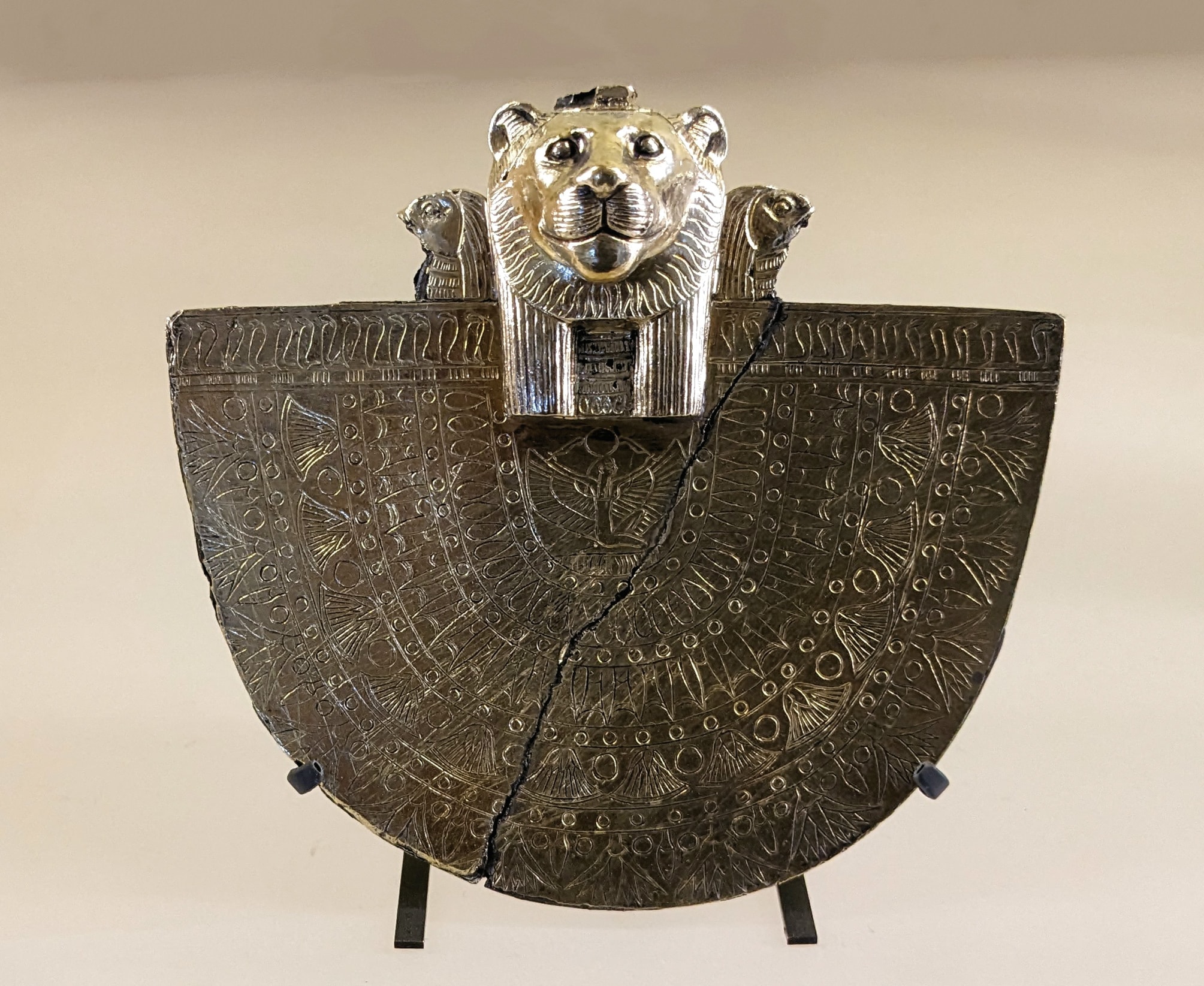 Aegis with a lioness head inscribed for King Osorkon IV and his mother, Queen Tadibastet, Twenty-second Dynasty, Louvre, Paris (E 7167). Photo: Shonagon, CC0 public domain, via Wikimedia Commons, resized.

The 30-second version:
So is the pharaoh Hoshea of Israel asked for help against Assyria around 725 BC (2 Kings 17:4). Egypt was then divided among several rulers. The most common identification is Osorkon IV of Tanis, the nearest Egyptian king to Israel, who is known from Egyptian monuments and probably from Sargon II's annals as "Shilkanni king of Egypt." A rival view reads the Hebrew as "to Sais, to the king of Egypt," meaning Tefnakht of Sais. Either way, the verse fits a divided Egypt that could promise much and deliver little.
See this page's graph and discover linked topics
In full
In the 720s BC Egypt was split among rival dynasts: the Twenty-second and Twenty-third Dynasty kings in the Delta and Middle Egypt, Tefnakht of Sais building a western Delta realm, and the Kushite king Piye pressing from the south. Osorkon IV ruled a reduced kingdom from Tanis and Bubastis, on the route to Palestine. He appears on Piye's victory stela (about 728 BC) as one of the rulers who submitted to the Kushite king. Sargon II's annals record that in 716 BC "Shilkanni king of Egypt" sent him twelve large horses. Kitchen argued that Shilkanni is Osorkon in Assyrian spelling and that "So" is a Hebrew abbreviation of the same name. Hoshea's embassy around 725 BC would then have gone to the nearest, and weakest, Egyptian court.
In the Bible
- 2 Kings 17:4. "And the king of Assyria found conspiracy in Hoshea; for he had sent messengers to So king of Egypt, and offered no tribute to the king of Assyria, as he had done year by year: therefore the king of Assyria shut him up, and bound him in prison" (ASV).
- Background in the prophets. Hosea condemns Israel's swinging between the powers: "they call unto Egypt, they go to Assyria" (Hosea 7:11, ASV), and "oil is carried into Egypt" (12:1, ASV). Isaiah later warns Judah against the same trust (Isaiah 30:1-7; 31:1).
Family and lineage
If So is Osorkon IV:
- Dynasty: the last king of the Twenty-second (Libyan) Dynasty line ruling at Tanis.
- Mother: Queen Tadibastet, named with him on the Louvre aegis pictured above.
- Father: probably Rudamun or Shoshenq V; the Egyptian evidence is incomplete.
Historical and archaeological evidence
| Source | What it says | Date | Where it is now | Grade |
|---|---|---|---|---|
| Piye's victory stela | Lists "Osorkon" of Bubastis and the district of Ranofer among Delta rulers who submitted to Piye | about 728 BC | Gebel Barkal, Sudan; Egyptian Museum, Cairo | Direct for Osorkon IV |
| Sargon II's annals | In 716 BC "Shilkanni (Šilkanni), king of Egypt (Musur)" sends twelve large horses as a gift | about 707 BC | Khorsabad; Louvre and other collections | Direct for an Egyptian king of that name; the link to Osorkon is Kitchen's |
| Aegis of Osorkon IV and Tadibastet | Cult object inscribed with the king's name and his mother's | late 8th century BC | Louvre, Paris | Direct for Osorkon IV |
| Tanis monuments | Inscriptions naming a king Usermaatre Osorkon, assigned by many Egyptologists to Osorkon IV | late 8th century BC | Tanis, Egypt | Direct, attribution debated |
Grade: debated. Osorkon IV certainly existed. Whether he is the So of 2 Kings 17:4 is a reasoned hypothesis. Lawrence Mykytiuk includes "So (Osorkon IV)" among his 53 confirmed Hebrew Bible figures and notes that the identification follows Kenneth Kitchen. See Biblical Figures Confirmed by Archaeology.
Scholarly consensus
Four proposals have been made:
- Osorkon IV of Tanis. K. A. Kitchen, The Third Intermediate Period in Egypt (1973 and later editions), argued that So is a shortened Hebrew form of (O)so(rkon), that Osorkon IV was the Egyptian king nearest Israel in the 720s, and that Sargon's "Shilkanni" is the same man. This is the most widely followed view and the one Mykytiuk adopts.
- Sais, meaning Tefnakht. Hans Goedicke ("The End of 'So, King of Egypt'," BASOR 171, 1963) proposed that the Hebrew originally meant "to Sais, to the king of Egypt," with So the name of the city of Sais, seat of Tefnakht. John Day (Vetus Testamentum, 1992) defended a version of this reading. Critics answer that Sais lay far to the west, and the text names So as a king.
- Shabaka (Shabako). Older scholars equated So with the Kushite king Shabaka. Most now regard this as too late, since Shabaka's rule over Egypt began around 716 BC or later.
- Sib'e, an Egyptian commander. An earlier reading of Sargon's annals named an Egyptian general "Sib'e," and some identified him with So. The name is now read Re'e, which removed the basis for this view.
The verse itself does not depend on which ruler is meant. The setting it describes, an Israelite appeal to a divided Egypt that brought no help, fits all the proposals and matches the Assyrian record of Egyptian weakness in these years.
Theological significance
- The broken reed. Hoshea's appeal to Egypt is the first of several in Kings. The Assyrian taunt a generation later, that Egypt is a "bruised reed... whereon if a man lean, it will go into his hand, and pierce it" (2 Kings 18:21, ASV), sums up the lesson.
- The prophets' warning. Hosea had denounced Israel for calling on Egypt and Assyria instead of returning to the LORD. 2 Kings 17 gives the result.
Church Fathers
No verified patristic comment on So is cited here.
Scholarship
Published academic works this page draws on, each matched to a publisher, index or library catalog record.
- Hans Goedicke, "The End of 'So, King of Egypt'," Bulletin of the American Schools of Oriental Research 171 (1963). doi:10.2307/1355608
See also
- People of the Bible, every person in this series grouped by the book of first mention
- Hoshea, the king of Israel who appealed to him
- Shalmaneser V, the Assyrian king Hoshea defied
- Sargon II, whose annals name "Shilkanni king of Egypt"
- Kenneth Kitchen, who proposed the Osorkon IV identification
- Taharqa, the later Kushite pharaoh who marched against Sennacherib
- Biblical Figures Confirmed by Archaeology
Common questions this page answers
Q: Who was So king of Egypt?
The pharaoh to whom Hoshea of Israel sent messengers around 725 BC (2 Kings 17:4). The most common identification is Osorkon IV of Tanis, proposed by K. A. Kitchen. Some scholars instead read the verse as a reference to the city of Sais and its ruler Tefnakht.
Q: Is So mentioned outside the Bible?
Not under that name. If So is Osorkon IV, he is attested on Piye's victory stela, on objects inscribed with his name, and probably in Sargon II's annals as "Shilkanni king of Egypt," who sent Sargon horses in 716 BC.
Q: Why did Hoshea ask Egypt for help?
Hoshea wanted to stop paying tribute to Assyria and hoped Egypt would support his revolt. No help came, and Shalmaneser V imprisoned Hoshea and besieged Samaria.
Q: Why is the identity of So debated?
Egypt was divided among several kings at the time, the Hebrew name is very short, and no Egyptian king is called "So" in Egyptian records. Scholars have proposed Osorkon IV, Tefnakht of Sais, Shabaka, and an Egyptian commander.