Person
Simon of Cyrene
Simon the Cyrenian, Simon the Cyrene, Cross-bearer of Jesus, Simon of CyrenaicaIntro
Simon of Cyrene is the man the Roman soldiers forced to carry Jesus' cross on the way to the crucifixion. He was from Cyrene, a large Greek city on the coast of what is now Libya, which had a big Jewish community. He was coming into Jerusalem from the countryside when the soldiers grabbed him.
Mark names his sons, Alexander and Rufus, as if the first readers knew them. That detail suggests Simon's family later became believers. So the man who carried the cross behind Jesus was an African Jew, and his family seems to have been part of the early church.
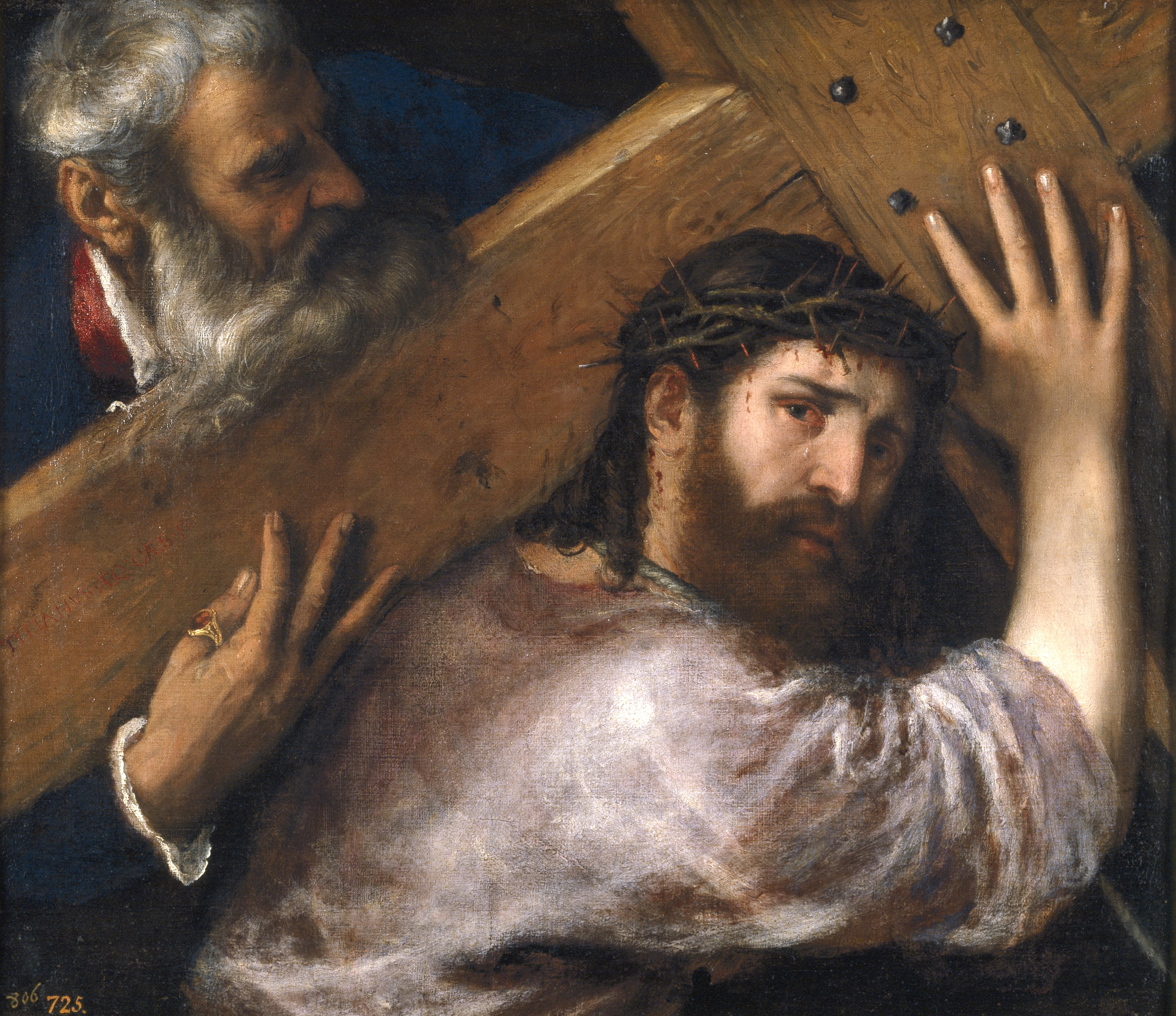 Christ Carrying the Cross, with Simon of Cyrene, Titian, c. 1565, Museo Nacional del Prado, Madrid. Public domain (Wikimedia Commons), resized.

See this page's graph and discover linked topics
In full
The three Synoptic Gospels record that Roman soldiers compelled a passer-by, Simon of Cyrene, to carry Jesus' cross (Mark 15:21; Matthew 27:32; Luke 23:26). Mark adds that he was "coming out of the country" and was "the father of Alexander and Rufus" (Mark 15:21, KJV). Luke adds that they laid the cross on him "that he might bear it after Jesus" (Luke 23:26, KJV), language that echoes Jesus' call to take up the cross and follow him (Luke 9:23; 14:27). John says Jesus went out "bearing his cross" (John 19:17, KJV), most naturally the first stage of the walk before Simon was pressed into service.
Simon was almost certainly a diaspora Jew. Cyrene, a Greek foundation in Cyrenaica (eastern Libya), had a large, long-established Jewish population, and Cyrenian Jews had their own synagogue community in Jerusalem (Acts 6:9). He was either a pilgrim in the city for Passover or a Cyrenian Jew living in or near Jerusalem.
The text, term by term
- "Compel" (Greek angareuō). A technical word for official requisition, the right of soldiers or couriers to press a civilian or his animal into service. Jesus uses the same verb in Matthew 5:41: "whosoever shall compel thee to go a mile, go with him twain" (KJV). Simon was not volunteering.
- "Coming out of the country" (ap' agrou). From the fields or the countryside. It does not say whether he had been working, which on a feast day some interpreters find significant; the phrase is too brief to settle that.
- "The father of Alexander and Rufus." Matthew and Luke drop the sons' names. Mark keeps them, and the most common explanation is that Mark's readers knew them. If Mark wrote for the church at Rome, as early tradition holds, the "Rufus chosen in the Lord, and his mother and mine" whom Paul greets in Romans 16:13 may be the same man, which would make Simon's wife a woman Paul regarded as a mother. Rufus was a common Roman name, so this is a possibility, not a proof.
- "After Jesus" (Luke). Luke's opisthen tou Iēsou places Simon in the posture of a disciple walking behind his master. Many interpreters read Luke as presenting him, deliberately, as the first person to literally carry the cross behind Jesus.
Cyrene and its Jews
- The city. Cyrene was founded by Greek colonists from Thera in the seventh century BC (Herodotus, Histories 4.150-158) and became the leading city of Cyrenaica, later a Roman province. Its ruins, including the sanctuary of Apollo, stand at Shahhat in eastern Libya.
- The Jewish settlement. Josephus reports that Ptolemy I settled Jews in the cities of Cyrenaica (Against Apion 2.44) and quotes Strabo that Cyrene had four classes of inhabitants, the fourth being Jews (Antiquities 14.115).
- Literary traces. 2 Maccabees is an abridgment of a five-volume history by "Jason of Cyrene" (2 Maccabees 2:23). A Roman letter in 1 Maccabees 15:23 lists Cyrene among the places to which it was sent.
- In the New Testament. Jews from "the parts of Libya about Cyrene" heard the apostles at Pentecost (Acts 2:10, KJV). Cyrenians belonged to the synagogue that disputed with Stephen (Acts 6:9). Men of Cyprus and Cyrene first preached to Greeks at Antioch (Acts 11:20), and Lucius of Cyrene was a teacher there (Acts 13:1); see Simeon Called Niger.
- The revolt. The Jewish community of Cyrenaica led the great diaspora revolt of AD 115-117 under Trajan, which ended in its destruction.
The Kidron Valley ossuary
In 1941 E. L. Sukenik and Nahman Avigad excavated a first-century burial cave in the Kidron Valley, Jerusalem. The excavators took it to be the tomb of a family of Jews from Cyrenaica, and one ossuary is inscribed in Greek "Alexander (son) of Simon," with a Hebrew word on the lid that has been read as a reference to Cyrene. Avigad published the tomb in 1962 and was himself cautious about identifying this Alexander with the son named in Mark 15:21. Both names were common. The find shows a Cyrenian Jewish family burying its dead in Jerusalem in the right period with the right pair of names; it does not prove that the cross-bearer's family has been found.
Was Simon Black?
The texts do not say. Cyrene was a Greek city in North Africa, Simon (Simōn, for Hebrew Shimon) is a Jewish name, and the Jews of Cyrenaica were a diaspora community of mixed origins. Simon was African by residence and very likely by birth, and Jewish by religion and probably descent. Whether he was dark-skinned is not recorded. Artistic tradition has painted him both ways, and African and African American churches have long read him as a kinsman, a reading the text permits but does not require. The safe claim is the one that matters: an African Jew carried the cross of Christ.
Some identify Simon with "Simeon that was called Niger" of Acts 13:1, the Antioch teacher whose nickname means "black." The names differ in form (Simōn and Symeōn are interchangeable for the same Hebrew name), and the context, next to Lucius of Cyrene, is suggestive. No ancient source makes the identification, and it remains speculation. See Simeon Called Niger.
Simon and the substitution theory
The second-century teacher Basilides, as reported by Irenaeus (Against Heresies 1.24.4), claimed that Simon was transformed to look like Jesus and was crucified in his place while Jesus stood by. A related idea later circulated in some Muslim interpretation of Quran 4:157. The Gospel texts themselves exclude it: the verse that names Simon names him as the man carrying another man's cross. See Substitution Theory Objection Defeater.
Simon in Christian devotion
- The Stations of the Cross. The fifth station in the traditional Western sequence is "Simon of Cyrene helps Jesus carry the cross."
- Discipleship. Preachers have long held Simon up as the image of the believer who bears the cross after Christ, sometimes unwillingly at first.
- African and African American reception. The cross-bearer from Africa became a recurring image in Black church preaching and art, a sign that Africa was present and serving at the cross itself.
See also
- Africans in Scripture Argument, the cumulative case for African presence in Scripture
- Simeon Called Niger, the Antioch teacher sometimes identified with him, with Lucius of Cyrene
- Substitution Theory Objection Defeater, answering the claim that Simon died in Jesus' place
- Jesus, whose cross he carried
- Pentecost, where Jews from Cyrene heard the gospel
- Ethiopian Eunuch, another African in the earliest Christian story
- Church at Antioch, where Cyrenians first preached to Greeks
- Africa and Christianity
Common questions this page answers
Q: Who was Simon of Cyrene?
He was the man Roman soldiers forced to carry Jesus' cross to the crucifixion (Mark 15:21; Matthew 27:32; Luke 23:26). He came from Cyrene, a Greek city in what is now Libya with a large Jewish community.
Q: Where is Cyrene in the Bible?
Cyrene was the chief city of Cyrenaica on the north coast of Africa, in modern eastern Libya. Its ruins stand at Shahhat. Cyrenian Jews appear at Pentecost, in a Jerusalem synagogue, and among the first preachers to Greeks at Antioch.
Q: Was Simon of Cyrene a Black man?
The Bible does not describe his appearance. He was a Jew from North Africa, African by residence and probably by birth, but whether he was dark-skinned is not recorded.
Q: Who were Alexander and Rufus?
Mark 15:21 names them as Simon's sons, probably because Mark's readers knew them as believers. Rufus may be the Rufus Paul greets in Romans 16:13, though that is not certain.
Q: Was Simon of Cyrene crucified instead of Jesus?
No. That claim comes from the second-century Gnostic Basilides, reported by Irenaeus. The Gospel texts name Simon as the man who carried the cross for Jesus, the one who was crucified.
Q: Has Simon of Cyrene's tomb been found?
A first-century ossuary from the Kidron Valley reads "Alexander son of Simon" and may be connected with Cyrene. The excavator, Nahman Avigad, was cautious, and the names were common, so the identification is possible but unproven.
Q: Why did the soldiers make Simon carry the cross?
Roman soldiers had the right to requisition civilians for labor. Jesus, weakened by flogging, apparently could not carry the beam the whole way, so they pressed the nearest passer-by into service.