Person
Simon Kimbangu
Kimbangu, Prophet Simon Kimbangu, Kimbanguism, Kimbanguist Church, EJCSKIntro
Simon Kimbangu was a Congolese Baptist catechist whose healing and preaching ministry in 1921 drew huge crowds in the lower Congo. It lasted only a few months. The Belgian colonial authorities arrested him, a military court sentenced him to death, and after the sentence was commuted he spent the last thirty years of his life in prison, dying in 1951. The movement he inspired became the Kimbanguist Church, one of the largest African Initiated Churches. Its later teaching about Kimbangu himself has led other churches to question its orthodoxy.
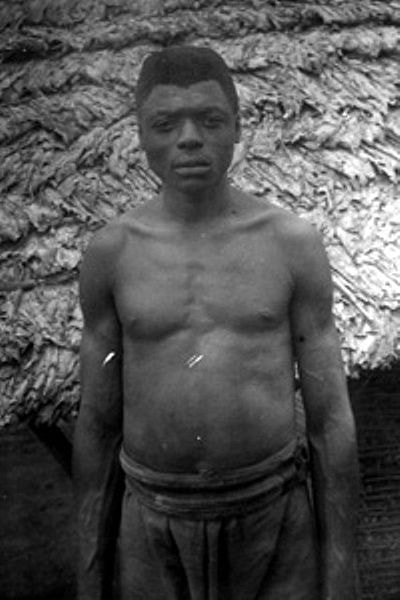 Simon Kimbangu. Photo: unknown photographer, public domain (Wikimedia Commons), resized.

See this page's graph and discover linked topics
In full
Kimbangu's story sits at the meeting point of three themes in Christianity and Colonialism in Africa: an African prophet carrying the gospel further than the missionaries could, a colonial state treating African Christian revival as sedition, and a later church that moved beyond the bounds of historic Trinitarian doctrine. Historians such as Marie-Louise Martin, who wrote a sympathetic study of the movement, and Adrian Hastings treat the 1921 events as a defining moment in Congolese Christianity. The account below separates what is well documented about Kimbangu's life from what the Kimbanguist Church later came to teach about him.
Life
- Birth and background. Born in Nkamba, in the lower Congo, around 1887 or 1889 (sources differ). He was baptized in the Baptist Missionary Society (BMS) mission and trained as a catechist.
- The 1921 ministry. In April 1921 reports spread that he had healed the sick at Nkamba. Crowds came from across the region. He preached repentance, the destruction of fetishes, faithfulness to the Bible and, by most accounts, monogamy.
- Colonial reaction. The colonial administration, worried about crowds leaving work, trade disruption and anti-colonial feeling, moved to arrest him. He escaped an attempted arrest in June 1921 and later surrendered in September.
- Trial. On 3 October 1921 a military court sentenced him to death for sedition. King Albert I of Belgium commuted the sentence to life imprisonment.
- Prison. He was taken far from home to Elisabethville (now Lubumbashi), where he remained until his death on 12 October 1951. Many of his followers were deported to other parts of the colony.
From movement to church
- During the decades of repression, Kimbangu's followers kept the movement alive underground.
- The church took the name Church of Jesus Christ on Earth through the Prophet Simon Kimbangu (French initials EJCSK) and was legally recognized by the Belgian authorities in 1959, shortly before Congolese independence. It is headquartered at Nkamba, which members call the New Jerusalem.
- Leadership passed to Kimbangu's sons and then his grandson.
- The church joined the World Council of Churches (WCC) in 1969, the first African Initiated Church to do so. In June 2021 the WCC Central Committee ended its membership on doctrinal grounds.
- Membership estimates vary enormously, from about six million to more than twenty million, and none is independently verified.
Doctrine and the orthodoxy question
The well-documented 1921 preaching was a simple, Bible-centered evangelical message. The difficulty lies in later teaching:
- The church came to regard Kimbangu as the Holy Spirit, or the Comforter promised in John 14, rather than as a prophet in the ordinary sense.
- Later teaching assigned divine identities to his sons, including the claim that one was a reincarnation of Christ, and the church moved its Christmas observance to that son's birthday.
- These developments were judged incompatible with the doctrine of the Trinity. The Church of Christ in Congo (the main Protestant body) ceased to recognize the Kimbanguist Church as a Christian church in 2002, the Catholic Church in Congo suspended ecumenical cooperation in 2004, and the WCC ended its membership in 2021.
Historic Christianity, Catholic, Orthodox and Protestant alike, teaches that the Holy Spirit is a divine person, not a human being, and that Christ became incarnate once, in Jesus of Nazareth (John 14:16-17, 26; Hebrews 9:26-28). On that standard, honoring Kimbangu as a faithful evangelist and martyr-like witness under colonial persecution is one thing; identifying him with the Spirit is another.
Significance
- Colonial persecution of an African Christian. The colonial state did not sponsor Kimbangu's Christianity; it jailed him for thirty years. See Christianity and Colonialism in Africa.
- African agency. Like William Wade Harris, Kimbangu reached tens of thousands without missionary direction.
- A cautionary case. Kimbanguism shows how a movement can begin in biblical revival and later drift doctrinally, which is why African evangelical leaders such as Byang Kato stressed theological education and confessional clarity.
Tensions
- Birth year. Sources give both 1887 and 1889.
- The church's self-understanding. Kimbanguist theologians describe their teaching in ways they hold to be compatible with Christianity; outside churches and the WCC judged otherwise. This page reports both and follows the historic creeds on the doctrine of God.
- Numbers. No reliable membership count exists.
See also
- African Initiated Churches, the wider family of African-founded churches
- William Wade Harris, the West African prophet of 1913-1914
- Christianity and Colonialism in Africa, the colonial state's response to African Christianity
- Trinity, the doctrine at issue in later Kimbanguist teaching
- Africa and Christianity, the master hub
Common questions this page answers
Q: Who was Simon Kimbangu?
He was a Congolese Baptist catechist whose healing and preaching ministry in the lower Congo in 1921 drew huge crowds. The Belgian colonial authorities arrested him, a military court sentenced him to death, and after the sentence was commuted he spent thirty years in prison until his death in 1951.
Q: Why was Simon Kimbangu arrested?
The colonial administration saw his mass following as a threat to order, labor and colonial authority and charged him with sedition. A military court sentenced him to death on 3 October 1921, and King Albert I commuted the sentence to life imprisonment.
Q: What is the Kimbanguist Church?
It is the Church of Jesus Christ on Earth through the Prophet Simon Kimbangu, founded by his followers and legally recognized in 1959. It is headquartered at Nkamba in the Democratic Republic of the Congo and is one of the largest African Initiated Churches.
Q: Is the Kimbanguist Church Christian?
Its origins are Christian and Kimbangu's 1921 preaching was a Bible-based evangelical message. But the church later came to identify Kimbangu with the Holy Spirit and his sons with divine figures. Because of this, Congo's main Protestant body stopped recognizing it in 2002 and the World Council of Churches ended its membership in 2021.
Q: Why was the Kimbanguist Church removed from the World Council of Churches?
The WCC Central Committee ended its membership in June 2021 on doctrinal grounds, over teaching about Simon Kimbangu and his descendants that other churches judged contrary to the doctrine of the Trinity.