Person
Shishak
Shoshenq I, Sheshonq I, Sheshonk I, Shoshenk I, Shishak king of Egypt, Pharaoh Shishak, SusakimIntro
Shishak was the king of Egypt who gave refuge to Jeroboam when he fled from Solomon, and who invaded Judah in the fifth year of Solomon's son Rehoboam. He took the treasures of the Temple and the palace, including Solomon's gold shields, and Rehoboam replaced them with bronze ones.
Shishak is the pharaoh Egyptologists call Shoshenq I (or Sheshonq I), founder of a new dynasty of Libyan origin. On a temple wall at Karnak in Egypt he had his victory over Canaan carved, with long rows of name-rings listing the towns he claimed, and a fragment of his victory stele was found at Megiddo in Israel.
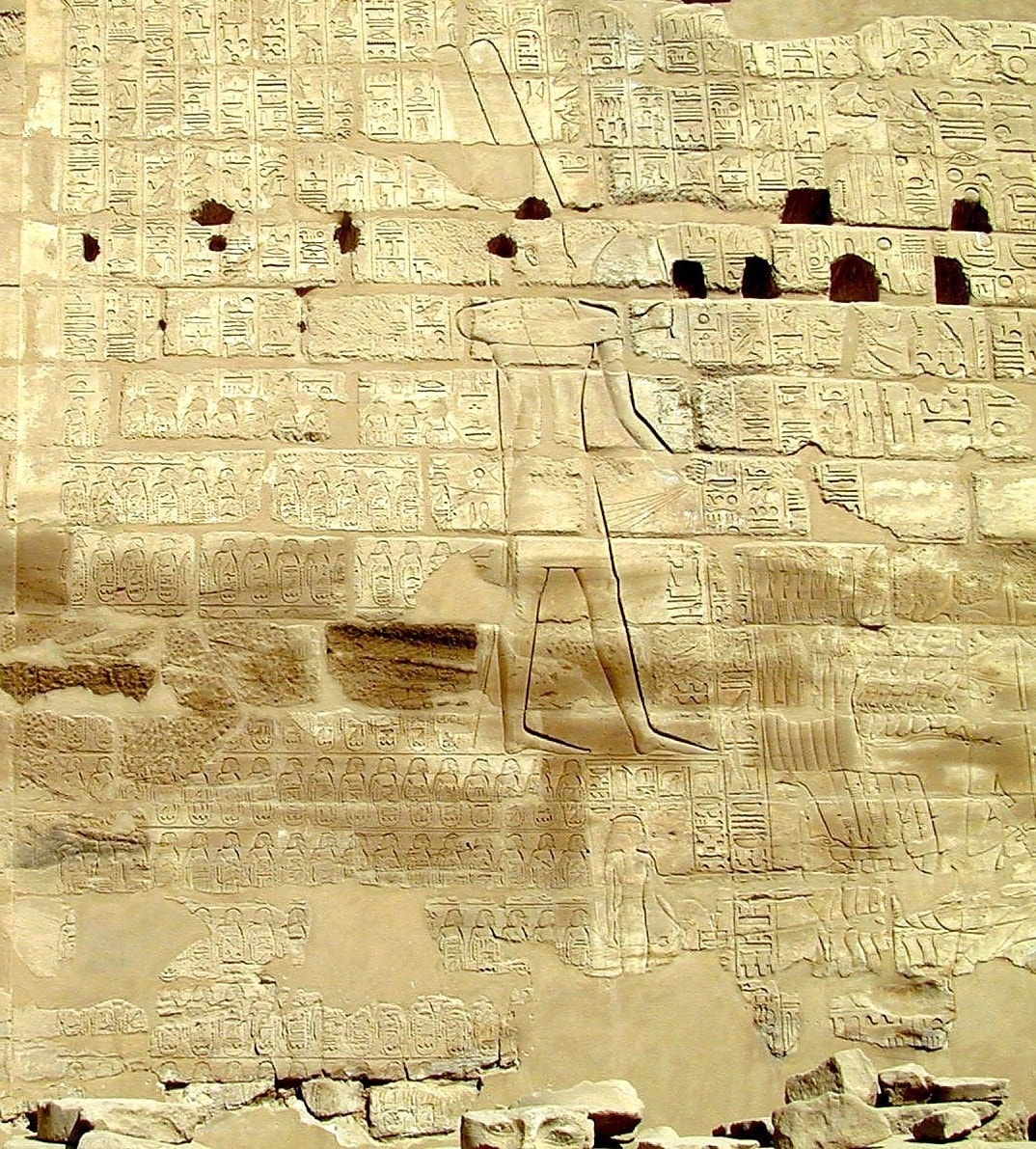
Part of the triumphal relief of Sheshonq I, the biblical Shishak, at the Bubastite Portal of the temple of Amun at Karnak, with rows of oval name-rings listing places from his campaign into Canaan. Photo: Jack1956 at English Wikipedia, public domain, via Wikimedia Commons, resized.

The 30-second version:
Shishak is Pharaoh Shoshenq I, who founded Egypt's Twenty-second Dynasty around 945 BC. The Bible says he sheltered Jeroboam and later invaded Judah, taking the Temple treasures from Rehoboam. Shoshenq's own victory relief at Karnak lists well over a hundred places he claimed in Canaan, and a piece of his stele turned up at Megiddo. It is the first pharaoh named in the Bible whose identity is secure, and his campaign is a fixed point for the chronology of the kings.
See this page's graph and discover linked topics
In full
Shoshenq I was a Libyan chief's descendant who became pharaoh around 945 BC, ending the Twenty-first Dynasty and reasserting Egyptian ambitions in Canaan after a long period of weakness. Near the end of his reign he campaigned through the southern Levant. His triumphal relief on the Bubastite Portal at Karnak shows the god Amun and the goddess of Thebes leading rows of bound captives, each topped by a name-ring for a conquered place. Over 150 names were listed, many now damaged; legible ones include Gezer, Aijalon, Beth-horon, Gibeon, Rehob, Beth-shean, Taanach, Megiddo, and numerous sites in the Negev, including Arad.
The equation of biblical Shishak with Shoshenq I rests on the name (the Hebrew Shishaq corresponds to Egyptian Shoshenq, whose n was often not written), on the date, and on the fact that both sources describe a campaign into Canaan by a pharaoh of this period. It is accepted by nearly all Egyptologists and biblical historians and anchors the absolute dating of Rehoboam's reign (about 926/925 BC for the invasion on most reckonings). Lawrence Mykytiuk counts Shishak as the first entry on his list of securely identified Hebrew Bible persons.
In the Bible
- Refuge for Jeroboam. "Solomon sought therefore to kill Jeroboam; but Jeroboam arose, and fled into Egypt, unto Shishak king of Egypt, and was in Egypt until the death of Solomon" (1 Kings 11:40, ASV). This is the first pharaoh in the Bible named by his personal name.
- The invasion. "It came to pass in the fifth year of king Rehoboam, that Shishak king of Egypt came up against Jerusalem; and he took away the treasures of the house of Jehovah, and the treasures of the king's house; he even took away all: and he took away all the shields of gold which Solomon had made" (1 Kings 14:25-26, ASV). "King Rehoboam made in their stead shields of brass" (14:27, ASV).
- Chronicles' account. Shishak came "with twelve hundred chariots, and threescore thousand horsemen," with Libyans (Lubim), Sukkiim and Ethiopians, and "took the fortified cities which pertained to Judah, and came unto Jerusalem" (2 Chronicles 12:3-4, ASV). The prophet Shemaiah declared, "Ye have forsaken me, therefore have I also left you in the hand of Shishak" (12:5, ASV). When the king and princes humbled themselves, God said, "I will not destroy them... Nevertheless they shall be his servants, that they may know my service, and the service of the kingdoms of the countries" (12:7-8, ASV).
Family and lineage
- Origin: a family of Libyan (Meshwesh) chiefs settled at Bubastis in the Delta; his dynasty is often called the Libyan or Bubastite dynasty.
- Successor: his son Osorkon I. Another son, Iuput, served as high priest of Amun at Thebes.
- No marriage link to Israel is recorded. The pharaoh whose daughter Solomon married (1 Kings 3:1) is unnamed and belongs to the previous dynasty; Siamun is the candidate most often proposed. The Septuagint of 1 Kings 12 contains an additional story that Shishak gave Jeroboam an Egyptian wife, which is not in the Hebrew text.
Historical and archaeological evidence
- The Bubastite Portal relief, Karnak. Carved for Shoshenq I on the temple of Amun at Karnak, Egypt, and still in place. It records his campaign into Canaan in the conventional form of a triumphal list of conquered towns. It does not name Rehoboam or Jeroboam, and Jerusalem is not among the surviving names, though many rings are damaged. Grade: direct for the pharaoh and his campaign.
- The Megiddo stele fragment. A fragment of a monumental stele bearing Shoshenq I's cartouche, found by the University of Chicago's Oriental Institute expedition at Megiddo in the 1920s in debris left by an earlier excavation, and now in the Oriental Institute in Chicago. A victory stele set up at Megiddo confirms that his campaign reached the Jezreel Valley, as the Karnak list says. Grade: direct.
- A scarab of Sheshonq I found in the copper-producing region of Faynan in southern Jordan, published by Thomas Levy and colleagues in Antiquity, has been connected with Egyptian interest in the copper trade during his campaign.
- Mykytiuk's list. Shishak (Sheshonq I) is entry 1 among the 53 persons Mykytiuk regards as securely identified.
Scholarly consensus
The identification of Shishak with Shoshenq I and the historicity of his Canaanite campaign are the consensus of Egyptology and biblical history. Kenneth Kitchen's The Third Intermediate Period in Egypt is the standard defense of both. Debated points:
- Jerusalem and the route. The Karnak list focuses on the north, the central hill country and the Negev and does not preserve Jerusalem. Many scholars, including Kitchen, explain this by Rehoboam's payment of tribute (1 Kings 14:26), which would have spared the city a siege and left it off a list of conquered towns; others suggest Jerusalem stood in a damaged section.
- Archaeology of the destruction. Which destruction layers at sites such as Megiddo, Arad and Gezer belong to Shishak's campaign is tied to the wider debate over tenth-century chronology. Israel Finkelstein, who proposed the "low chronology," assigns different strata to the campaign than scholars such as Amihai Mazar and William Dever. See Solomons Gates at Hazor Megiddo Gezer.
- The New Chronology dissent. Peter James (Centuries of Darkness, 1991) and David Rohl (A Test of Time, 1995) argued that Egyptian chronology should be lowered by about three centuries and that the biblical Shishak was Ramesses II. Their proposal has been rejected by most Egyptologists, notably Kitchen, and is not followed here.
Theological significance
- Judgment through a foreign power. Chronicles presents the invasion as the consequence of Judah's forsaking the law (2 Chronicles 12:1-2, 5), and the partial deliverance as the response to humility: "when he humbled himself, the wrath of Jehovah turned from him" (12:12, ASV).
- Gold to bronze. The replacement of Solomon's golden shields with bronze ones (1 Kings 14:27) is the narrative's image of how quickly Solomon's glory faded after the division of the kingdom.
- Serving God or serving the nations. God's word in 2 Chronicles 12:8, that Judah would learn the difference between "my service" and "the service of the kingdoms of the countries," frames the cost of rejecting God's rule as subjection to human rulers.
- History's fixed point. For apologetics, Shishak is the earliest secure synchronism between biblical and Egyptian history, which makes the Bible's account of the divided monarchy checkable against an independent record from its first generation.
Church Fathers
No patristic discussion of Shishak with a verified locator is cited here.
Scholarship
Published academic works this page draws on, each matched to a publisher, index or library catalog record.
- Peter James, Centuries of Darkness (1991). Open Library
- David M. Rohl, A test of time (1995). Open Library
See also
- People of the Bible, every person on the codex's list, by the book that first names them
- Biblical Figures Confirmed by Archaeology, Mykytiuk's list, where Shishak is number 1
- Solomon, whose treasures Shishak carried off
- Solomons Gates at Hazor Megiddo Gezer, the debate over tenth-century strata
- Kenneth Kitchen, the leading defender of the identification
- Merneptah Stele, an earlier Egyptian monument naming Israel
- Biblical Archaeology, parent hub for the artifact evidence
Common questions this page answers
Q: Who was Shishak king of Egypt?
Shishak is Pharaoh Shoshenq I (Sheshonq I), founder of Egypt's Twenty-second Dynasty, who reigned about 945 to 924 BC. The Bible says he sheltered Jeroboam from Solomon and later invaded Judah in Rehoboam's fifth year, taking the Temple treasures (1 Kings 11:40; 14:25-26).
Q: Is there archaeological evidence for Shishak's invasion?
Yes. Shoshenq I's triumphal relief at Karnak lists well over a hundred places he claimed in Canaan, including Megiddo, Gibeon and Arad, and a fragment of his victory stele was found at Megiddo itself. Scholars accept the campaign as historical.
Q: Why is Jerusalem not on Shishak's list at Karnak?
Many of the name-rings are damaged, so it may have been lost. Many scholars, including Kenneth Kitchen, think Rehoboam paid Shishak off with the Temple and palace treasures, as 1 Kings 14:26 says, so Jerusalem was not besieged or listed as conquered.
Q: Was Shishak Ramesses II?
That identification was proposed by David Rohl and Peter James as part of a revised "New Chronology" of Egypt. Most Egyptologists reject it, and the standard view identifies Shishak with Shoshenq I on the grounds of name, date and the campaign record.