Person
Shaphan
Shaphan the scribe, Shaphan son of Azaliah, Shaphan the secretary, ShafanIntro
Shaphan was the royal scribe, in effect the secretary of state, of King Josiah of Judah. When the high priest Hilkiah found the book of the law in the temple in 622 BC, he handed it to Shaphan, and Shaphan read it aloud to the king. Josiah's grief at what he heard set off his great reform.
Shaphan's family became the protectors of the prophet Jeremiah. His son Ahikam saved Jeremiah from a mob, his son Gemariah lent the room where Jeremiah's scroll was read to the people, and his grandson Gedaliah became governor of Judah after the fall of Jerusalem and took Jeremiah in. A seal impression reading "belonging to Gemariah son of Shaphan" was found in the City of David.
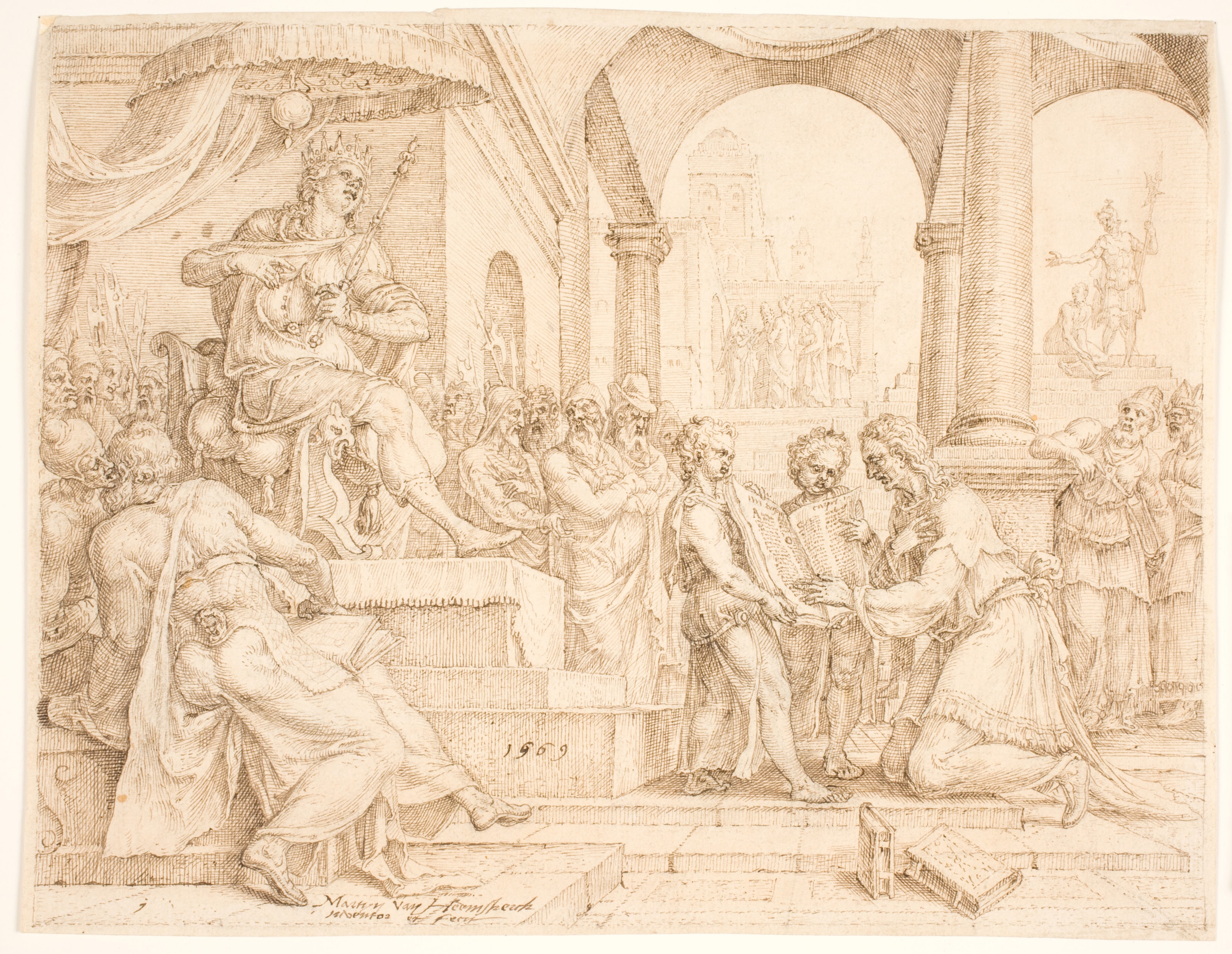
Shaphan the scribe reads the book of the law to King Josiah, who tears his clothes; drawing by Maarten van Heemskerck, 1569. Statens Museum for Kunst, Copenhagen. Public domain, via Wikimedia Commons, resized.

The 30-second version:
Shaphan was King Josiah's royal scribe. He received the book of the law from Hilkiah in 622 BC and read it to the king (2 Kings 22). His sons and grandson protected Jeremiah: Ahikam rescued him, Gemariah hosted the reading of his scroll, and Gedaliah sheltered him after Jerusalem fell. A bulla of "Gemariah son of Shaphan" from the City of David confirms the family, and Lawrence Mykytiuk counts Shaphan among the people of the Bible confirmed by archaeology.
See this page's graph and discover linked topics
In full
Shaphan (Hebrew Šāpān, "rock badger" or hyrax) son of Azaliah son of Meshullam was hassōpēr, the royal scribe or secretary, under Josiah (2 Kings 22:3). In Josiah's eighteenth year he oversaw the payment of temple repair funds, received from Hilkiah the newly found "book of the law," read it, reported to the king, read it before him, and was sent with Hilkiah, his son Ahikam and others to consult the prophetess Huldah (2 Kings 22:3-14; 2 Chronicles 34:8-28). His family is the most fully documented non-royal family of late Judah: Ahikam (2 Kings 22:12; Jeremiah 26:24), Gemariah (Jeremiah 36:10-12, 25), Elasah (Jeremiah 29:3), the grandson Micaiah son of Gemariah (Jeremiah 36:11-13), and the grandson Gedaliah son of Ahikam, governor after 586 BC (2 Kings 25:22; Jeremiah 39:14; 40:5-41:3). A bulla from Yigal Shiloh's City of David excavations reads lgmryhw bn špn, "belonging to Gemariah son of Shaphan," from the House of the Bullae destroyed in 586 BC. Lawrence Mykytiuk counts both Shaphan and Gemariah among the 53 Hebrew Bible persons confirmed by archaeology, with Shaphan attested as the father named on his son's seal.
In the Bible
- 2 Kings 22:3-14. "the king sent Shaphan, the son of Azaliah the son of Meshullam, the scribe, to the house of Jehovah" (22:3, ASV). "And Shaphan the scribe told the king, saying, Hilkiah the priest hath delivered me a book. And Shaphan read it before the king" (22:10, ASV).
- 2 Chronicles 34:8-28. The parallel account, in which Shaphan is sent with Maaseiah the governor of the city and Joah the recorder to repair the temple.
- Jeremiah 26:24. "But the hand of Ahikam the son of Shaphan was with Jeremiah, that they should not give him into the hand of the people to put him to death" (ASV).
- Jeremiah 29:3. Jeremiah's letter to the exiles is carried "by the hand of Elasah the son of Shaphan" (ASV).
- Jeremiah 36:10-25. Baruch reads Jeremiah's scroll "in the chamber of Gemariah the son of Shaphan the scribe" (36:10, ASV); Gemariah's son Micaiah reports it to the officials; Gemariah urges King Jehoiakim not to burn it (36:25).
- Jeremiah 39:14; 40:5-41:3; 2 Kings 25:22-25. Gedaliah, "the son of Ahikam, the son of Shaphan," is made governor over the remnant, receives Jeremiah, and is murdered by Ishmael son of Nethaniah.
- Ezekiel 8:11. "Jaazaniah the son of Shaphan" stands among the seventy elders offering incense to idols in Ezekiel's temple vision. Whether this Shaphan is the scribe is uncertain; many commentators think he is a different man, since the scribe's family appears consistently on the side of reform and of Jeremiah.
Family and lineage
- Father: Azaliah. Grandfather: Meshullam (2 Kings 22:3).
- Sons: Ahikam, Gemariah, Elasah; possibly Jaazaniah (Ezekiel 8:11, disputed).
- Grandsons: Gedaliah son of Ahikam, governor of Judah; Micaiah son of Gemariah.
- Office: sōpēr, royal scribe. Under the Judean kings this was one of the chief officers of state, alongside the recorder and the steward, as in Hezekiah's court (2 Kings 18:18).
Historical and archaeological evidence
- The bulla of Gemariah son of Shaphan. One of the 51 bullae from the House of the Bullae in Area G of the City of David, excavated by Yigal Shiloh in 1982 and preserved by the fire of 586 BC. It reads "belonging to Gemariah son of Shaphan." Published in Yair Shoham's final report on the Hebrew bullae (Qedem 41, 2000); catalogued in Avigad and Sass, Corpus of West Semitic Stamp Seals (1997), no. 470; analyzed by Mykytiuk, Identifying Biblical Persons (2004), pp. 139-146. Grade: strong, for Shaphan as the named father; Mykytiuk's confirmed list for both men. See Jeremiah Bullae.
- The archive it belongs to. The same building produced the bulla of Azariah son of Hilkiah, son of the high priest who handed Shaphan the book. Two of the families in the account of 2 Kings 22 thus appear side by side in one Jerusalem archive.
Scholarly consensus
- Strong identification. The bulla is from a controlled excavation, dated to the decades before 586 BC, and names a father-son pair the Bible places in exactly that setting. Mykytiuk and most epigraphers accept it. Some scholars note that the bulla has no title and that Gemariah and Shaphan were not rare names; the identification rests on the pair, the place and the date together.
- The Shaphanide family. Many historians and commentators on Jeremiah treat Shaphan's family as a pro-reform, pro-Babylonian party at court whose patronage explains Jeremiah's survival; this reconstruction is widely held and rests on the biblical texts.
- The book of the law. On what Shaphan read to Josiah and when it was written, see Hilkiah and Josiah Wrote the Bible Objection Defeater.
Theological significance
- The word read aloud. Shaphan's reading of the scroll to Josiah, and his son Gemariah's chamber where Baruch read Jeremiah's scroll to the people, frame two great moments when God's written word confronted Judah's kings: Josiah tore his clothes; Jehoiakim cut up the scroll and burned it (Jeremiah 36:23). One family stands at the center of both.
- Faithfulness across generations. Shaphan, his sons and his grandson consistently sided with the prophet and the law at personal risk. The family is a picture of godly influence handed down in a dark time.
- Accuracy in small names. A father, his sons and his grandson recur across Kings and Jeremiah with consistent relationships, and a seal from the right house names one of them. That consistency is hard to explain as late invention.
Scholarship
Published academic works this page draws on, each matched to a publisher, index or library catalog record.
- Nahman Avigad, Corpus of West Semitic stamp seals (1997). Open Library
See also
- Gemariah son of Shaphan, his son, whose bulla names him
- Hilkiah, the high priest who gave him the book of the law
- Azariah son of Hilkiah, whose bulla was found with Gemariah's
- Jeremiah Bullae, the seal impressions of Jeremiah's contemporaries
- Nebuzaradan, who committed Jeremiah and the remnant to Shaphan's grandson Gedaliah
- Josiah Wrote the Bible Objection Defeater, the debate over the book he read
- Biblical Figures Confirmed by Archaeology, Mykytiuk's list
- People of the Bible, every person on the hub, grouped by book of first mention
Common questions this page answers
Q: Who was Shaphan the scribe?
He was the royal scribe or secretary of King Josiah. He received the newly found book of the law from Hilkiah the high priest in 622 BC and read it to Josiah, which led to Josiah's reform (2 Kings 22:8-11).
Q: Is there archaeological evidence for Shaphan?
Yes, through his son. A clay bulla from the City of David reads "belonging to Gemariah son of Shaphan," matching Gemariah son of Shaphan the scribe in Jeremiah 36:10. Lawrence Mykytiuk counts both Shaphan and Gemariah as confirmed.
Q: How was Shaphan's family connected to Jeremiah?
His son Ahikam protected Jeremiah from being killed (Jeremiah 26:24), his son Gemariah's chamber was where Baruch read Jeremiah's scroll (Jeremiah 36:10), his son Elasah carried Jeremiah's letter to the exiles (Jeremiah 29:3), and his grandson Gedaliah, governor after 586 BC, took Jeremiah into his care (Jeremiah 39:14).
Q: Is the Jaazaniah son of Shaphan in Ezekiel 8 the scribe's son?
It is uncertain. Ezekiel 8:11 places a Jaazaniah son of Shaphan among elders offering incense to idols. Many commentators think this is a different Shaphan, since the scribe's family consistently supported reform and Jeremiah, but the text does not say.