Person
Shalmaneser V
Shalmaneser, Shalmaneser king of Assyria, Shulmanu-ashared V, Ululayu, Shalman, Shalmaneser V of AssyriaIntro
Shalmaneser V was king of Assyria from 727 to 722 BC, the son of Tiglath-Pileser III. The Bible names him twice, both times as the king who came against Samaria. Hoshea, the last king of Israel, paid him tribute and then rebelled, sending messengers to "So king of Egypt." Shalmaneser imprisoned Hoshea and laid siege to Samaria for three years, and the northern kingdom of Israel came to an end.
A Babylonian chronicle written from official records says the same in one line: Shalmaneser came to the throne and "ravaged Samaria."
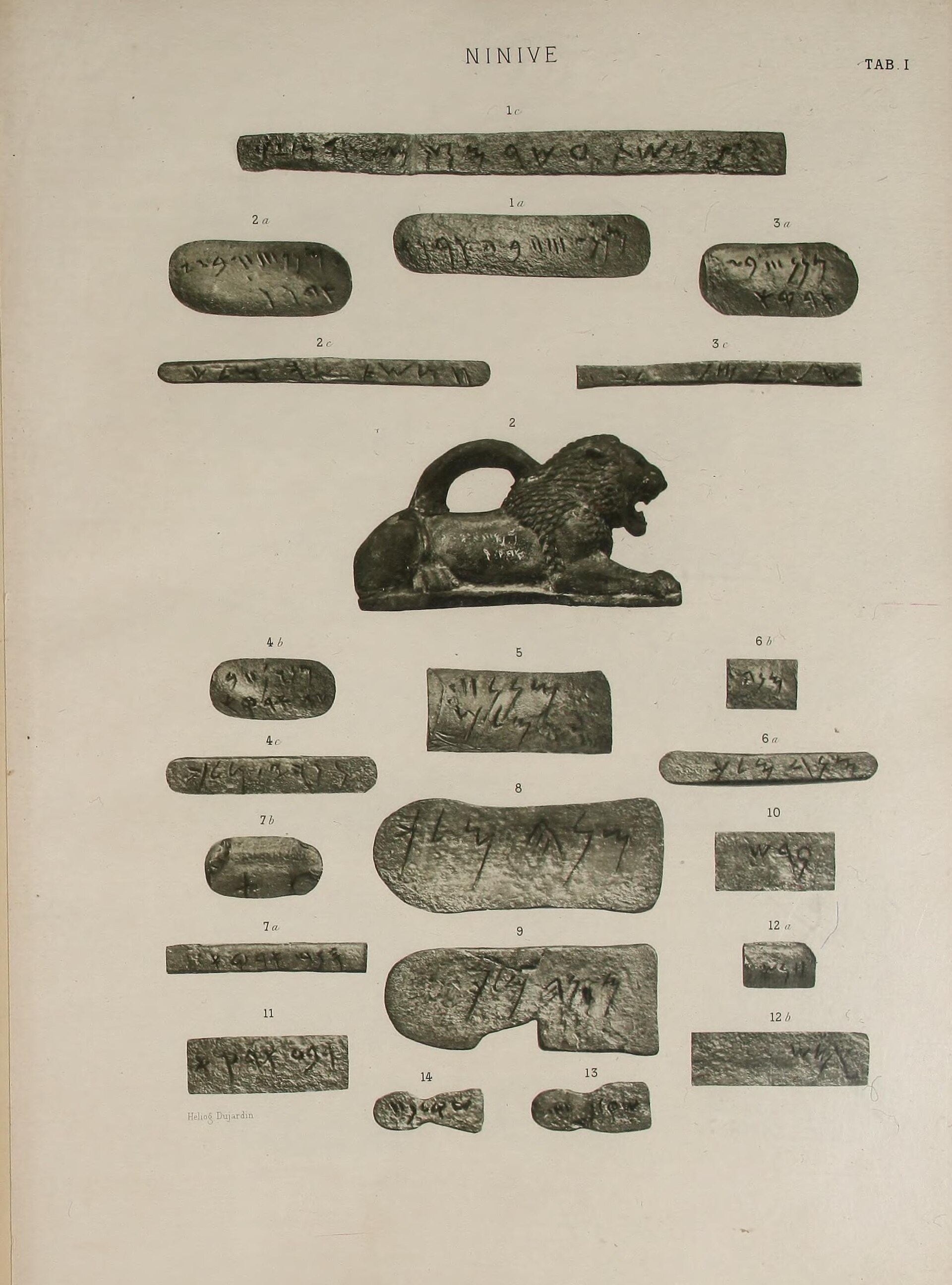 Inscribed Assyrian weights, including a bronze lion weight, as published in the Corpus Inscriptionum Semiticarum (part II, Aramaic inscriptions). The bronze lion weights from the royal workshops bear the names of Assyrian kings, Shalmaneser V among them, with Aramaic labels beside the cuneiform. Public domain, via Wikimedia Commons.

The 30-second version:
Shalmaneser V ruled Assyria for five years, 727 to 722 BC. The Bible says Hoshea of Israel became his vassal, then rebelled and looked to Egypt, so Shalmaneser jailed him and besieged Samaria for three years until it fell. The Babylonian Chronicle records his accession and says he ravaged Samaria. His successor Sargon II also claimed Samaria's capture, and historians still discuss how the two claims fit together.
See this page's graph and discover linked topics
In full
Shalmaneser V (Akkadian Šulmānu-ašarēd) succeeded his father Tiglath-Pileser III in the month Tebet of 727 BC, ruling both Assyria and Babylon, where he bore the name Ululayu. His short reign left few royal inscriptions; he is known chiefly from the Babylonian Chronicle, the Assyrian eponym lists, king lists, and inscribed weights. When Hoshea of Israel withheld tribute and courted Egypt, Shalmaneser moved against Israel, took Hoshea prisoner, and besieged Samaria. Josephus, quoting the Tyrian historian Menander, adds that Shalmaneser also attacked Tyre and blockaded it for five years. Shalmaneser died in Tebet of 722 BC, and the throne passed to Sargon II, whose relationship to him is unclear.
In the Bible
- 2 Kings 17:3-6. "Against him came up Shalmaneser king of Assyria; and Hoshea became his servant, and brought him tribute" (2 Kings 17:3, ASV). When Hoshea sends messengers "to So king of Egypt" and stops paying, "the king of Assyria shut him up, and bound him in prison" (17:4, ASV), besieges Samaria three years, and in Hoshea's ninth year "took Samaria, and carried Israel away unto Assyria" (17:6, ASV).
- 2 Kings 18:9-11. The same events are dated by Judah's king: "in the fourth year of king Hezekiah... Shalmaneser king of Assyria came up against Samaria, and besieged it. And at the end of three years they took it" (2 Kings 18:9-10, ASV).
- 2 Kings 17:7-23. The longest theological commentary in Kings explains why Samaria fell: Israel's persistent covenant unfaithfulness despite the warnings of the prophets.
- Hosea 10:14? "As Shalman destroyed Beth-arbel in the day of battle" (ASV). Some identify Shalman with Shalmaneser V; others with Salamanu, a Moabite king who paid tribute to Tiglath-Pileser III. Lawrence Mykytiuk regards Shalman as too thinly described to identify.
Notice the wording. Kings names Shalmaneser as the one who "came up" and besieged Samaria, but says only "they took it" and "the king of Assyria took Samaria." The text leaves room for the capture and deportation to have been completed under the next king.
Family and lineage
- Father: Tiglath-Pileser III (reigned 745-727 BC).
- Successor: Sargon II (reigned 722-705 BC). Sargon's own inscriptions avoid naming his father, and most historians think he was a brother or other relative of Shalmaneser who took power in a disputed succession.
Historical and archaeological evidence
| Source | What it says | Date | Where it is now | Grade |
|---|---|---|---|---|
| Babylonian Chronicle 1 (ABC 1) | Records his accession on the 25th of Tebet, that "he ravaged Samaria" (Šamara'in), his five-year reign, and his death in Tebet | compiled in the Persian period from earlier records; events 727-722 BC | British Museum (BM 92502) | Direct |
| Assyrian eponym lists and king lists | Name him as king and give his years | contemporary and later copies | British Museum and other collections | Direct |
| Babylonian King List A and Ptolemy's Canon | Record his Babylonian reign under the name Ululayu (Greek Ilulaios) | later compilations | British Museum; Almagest tradition | Direct |
| Bronze lion weights from Nimrud | A set of inscribed lion-shaped weights; some bear his name and title, with Aramaic labels beside the Akkadian | 727-722 BC | Excavated by Austen Henry Layard at Nimrud; British Museum | Direct |
| Menander of Ephesus, via Josephus | The king of Assyria, named as Shalmaneser, made war on Phoenicia and besieged Tyre for five years | quoted in Antiquities of the Jews 9.283-287 (9.14.2) | Literary source | Supporting |
Grade: direct. Lawrence Mykytiuk lists Shalmaneser V among his 53 confirmed Hebrew Bible figures, on the basis of the Babylonian Chronicle, king lists and a few inscriptions. His surviving texts are edited with his father's in Hayim Tadmor and Shigeo Yamada, The Royal Inscriptions of Tiglath-pileser III and Shalmaneser V (RINAP 1, 2011). See Biblical Figures Confirmed by Archaeology.
Scholarly consensus
- "Šamara'in" is Samaria. Some earlier scholars read the chronicle's place name as Sibraim in Syria. Most now follow Hayim Tadmor and others in reading it as Samaria, written in its Aramaic form, which matches the Bible.
- Who took Samaria? Sargon II claims in several inscriptions that he besieged and conquered Samaria and deported 27,290 people. Three main reconstructions:
- Shalmaneser took it, Sargon finished the work. Tadmor (1958) argued that Shalmaneser captured Samaria in 722 BC and Sargon, after suppressing a revolt in 720, carried out the deportations and later claimed the whole victory. This fits 2 Kings 17:3-6 and 18:9-10 closely.
- Two conquests. Bob Becking (The Fall of Samaria, 1992) argued for a capture under Shalmaneser in 723/722 and a second conquest by Sargon in 720 after Samaria joined a Syrian revolt.
- Sargon alone. A minority credits the capture to Sargon and treats the biblical attribution as a simplification. Most historians accept that Shalmaneser began the siege, as Kings says; the debate is over who completed it.
- Hoshea's imprisonment. 2 Kings 17:4 implies Hoshea was taken before the siege ended. Many historians think he was seized when he came to submit, leaving Samaria to resist without a king.
Theological significance
- The end of the northern kingdom. 2 Kings 17 makes the fall of Samaria a turning point in the whole history: "Jehovah rejected all the seed of Israel... until he had cast them out of his sight" (2 Kings 17:20, ASV). The cause given is covenant unfaithfulness; Assyria is the instrument.
- Prophecy fulfilled. Amos and Hosea had warned Israel of exile beyond Damascus a generation earlier (Amos 5:27; Hosea 9:3). Shalmaneser's siege is the fulfillment the books of Kings point back to (2 Kings 17:13, 23).
- Judah warned. Kings dates the siege by Hezekiah's reign in 18:9-10, placing Samaria's fall as a warning at the threshold of Judah's own crisis under Sennacherib.
Church Fathers
No verified patristic comment on Shalmaneser as a historical figure is cited here.
Scholarship
Published academic works this page draws on, each matched to a publisher, index or library catalog record.
- Bob Becking, The Fall of Samaria: An Historical and Archaeological Study (Brill, 1992). doi:10.1163/9789004668836
See also
- People of the Bible, every person in this series grouped by the book of first mention
- Biblical Figures Confirmed by Archaeology, Mykytiuk's list of confirmed persons
- Hoshea, the last king of Israel, whom he imprisoned
- Hezekiah, king of Judah when Samaria fell
- Tiglath-Pileser III, his father
- Sargon II, his successor, who also claimed Samaria
- So King of Egypt, the pharaoh to whom Hoshea appealed
- Shalmaneser III, the earlier Shalmaneser whose monuments name Ahab and Jehu
Common questions this page answers
Q: Which Shalmaneser is in the Bible?
Shalmaneser V, king of Assyria from 727 to 722 BC. 2 Kings 17:3 and 18:9 name him as the king who received Hoshea's tribute and besieged Samaria. Shalmaneser III, who fought Ahab, is not named in the Bible.
Q: Did Shalmaneser V or Sargon II capture Samaria?
The Bible says Shalmaneser besieged Samaria and that after three years "they took it." The Babylonian Chronicle says Shalmaneser ravaged Samaria, while Sargon II later claimed its conquest. Many historians think Shalmaneser took the city in 722 BC and Sargon completed the deportations after a revolt in 720.
Q: Is there evidence for Shalmaneser V outside the Bible?
Yes. The Babylonian Chronicle records his accession, his ravaging of Samaria and his death; Assyrian and Babylonian king lists name him; and inscribed bronze lion weights from Nimrud bear his name.
Q: When did Samaria fall?
In 722 BC by the most common reckoning, after a three-year siege, in the ninth year of Hoshea and the sixth of Hezekiah (2 Kings 18:10). Some historians date the final conquest and deportation to 720 BC under Sargon II.