Person
Shalmaneser III
Shalmaneser III of Assyria, Shulmanu-ashared III, Salmanu-ashared III, king of Assyria Shalmaneser III, Shalmaneser of the Black ObeliskIntro
Shalmaneser III was king of Assyria from 859 to 824 BC. The Bible never names him, yet he is one of the most important outside witnesses to the Old Testament. His own monuments name two kings of Israel: Ahab, who fought him at the battle of Qarqar in 853 BC, and Jehu, who paid him tribute in 841 BC. The Black Obelisk in the British Museum even shows Jehu, or Jehu's envoy, bowing to the ground before him.
These two inscriptions give the earliest fixed dates in Israel's history and tie the stories of 1 and 2 Kings to a calendar kept by a foreign empire.
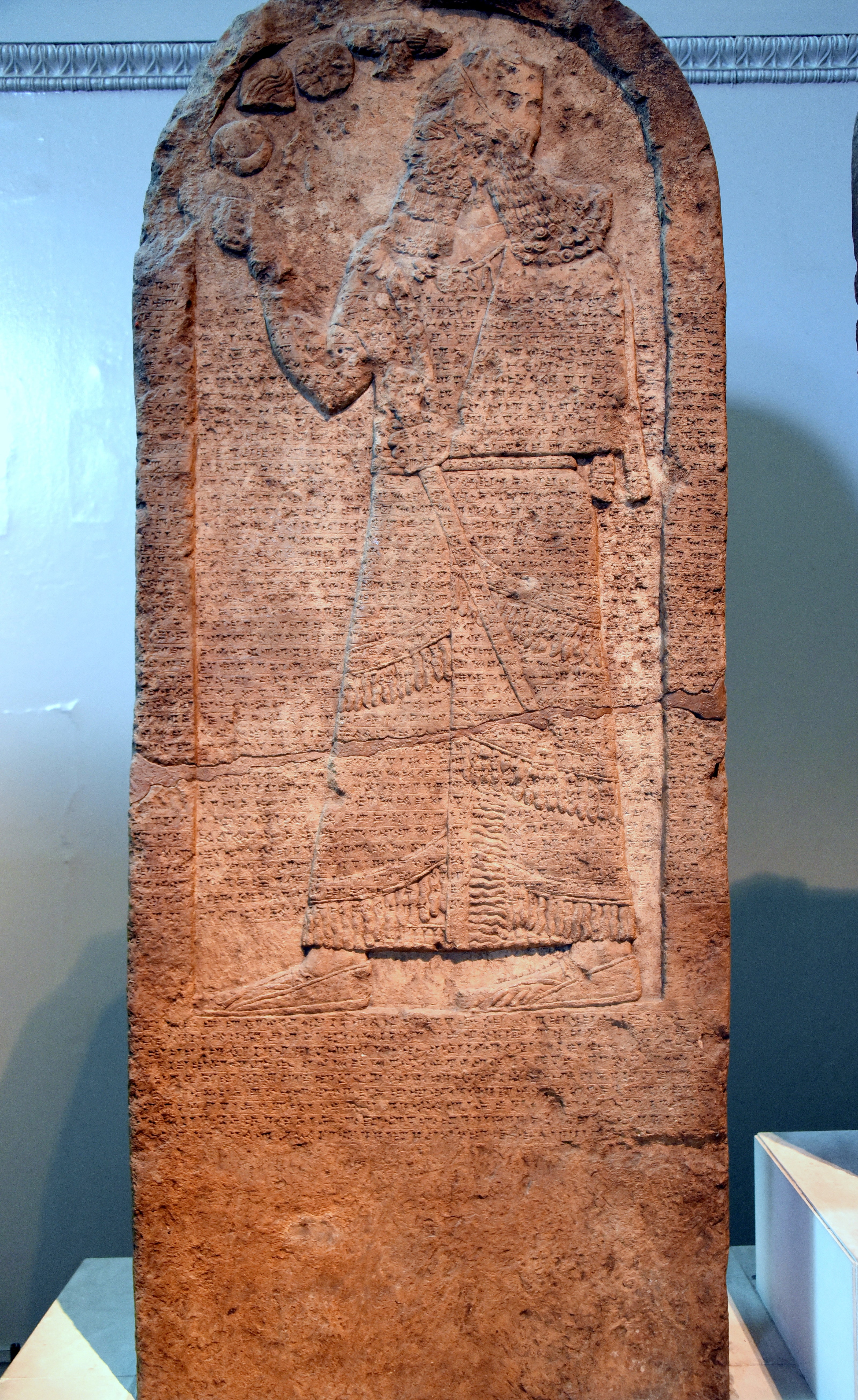 The Kurkh Monolith of Shalmaneser III, from Kurkh near Diyarbakır, Turkey, about 852 BC, British Museum. Photo: Osama Shukir Muhammed Amin FRCP(Glasg), CC BY-SA 4.0, via Wikimedia Commons, resized.

The 30-second version:
Shalmaneser III ruled Assyria from 859 to 824 BC. He is absent from the Bible, yet his own monuments name two kings of Israel. His Kurkh Monolith lists "Ahab the Israelite" among the kings who fought him at Qarqar in 853 BC, and his Black Obelisk records the tribute of "Jehu son of Omri" in 841 BC. Those two dates anchor the chronology of the kings of Israel and confirm that Ahab and Jehu were real rulers who dealt with the great powers of their day.
See this page's graph and discover linked topics
In full
Shalmaneser III (Akkadian Šulmānu-ašarēd, "the god Shulmanu is foremost") was the son of Ashurnasirpal II and ruled from Kalhu (modern Nimrud) for thirty-five years. He campaigned west of the Euphrates almost every year, aiming at the trade routes of Syria and the Mediterranean coast. In 853 BC, at Qarqar on the Orontes, he met a coalition of twelve kings led by Hadadezer (Adad-idri) of Damascus and Irhuleni of Hamath, with Ahab of Israel supplying the largest chariot force. He claimed a crushing victory, but the coalition held, and he had to return to the region in 849, 848 and 845. In 841 BC, after Hazael had seized the throne of Damascus, he besieged Damascus without taking it and received tribute from Tyre, Sidon and "Jehu son of Omri." His last years were troubled by the revolt of his son Assur-danin-pal, and he was succeeded by another son, Shamshi-Adad V.
In the Bible
Shalmaneser III is not named anywhere in Scripture. His reign runs alongside these biblical narratives:
- Ahab's reign and wars with Aram (1 Kings 16:29 to 22:40). Kings records Ahab's battles with Ben-hadad of Damascus and a three-year peace between Israel and Aram (1 Kings 22:1), but it says nothing of Qarqar. A temporary alliance of Israel and Damascus against a common Assyrian threat would explain why former enemies were at peace.
- Hazael's coup in Damascus (2 Kings 8:7-15). Shalmaneser's statue inscription from Assur calls Hazael "son of a nobody," a usurper, which matches the biblical account of Hazael murdering his master and taking the throne.
- Jehu's revolt (2 Kings 9-10). Jehu wiped out the house of Omri and Ahab. The Black Obelisk shows the new king submitting to Assyria in his first year.
Some interpreters have connected "Shalman" in Hosea 10:14 with an Assyrian Shalmaneser. That verse is usually linked with Shalmaneser V or with Salamanu of Moab, and Lawrence Mykytiuk treats Shalman as too thinly described to identify. See Shalmaneser V.
Family and lineage
- Father: Ashurnasirpal II (reigned 883-859 BC), builder of the great palace at Kalhu.
- Sons: Assur-danin-pal, who led a long revolt in his father's last years, and Shamshi-Adad V, who succeeded him in 824 BC.
- Dynasty: the Middle and Neo-Assyrian royal line that later produced Tiglath-Pileser III, Shalmaneser V, Sargon II and Sennacherib, though Sargon's descent from it is disputed.
Historical and archaeological evidence
| Artifact | What it says | Date | Findspot and current home | Grade |
|---|---|---|---|---|
| Kurkh Monolith | Lists the Qarqar coalition, including "Ahab the Israelite" with 2,000 chariots and 10,000 soldiers, and Hadadezer of Damascus | about 852 BC | Kurkh (Üçtepe), near Diyarbakır, Turkey; found 1861 by the British consul J. E. Taylor; British Museum | Direct. The name and setting are secure. |
| Black Obelisk | Five registers of tributaries; the second shows a man kneeling with his face to the ground before the king, captioned as the tribute of "Jehu (Ia-ú-a) son of Omri (mar Ḫu-um-ri-i)": silver, gold, a gold bowl and other gold vessels, tin, and a staff for the king's hand | about 825 BC | Nimrud (Kalhu); excavated by Austen Henry Layard in 1846; British Museum | Direct for Jehu, by the majority reading |
| Annals from Assur and the Kurba'il statue | Record the 841 BC campaign and the tribute of "Jehu son of Omri" | 841 to about 830 BC | Assur and Kurba'il, northern Iraq | Direct |
| Assur basalt statue | Calls Hazael "son of a nobody," a usurper of Damascus | about 838 BC | Assur, northern Iraq | Direct for Hazael |
| Balawat Gates | Bronze bands from palace gates picturing his campaigns, including tribute from Tyre and Sidon | mid 9th century BC | Balawat (Imgur-Enlil), Iraq; British Museum | Direct for the king; context for the Levant |
Grade: direct. Shalmaneser III is known from his own royal inscriptions, palace (Fort Shalmaneser at Nimrud) and monuments. Because he is not named in the Bible, he is not one of Lawrence Mykytiuk's 53 Hebrew Bible figures; Mykytiuk counts Ahab, Jehu, Hadadezer and Hazael as confirmed through his inscriptions. See Biblical Figures Confirmed by Archaeology.
Scholarly consensus
- Qarqar and Ahab. The identification of "Ahab the Israelite" with the biblical Ahab is universal. The figure of 2,000 chariots is debated: Nadav Na'aman and others have suggested a scribal slip for 200, while others accept that Israel fielded a large chariot corps, as the stables and stores of the Omride period suggest.
- Jehu on the Black Obelisk. The caption is read as Jehu by almost all current scholars. P. Kyle McCarter (1974) proposed reading it as Joram, Ahab's son, on philological grounds; that proposal has not won a following, because Assyrian annals of the same campaign date the tribute to 841 BC, the year Jehu took the throne. Whether the kneeling man is Jehu himself or an envoy representing him is debated.
- "Son of Omri." Jehu was not Omri's descendant; he destroyed Omri's dynasty. Assyrian scribes called Israel Bit Ḫumri, "House of Omri," and "son of Omri" here means a ruler of Omri's land.
- Chronology. Edwin Thiele built his chronology of the Hebrew kings on these two fixed points: Ahab alive in 853 and Jehu reigning in 841. The twelve years between them match the reigns of Ahaziah and Joram in Kings once the non-accession dating method of the northern kingdom is applied.
Theological significance
- The kings of Kings were real kings. The Bible presents Ahab and Jehu as rulers of a real kingdom caught between Aram and Assyria. Shalmaneser's monuments place both men exactly where Kings puts them.
- Selective history. The biblical writer does not mention Qarqar or Jehu's submission. The books of Kings say openly that they are selective and point readers to "the book of the chronicles of the kings of Israel" (1 Kings 22:39). Their interest is the covenant faithfulness of the kings, not their military record.
- The shadow of Assyria. Shalmaneser's campaigns are the first appearance of the Assyrian power that would, a century later, destroy Samaria under Shalmaneser V and Sargon II.
Church Fathers
The Church Fathers did not know Shalmaneser III; his inscriptions were recovered only in the nineteenth century.
See also
- People of the Bible, every person in this series grouped by the book of first mention
- Biblical Figures Confirmed by Archaeology, Mykytiuk's list of confirmed persons
- Ahab, "Ahab the Israelite" of the Kurkh Monolith
- Jehu, the king of the Black Obelisk
- Omri, founder of the "House of Omri" named in Assyrian records
- Hadadezer of Damascus and Hazael, the kings of Damascus he fought
- Joram of Israel, king of Israel between Ahab and Jehu
- Tiglath-Pileser III, the next Assyrian king to deal directly with Israel
- Shalmaneser V, the later Shalmaneser named in 2 Kings 17
- Nineveh Discovery, the recovery of Assyria in the nineteenth century
- Tel Dan Stele, the Aramaean inscription from the same generation
- Mesha Stele, the Moabite inscription naming Omri
- Biblical Archaeology
Common questions this page answers
Q: Is Shalmaneser III mentioned in the Bible?
No. The Bible never names him. He matters because his own inscriptions name two kings of Israel, Ahab and Jehu, and give firm dates for them.
Q: What does the Black Obelisk say about Jehu?
Its second register shows a man bowing to the ground before Shalmaneser III, with a caption recording the tribute of "Jehu son of Omri": silver, gold, gold vessels, tin and a royal staff. It dates to about 825 BC and records events of 841 BC.
Q: What is the Kurkh Monolith?
A stone stele of Shalmaneser III found at Kurkh in southern Turkey in 1861 and now in the British Museum. It describes the battle of Qarqar in 853 BC and lists "Ahab the Israelite" among the kings who fought Assyria.
Q: Why does the Bible not mention the battle of Qarqar?
The books of Kings are selective. They judge each king by his loyalty to the covenant and refer readers to royal chronicles for other deeds. The three-year peace between Israel and Aram in 1 Kings 22:1 fits a temporary alliance against Assyria.
Q: Why is Jehu called "son of Omri" if he destroyed Omri's family?
Assyrian scribes called Israel the "House of Omri" after the dynasty's founder. "Son of Omri" meant a king of Omri's land, not a blood descendant.