Concept
Seventh-day Adventism
Seventh-day Adventists, Seventh-day Adventist, Seventh-day Adventist Church, SDA, Adventism, Adventists, Seventh Day Adventists, Seventh Day AdventismIntro
Seventh-day Adventists are a worldwide Protestant church that grew out of the Millerite movement in the United States. The church was organized in Battle Creek, Michigan, in May 1863. At the end of 2025 it reported 24,372,139 members.
Adventists confess the Trinity, the full deity of Christ, his bodily resurrection and salvation by grace through faith. That puts them inside the core of historic Christian belief. Other Christians still dispute several of their distinctive teachings:
- Saturday is the Sabbath and still binds Christians.
- Christ began a final phase of his priestly work in heaven in 1844, which Adventists call the investigative judgment.
- Ellen G. White had the gift of prophecy, and her writings speak with prophetic authority under the Bible.
- The dead are unconscious until the resurrection.
- The wicked are finally destroyed by fire, so hell does not last forever.
- Michael the archangel is a title of Christ. Adventists hold that Christ is fully God and was never created.
Adventists are often confused with Jehovah's Witnesses because both identify Michael with Christ. The two groups differ at the decisive point: Adventists confess Christ as eternal God, and the Witnesses call him a creature.
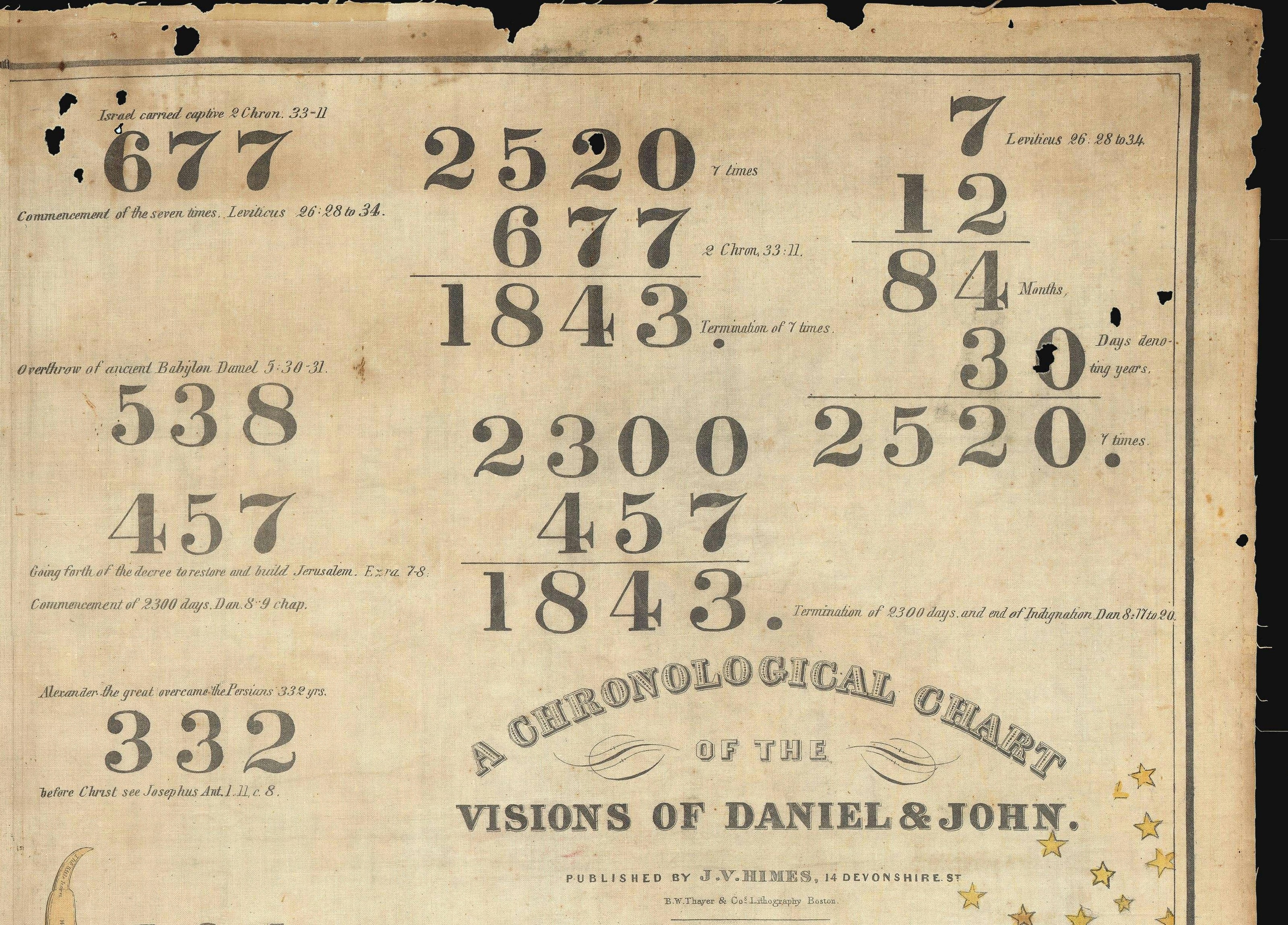
Detail of the Millerite "Chronological Chart of the Visions of Daniel and John" (Boston, 1843), published by Joshua V. Himes. The middle sum adds Daniel's 2,300 days to 457 BC and arrives at 1843. Public domain, via Wikimedia Commons.
See this page's graph and discover linked topics
In full
Seventh-day Adventism is a Sabbatarian, premillennial Protestant body. Its current doctrinal standard is the 28 Fundamental Beliefs. The church holds that the Bible is the standard by which all teaching is tested. It also holds that the prophetic gift was manifested in Ellen G. White (1827-1915), one of its founders.
The church's distinctive cluster comes from its origin. William Miller's followers expected Christ's return in 1843 and then on October 22, 1844, reading the "2300 evenings and mornings" of Daniel 8:14 as years counted from 457 BC. When Christ did not return, a group of Millerites concluded that the date was right and the event was misidentified. In their reading, the "cleansing of the sanctuary" in Daniel 8:14 names Christ's entry into the second phase of his priestly ministry in the heavenly sanctuary. That reading is now Fundamental Belief 24.
The assessment of Adventism by other evangelicals has changed over time. In the early twentieth century many classed it with the cults. After a series of conversations with Adventist leaders in the 1950s, Donald Grey Barnhouse and Walter Martin both concluded that Adventists are Christians who hold some doctrines they believed Scripture does not support. Adventist leaders set out their positions in Seventh-day Adventists Answer Questions on Doctrine (1957), which explicitly rejects the Jehovah's Witness view of Christ.
This page sets out what Adventists believe in their own words, the case they make, the reply from the wider Christian tradition, and the precise question each dispute turns on. Scripture quotations are from the ASV.
History
- The Millerite movement (1830s-1844). William Miller, a Baptist farmer-preacher in New York, calculated from Daniel 8:14 and Ezra 7 that Christ would return about 1843. His associate Joshua V. Himes published charts and papers that spread the message across New England.
- The Great Disappointment, October 22, 1844. The final date passed. The movement fractured.
- The Sabbatarian Adventists (1844-1863). A small group came together around three convictions: the seventh-day Sabbath, the heavenly-sanctuary reading of Daniel 8:14, and the visions of Ellen Harmon. Her first vision came late in December 1844, two months after the disappointment. She married James White in August 1846.
- Organization, 1863. The General Conference of Seventh-day Adventists met in Battle Creek, Michigan, on May 20-21, 1863, and adopted a constitution.
- Growth. The church built a large network of schools, hospitals and publishing houses. The 2026 Annual Statistical Report gives 24,372,139 members, 106,936 churches and 78,061 companies at the end of 2025.
- Doctrinal statements. A statement of 27 Fundamental Beliefs was voted in 1980. A belief on growing in Christ was added in 2005, making 28, and the wording was revised in 2015.
What Adventists hold in common with historic Christianity
The Fundamental Beliefs confess the doctrines that define historic Christian faith:
There is one God: Father, Son, and Holy Spirit, a unity of three coeternal Persons. (Fundamental Belief 2, The Trinity)
God the eternal Son became incarnate in Jesus Christ. ... Forever truly God, He became also truly human, Jesus the Christ. (Fundamental Belief 4, God the Son)
Adventists also confess the virgin birth, the atoning death of Christ, his bodily resurrection, salvation by grace through faith, and the visible personal return of Christ. On the questions the early councils settled, they stand with Nicaea and Chalcedon. That is the main reason Barnhouse and Martin refused to class them with the Jehovah's Witnesses or the Latter-day Saints (see Jehovahs Witnesses, Mormonism).
The distinctive doctrines
1. The investigative judgment and 1844
What Adventists teach.
In 1844, at the end of the prophetic period of 2300 days, He entered the second and last phase of His atoning ministry ... It is a work of investigative judgment ... (Fundamental Belief 24, Christ's Ministry in the Heavenly Sanctuary)
The Adventist case.
- Leviticus 16 describes a daily ministry in the holy place and a yearly Day of Atonement in the most holy place. Hebrews treats the earthly sanctuary as a copy of the heavenly one (Hebrews 8:5).
- Daniel 7:9-10 shows a heavenly judgment in which "the books were opened," before the kingdom is given to the saints.
- Daniel 8:14 ("Unto two thousand and three hundred evenings and mornings; then shall the sanctuary be cleansed") is read on the day-for-a-year principle (Numbers 14:34, Ezekiel 4:6), counted from the decree of Ezra 7 in 457 BC, which brings it to 1844.
- Adventists insist the cross was a complete sacrifice. They hold that 1844 began a new phase of applying it, with no addition to it.
The reply from the wider Christian tradition.
- Hebrews places Christ in the inner sanctuary at his ascension. He entered "once for all into the holy place, having obtained eternal redemption" (Hebrews 9:12). He "entered ... into heaven itself, now to appear before the face of God for us" (Hebrews 9:24). He "sat down on the right hand of God" (Hebrews 10:12). Hebrews 6:19-20 speaks of the hope that enters "within the veil," where Jesus has already gone.
- The day-for-a-year principle is drawn from two passages where God states the equation for that occasion. Applying it as a general key to every prophetic number is an interpretive step the texts themselves do not take.
- Daniel 8 sets the vision in the Persian and Greek kingdoms (8:20-21). Most interpreters outside Adventism read the defiled sanctuary of 8:11-14 as the Jerusalem temple under Antiochus IV, rededicated in 164 BC.
The precise question. What text places the start of Christ's second-phase ministry in 1844, when Hebrews places him within the veil at his ascension?
2. The gift of prophecy and Ellen G. White
What Adventists teach.
This gift is an identifying mark of the remnant church and we believe it was manifested in the ministry of Ellen G. White. Her writings speak with prophetic authority and provide comfort, guidance, instruction, and correction to the church. They also make clear that the Bible is the standard by which all teaching and experience must be tested. (Fundamental Belief 18, The Gift of Prophecy)
The Adventist case.
- The New Testament expects prophecy in the church (1 Corinthians 12:28, Ephesians 4:11, 1 Thessalonians 5:20-21). Joel 2:28 promises it for the last days.
- Revelation 12:17 describes the end-time remnant as those who "hold the testimony of Jesus," and Revelation 19:10 calls that testimony "the spirit of prophecy."
- White herself said her writings were "a lesser light" leading to the greater light of Scripture, and the Fundamental Belief keeps the Bible as the test.
The reply.
- Continuationist Christians grant that prophecy can continue. Their question is about authority. A prophet whose writings "speak with prophetic authority" to the whole church functions as a binding guide alongside the Bible, whatever the formal subordination.
- In practice the distinctive doctrines in this list were shaped and confirmed in White's writings. A reader who reaches a different conclusion from Scripture alone has no route within the church to set her interpretation aside.
- Cessationist Protestants hold that revelation binding on the whole church closed with the apostles (Hebrews 1:1-2, Jude 3). See Sola Scriptura.
The precise question. When a careful reading of Scripture and Ellen White's interpretation of it disagree, which one does the church follow, and who decides?
3. The seventh-day Sabbath
What Adventists teach.
... instituted the Sabbath for all people as a memorial of Creation. The fourth commandment of God's unchangeable law requires the observance of this seventh-day Sabbath ... (Fundamental Belief 20, The Sabbath)
The Adventist case. The Sabbath was given at creation (Genesis 2:2-3), before Israel existed. It sits inside the Ten Commandments, which Christians otherwise treat as moral law. Jesus kept it and called himself its Lord (Mark 2:27-28). Nothing in the New Testament transfers it to Sunday.
The reply. Paul lists the Sabbath among things that are "a shadow of the things to come; but the body is Christ's" (Colossians 2:16-17). He treats the observance of days as a matter of conscience (Romans 14:5-6). The Jerusalem council laid no Sabbath requirement on Gentile believers (Acts 15:28-29). The earliest Christians gathered on the first day of the week (Acts 20:7, 1 Corinthians 16:2). See Sabbath for the three positions held across the church.
The precise question. Where do the apostles require Gentile converts to keep the seventh day, given that the council of Acts 15 listed what it required and the Sabbath is absent?
4. Death as unconscious sleep
What Adventists teach.
Until that day death is an unconscious state for all people. (Fundamental Belief 26, Death and Resurrection)
The Adventist case. Scripture often calls death sleep (Daniel 12:2, John 11:11-14, 1 Thessalonians 4:13-16). "The dead know not anything" (Ecclesiastes 9:5). Immortality is God's gift at the resurrection (1 Corinthians 15:53-54), and God "only hath immortality" (1 Timothy 6:16).
The reply. Jesus promised the dying thief, "To-day shalt thou be with me in Paradise" (Luke 23:43). Paul says that to depart and be with Christ is "very far better" (Philippians 1:23), and that to be absent from the body is to be at home with the Lord (2 Corinthians 5:8). The souls of the martyrs speak before God's throne (Revelation 6:9-11). "Sleep" describes how death looks from this side, as Christians have long read it. See Soul and Resurrection of the Body.
The precise question. If death is unconsciousness until the resurrection, why does Paul call departing to be with Christ "very far better" than staying alive?
5. The final destruction of the wicked
What Adventists teach.
The unrighteous dead will then be resurrected, and with Satan and his angels will surround the city; but fire from God will consume them and cleanse the earth. (Fundamental Belief 27, The Millennium and the End of Sin)
The Adventist case. The wages of sin is death (Romans 6:23). The wicked "shall be ashes under the soles of your feet" (Malachi 4:3). "Eternal destruction" (2 Thessalonians 1:9) describes a result that lasts forever.
The reply and its limits. The traditional reading takes "eternal punishment" and "eternal life" in Matthew 25:46 as equal in duration, and points to Revelation 14:11 and 20:10. This dispute does not set Adventists apart from evangelicals in general: conditional immortality is held by a number of evangelical scholars outside Adventism. The codex treats it as a live question inside the church. See Conditional Immortality and Hell and Eternal Punishment.
6. The remnant church
What Adventists teach.
... in the last days, a time of widespread apostasy, a remnant has been called out to keep the commandments of God and the faith of Jesus. This remnant announces the arrival of the judgment hour, proclaims salvation through Christ, and heralds the approach of His second advent. (Fundamental Belief 13, The Remnant and Its Mission)
The Adventist case. Revelation 12:17 and 14:12 describe an end-time people who keep God's commandments and the faith of Jesus, and Revelation 14:6-12 gives them the three angels' messages. Adventists identify their movement with that mission while affirming that true believers exist in every church.
The reply. Scripture names one body of Christ (Ephesians 4:4-6, 1 Corinthians 12:13). Revelation 12:17 describes a faithful people in conflict with the dragon. Identifying that people with a nineteenth-century denomination and its distinctive teachings is a further step that needs its own textual warrant.
The precise question. What in Revelation 12-14 identifies the remnant by the specific doctrines of the Adventist movement?
7. Michael the archangel as a title of Christ
What Adventists teach. Michael's identity is not one of the 28 Fundamental Beliefs, but it is the church's standing interpretation and appears in its official teaching materials:
Thus Michael is none other than Jesus Christ. (Adult Sabbath School Bible Study Guide, Daniel, first quarter 2020, Lesson 11, "From Battle to Victory," Thursday, March 12)
Michael is another name for Jesus. (Adult Bible Study Guide, Easy Reading Edition, second quarter 2018, Lesson 1, Tuesday, April 3)
Ellen White taught the same identification:
Michael, or Christ, with the angels that buried Moses, came down from Heaven, after he had remained in the grave a short time, and resurrected him, and took him to Heaven. (Ellen G. White, Spiritual Gifts, vol. 4a, 1864, p. 57)
The church's Biblical Research Institute is candid about the textual basis:
So even though the Bible does not clearly identify Michael with Christ, there is enough biblical information to warrant the view that They are the same person. The name Michael stresses the fact that Christ is the supreme leader of the heavenly angels and the defender of His people as warrior, judge, and priest. (Biblical Research Institute, "Is Michael Another Name for Jesus?", 2012)
How this differs from the Jehovah's Witnesses. Adventists hold that "archangel" names Christ's rank as commander of the angels, with no implication that he belongs to their created class:
We emphatically reject the idea set forth in this question, and the position held by the Jehovah's Witnesses. We do not believe that Christ is a created being. (Seventh-day Adventists Answer Questions on Doctrine, 1957, p. 71)
We believe that the term "Michael" is but one of the many titles applied to the Son of God, the second person of the Godhead. But such a view does not in any way conflict with our belief in His full deity and eternal pre-existence ... (ibid.)
The Adventist case.
- Michael is "the great prince who standeth for the children of thy people" (Daniel 12:1), a role Scripture also gives the Messiah.
- The Lord descends "with the voice of the archangel" (1 Thessalonians 4:16), and the dead are raised at his voice (John 5:28-29).
- In Revelation 12:7 Michael leads the war against the dragon. Ekkehardt Mueller of the Biblical Research Institute pairs 1 Thessalonians 4:16 with 1 Peter 5:4, where Christ is "chief Shepherd" (archipoimēn), and argues that arch- there marks Christ's rank.
- The identification is older than Adventism. The White Estate notes that "many non-Adventist Bible scholars equate Michael with Christ."
The reply.
- Daniel 10:13 calls Michael "one of the chief princes." That places him in a class with others of his kind, which is the opposite of the Son's uniqueness.
- Hebrews 1 sets the Son apart from every angel: "unto which of the angels said he at any time, Thou art my Son" (Hebrews 1:5), and "of which of the angels hath he said at any time, Sit thou on my right hand" (Hebrews 1:13). An argument built to show the Son is no angel would be weakened if the Son held an angel's title.
- In Jude 9 Michael "durst not bring against him a railing judgment, but said, The Lord rebuke thee." Jesus rebukes Satan and demons in his own name (Matthew 4:10, Mark 1:25). Michael appeals to another's authority.
- 1 Thessalonians 4:16 says the Lord descends with an archangel's voice, alongside "the trump of God." Neither phrase makes the Lord an archangel or a trumpet.
The precise question. If even the Biblical Research Institute grants that Scripture never clearly identifies Michael with Christ, what positive text overcomes Daniel 10:13, Hebrews 1 and Jude 9?
Because Adventists confess Christ's full deity, this dispute is about the identity of an angelic figure. Treating it as a denial of Christ's deity misstates what they teach. See Jehovah's Witnesses vs the Christian God for the Arian version of the identification and Angels.
8. The scapegoat and Satan
What Adventists teach. Ellen White read the second goat of Leviticus 16 as a type of Satan:
... the scapegoat typified Satan, the author of sin, upon whom the sins of the truly penitent will finally be placed. (Ellen G. White, The Great Controversy, 1911, p. 422)
Critics have read this as making Satan a sin-bearer alongside Christ. Adventist leaders rejected that reading in plain terms:
Satan makes no atonement for our sins. (Questions on Doctrine, 1957, p. 400)
Seventh-day Adventists therefore repudiate in toto any idea, suggestion, or implication that Satan is in any sense or degree our sin bearer. (ibid.)
The Adventist case. On the Day of Atonement only the goat "for Jehovah" is killed and its blood carried into the sanctuary (Leviticus 16:9, 15). The live goat is sent away "for Azazel" (16:8, 10) after the atonement is complete. Adventists read the sending away as the final removal of sin's responsibility to its originator, with no saving value. The scapegoat is not one of the 28 Fundamental Beliefs.
The reply. Leviticus 16:21-22 says Aaron confesses Israel's iniquities over the live goat and "the goat shall bear upon him all their iniquities unto a solitary land." Many interpreters read the two goats as one sin offering (16:5 calls both "a sin-offering") showing two sides of one atonement: sin covered by blood and sin carried away, both fulfilled in Christ (Isaiah 53:6, John 1:29, Hebrews 9:26). The meaning of ʿazāʾzēl is itself disputed: a proper name of a desert spirit, "the goat that departs," or a place name.
The precise question. If the live goat in Leviticus 16 is part of a single sin offering, on what textual ground is one half of it a type of Christ and the other a type of Satan?
How evangelicals have assessed Adventism
| Assessment | Who | Basis |
|---|---|---|
| A cult or heretical sect | Walter Martin's first treatment in The Rise of the Cults (1955); Anthony Hoekema, The Four Major Cults (1963) | Ellen White's authority, the investigative judgment, Sabbath legalism |
| Christians with some unbiblical teachings | Donald Grey Barnhouse, "Are Seventh-day Adventists Christians?", Eternity, September 1956; Walter Martin, The Truth About Seventh-day Adventism (1960) | The church's confession of the Trinity, Christ's deity and salvation by grace, as set out in Questions on Doctrine (1957) |
Barnhouse concluded that Adventists should be taken out of the group that includes the Jehovah's Witnesses, the Mormons and the Christian Scientists, and acknowledged as redeemed brethren and members of the body of Christ. Martin's book reached the same judgment and still named the doctrines he believed Scripture does not support.
Comparison table
| Question | Seventh-day Adventists | Jehovah's Witnesses | Historic Christian consensus |
|---|---|---|---|
| Trinity | Affirmed (FB 2) | Denied | Affirmed |
| Deity of Christ | Eternal, truly God (FB 4) | Created, "a god" | Eternal, truly God |
| Michael | A title of Christ, who is uncreated | Christ's identity before his human life, as a creature | A created archangel |
| Salvation | By grace through faith | Faith plus Watchtower-defined obedience | By grace through faith |
| Day of worship | Saturday, binding | No weekly Sabbath | Sunday by custom; Sabbath fulfilled in Christ |
| State of the dead | Unconscious until resurrection | Unconscious; many not raised | Conscious with Christ |
| Final state of the wicked | Destroyed | Destroyed | Mostly everlasting punishment; conditional immortality a minority view |
| Later prophet | Ellen G. White, under Scripture | The Governing Body as channel | None binding on the church |
| 1844 / 1914 | Investigative judgment from 1844 | Christ's invisible presence from 1914 | No dated phase |
How to engage
- Start from what you share. Adventists confess the Trinity and the deity of Christ. Begin there. Treating an Adventist as a Jehovah's Witness ends the conversation and misstates their faith.
- Pick one dispute and stay with it. The investigative judgment and the authority of Ellen White are the most consequential, because the others depend on them.
- Use their own sources. The Fundamental Beliefs and Questions on Doctrine are public. Quoting them accurately earns a hearing.
- Ask the precise question. Each section above ends with one. Ask it, then listen to the answer.
- Honor their strengths. Adventist health ministry, education and missions are admired well beyond the church. A conversation about doctrine goes better when that is acknowledged.
Scholarship
Published academic works this page draws on, each matched to a publisher, index or library catalog record.
- Anthony A. Hoekema, The four major cults (1963). Open Library
- Walter Ralston Martin, Rise of the cults (1955). Open Library
- Ellen Gould Harmon White, The Great Controversy (1911). Open Library
See also
- Ellen G. White, the church's prophetic figure and most-translated author
- Jehovahs Witnesses, the other movement with roots in nineteenth-century Adventism, which denies Christ's deity
- Jehovah's Witnesses vs the Christian God, the Michael identification in its Arian form
- Sabbath, the three positions on the Sabbath held across the church
- Conditional Immortality, the case for the final destruction of the wicked
- Hell and Eternal Punishment, the traditional view
- Sola Scriptura, Scripture as the final authority
- Trinity, the doctrine Adventists confess with historic Christianity
- Local Church Movement, another case study in how evangelicals classify disputed groups
- Mormonism, a nineteenth-century movement with a later prophet that does deny the Trinity
- Angels, Michael and the angelic orders
Common questions this page answers
Q: Are Seventh-day Adventists Christians?
Adventists confess the Trinity, the full deity of Christ, his bodily resurrection and salvation by grace through faith, which are the defining beliefs of historic Christianity. Evangelical assessors such as Donald Grey Barnhouse (1956) and Walter Martin (1960) concluded they are Christians, while disputing several distinctive doctrines.
Q: Do Seventh-day Adventists believe Jesus is Michael the archangel?
Yes. Their teaching materials say "Michael is none other than Jesus Christ." They hold that Michael is a title for the eternal, uncreated Son, and in 1957 they explicitly rejected the Jehovah's Witness view that Christ is a created being.
Q: What is the investigative judgment?
It is Fundamental Belief 24: in 1844, at the end of the 2,300 days of Daniel 8:14, Christ entered the second and last phase of his atoning ministry in the heavenly sanctuary. Other Christians reply that Hebrews 9:12, 9:24 and 10:12 place Christ in God's presence at his ascension.
Q: What role does Ellen G. White have in the Adventist church?
Fundamental Belief 18 says the gift of prophecy was manifested in her ministry and that her writings "speak with prophetic authority," while the Bible remains the standard for testing all teaching. Critics ask how that authority works when her interpretation and a reader's study of Scripture disagree.
Q: Do Seventh-day Adventists believe in hell?
They believe in final judgment and teach that fire from God will consume the wicked, so the wicked cease to exist and are not tormented forever. A number of evangelicals outside Adventism also hold this view, called conditional immortality.
Q: Why do Seventh-day Adventists worship on Saturday?
They hold that the seventh-day Sabbath was given at creation and is part of the Ten Commandments, so it still binds all people. Most other Christians read Colossians 2:16-17 and Romans 14:5-6 as fulfilling the Sabbath in Christ, and gather on the first day of the week.
Q: Do Adventists teach that Satan bears our sins as the scapegoat?
Ellen White taught that the scapegoat of Leviticus 16 typifies Satan, on whom the sins of the penitent are finally placed. Questions on Doctrine (1957) states that "Satan makes no atonement for our sins" and repudiates any idea that he is in any sense our sin bearer.