Person
Sergius Paulus
Lucius Sergius Paulus, Lucius Sergius Paullus, Sergius Paullus, Proconsul of Cyprus, Paulus the proconsulIntro
Sergius Paulus was the Roman governor of Cyprus when Paul and Barnabas arrived there on their first missionary journey, around AD 46-48. Acts calls him "a man of understanding" who sent for the missionaries because he wanted "to hear the word of God" (Acts 13:7, ASV). A Jewish sorcerer at his court, Elymas Bar-Jesus, tried to turn him away from the faith. Paul rebuked Elymas, who was struck blind for a time, and the governor "believed, being astonished at the teaching of the Lord" (Acts 13:12, ASV).
He is the first named convert of Paul's missionary career in Acts, and the first Roman governor in the New Testament to believe. Several Roman inscriptions name men called Sergius Paullus, and one of them may be the governor of Acts, but none names him as governor of Cyprus beyond doubt.
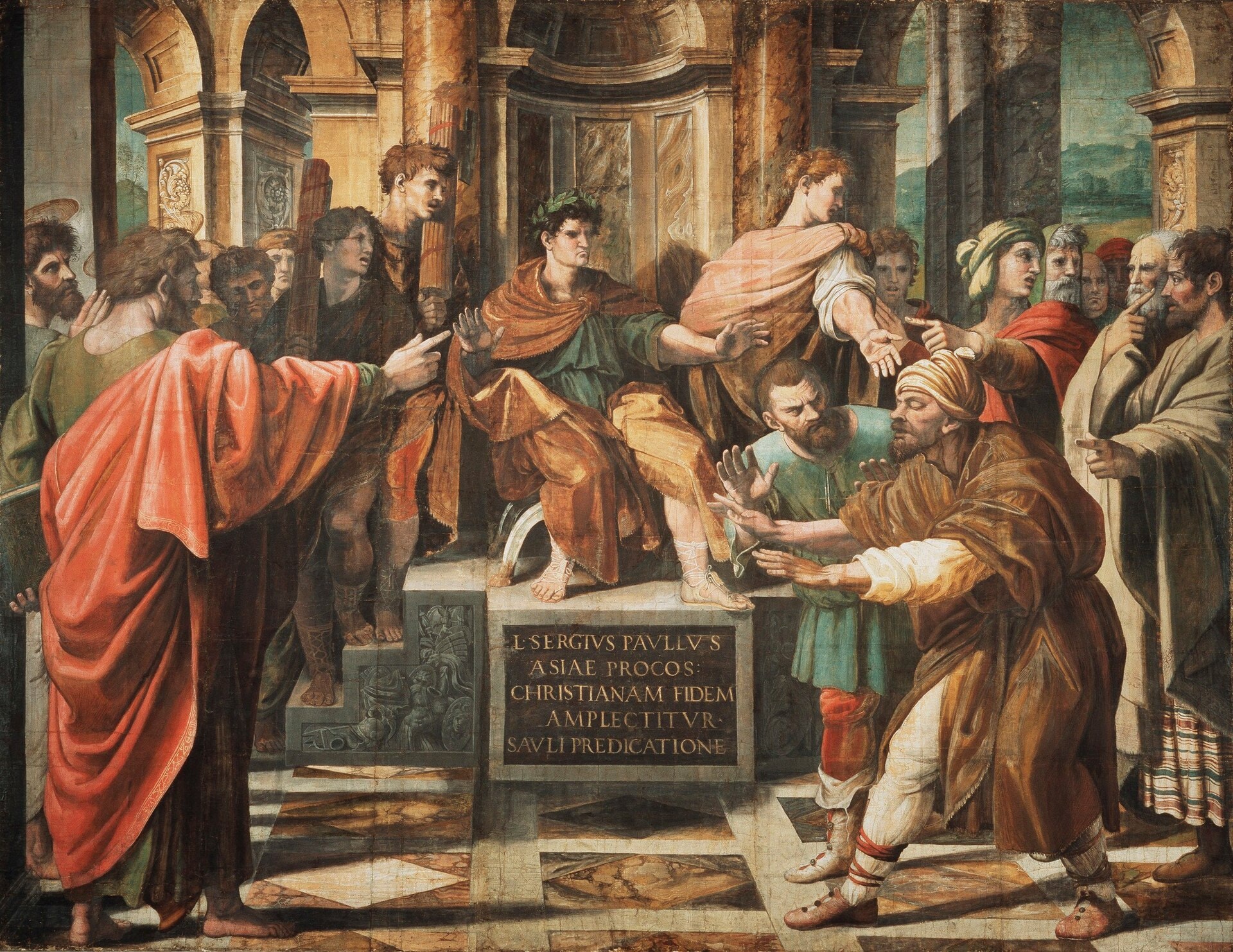
Raphael, The Conversion of the Proconsul (c. 1515-1516), tapestry cartoon for the Sistine Chapel, Royal Collection, on loan to the Victoria and Albert Museum. Paul (left, in red) rebukes the blinded Elymas before Sergius Paulus. Public domain, via Wikimedia Commons, resized.

The 30-second version:
Sergius Paulus was the Roman proconsul of Cyprus who heard Paul and Barnabas at Paphos and believed after Paul's confrontation with the sorcerer Elymas. Luke gets his title exactly right: Cyprus was then a senatorial province ruled by a proconsul. A Lucius Sergius Paullus appears in a Roman inscription as a Tiber commissioner under Claudius, and inscriptions of a Sergius Paullus family were found at Pisidian Antioch, where Paul went next. Whether any of these is the man of Acts is debated.
See this page's graph and discover linked topics
In full
Acts 13:4-12 records that Barnabas and Saul crossed Cyprus from Salamis to Paphos, the seat of the Roman governor, where "the proconsul, Sergius Paulus, a man of understanding" summoned them. Elymas, a Jewish magician and false prophet in his entourage, opposed them; Paul, "filled with the Holy Spirit," pronounced temporary blindness on him, and the proconsul believed. From this point Luke calls Saul "Paul" (13:9) and lists him before Barnabas. Luke's use of the title anthypatos, proconsul, is accurate: Augustus transferred Cyprus to the Senate in 22 BC, and from then it was governed by proconsuls. The man himself is not securely identified outside Acts. The strongest candidate is the Lucius Sergius Paullus named on a Roman inscription as one of the curators of the Tiber banks under Claudius (CIL VI 31545); the senatorial Sergii Paulli also had connections to Pisidian Antioch. Lawrence Mykytiuk lists him among New Testament figures not clearly documented outside the Bible, and the codex grades him accordingly.
In the Bible
- Acts 13:6-7. At Paphos the missionaries "found a certain sorcerer, a false prophet, a Jew, whose name was Bar-Jesus; who was with the proconsul, Sergius Paulus, a man of understanding. The same called unto him Barnabas and Saul, and sought to hear the word of God" (ASV).
- Acts 13:8-11. "Elymas the sorcerer... withstood them, seeking to turn aside the proconsul from the faith. But Saul, who is also called Paul, filled with the Holy Spirit, fastened his eyes on him," called him "thou son of the devil," and declared, "thou shalt be blind, not seeing the sun for a season" (ASV).
- Acts 13:12. "Then the proconsul, when he saw what was done, believed, being astonished at the teaching of the Lord" (ASV).
- What follows. Paul's party sails from Paphos to Perga and goes inland to Antioch of Pisidia (Acts 13:13-14).
Family and lineage
Acts gives no family details. If he is the Lucius Sergius Paullus of the Tiber inscription, he belonged to a senatorial family; a later Lucius Sergius Paullus was consul in AD 168, and inscriptions at Pisidian Antioch name a Lucius Sergius Paullus "the younger" and a Sergia Paulla, which suggests the family held land in that region. These connections are possible, not established.
Historical and archaeological evidence
The title "proconsul"
Cassius Dio records that in 22 BC Augustus handed Cyprus and Gallia Narbonensis to the Senate (Roman History 54.4.1). Senatorial provinces were governed by proconsuls, so Luke's title is correct for the time. Earlier critics who thought Cyprus had a legate or propraetor were mistaken; the point is now uncontroversial.
Inscriptions naming a Sergius Paullus
- Rome, CIL VI 31545. A boundary inscription lists the five curators of the banks and channel of the Tiber under Claudius, among them Lucius Sergius Paullus. Because a senator often served as such a curator before a proconsulship, William Ramsay and many after him proposed that this is the governor of Acts. The name and the period fit; the inscription does not mention Cyprus.
- Pisidian Antioch. Ramsay and later excavators recorded inscriptions of a Lucius Sergius Paullus the younger and a woman named Sergia Paulla in and near Antioch of Pisidia. Ramsay suggested that the proconsul's family had estates there and that this explains why Paul went straight from Paphos to that inland city. This is an attractive hypothesis that the evidence does not settle.
- Cyprus. A Greek inscription from Soloi in Cyprus is dated "in the proconsulship of Paulus." Its date is uncertain, and it has been assigned to more than one reign, so it cannot be firmly attached to the Paulus of Acts.
Grade. Debated. The title is confirmed, the name belongs to a known senatorial family of the right period, and a Lucius Sergius Paullus held office under Claudius. But no inscription yet names Sergius Paulus as proconsul of Cyprus. Mykytiuk lists him among New Testament persons not clearly documented outside the Bible (see Biblical Figures Confirmed by Archaeology).
Scholarly consensus
- Historicity. Most scholars accept that a proconsul named Sergius Paulus governed Cyprus around this time; Luke's accuracy about the title and setting supports it, and the name is not one a writer would invent. The precise identification remains open.
- His conversion. Some scholars read "believed" (13:12) as a full conversion, as Luke's language usually means; others suggest he was impressed rather than baptized, since Acts does not mention his baptism. Luke's narrative clearly presents him as the first Gentile ruler to believe.
- Paul's name. Older interpreters, including Jerome, thought Saul took the name Paul from his convert. Most modern scholars hold that Paul, a Roman citizen, had both names from birth, a Hebrew name (Saul) and a Roman cognomen (Paullus), and that Luke switches to the Roman name as the mission turns to the Gentile world.
Theological significance
- The gospel reaches the governing class. The first named convert of the Gentile mission is a Roman provincial governor, "a man of understanding." Luke shows the faith persuading an educated Roman official, not only the poor.
- Truth against sorcery. The scene parallels Peter's confrontation with Simon the sorcerer in Samaria (Acts 8:9-24). In both, the apostles' authority exposes the magician and the hearers believe the teaching. The proconsul is astonished "at the teaching of the Lord," not merely at the miracle.
- Saul becomes Paul. At this moment Luke begins calling him Paul and places him at the head of the mission, marking the turn toward the nations that runs through the rest of Acts.
Church Fathers
- Jerome (AD 392): "As Sergius Paulus Proconsul of Cyprus was the first to believe in his preaching, he took his name from him because he had subdued him to faith in Christ" (On Illustrious Men 5, NPNF translation).
- Augustine (c. AD 397) makes the same suggestion: when "Paulus the proconsul" was "made to pass under the easy yoke" of Christ, the apostle, "instead of Saul, his former name, desired to be called Paul, in testimony of so great a victory" (Confessions 8.4.9, NPNF translation).
- John Chrysostom notes that the sorcerer only opposed the apostles when they approached the proconsul, and that "although prepossessed by the man's sorcery, he was nevertheless willing to hear the Apostles" (Homilies on Acts 28, NPNF translation).
See also
- Paul the Apostle, whose first named convert he was
- Acts as History (Ramsay's Verification), where Luke's titles for Roman officials are tested
- Gallio, another proconsul Paul stood before
- Politarch Inscriptions, another case of Luke's exact local titles
- Claudius, the emperor under whom he served
- Jerome and Augustine, who connected his conversion with Paul's name
- Biblical Figures Confirmed by Archaeology, why Mykytiuk holds him back from the confirmed list
- People of the Bible, every person on the list, by book of first mention
Common questions this page answers
Q: Who was Sergius Paulus in Acts 13?
He was the Roman proconsul (governor) of Cyprus who heard Paul and Barnabas at Paphos around AD 46-48. After Paul struck the sorcerer Elymas blind, the proconsul "believed, being astonished at the teaching of the Lord" (Acts 13:12).
Q: Is Sergius Paulus attested outside the Bible?
Possibly. A Roman inscription (CIL VI 31545) names a Lucius Sergius Paullus as a Tiber commissioner under Claudius, and inscriptions of the Sergii Paulli family were found at Pisidian Antioch. None names him as proconsul of Cyprus, so scholars such as Lawrence Mykytiuk count him as not clearly documented.
Q: Did Luke get the title "proconsul" right?
Yes. Augustus transferred Cyprus to the Senate in 22 BC, and senatorial provinces were governed by proconsuls, which is the title Luke uses.
Q: Did Paul take his name from Sergius Paulus?
Jerome and Augustine thought so. Most modern scholars think Paul, as a Roman citizen, already had the Roman name Paullus alongside his Hebrew name Saul, and that Luke switches to it here because the mission is turning to the Gentiles.