Person
Sennacherib
Sennacherib king of Assyria, Sin-ahhe-eriba, Sin-ahhe-riba, Sanacharib, Sennacherib of AssyriaIntro
Sennacherib was king of Assyria from 705 to 681 BC. In 701 BC he invaded Judah, took its fortified cities, besieged Lachish, and threatened Jerusalem in the days of King Hezekiah. The Bible tells the story three times, in 2 Kings 18-19, Isaiah 36-37 and 2 Chronicles 32. It says the angel of the LORD struck the Assyrian camp and Sennacherib went home to Nineveh, where his own sons later killed him.
Sennacherib told his side of the story too. His prisms boast that he shut Hezekiah up in Jerusalem "like a bird in a cage," and his palace walls at Nineveh were carved with the siege of Lachish. He never claims to have taken Jerusalem.
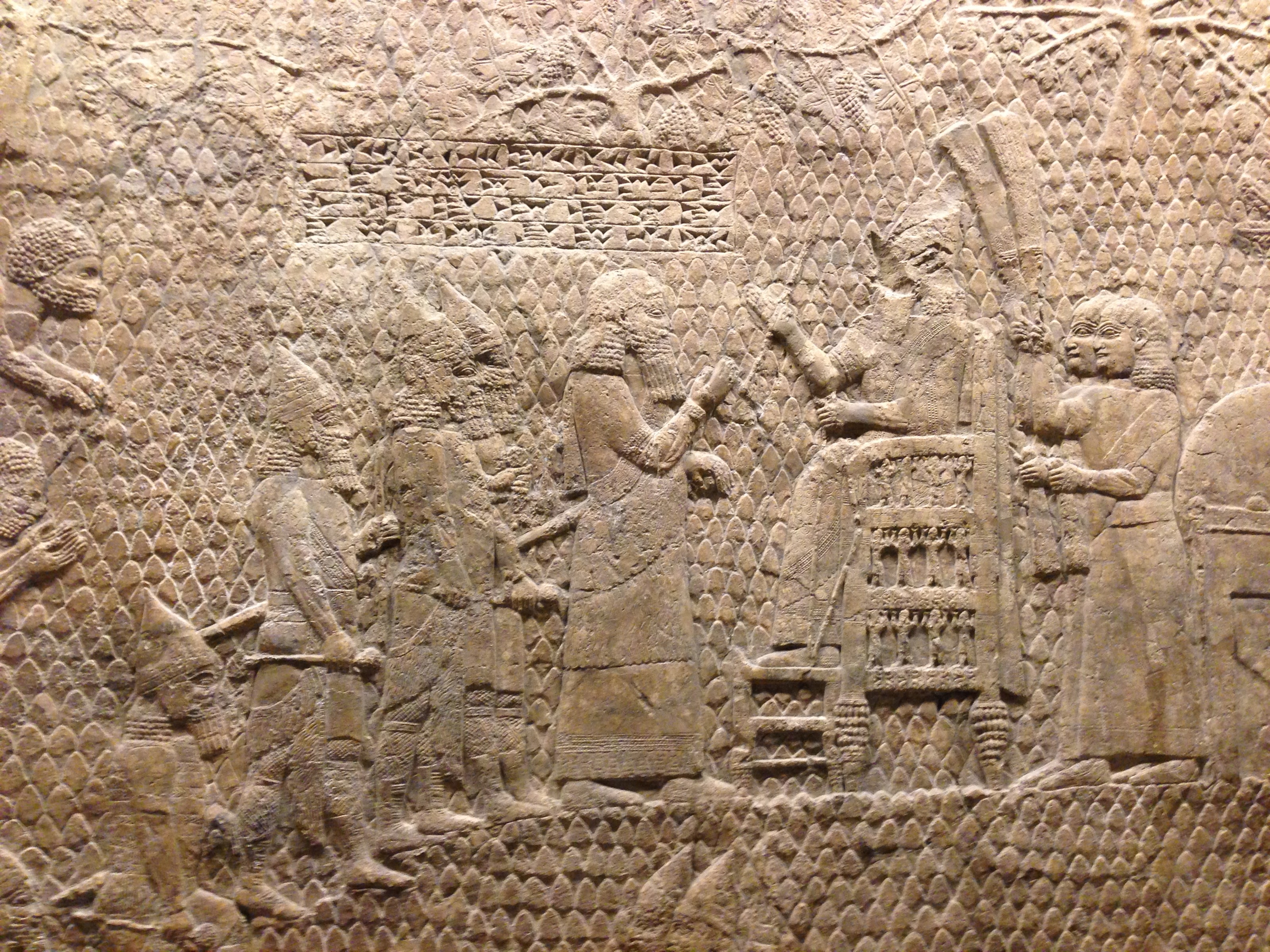 Sennacherib enthroned before Lachish, receiving the surrender of the city, from the Lachish reliefs of his South-West Palace at Nineveh, about 700-692 BC, British Museum. Photo: Nate Loper, CC BY 2.0, via Wikimedia Commons, resized.

The 30-second version:
Sennacherib ruled Assyria from 705 to 681 BC. In 701 BC he invaded Judah, and both the Bible and his own annals describe the same campaign: forty-six fortified cities taken, Lachish besieged, heavy tribute paid by Hezekiah, Jerusalem shut in. His reliefs of the siege of Lachish hang in the British Museum. He boasts of everything except taking Jerusalem, which the Bible says God delivered. Twenty years later he was murdered by a son, as both the Bible and the Babylonian Chronicle report.
See this page's graph and discover linked topics
In full
Sennacherib (Akkadian Sîn-aḫḫē-erība, "the moon god Sin has replaced the brothers") succeeded his father Sargon II in 705 BC. Sargon's death in battle triggered revolts across the empire. In the east Merodach-baladan retook Babylon; in the west Hezekiah of Judah, the cities of Philistia and Phoenicia, and Egypt and Kush joined a rebellion. Sennacherib's first campaign (703) drove out Merodach-baladan. His third campaign (701) went west: he took Sidon, defeated an Egyptian and Kushite army at Eltekeh, captured Lachish and the other fortified towns of Judah, and received Hezekiah's tribute. He later fought repeated wars with Babylon and Elam, and in 689 BC he destroyed Babylon. He rebuilt Nineveh as his capital, with the "Palace Without Rival," a system of canals and aqueducts, and great gardens. In 681 BC he was murdered by one of his sons, and Esarhaddon succeeded him.
In the Bible
- 2 Kings 18:13-16. "Now in the fourteenth year of king Hezekiah did Sennacherib king of Assyria come up against all the fortified cities of Judah, and took them" (2 Kings 18:13, ASV). Hezekiah sends word to him at Lachish and pays "three hundred talents of silver and thirty talents of gold" (18:14, ASV).
- 2 Kings 18:17-37; Isaiah 36. Sennacherib sends the Tartan, the Rab-saris and the Rabshakeh from Lachish to Jerusalem. The Rabshakeh mocks trust in Egypt, "this bruised reed" (18:21, ASV), and in the LORD.
- 2 Kings 19:1-34; Isaiah 37:1-35. Hezekiah spreads Sennacherib's letter before the LORD and prays. Isaiah answers that the king of Assyria "shall not come unto this city, nor shoot an arrow there" (2 Kings 19:32, ASV). Tirhakah of Cush marches out against him (19:9).
- 2 Kings 19:35-37; Isaiah 37:36-38. "The angel of Jehovah went forth, and smote in the camp of the Assyrians a hundred fourscore and five thousand" (2 Kings 19:35, ASV). Sennacherib returns to Nineveh, and while worshipping in the house of Nisroch his god, Adrammelech and Sharezer his sons kill him.
- 2 Chronicles 32:1-23. The Chronicler's parallel, adding Hezekiah's preparations: stopping the springs, repairing the wall, and bringing water into the city (32:3-5, 30).
Family and lineage
- Father: Sargon II (reigned 722-705 BC).
- Sons: Ashur-nadin-shumi, whom he made king of Babylon and who was handed over to the Elamites in 694 BC; Arda-Mulissu, the biblical Adrammelech; Esarhaddon, his chosen heir and successor; and others.
- Wives: Tashmetu-sharrat, named as queen in palace inscriptions, and Naqi'a (Zakutu), mother of Esarhaddon.
- Grandson: Ashurbanipal.
Historical and archaeological evidence
| Source | What it says | Date | Findspot and current home | Grade |
|---|---|---|---|---|
| Sennacherib Prisms (Taylor, Oriental Institute, Jerusalem) | The annals of eight campaigns; the third (701 BC) records 46 Judahite cities taken, 200,150 people deported, Hezekiah shut up in Jerusalem "like a bird in a cage," and tribute of 30 talents of gold and 800 of silver | 691-689 BC | Nineveh; British Museum, Oriental Institute Chicago, Israel Museum | Direct |
| Rassam Cylinder | The earliest edition of the 701 BC account, written within a year of the campaign | 700 BC | Nineveh; British Museum | Direct |
| Lachish reliefs | A sequence of carved panels showing the assault on Lachish, its ramp and siege engines, deportees, and Sennacherib enthroned, with a caption naming him and Lachish | about 700-692 BC | South-West Palace, Nineveh; excavated by Layard in 1847-51; British Museum | Direct |
| Sennacheribs Siege Ramp at Lachish | The Assyrian siege ramp and Judahite counter-ramp, arrowheads, and destruction layer (Level III) | 701 BC | Tel Lachish, Israel; excavated by David Ussishkin | Direct, physical confirmation |
| Bull inscriptions | Shorter accounts of the same campaign on colossal bulls of his palace | about 694 BC | Nineveh; British Museum | Direct |
| Babylonian Chronicle (ABC 1) | "On the twentieth of Tebet, Sennacherib, king of Assyria, was killed by his son in a rebellion" (paraphrase) | compiled later from records; event 681 BC | British Museum | Direct |
| Esarhaddon's Nineveh A prism | Esarhaddon's own account of his brothers' revolt after Sennacherib's death | about 673 BC | Nineveh; British Museum | Direct |
| Herodotus, Histories 2.141 | Story of "Sanacharib, king of the Arabians and Assyrians," whose army near Pelusium was undone overnight when field mice gnawed its bowstrings | 5th century BC | Literary source | Independent tradition of a sudden reverse |
Grade: direct. Lawrence Mykytiuk lists Sennacherib among his 53 confirmed Hebrew Bible figures, attested in many inscriptions of his own. The standard edition is A. Kirk Grayson and Jamie Novotny, The Royal Inscriptions of Sennacherib, King of Assyria (704-681 BC) (RINAP 3, Eisenbrauns 2012-2014). See Biblical Figures Confirmed by Archaeology.
Scholarly consensus
- The campaign is one of the best documented events in the Old Testament. Historians of every school accept that the biblical and Assyrian accounts describe the same 701 BC invasion, the fall of Lachish, the tribute, and Jerusalem's survival.
- The tribute. Kings gives 300 talents of silver, the prism 800; the gold agrees at 30. Proposed explanations include different talent standards and the Assyrian inclusion of other goods; K. A. Kitchen and Mordechai Cogan discuss the difference.
- Why Jerusalem was not taken. The Bible credits the angel of the LORD. Sennacherib's annals record no capture and say Hezekiah sent tribute after him to Nineveh. Historians differ on the immediate cause: plague in the camp (some connect Herodotus' mice), the Kushite army under Taharqa (Henry Aubin), troubles elsewhere in the empire, or a negotiated surrender. The silence of the annals about the city's fall is agreed by all.
- One campaign or two? John Bright and William Shea argued that the Bible combines the 701 campaign with a second, later one (about 688 BC), partly because of the reference to Tirhakah. No Assyrian record of a second campaign has been found, and most scholars now hold to one campaign; see Taharqa for the Tirhakah question.
- The murder. The Babylonian Chronicle says "his son" killed him; the Bible names two sons. Simo Parpola identified the leading conspirator as Arda-Mulissu, the biblical Adrammelech, from a letter in the royal archives. The Bible compresses twenty years between the return to Nineveh and the murder into one verse, without claiming they were close in time.
Theological significance
- God's honor against Assyria's boast. The Rabshakeh's speeches set the gods of the nations beside the LORD (2 Kings 18:33-35). Hezekiah's prayer asks God to act "that all the kingdoms of the earth may know that thou Jehovah art God alone" (2 Kings 19:19, ASV). The deliverance is presented as the answer.
- Isaiah's word fulfilled. Isaiah 10:12 had foretold that God would punish "the stout heart of the king of Assyria" (ASV) once his work on Zion was done, and Isaiah 37:7 that he would fall by the sword in his own land.
- Trust and its testing. The accounts honor Hezekiah's trust in God while recording his costly tribute and Judah's devastation. Micah's lament over Lachish (Micah 1:13) and the ruined cities of the Shephelah belong to this same year.
Church Fathers
No verified patristic quotation is cited here. The Fathers read the deliverance of Jerusalem as a type of divine rescue in their commentaries on Isaiah, but those passages have not been checked against primary texts for this page.
See also
- People of the Bible, every person in this series grouped by the book of first mention
- Sennacherib Prism, his annals of the 701 BC campaign
- Sennacheribs Siege Ramp at Lachish, the physical remains of the siege
- Hezekiahs Tunnel and Siloam Inscription, Hezekiah's water tunnel dug against the siege
- Hezekiahs Bulla, the royal seal impression of Hezekiah
- Hezekiah, the king of Judah he besieged
- Taharqa, the Kushite king who marched against him
- Sargon II, his father
- Esarhaddon, his son and successor
- Adrammelech, the son who murdered him
- Nineveh Discovery, the excavation of his palace
- Isaiah the Prophet
- Biblical Figures Confirmed by Archaeology
Common questions this page answers
Q: Is Sennacherib's attack on Jerusalem confirmed by archaeology?
Yes. His prisms describe the 701 BC campaign against Hezekiah, the reliefs from his palace show the siege of Lachish, and the siege ramp survives at Lachish. They agree with 2 Kings 18-19 on the cities taken and the tribute, and none claim that Jerusalem was captured.
Q: What did Sennacherib say about Hezekiah?
His annals say he took forty-six of Hezekiah's walled cities, deported 200,150 people, shut Hezekiah up in Jerusalem "like a bird in a cage," and received 30 talents of gold and 800 talents of silver.
Q: How did Sennacherib die?
He was murdered by his son in 681 BC, according to the Babylonian Chronicle. The Bible says his sons Adrammelech and Sharezer killed him while he worshipped in the house of Nisroch. An Assyrian letter names the conspirator Arda-Mulissu, matching Adrammelech.
Q: Why didn't Sennacherib capture Jerusalem?
The Bible says the angel of the LORD struck the Assyrian camp. Sennacherib's annals are silent about any capture. Historians have suggested plague, the Kushite army, or a negotiated settlement as the immediate cause.
Q: Where are the Lachish reliefs?
In the British Museum in London. They were carved for Sennacherib's South-West Palace at Nineveh and excavated by Austen Henry Layard in the mid nineteenth century.