Concept
Sean George (Kambalda 2008)
Sean George, Dr Sean George, Kambalda cardiac arrest revival, Miracle Man Sean George, The day God raised me from the deadIntro
On 24 October 2008 Dr Sean George, a 39-year-old hospital physician in the Western Australian goldfields, felt chest pain while driving home to Kalgoorlie. He stopped at the small clinic in the mining town of Kambalda. His own heart tracing showed a heart attack, and a few minutes later his heart stopped.
The clinic team shocked his heart 13 times and gave CPR for well over an hour. Nothing worked. An emergency physician who had come out from Kalgoorlie declared him dead and stopped the resuscitation. His wife, Sherry, also a doctor, was let in to say goodbye. She held his hand and prayed, "I need a miracle." Soon after, his heart started beating on its own.
He was flown to Royal Perth Hospital, survived kidney and liver failure, woke without reported brain damage, and was back at work within three months. He kept his medical records and has published them.
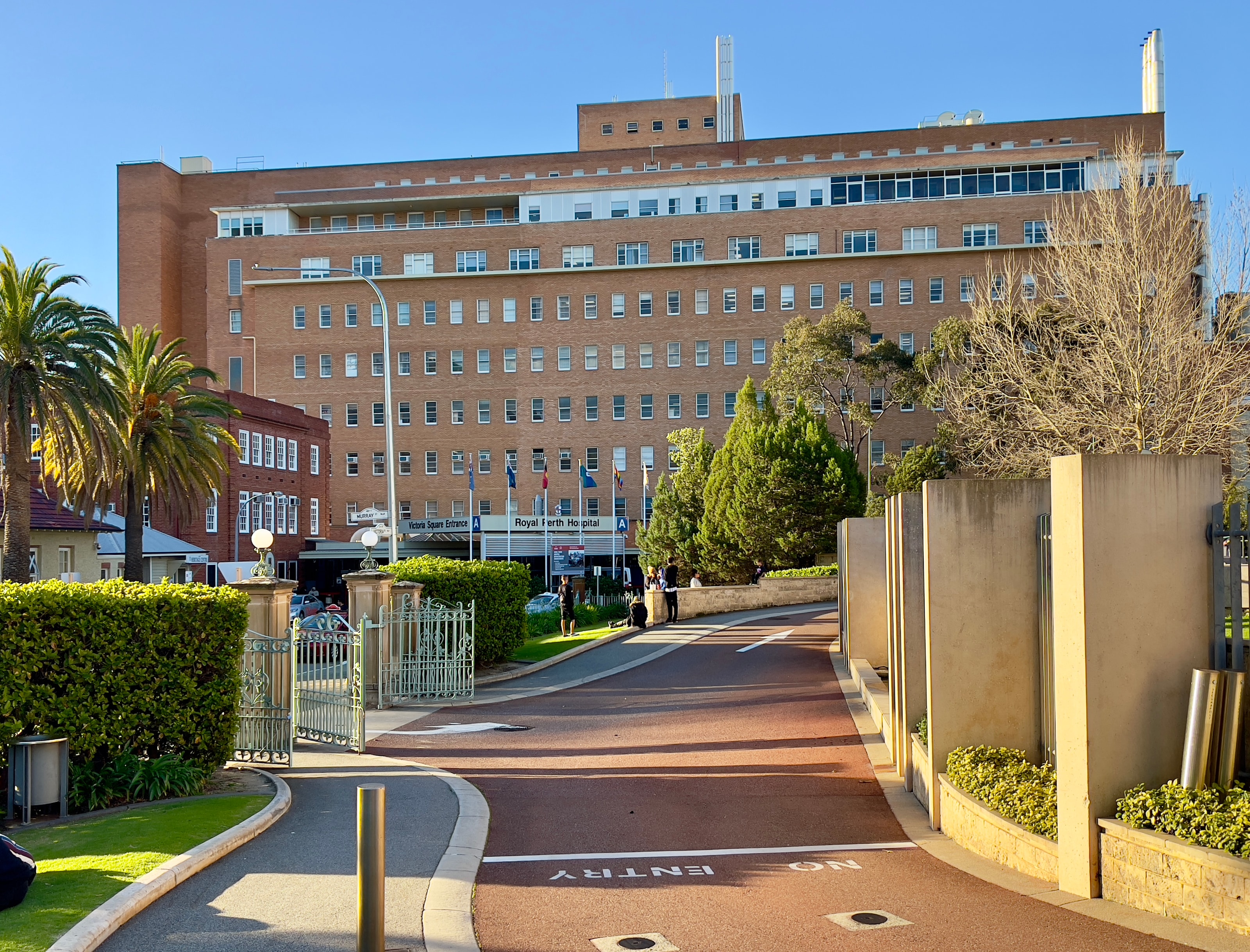
Royal Perth Hospital, where Sean George was treated in intensive care after the Kambalda arrest. Photo: Kgbo, CC BY-SA 4.0, via Wikimedia Commons, resized.

See this page's graph and discover linked topics
In full
A Tier 2 resurrection report: return of spontaneous circulation after prolonged, failed and then abandoned resuscitation, coinciding with prayer, in a patient who is himself a consultant physician. Its strength over most revival reports is documentation made on the day. The defibrillator logs and ECGs carry time stamps, and the laboratory results from the following days record the organ damage. The patient has released them publicly. Named physicians who treated him have put their names to statements, and an emergency physician who was present has described the resuscitation on camera.
Its limits are equally clear. The records were released by the patient, not by the hospitals; no independent physician has audited them; nothing has been published in a medical journal; and the accounts differ on the length of the arrest and the timing of the wife's arrival. The most serious natural explanation, the Lazarus phenomenon (return of circulation shortly after CPR stops), fits the outline of the case and is engaged below. The atheist writer Bradley Bowen has published a detailed critique that accepts the core facts and disputes the inference.
Summary
Dr Sean George, consultant physician and head of general medicine at Kalgoorlie Hospital, Western Australia, had an inferior-wall heart attack at the Kambalda Health Centre on 24 October 2008 and went into cardiac arrest at about 13:42. After 13 shocks, prolonged CPR and high-dose adrenaline, the attending emergency physician stopped resuscitation at about 14:52. His wife, Dr Sherry George, prayed at his side, and at about 15:07 his heart restarted. He was treated at Kalgoorlie and Royal Perth hospitals, discharged on day 13, and returned to full duties within three months. Documented by his own published records, statements from Drs Stephen Dunjey, Mark Thomas and Pravin Sulya Shetty, and press coverage from March 2009 onward.
The event
The times below are from George's published timeline and medical summary.
- The journey. George, aged 39, was driving the roughly 400 km from Esperance, where he had run a specialist clinic, back to Kalgoorlie with an intern. Near Kambalda, a mining town about 60 km south of Kalgoorlie, he felt chest discomfort and stopped at the town's health centre.
- 13:34, the diagnosis. An ECG showed ST elevation in leads II, III and aVF, an inferior-wall heart attack. He read the tracing himself.
- 13:42, cardiac arrest. He had a seizure and lost his pulse, blood pressure and breathing. The local GP started CPR, intubated him and attached an automated defibrillator.
- 13:44 to 14:30, shocks. The defibrillator found ventricular fibrillation and delivered 13 shocks over about 48 minutes. After the last shock, at 14:30, the rhythm went to asystole (a flat line) and the device advised no further shocks. CPR continued.
- 14:50 to 14:52, resuscitation stopped. An emergency physician arrived from Kalgoorlie Hospital. After a final large dose of adrenaline (5 mg) and two further cycles, CPR was stopped and he was declared dead. Dr Stephen Dunjey, later identified as that physician, recalled: "I announced to the room that Sean was dead, and I said we're going to make a last couple of attempts."
- The prayer. Sherry George, a doctor herself, had driven from Kalgoorlie and was allowed in to say goodbye. She held his hand and prayed, by her account: "Lord, Sean is only 39 years old, I am only 38, we have a 10-year-old boy, I need a miracle."
- 15:07, the heartbeat returns. Soon after the prayer his circulation returned. A second ECG at 15:09 showed electrical activity compatible with a pulse.
- Transfer and treatment. He was taken by ambulance to Kalgoorlie Hospital (about 16:30), given a clot-dissolving drug, and flown by the Royal Flying Doctor Service to Royal Perth Hospital (about 21:00), where a blocked right coronary artery was stented and a balloon pump inserted.
- Recovery. He opened his eyes briefly on day 3, moved his limbs on day 4, and was breathing unassisted on day 6. Kidney failure needed six sessions of dialysis, and his liver enzymes showed injury that resolved. He was discharged on day 13 and returned to full duties at Kalgoorlie Hospital within three months, with no reported neurological damage.
Witnesses + documentation
- Dr Sean George, the patient, then consultant physician and head of general medicine at Kalgoorlie Hospital and a clinical associate professor with the University of Western Australia. His account, timeline and records are on his website.
- Dr Sherry George, his wife, a doctor, who prayed at his side.
- Dr Stephen Dunjey, consultant emergency physician (later at Royal Perth Hospital and professor of emergency medicine), identified by The Week as the physician who came from Kalgoorlie and declared him dead. Statement: "As extraordinary as Sean's story sounds, it is true." He also speaks in the documentary Miracle Man.
- Dr Mark Thomas, staff nephrologist at Royal Perth Hospital, who treated his kidney failure and wrote a first-person account of the sudden recovery.
- Dr Pravin Sulya Shetty, consultant physician and colleague at Kalgoorlie Hospital, named by The Week as one of the colleagues who went to Kambalda. Statement: "I must say its not possible to explain this in medical terms."
- Unnamed: the Kambalda GP who ran the resuscitation, the intern and the nursing staff.
- Records released by the patient: the 13:34 and 15:09 ECGs, two defibrillator logs (the last shock time-stamped 14:30), a positive troponin, and creatinine and liver-enzyme results charting kidney failure and liver injury.
- Press: The West Australian (March 2009 and July 2011), The Kalgoorlie Miner (2018), Premier Christianity (February 2019), and The Week (India), "A near-death experience transforms a couple's life," by Anjuly Mathai (27 July 2025). George was cross-examined by Bradley Bowen and Hans Vodder on Premier's Unbelievable? (April 2019).
Verification
- What is solid. The patient is a named senior physician whose professional standing is checkable, and the event is fixed in time by machine-printed records made on the day. Three other named physicians have put their names to it. Even the skeptical analysis grants the core facts: a cardiac arrest of more than an hour and a recovery without obvious neurological harm.
- What is missing. The records come from the patient, not from the hospitals, and no independent physician has published a review of them. No medical journal has reported the case. The GP who ran the resuscitation has not been named. The physicians' statements are undated and appear on George's own website, though Dunjey's also appears on film.
- Discrepancies between accounts.
- The length of the arrest is given as 55 minutes (a 2011 radio feature), about 70 minutes of resuscitation (a 2025 account), and 1 hour 25 minutes (George). From George's own data Bowen calculates at least 75 and possibly 81 minutes.
- The asystole phase is described as 37 minutes in one summary, while the clock times give about 22 minutes of asystole with CPR before resuscitation stopped.
- One account says Sherry arrived about an hour into the arrest; The Week says he had been dead for 1 hour 20 minutes when she arrived.
- Naturalistic explanations considered.
- The Lazarus phenomenon. Return of circulation minutes after CPR stops is rare but documented. A review by Adhiyaman, Adhiyaman and Sundaram (Journal of the Royal Society of Medicine 100, 2007, 552-557) found 38 published cases since 1982. Proposed mechanisms include trapped air pressure in the chest easing once ventilation stops, and delayed action of large doses of adrenaline, both present here. This is the strongest natural account of the timing, and it should be conceded as a real possibility. What it does not explain is why it happened in this patient at this moment, after more than an hour in which nothing worked.
- Survival statistics. Bowen argues that survival, not brain outcome, is the real hurdle. Most survivors of cardiac arrest, even after long CPR, recover good brain function, and with millions of arrests a year rare recoveries are bound to happen somewhere. That is a fair point about the neurological outcome. The case rests instead on the return of circulation, after resuscitation had been abandoned, coinciding with prayer.
- No credible refutation found. No source disputes that the arrest, the abandoned resuscitation or the recovery happened. Bowen's critique concedes them and disputes only the duration claimed and the inference to God.
- Why Tier 2 and not Tier 1. It has named witnesses, physician witnesses and records made on the day, but no peer-reviewed report, no independent audit of the records, and no formal investigating body.
Apologetic value
- A hard case for a naturalist, honestly stated. The case is useful precisely because the records exist and the skeptic's best reply is on the table. Concede the Lazarus phenomenon as a real phenomenon, then press the timing: after 13 failed shocks and more than an hour of failed CPR, the heart restarted on its own within minutes of a prayer for a miracle.
- Against Hume's in-principle dismissal. David Hume held that testimony to a miracle can never outweigh uniform experience. Here the testimony includes machine-printed time stamps and the word of the physician who declared the death. Whatever one concludes, the evidence has to be weighed, not ruled out in advance.
- How to deploy. Use it alongside John Smith Ice Drowning (Lake Saint Louis 2015), which has a similar pattern with contemporaneous news coverage. Do not claim it proves a miracle. Claim that it is the kind of well-documented answered prayer that naturalism must explain away case by case.
- Fit with the biblical pattern. Restoration of life in answer to prayer echoes Elijah (1 Kings 17:17-24), Peter (Acts 9:36-42) and Paul (Acts 20:9-12), and points to the resurrection on which the faith stands (Argument from the Resurrection).
See also
- Miracles, master hub
- John Smith Ice Drowning (Lake Saint Louis 2015), a prayer-linked return of heartbeat with named physicians and news coverage at the time
- Jeff Markin (Palm Beach Gardens 2006), a cardiologist's report of a heart restarting after prayer, less well documented
- Don Piper (Resurrection 1989), another revival during prayer after death was declared
- Argument from the Resurrection, the pattern these reports are often linked to
- David Hume, whose argument against miracle testimony the case tests
Common questions this page answers
Q: Was Dr Sean George really dead for 85 minutes?
His heart stopped at about 13:42 on 24 October 2008 and started again at about 15:07, by his published records, which is about 85 minutes. Resuscitation had been stopped about fifteen minutes before his heart restarted. Some accounts give shorter figures, and the skeptic Bradley Bowen calculates between 75 and 81 minutes from the same data.
Q: What happened when Sean George's wife prayed?
Resuscitation had been abandoned and he had been declared dead. His wife, Dr Sherry George, held his hand and prayed for a miracle, and soon afterwards his heart began beating on its own. A second ECG two minutes later recorded the returning rhythm.
Q: Could the Lazarus phenomenon explain Sean George's recovery?
It is the strongest natural explanation. The Lazarus phenomenon is a rare, documented return of circulation shortly after CPR stops, and it fits the outline of this case. What it does not explain is the timing, within minutes of a prayer after more than an hour of failed resuscitation, which is why the case is still weighed as evidence.
Q: Is there medical evidence for the Sean George story?
Yes. He has published the time-stamped ECGs and defibrillator logs from the day and the laboratory results from his hospital stay, and three named physicians have given statements. The records were released by him rather than by the hospitals and have not been independently reviewed or published in a journal.