Concept
Satan and the Serpent in Eden
Did Satan turn into a snake, Did Satan possess the serpent, Was the serpent in Eden Satan, Was the serpent in Eden a real snake, The serpent in Eden, Satan as the serpent, Who was the serpent in Genesis 3, Where does the Bible say the serpent was Satan, Why did God curse the snake, Nachash in Genesis 3, The old serpent, Serpent of oldIntro
Did Satan turn into a snake? Did he take over a real snake? Or is the snake in Genesis a picture of something else?
Genesis 3 never names Satan. It says the tempter was a serpent, one of the animals God made, and that it was more "subtle," or cunning, than the others. God then curses the serpent to crawl on its belly and promises that a child of the woman will crush its head.
The rest of the Bible fills in who was behind it. Revelation calls Satan "the old serpent." Jesus calls the devil "a murderer from the beginning" and "the father" of lies. Paul says "the serpent beguiled Eve."
So the Bible teaches clearly that Satan was the deceiver in Eden. It does not explain exactly how he worked. Christians have held three main views:
- Satan spoke through a real serpent. This is the most common view in church history.
- Satan appeared in the form of a serpent.
- "Serpent" is the Bible's word picture for a spiritual being who rebelled against God.
All three agree on what matters most. The deceiver was a created being, God stayed in control, and God promised from the start that the serpent's head would be crushed. Christians see that promise kept in Jesus.
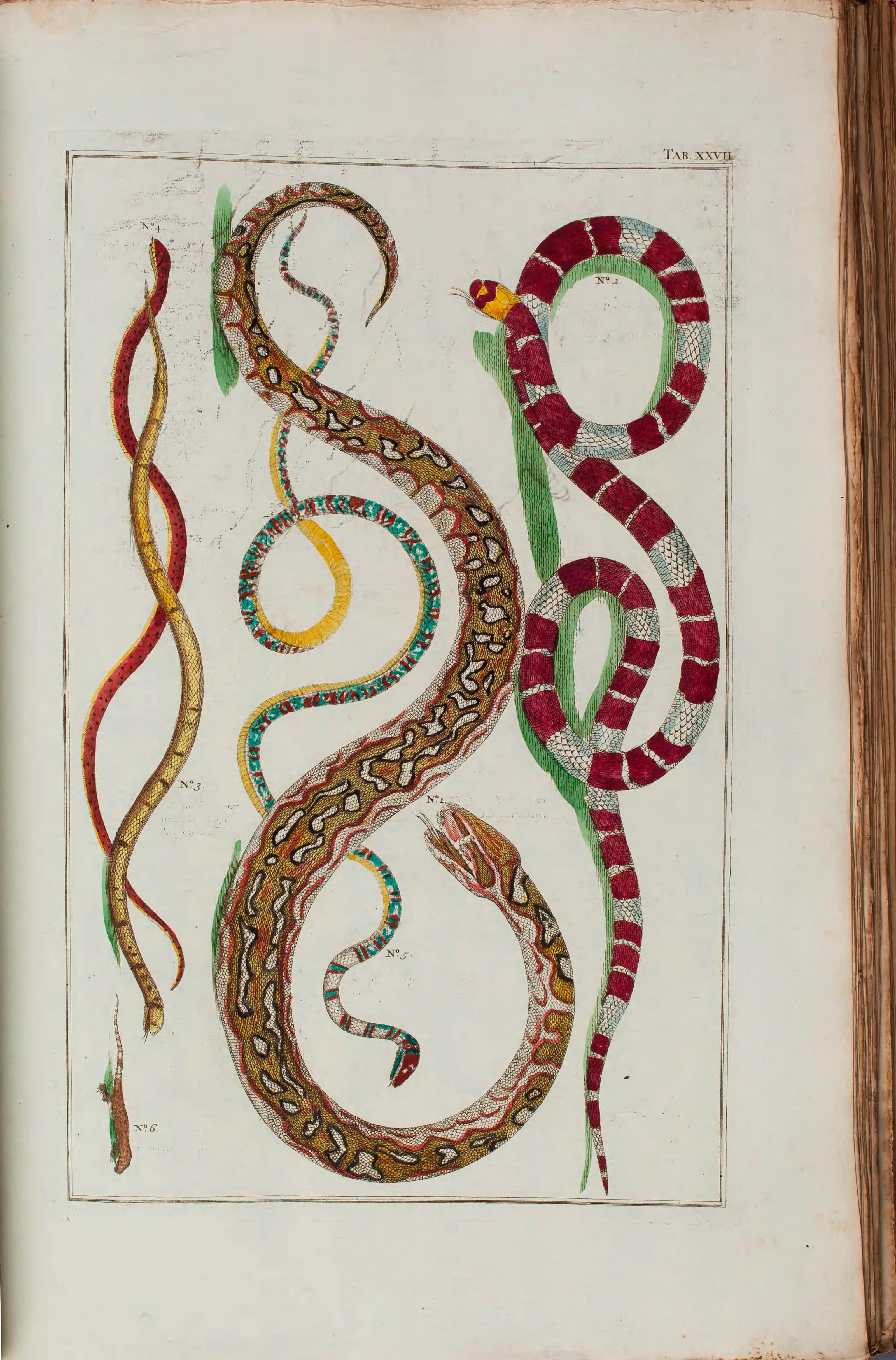
Serpents, plate XXVII from Albertus Seba's Locupletissimi rerum naturalium thesauri (Amsterdam, 1735), hand-coloured engraving. Genesis calls the tempter by the ordinary Hebrew word for a snake. Image: public domain, via the Biodiversity Heritage Library and Wikimedia Commons.
See this page's graph and discover linked topics
In full
Genesis 3 presents the tempter as ha-naḥash, "the serpent," using the common Hebrew noun for a snake (Strong's H5175), and places it among "any beast of the field which Jehovah God had made" (Genesis 3:1, ASV). The narrative attributes speech, intent and cunning to it, sentences it separately from the man and the woman, and pronounces over it the first promise of redemption (Genesis 3:15). The text does not name Satan and does not describe the mechanism of his involvement.
The identification is made canonically. Revelation 12:9 and 20:2 call the dragon "the old serpent, he that is called the Devil and Satan." John 8:44 describes the devil as a murderer "from the beginning" and the father of lies. Paul treats the Eden deception as the pattern of satanic deceit (2 Corinthians 11:3, 11:14) and alludes to Genesis 3:15 in promising that God "shall bruise Satan under your feet" (Romans 16:20). Second Temple Jewish literature had already begun connecting the devil to the Fall (Wisdom of Solomon 2:24; 1 Enoch 69:6; the Greek Life of Adam and Eve, also called the Apocalypse of Moses, 16 to 17).
Three accounts of the mechanism have been held. (1) Instrumental: Satan used and spoke through a real serpent, the majority view from Augustine through the Reformers. (2) Appearance: Satan manifested in serpentine form. (3) Figurative or divine-being: "the serpent" denotes a spiritual being described in serpent imagery, most fully developed in recent evangelical scholarship by Michael Heiser, who read naḥash as a divine throne-guardian figure. Each view affirms that the deceiver was a creature acting under God's sovereignty, and each reads Genesis 3:15 as a promise of the deceiver's defeat, which the New Testament sees fulfilled in Christ (Galatians 4:4; Hebrews 2:14; 1 John 3:8).
What Genesis 3 says
The introduction of the serpent:
Now the serpent was more subtle than any beast of the field which Jehovah God had made. And he said unto the woman, Yea, hath God said, Ye shall not eat of any tree of the garden? (Genesis 3:1, ASV)
- The serpent is described as a creature, one of the beasts "Jehovah God had made." The narrative does not set up a rival creator or an eternal evil power.
- It speaks, reasons and questions God's word. The woman later names it as the one who deceived her: "The serpent beguiled me, and I did eat" (Genesis 3:13, ASV).
- God questions the man and the woman, and pronounces sentence on the serpent without questioning it.
The sentence on the serpent:
And Jehovah God said unto the serpent, Because thou hast done this, cursed art thou above all cattle, and above every beast of the field; upon thy belly shalt thou go, and dust shalt thou eat all the days of thy life: (Genesis 3:14, ASV)
and I will put enmity between thee and the woman, and between thy seed and her seed: he shall bruise thy head, and thou shalt bruise his heel. (Genesis 3:15, ASV)
- Verse 14 addresses the serpent as an animal, "above all cattle, and above every beast of the field."
- Verse 15 looks past the animal to a long conflict between two lines of descendants, "thy seed" and "her seed," ending in a head wound for the serpent and a heel wound for the woman's offspring.
- Christian interpreters since the second century have read verse 15 as the first announcement of the gospel, often called the protevangelium. Irenaeus applied it to Christ, born of a woman, "keeping watch for the head of the serpent" (Against Heresies 5.21.1).
Word notes
These notes stay at the level of vocabulary, which the lexicons settle.
- naḥash (H5175) is the ordinary Hebrew noun for a snake. It is the same word used of the "fiery serpents" in the wilderness and of the serpent Moses made: "Moses made a serpent of brass" (Numbers 21:9, ASV).
- 'arum (H6175), "subtle," describes the serpent in Genesis 3:1. The verse before says the man and woman were "naked" (Genesis 2:25), a similar-sounding Hebrew word, and many commentators see a deliberate wordplay: the humans are naked and the serpent is shrewd.
- The same consonants n-ḥ-sh also form a verb meaning to practice divination (H5172), as in Joseph's cup "whereby he indeed divineth" (Genesis 44:5, ASV), and the related noun for bronze or brass is neḥoshet (H5178). Whether Genesis 3 plays on these senses is a matter of interpretation, discussed under view 3 below. The noun in Genesis 3 is the ordinary word for "serpent."
Where the Bible identifies the serpent with Satan
| Text | What it says | What it adds |
|---|---|---|
| Revelation 12:9 | "the great dragon was cast down, the old serpent, he that is called the Devil and Satan, the deceiver of the whole world" (ASV) | Names the Eden deceiver directly |
| Revelation 20:2 | "the dragon, the old serpent, which is the Devil and Satan" (ASV) | Repeats the identification at his binding |
| John 8:44 | "He was a murderer from the beginning, and standeth not in the truth ... for he is a liar, and the father thereof." (ASV) | Places the devil's lie and the death it caused at the beginning |
| 2 Corinthians 11:3 | "as the serpent beguiled Eve in his craftiness" (ASV) | Treats Eden as the pattern for later deception |
| 2 Corinthians 11:14 | "even Satan fashioneth himself into an angel of light." (ASV) | Satan deceives by taking on appearances |
| Romans 16:20 | "the God of peace shall bruise Satan under your feet shortly." (ASV) | Echoes Genesis 3:15 with Satan in the serpent's place |
The phrase "the old serpent" in Revelation points back to the serpent of Genesis 3. Revelation also draws on the wider Old Testament picture of a chaos serpent defeated by God, "leviathan the swift serpent, and leviathan the crooked serpent" (Isaiah 27:1, ASV). See The Seven-Headed Dragon of Revelation.
Second Temple witnesses
Jewish writers between the Testaments were already connecting the devil to the Fall. Their works are not Scripture for Protestants, and they are useful evidence of how the story was being read.
- Wisdom of Solomon 2:24 (usually dated to the first century BC): "Nevertheless through envy of the devil came death into the world: and they that do hold of his side do find it" (KJV Apocrypha). The previous verse speaks of God creating man "to be immortal," so most readers take this as a reference to Eden. The verse does not mention the serpent, and its exact reference has been debated.
- 1 Enoch 69:6, in the section called the Similitudes, lists fallen angels by name: "And the third was named Gadreel: he it is who showed the children of men all the blows of death, and he led astray Eve" (R. H. Charles, 1913). This passage names a fallen angel as Eve's deceiver and does not mention a serpent.
- The Apocalypse of Moses (the Greek Life of Adam and Eve, a Jewish work of uncertain date from around the early centuries AD) has Eve tell the story. The devil approaches the serpent and says, "Fear not, only be my vessel and I will speak through thy mouth words to deceive him" (16:5). Later "The devil answered through the mouth of the serpent" (17:4). The same chapter says Satan also "appeared in the form of an angel" (17:2) (all R. H. Charles, 1913).
Together these show that by the first century, Jewish readers widely saw a spiritual adversary behind the serpent. The Apocalypse of Moses is the clearest early statement of the instrumental view.
Three views of how Satan was involved
| View | Claim | Main support | Main difficulty |
|---|---|---|---|
| 1. Satan used a real serpent | A spiritual being spoke through an actual animal | Genesis 3:1 calls it a beast God made; the curse in 3:14 fits an animal; Apocalypse of Moses 16 to 17; Augustine | Genesis never mentions possession |
| 2. Satan appeared as a serpent | Satan took on a serpent's form | 2 Corinthians 11:14 shows Satan disguising himself | Genesis 3:1 counts the serpent among the beasts God made |
| 3. "Serpent" names a spiritual being | The tempter was a divine being described in serpent imagery | The serpent's knowledge and speech; Revelation's dragon imagery; Heiser | The text places it among "the beast of the field" |
View 1, Satan spoke through a real serpent
- Claim. A real snake was the instrument, and Satan was the speaker.
- Support. It takes both halves of the evidence at face value: Genesis describes an animal, and the New Testament names Satan. It explains why verse 14 sentences an animal and verse 15 reaches beyond it.
- History. This is the dominant view in Christian history. Augustine wrote that the devil "chose the serpent as his mouthpiece" and "abused [it] as his instrument" (City of God 14.11, trans. Marcus Dods).
- Limit. Genesis does not say Satan possessed or entered the animal. The view is an inference from combining Genesis with later texts, and a reasonable one.
View 2, Satan appeared in serpent form
- Claim. No ordinary snake was involved. Satan took on the appearance of one.
- Support. Paul says Satan "fashioneth himself into an angel of light" (2 Corinthians 11:14, ASV), so taking on appearances is within his range.
- Limit. Genesis 3:1 counts the serpent among the beasts "Jehovah God had made," and the curse in verse 14 treats it as one of the animals. This view has had fewer defenders.
View 3, the serpent as a spiritual being in serpent imagery
- Claim. The figure in Eden was a divine being, and "serpent" describes him the way "dragon" describes him in Revelation.
- Heiser's version. Michael Heiser, in The Unseen Realm (Lexham, 2015), chapters 10 and 11, argued that the tempter was a rebellious member of God's heavenly council. He wrote that the serpent was "an image commonly used in reference to a divine throne guardian," and proposed that naḥash carries more than one sense at once: "serpent," the related verb for divination, and a sense of brightness that connects the figure with the "shining one" of Isaiah 14:12 and the guardian in Eden of Ezekiel 28.
- Criticism. The proposal is contested. Reviewing the book, David Instone-Brewer called the link between Isaiah's "shining one" and the serpent of Genesis 3 "tenuous." Others note that the brightness sense belongs to the related noun for bronze, neḥoshet, and that Ezekiel 28 is formally an oracle against the human king of Tyre. Readers who accept Heiser's wider divine-council framework often find the reading attractive, and it remains a minority position. See Michael Heiser and Elohim Is a Divine Council Objection Defeater.
- Limit. Genesis 3:1 explicitly places the serpent among the beasts of the field. View 3 must read that phrase as part of the imagery.
What the text states, and what interpreters infer
Stated in Scripture:
- The tempter was a serpent, more subtle than the other beasts God made (Genesis 3:1).
- The serpent deceived the woman (Genesis 3:13; 2 Corinthians 11:3).
- God cursed the serpent and promised its head would be crushed by the woman's seed (Genesis 3:14-15).
- The devil and Satan is "the old serpent" (Revelation 12:9; 20:2).
- The devil was a liar and murderer "from the beginning" (John 8:44).
- Satan can take on appearances (2 Corinthians 11:14).
Inferred by interpreters:
- That Satan possessed or spoke through the animal (view 1).
- That Satan took a serpent's form (view 2).
- That the serpent was a throne-guardian or council being (view 3).
- That the original serpent had legs or walked upright before the curse. The text says only that it would go "upon thy belly" from then on.
A good test question for any confident claim: "Which verse says that, and which part is an inference?"
Why did God curse the animal if Satan was responsible?
- Animals that harm people are held to account in the Law. "If an ox gore a man or a woman to death, the ox shall be surely stoned" (Exodus 21:28, ASV). See also Genesis 9:5. The ox is not morally guilty; its destruction marks the seriousness of what happened. On view 1, the serpent's curse works the same way.
- The curse is a sign of defeat. Crawling on the belly and eating dust is stock language for humiliated enemies: "his enemies shall lick the dust" (Psalm 72:9, ASV); "They shall lick the dust like a serpent" (Micah 7:17, ASV). The curse signals the deceiver's coming humiliation.
- The sentence does not stop at the animal. Verse 15 announces a war between two lines that lasts through history and ends with a crushed head. A snake does not have enemies across generations. The spiritual adversary does, which is why the New Testament applies the promise to Satan (Romans 16:20).
- On view 3, the question changes shape: the curse falls directly on the spiritual being, described in serpent terms.
The theological point
- The deceiver is a creature. Genesis introduces him among the things God made. Scripture never presents Satan as a second god. See Satan and The Devil.
- God remains sovereign. God questions, judges and sentences. The serpent receives a sentence and no hearing. See God Created Satan Knowing He Would Rebel Objection Defeater and Why Doesnt God Stop Satan Objection Defeater.
- Grace comes before the expulsion. The first promise of rescue is spoken in the same breath as the first curse, before Adam and Eve leave the garden.
- The promise is kept in Christ. "When the fulness of the time came, God sent forth his Son, born of a woman" (Galatians 4:4, ASV). Jesus shared flesh and blood "that through death he might bring to nought him that had the power of death, that is, the devil" (Hebrews 2:14, ASV), and "To this end was the Son of God manifested, that he might destroy the works of the devil" (1 John 3:8, ASV).
- Deception still follows the Eden pattern. Paul's warning in 2 Corinthians 11:3 assumes the same strategy is still in use: question what God said, deny the consequence, promise a shortcut to godlikeness. See Spirit of Deception.
Patristic and scholarly note
Early and classical:
- Irenaeus (Against Heresies 5.21.1, second century) reads Genesis 3:15 as fulfilled in Christ, born of the Virgin, who defeats the serpent.
- Augustine (City of God 14.11) holds that the devil used the serpent "as his mouthpiece," the classic statement of view 1.
Modern:
- Michael S. Heiser, The Unseen Realm (Lexham, 2015), chapters 10 and 11, argues for the divine-being reading (view 3).
- David Instone-Brewer's review of The Unseen Realm for Logos questions Heiser's lexical link between the "shining one" and the serpent.
Scholarship
Published academic works this page draws on, each matched to a publisher, index or library catalog record.
- Michael S. Heiser, The unseen realm (2015). Open Library
See also
- Satan, the parent hub on who Satan is
- The Devil, the master hub on the devil's names and work
- Genesis 3, the chapter itself
- Top 20 Adam and Eve Objections and Their Defeaters, including the "talking snake" objection
- Eve From the Rib of Adam Objection Defeater, another Genesis objection answered from the Hebrew
- Lucifer Is Not Satans Name Objection Defeater, on Isaiah 14 and the name "Lucifer"
- God Lied by Omission in Eden Objection Defeater, on the serpent's half-truth
- Tree of Knowledge Objection Defeater, on the command the serpent attacked
- Michael Heiser, the scholar behind view 3
- The Seven-Headed Dragon of Revelation, the serpent's last appearance
- Original Sin, what followed from Eden
Common questions this page answers
Q: Did Satan turn into a snake in the Garden of Eden?
The Bible does not say so. Genesis 3 calls the tempter a serpent, one of the animals God made, and later Scripture identifies the devil as "the old serpent" (Revelation 12:9). Most Christians through history have held that Satan spoke through a real serpent; some hold that he appeared in serpent form, and some read "serpent" as a description of a spiritual being.
Q: Where does the Bible say the serpent was Satan?
Revelation 12:9 and 20:2 call the dragon "the old serpent, he that is called the Devil and Satan." John 8:44 calls the devil a liar and murderer from the beginning, 2 Corinthians 11:3 points to the serpent who deceived Eve, and Romans 16:20 echoes Genesis 3:15 by promising that God will crush Satan under believers' feet.
Q: Was the serpent in Eden a real snake?
On the most common Christian view, yes: Genesis 3:1 places it among "the beast of the field" that God made, and Satan used it as his instrument. Other interpreters, including Michael Heiser, read the serpent as a spiritual being described in serpent imagery. Genesis itself uses the ordinary Hebrew word for a snake.
Q: Why did God curse the snake if Satan was responsible?
The Law of Moses held animals to account when they caused human death (Exodus 21:28), without treating them as morally guilty. The curse to crawl and eat dust is also biblical language for a defeated enemy (Psalm 72:9; Micah 7:17). And the sentence in Genesis 3:15 reaches past the animal to the spiritual enemy, promising that the woman's seed would crush the serpent's head.
Q: What is the protevangelium in Genesis 3:15?
It is the name Christians give to Genesis 3:15, often called the first announcement of the gospel. God promises enmity between the serpent and the woman, and between their offspring, ending with the serpent's head crushed. Irenaeus in the second century already applied it to Christ, and the New Testament speaks of Jesus destroying the works of the devil (1 John 3:8).
Q: Did Jewish writers before Jesus connect the serpent with the devil?
Yes. The Wisdom of Solomon (2:24) says death came into the world "through envy of the devil," 1 Enoch 69:6 says a fallen angel named Gadreel "led astray Eve," and the Apocalypse of Moses has the devil ask the serpent to be his "vessel" so he can speak through its mouth.