Person
Sanballat
Sanballat the Horonite, Sanballat I, Sanballat governor of Samaria, Sin-uballit, Sanballat of SamariaIntro
Sanballat the Horonite was the chief opponent of Nehemiah when Nehemiah rebuilt the walls of Jerusalem around 445 BC. He mocked the builders, plotted with Tobiah and Geshem to attack the city, tried to lure Nehemiah into a trap, and hired a false prophet to frighten him. Years later Nehemiah found that a grandson of the high priest had married Sanballat's daughter, and drove him out.
A letter written in 407 BC by the Jews of Elephantine in Egypt names "Sanballat governor of Samaria" and his sons. It is outside confirmation that Nehemiah's adversary was a real official, and that he held the power the book implies.
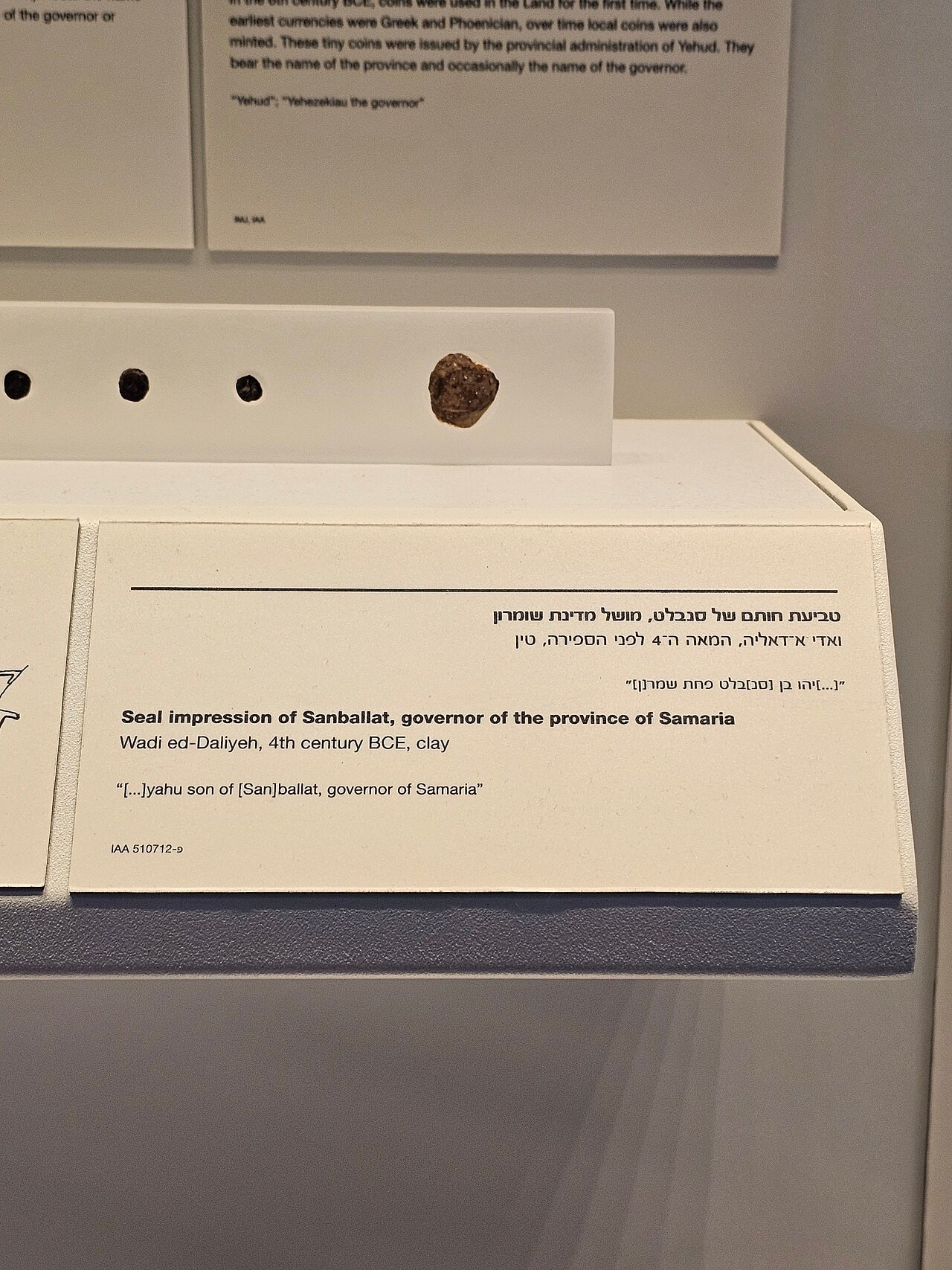
A fourth-century BC clay seal impression from Wadi ed-Daliyeh reading "[...]yahu son of [San]ballat, governor of Samaria," on display at the Israel Museum, Jerusalem (IAA 510712). Photo: Jprg1966, CC BY-SA 4.0, via Wikimedia Commons, resized.

See this page's graph and discover linked topics
In full
Sanballat (Akkadian Sin-uballiṭ, "the moon god Sin has given life") is called "the Horonite" in Nehemiah 2:10, 2:19 and 13:28, usually understood as a man of Beth-horon northwest of Jerusalem; some scholars suggest Horonaim in Moab or Haran in Mesopotamia. Nehemiah never gives his title, but places him before "his brethren and the army of Samaria" (Nehemiah 4:2), and the Elephantine evidence shows that he was governor of the province of Samaria. He opposed Nehemiah's mission from its start in the twentieth year of Artaxerxes I (445 BC) through the completion of the wall, and his family was connected by marriage to the high-priestly house of Eliashib (Nehemiah 13:28).
The Elephantine petition of 407 BC (Cowley 30; TAD A4.7), written in the seventeenth year of Darius II, reports that the Jews of Elephantine had written about their destroyed temple "to Delaiah and Shelemiah the sons of Sanballat governor of Samaria." By then his sons appear to have been acting for him, which fits a man active since the 440s. Lawrence Mykytiuk lists him as "Sanballat 'I'," governor of Samaria under Persian rule (no. 20 in his 2014 list), placing the numeral in quotation marks because later Sanballats proposed by some scholars cannot be demonstrated.
In the Bible
- Nehemiah 2:10. "And when Sanballat the Horonite, and Tobiah the servant, the Ammonite, heard of it, it grieved them exceedingly, for that there was come a man to seek the welfare of the children of Israel" (ASV).
- Nehemiah 2:19. Sanballat, Tobiah and Geshem the Arabian laugh the builders to scorn: "will ye rebel against the king?"
- Nehemiah 4:1-8. He mocks "these feeble Jews" before the army of Samaria, then conspires with Tobiah, the Arabians, the Ammonites and the Ashdodites "to come and fight against Jerusalem."
- Nehemiah 6:1-14. Four invitations to meet "in the plain of Ono," an open letter accusing Nehemiah of planning rebellion, and the hiring of Shemaiah to lure him into the Temple: "Tobiah and Sanballat had hired him" (6:12, ASV).
- Nehemiah 13:28. "And one of the sons of Joiada, the son of Eliashib the high priest, was son-in-law to Sanballat the Horonite: therefore I chased him from me" (ASV).
Family and lineage
- Sons: Delaiah and Shelemiah, named in the Elephantine petition of 407 BC.
- Daughter: married a son of Joiada, son of the high priest Eliashib (Nehemiah 13:28).
- Later family (possible): the Wadi Daliyeh papyri and a seal impression name a "[...]yahu son of [San]ballat, governor of Samaria" in the fourth century BC. Frank Moore Cross reconstructed from them a line of governors including a Sanballat II and Sanballat III; others, for example Jan Dušek (2012), argue the evidence does not establish more than one Sanballat.
Historical and archaeological evidence
| Item | What it says | Date | Findspot | Where now | Grade |
|---|---|---|---|---|---|
| Elephantine petition to Bagohi (TAD A4.7) | Reports a letter sent "to Delaiah and Shelemiah the sons of Sanballat governor of Samaria" | 407 BC (year 17 of Darius II) | Elephantine, Egypt | Berlin (Ägyptisches Museum und Papyrussammlung) | Very strong: name, office, place and generation match; Mykytiuk no. 20 |
| Wadi Daliyeh bulla (WD 22) | "[...]yahu son of [San]ballat, governor of Samaria," name partly restored | 4th century BC | Cave of Abu Shinjeh, Wadi ed-Daliyeh, north of Jericho (found 1962) | Israel Museum, Jerusalem (IAA 510712) | Supports a family of Sanballat as governors; does not name Nehemiah's Sanballat himself |
- The Wadi Daliyeh papyri. Legal documents of Samarian families who fled from Alexander the Great's forces around 332 BC and died in the cave. They show Samaria still governed by a family linked to the name Sanballat in the fourth century.
- Josephus. Antiquities 11.302-347 tells of a Sanballat sent by Darius III as governor of Samaria, whose daughter married Manasseh, brother of the high priest Jaddua, and who built the Samaritan temple on Mount Gerizim. Many historians think Josephus has transferred the story of Nehemiah 13:28 to a later century; others, following Cross, think a later Sanballat repeated the pattern. The question remains open.
Scholarly consensus
- Existence and office. Agreed. Mykytiuk counts him as confirmed; the Elephantine petition is a contemporary document from outside Judah that names him with the title Nehemiah implies.
- Sanballat I, II, III. Disputed. Cross's reconstruction of several governors named Sanballat was widely followed for decades; Dušek and others have questioned it. Mykytiuk notes that the existence of a Sanballat II and III cannot be demonstrated.
- "The Horonite." Beth-horon is the most common identification; it is consistent with a Yahwistic family, as his sons' names (Delaiah, Shelemiah) suggest.
Theological significance
- Opposition by ridicule, intrigue and fear. Sanballat's methods escalate from mockery (Nehemiah 4:1-3) to threatened violence (4:8), to diplomacy as a trap (6:2), to slander (6:5-7), to manipulating a prophet (6:10-13). Nehemiah answers each with prayer, vigilance and refusal to stop the work.
- Mixed allegiances. His sons bear Yahwistic names, and his family married into the high priesthood. The book's concern in Nehemiah 13 is the integrity of the priesthood and covenant identity, not ethnicity alone.
- The rise of the Samaritan divide. The rivalry between Jerusalem and Samaria in Nehemiah is one strand of the background to the Jewish-Samaritan estrangement assumed in the Gospels (John 4:9).
Church Fathers
No patristic commentary focused on Sanballat has been located.
See also
- People of the Bible, every person in the codex's biblical-figures series, grouped by book of first mention
- Elephantine Papyri, the archive that names him and his sons
- Artaxerxes I, the king who sent Nehemiah
- Darius II, in whose reign the petition was written
- Josephus, whose Antiquities tells of a later Sanballat
- Biblical Figures Confirmed by Archaeology, Mykytiuk's list
- Nehemiah, the book's passages
Common questions this page answers
Q: Who was Sanballat in the book of Nehemiah?
Sanballat the Horonite was governor of Samaria and Nehemiah's main opponent when Nehemiah rebuilt Jerusalem's walls around 445 BC. He mocked the work, plotted an attack, tried to trap Nehemiah, and hired a false prophet to frighten him.
Q: Is there archaeological evidence for Sanballat?
Yes. An Aramaic letter of 407 BC from the Jews of Elephantine in Egypt mentions "Delaiah and Shelemiah the sons of Sanballat governor of Samaria." Lawrence Mykytiuk counts him among the biblical persons confirmed by inscriptions.
Q: Were there several governors named Sanballat?
Possibly. Fourth-century documents from Wadi Daliyeh name a son of a Sanballat as governor of Samaria, and Frank Moore Cross proposed a Sanballat II and III. Other scholars argue the evidence does not prove more than one Sanballat.
Q: What does Sanballat have to do with the Samaritans?
His family were rulers of Samaria, and one of his daughters married into the Jerusalem high priesthood (Nehemiah 13:28). Josephus links a Sanballat to the founding of the Samaritan temple on Mount Gerizim, though historians debate his chronology.