Argument
Salem Witch Trials Objection Defeater
Salem Witch Trial Disanalogy (Defeater), Salem Witch Trials Defeater, Salem witch trials prove Christians should not rule, Christians should not hold authority because of Salem, What about the Salem witch trials, Salem Witch Trials ObjectionIntro
"Look at the Salem witch trials. That's what happens when Christians are in charge." The objection is popular because the history is real and terrible. In 1692 a court in Puritan Massachusetts hanged nineteen people for witchcraft, pressed one man to death under stones, and let at least five more die in jail. Religious belief drove it.
A Christian should say all of that first, and mean it. But the objection does not stop at "this was wrong." It jumps to "so Christians should never hold authority," and that jump does not work, for three reasons.
- The same rule would bar everyone. Secular governments, scientists, doctors and atheist regimes have all abused power, many on a far larger scale. If one group's worst moment disqualifies everyone in it, nobody can govern.
- The trials broke the Bible's own rules. Scripture demands two or three witnesses to a real act. Salem convicted people on testimony about invisible ghosts that no one else could see or check.
- Christians stopped it. A Puritan minister's book broke the court's method of evidence, the governor shut the court down, and the judges and jurors later confessed in public that they had been wrong.
Salem is a strong argument for fair courts and for keeping the state's sword out of the church's hand. It is not an argument that Christians cannot be trusted with office.
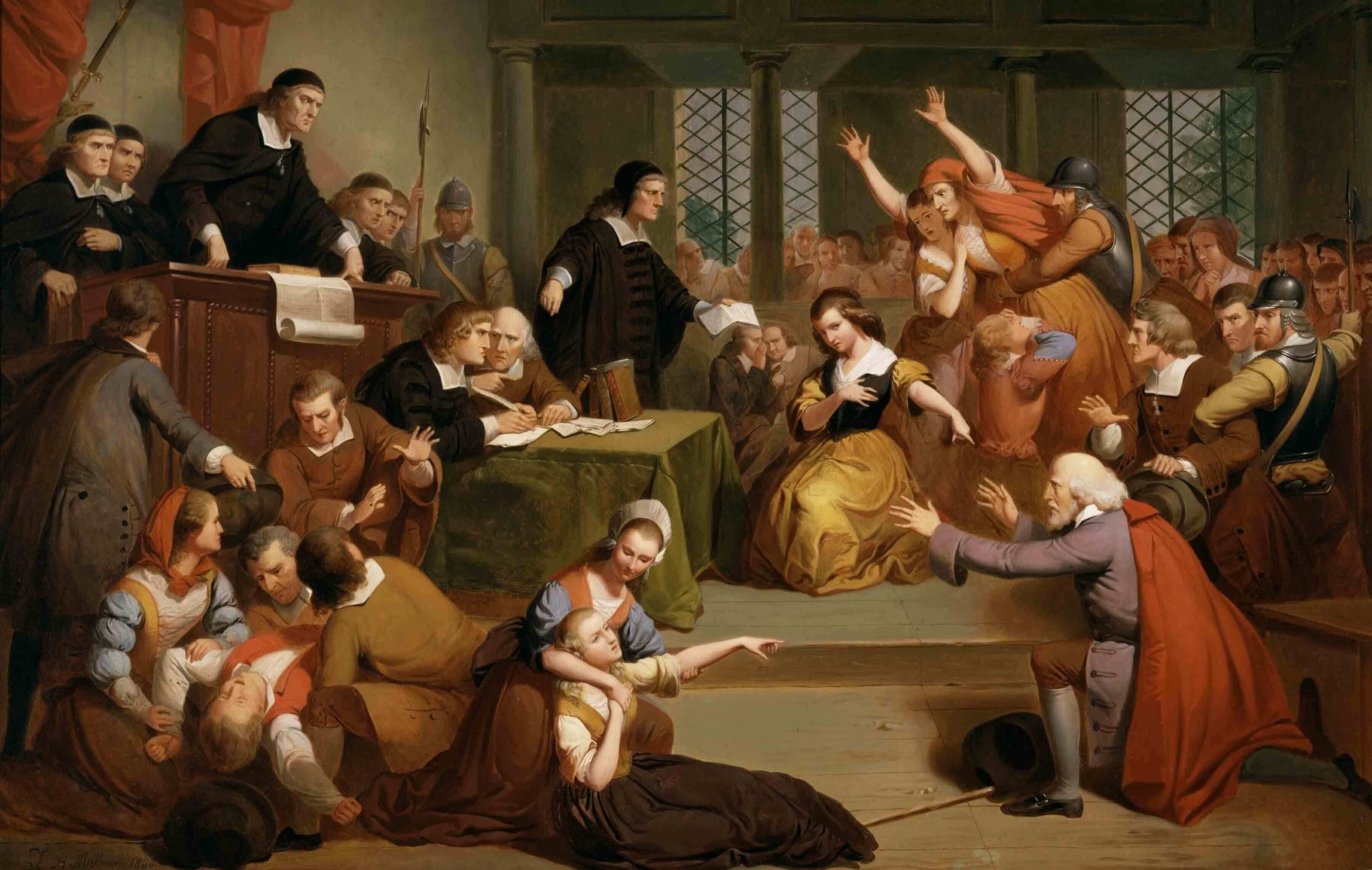
Tompkins H. Matteson, Trial of George Jacobs, August 5, 1692 (1855). Peabody Essex Museum. Image: public domain, via Wikimedia Commons.
See this page's graph and discover linked topics
Cheatsheet
30-second reply. "Salem was a real injustice and I condemn it. Twenty people were executed on evidence nobody could check. But notice what broke it: a Puritan minister wrote that it was better for ten suspected witches to escape than for one innocent person to be condemned, the governor dissolved the court, and five years later a judge and twelve jurors confessed in public. The trials broke the Bible's own rule of two or three witnesses. So Salem shows Christians can do wrong. Everyone can. If that disqualifies Christians from office, the same rule disqualifies every worldview that has ever held power, including yours."
Fast facts.
- 1692, Massachusetts Bay. The Court of Oyer and Terminer was commissioned on 27 May and dissolved on 29 October.
- Nineteen hanged, Giles Corey pressed to death, at least five died in jail.
- Over 150 people were accused across many towns, not only Salem.
- Increase Mather's Cases of Conscience (1692) attacked spectral evidence.
- The successor court in 1693 convicted only three of those it tried, and none was executed.
- 14 January 1697: a public fast day. Judge Samuel Sewall confessed his guilt in church, and twelve jurors signed an apology.
- 1711: the colony reversed most of the convictions and paid the families.
- 2022: Massachusetts exonerated Elizabeth Johnson Jr., the last convicted defendant whose name had never been cleared.
Concessions, and what each one collects.
- Grant: Christians ran the court, and religious belief drove the prosecutions. Collect: Christian ministers also supplied the argument that ended them, and Christian officials repented publicly by name.
- Grant: twenty people were executed and at least five more died in jail. Collect: the twentieth century's officially atheist states killed millions. If body counts disqualify, the objector's side is disqualified first. See Atheist Regime Body Count.
- Grant: the colony wrote witchcraft into its criminal law. Collect: the court broke the Bible's own standard of proof (Deuteronomy 19:15), so Salem is a case of Christians failing Christianity, not of Christianity working as designed.
- Grant: Salem is a good argument against letting a church wield the state's coercive power. Collect: that is a different conclusion from "Christians should not hold office," and many Christians have argued for it themselves.
Closing line. "Salem proves people with power need fair rules of evidence. It doesn't prove Christians can't be trusted with power, unless you're willing to apply that rule to everyone."
In full
The Salem witch trials objection argues from the 1692 prosecutions in Massachusetts Bay to the conclusion that Christians as such should be excluded from political authority, or that Christian influence on government is inherently dangerous. It is usually offered as an emotional capstone to the broader religion-causes-violence charge.
The defeater has four moves:
- Historical concession without minimizing. The facts are granted as stated, including the parts that hurt: the court was made up of church members, ministers advised it, and religious beliefs about the devil drove the accusations.
- A consistency reductio. The objection's hidden premise is that a group's abuse of power disqualifies all its members from power. Applied consistently, that premise disqualifies secular, scientific, medical and atheist actors as well, so it proves too much. This is a composition error and guilt by association.
- An internal critique. The procedure violated the Bible's own evidentiary law: two or three witnesses to an act (Deuteronomy 19:15), no false report (Exodus 23:1), no condemning the innocent (Proverbs 17:15). Christianity supplied the standard by which Salem stands condemned, and Christians in 1692 used it.
- The defensible principle. Officeholders should be judged by their qualifications, conduct and commitment to just procedure, not by their religious identity. Augustine's account of the two cities explains why a Christian magistrate is not made righteous by professing faith, and why Christians should expect to need checks on their own power.
What the defeater concedes openly is that Salem is a serious argument for keeping the coercive power of the state separate from the governing power of the church. That is a different and much narrower conclusion, and it is one many Christians hold. See Theocracy.
Grammar and hermeneutics
The court defended itself with Scripture, and objectors often point to the same text. Read on its own terms, the Bible's legal material condemns the method Salem used.
Thou shalt not suffer a sorceress to live. (Exodus 22:18, ASV)
-
What the verse governs. The Hebrew məkaššēpāh is a participle, "a woman who practices sorcery." It names someone doing a deed, not someone accused of being something. A conviction under it still required proof of the act, and the law said how that proof had to be given.
-
Whose law it is. Exodus 22 belongs to the civil code of the Sinai covenant, given to Israel as a nation. The New Testament does not hand that civil code to Gentile governments. The church's response to sorcery in Acts 19:18-19 is confession and the burning of books by their owners, not prosecution. See Christians Not Under Mosaic Law and Mosaic Capital Punishment.
-
The standard of proof.
One witness shall not rise up against a man for any iniquity, or for any sin, in any sin that he sinneth: at the mouth of two witnesses, or at the mouth of three witnesses, shall a matter be established. (Deuteronomy 19:15, ASV)
The verb yāqûm, "shall be established" or "shall stand," puts the burden on the witnesses, not the accused. Jesus carries the same rule into church discipline (Matthew 18:16). Spectral evidence was testimony that the accused person's spirit had appeared and attacked the witness. No second witness could see it, and the accused could not answer it. It fails the two-or-three rule by its nature.
-
False report and crowd pressure.
Thou shalt not take up a false report: put not thy hand with the wicked to be an unrighteous witness. (Exodus 23:1, ASV)
The next verse forbids following "a multitude to do evil," and turning aside "after a multitude to wrest justice" (Exodus 23:2). Salem is close to a textbook case of both: accusation spreading by fear and crowd momentum from one village to many towns.
-
Partiality and appearance.
Thou shalt not wrest justice: thou shalt not respect persons; neither shalt thou take a bribe; for a bribe doth blind the eyes of the wise, and pervert the words of the righteous. (Deuteronomy 16:19, ASV)
Judge not according to appearance, but judge righteous judgment. (John 7:24, ASV)
Courts at Salem treated fits, bodily marks and a defendant's demeanour as signs of guilt, which is judging by appearance in the plainest sense.
-
The verdict on the verdict. "He that justifieth the wicked, and he that condemneth the righteous, Both of them alike are an abomination to Jehovah" (Proverbs 17:15, ASV). By that standard, the Salem convictions stand condemned by the book the court claimed to follow.
History: what actually happened
These are the facts the defeater stands on. They should be stated accurately, including the ones that cut against Christians.
The court and its victims.
- In early 1692 several girls in Salem Village began having fits, and accusations of witchcraft followed. Over the following months more than 150 people from Salem Village and neighbouring towns were accused.
- On 27 May 1692 Governor William Phips commissioned a special Court of Oyer and Terminer, with Lieutenant Governor William Stoughton presiding. Its judges included John Hathorne and Samuel Sewall.
- Between June and September the court sentenced people to death. Nineteen were hanged. Giles Corey, who refused to enter a plea, was pressed to death under heavy stones in September 1692. At least five people died in jail. The accused were hanged, not burned.
- Rebecca Nurse, an elderly church member, was first found not guilty. After the court pressed the jury about a remark she had made, the jury reconsidered and returned a guilty verdict. She was hanged on 19 July 1692.
- George Burroughs, a former minister of Salem Village, recited the Lord's Prayer without error on the gallows on 19 August 1692, something people believed a witch could not do. The crowd was moved. Cotton Mather, present on horseback, answered the crowd by defending the court's verdict, and the execution went ahead.
- Dorcas Good, the small daughter of the accused Sarah Good, was jailed for months as a young child. Her mother was hanged.
The evidence.
- The court admitted spectral evidence: testimony that the accused person's spirit or shape had appeared to and tormented the witness. No one else could see it, and no defence could disprove it.
- The historian Wendel Craker argued in The Historical Journal (1997) that spectral evidence alone rarely carried a case to trial, and that other allegations (alleged acts of witchcraft, confessions, physical "marks") were also central. The failure was broader than one kind of testimony. The whole standard of proof had collapsed.
How it stopped.
- On 15 June 1692, a group of Boston ministers including Cotton Mather advised the government to be cautious about spectral evidence while still urging vigorous prosecution. The advice was mixed and the prosecutions went on.
- In the autumn of 1692, Increase Mather, a Puritan minister and president of Harvard, circulated Cases of Conscience Concerning Evil Spirits Personating Men. Its most famous line: "It were better that ten suspected witches should escape, than that one innocent person should be condemned." Other ministers endorsed it.
- On 8 October 1692 Thomas Brattle, a Boston merchant and scientist, wrote a long letter attacking the court's reasoning.
- On 29 October 1692 Governor Phips dissolved the Court of Oyer and Terminer.
- A new Superior Court of Judicature met in January 1693 and refused to rely on spectral evidence. Of the accused it tried, it convicted only three, and none of them was executed. Phips pardoned those still held in May 1693.
Repentance and reversal.
- On 14 January 1697 Massachusetts held a public day of fasting for the tragedy. Samuel Sewall stood in his church while his written confession was read, taking "the blame and shame" of his part. Twelve jurors signed a statement that they had convicted on insufficient evidence and asked forgiveness.
- In 1711 the colony reversed the convictions of most of those named in a petition and paid compensation to their families.
- Some names were left out of every act. The last, Elizabeth Johnson Jr., was exonerated by the Massachusetts legislature in July 2022, after a campaign begun by a middle-school civics class.
Cotton Mather's mixed role. Christians defending the faith should not claim that all ministers opposed the trials. Cotton Mather cautioned against relying on spectral evidence, but he also defended the court, published a defence of its proceedings, and supported the execution of Burroughs. He is a real part of the case against the Christians of Salem, and the honest defeater includes him.
Argument structure
| # | Premise |
|---|---|
| P1 | The objection needs a hidden premise: members of a group whose members abused power are unfit to hold power. |
| P2 | Applied consistently, that premise disqualifies every worldview that has held power, secular and atheist included. |
| P3 | Salem's procedure violated the Bible's own standards of evidence and justice, and Christians in 1692 used those standards to end it. |
| P4 | The defensible principle is to judge officeholders by qualifications, conduct and commitment to just procedure, not by religious identity. |
| P5 | Salem does support keeping the state's coercive power separate from the church's governance, but that is a different and narrower conclusion. |
| C | Salem shows that Christians, like everyone, can abuse power and need just procedure. It does not show that Christians should be barred from authority. |
Form
The defeater is defensive. P1 and P2 form a consistency reductio: grant the objector's rule, apply it evenly, and it disqualifies everyone, including the objector. P3 is an internal critique: the injustice is measured by the Christian standard it violated. P4 supplies the positive principle, and P5 concedes the true conclusion that sits inside the objection, so the defeater does not overclaim.
Its weakest point is P3 read too strongly. The Massachusetts authorities really did believe they were applying Scripture, and Exodus 22:18 really is in the Bible. The defeater does not deny that. It argues that the colony misapplied a covenant civil law and ignored the procedural law that went with it.
P1, The objection needs a hidden premise
Affirmative case (second-order arguments)
- The stated argument is invalid as it stands. "Christians held authority at Salem. That authority was abused. Therefore Christians should not hold authority." The conclusion only follows if a further premise is added: that a group's abuse of power disqualifies all its members.
- The move is a hasty generalization. One colony in one year, out of twenty centuries of Christian magistrates, judges and legislators, is treated as the measure of all of them.
- The move is guilt by association. Christians alive today, who had no part in 1692 and who condemn it, are treated as responsible for it because they share a creed with the judges.
Anticipated objections
- "It's not one case. It's a pattern: the Inquisition, the wars of religion, Salem."
- "I'm not saying every Christian is guilty, just that Christian rule is dangerous."
Rebuttals
- Patterns need denominators. The Inquisition and the wars of religion have their own histories, and the codex treats them on their own pages. Counting only the vivid cases and ignoring the many Christian rulers and judges who governed justly is the Availability Heuristic at work. See Religion Causes Violence Objection Defeater.
- Then the claim is about procedure, not persons. "Rule by a church that controls the courts is dangerous" is a fair claim, and P5 grants it. "Christians should not hold office" is a different claim, and Salem does not support it.
Live-cite kit
- Scripture: Matthew 18:16, the two-or-three-witness rule carried into the church.
- Scholarly: see Composition and Division on reasoning from parts to wholes.
- Aphorism: "One court's sin is not a creed's verdict."
Tactical notes
- Write the objector's argument out in three lines and ask him to supply the missing premise. Most will not want to state it.
P2, Applied consistently, the premise disqualifies everyone
Affirmative case (second-order arguments)
- Atheist regimes. The twentieth century's officially atheist states killed people on a scale that dwarfs Salem by many orders of magnitude. If abuse disqualifies, atheists are disqualified first. See State Atheism Regimes (Stalin, Mao, Pol Pot) and Atheist Regime Body Count.
- Science and medicine. Governments used the science of their day to justify forced sterilization, and doctors have run unethical experiments on human beings. Nobody concludes that scientists and doctors should be barred from office. They conclude that power needs ethics and oversight.
- Secular courts. Courts with no religious basis have convicted innocent people through panic and bad evidence. The lesson drawn is about procedure.
Anticipated objections
- "Atheist regimes didn't kill because of atheism."
- "Those analogies are different; witchcraft trials were religious by nature."
Rebuttals
- Then motive matters, and Salem's motive was a failure of Christianity, not its fulfilment. If the objector says atheist regimes acted against their worldview's real implications, he must allow the same defence for Christians whose court broke Scripture's rules of evidence (P3). He cannot have it both ways. See Tu Quoque on why this is consistency, not deflection.
- The analogy is about the inference, not the content. The point is that no one reasons from "members of group X abused power" to "members of group X may never hold power" anywhere else. The objection makes an exception for Christians, which is Special Pleading.
Live-cite kit
- Scholarly: Atheist Regime Body Count for the comparison figures.
- Aphorism: "If one atrocity disqualifies a worldview, show me the worldview still qualified."
Tactical notes
- Lead with the medical analogy. It carries no religious charge and makes the logical point cleanly. Bring in the atheist-regime comparison only if the objector insists on body counts.
P3, Salem broke the Bible's standards, and Christians used them to end it
Affirmative case (second-order arguments)
- The evidentiary law. Deuteronomy 19:15 requires two or three witnesses to an act. Exodus 23:1-2 forbids false report and following a crowd to pervert justice. Proverbs 17:15 calls condemning the righteous an abomination. Spectral evidence fails all three. See Grammar and hermeneutics above.
- A minister broke the method. Increase Mather's Cases of Conscience argued that the devil could take the shape of an innocent person, so spectral testimony could not prove guilt, and it set out the principle that it is better for ten suspected witches to escape than for one innocent to be condemned. His argument was theological from start to finish.
- Christians repented in public. Sewall's confession and the jurors' apology in 1697 were acts of Christian repentance, made in church on a day of fasting. A worldview that requires its powerful to confess their crimes publicly carries its own corrective.
Anticipated objections
- "The Bible says 'thou shalt not suffer a witch to live.' The Puritans were just obeying it."
- "Mather only objected late, after twenty people were dead."
Rebuttals
- They obeyed one verse and ignored the procedure attached to it. Exodus 22:18 is part of Israel's covenant civil code, and even there a conviction required witnesses to a real act. The New Testament does not hand that code to Gentile states, and the apostolic response to sorcery was the gospel, confession and repentance (Acts 19:18-19). See Christians Not Under Mosaic Law.
- Granted, and that is an indictment of the delay, not of the standard. The point is that the standard that stopped the killing was a Christian one, argued by a Christian minister and endorsed by other ministers. Late correction is still correction from inside the faith.
Live-cite kit
- Scripture: Deuteronomy 19:15; Exodus 23:1; Proverbs 17:15; John 7:24.
- Scholarly: Increase Mather, Cases of Conscience (1692); Samuel Sewall's confession (1697).
- Aphorism: "Salem was condemned by the very book it claimed to obey."
Tactical notes
- Quote the "ten suspected witches" line. Most objectors have never heard it, and it is the ancestor of the presumption of innocence that the objector himself relies on.
- Do not deny that Puritan belief in witchcraft drove the trials. It did. The argument is about the standard of proof.
P4, Judge officeholders by qualifications and conduct
Affirmative case (second-order arguments)
- The relevant tests. Fitness for office is a matter of competence, character and commitment to just procedure and the rights of others. Religious identity alone settles none of these.
- Augustine's two cities. In The City of God, Augustine distinguishes the earthly city, ordered by self-love, from the city of God, ordered by love of God. Earthly rulers, Christian or not, belong to the first and pursue at best a partial justice. Professing Christ does not make a ruler's power righteous.
- Servant authority. Jesus told His disciples that "whosoever would become great among you shall be your minister" (Matthew 20:26, ASV). The Christian standard for power is service, which is the measure Salem's judges failed.
Anticipated objections
- "A Christian's faith will shape how he governs. That's the danger."
Rebuttals
- Everyone's worldview shapes how they govern. The question is whether the convictions a person brings include just procedure, equal treatment and the protection of the innocent. Scripture's own standards (P3) are on the side of all three.
Live-cite kit
- Scripture: Deuteronomy 16:19, no partiality in judgment.
- Scholarly: Augustine, The City of God, on the two cities.
- Aphorism: "Judge the officeholder by his oath and his record, not by his creed."
Tactical notes
- Ask the objector what test he would use to disqualify a candidate. Then ask whether Salem's judges would have failed it for their creed or for their conduct.
P5, The honest steel-man: keep the sword out of the church's hand
Affirmative case (second-order arguments)
- Grant the real lesson. Salem shows the danger of a government that enforces supernatural beliefs through its criminal law without safeguards. That is a strong argument for religious liberty and for the separation of church governance from the state's coercive power. See Theocracy.
- Christians made this argument. Many Christians, from Baptist dissenters in colonial America to modern advocates of religious liberty, have argued that the state should not punish belief. The lesson of Salem is one Christians can teach.
- The conclusion is narrower than the objection. "No established church should run the courts" does not imply "no Christian should hold office." The first is a principle about institutions. The second is a test of faith for public life, which itself violates religious liberty.
Anticipated objections
- "If Christians agree the church shouldn't control the state, why do they keep trying to legislate their morals?"
Rebuttals
- Every citizen legislates from moral convictions. Laws against theft, fraud and violence all rest on moral claims. The question is not whether convictions enter politics but whether the procedures are fair and the rights of dissenters are protected. Salem fails that test because of its procedure, not because its judges were Christians.
Live-cite kit
- Scripture: Acts 19:18-19, sorcery answered by repentance, not prosecution.
- Aphorism: "Salem argues for fair courts and free consciences. Christians can sign both."
Tactical notes
- Granting P5 early often lowers the temperature. It shows you are not defending Puritan theocracy, and it narrows the disagreement to the one claim that does not follow.
Conclusion
Salem shows that Christians, like everyone else, can abuse power and need just procedure. It does not show that Christians should be barred from authority. The injustice was real (granted). The objection's rule would disqualify every worldview (P1, P2). The procedure broke the Bible's own standards, and Christians used those standards to end it and then repented in public (P3). The right test for office is qualification and conduct (P4). And the true lesson inside the objection, that the state's sword should not serve a church's governance, is one Christians can affirm (P5).
Master objections to the whole argument
- "You're just doing whataboutism." No. Whataboutism changes the subject to avoid a charge. This defeater grants the charge in full, then tests the rule the objector draws from it. Applying a rule consistently is how any rule is tested. See Tu Quoque.
- "No true Christian would do that, is that your defence?" No. The Salem judges were real Christians who did real wrong. The defence is not that they were not Christians, but that they broke the standards their own faith set, and that Christianity treats such failure as sin to be confessed, which is exactly what Sewall did.
- "Christian belief in witches caused it. Without that belief, no trials." Belief in witchcraft was nearly universal in the seventeenth century, among Christians and non-Christians alike, and witch panics have occurred in many cultures with no Christian connection. What Salem's Christianity added was the evidentiary law that condemned the trials and the call to repentance that followed them.
Tactical opening / closing
Opening line: "I'll agree with you before you finish: Salem was wicked, and I'm not going to defend it. What I want to test is the conclusion you're drawing from it."
Closing landing strip: "Salem teaches that people with power need fair courts, two or three real witnesses, and the humility to confess when they're wrong. A Puritan minister taught the first, Moses taught the second, and a Christian judge modeled the third. That's not a case against Christians in office. It's a case for Christians who actually keep the rules they believe in."
Connection to Scripture
- Exodus 22:18, the verse the court relied on, read in its covenant setting
- Deuteronomy 19:15, two or three witnesses to an act
- Exodus 23:1, no false report, no unrighteous witness
- Deuteronomy 16:19, no wresting of justice, no partiality
- Proverbs 17:15, condemning the righteous is an abomination
- John 7:24, judge righteous judgment, not by appearance
- Matthew 18:16, the witness rule carried into the church
- Exodus 20:16, no false witness
- 1 John 4:1, test the spirits rather than trusting every claimed experience
Patristic / scholarly note
Classical / patristic:
- Augustine (The City of God), the two cities; earthly power is not made righteous by the ruler's profession
Primary sources and modern:
- Increase Mather, Cases of Conscience Concerning Evil Spirits Personating Men (1692), the theological case against spectral evidence
- Thomas Brattle, letter of 8 October 1692, a contemporary critique of the court's reasoning
- Samuel Sewall, public confession read on 14 January 1697
- Wendel D. Craker, "Spectral Evidence, Non-Spectral Acts of Witchcraft, and Confession at Salem in 1692," The Historical Journal 40.2 (1997), on the wider failure of evidence
Scholarship
Published academic works this page draws on, each matched to a publisher, index or library catalog record.
- Wendel D. Craker, "Spectral Evidence, Non-Spectral Acts Of Witchcraft, And Confession At Salem In 1692," The Historical Journal 40 (1997). doi:10.1017/s0018246x9700719x
See also
- Religion Causes Violence Objection Defeater, the broader charge Salem is usually offered to support
- Religion and Violence, the concept hub
- Theocracy, what a state-church union is and why Christians have argued against it
- Inquisition, the other case usually paired with Salem
- Atheist Regime Body Count, the comparison the consistency test invites
- Christians Not Under Mosaic Law, why Israel's civil code is not a mandate for Christian magistrates
- Mosaic Capital Punishment, the Mosaic death penalties in their setting
- Availability Heuristic, why vivid cases feel like the whole record
- Composition and Division, reasoning from part to whole
- Christian Civilizational Impact, the rest of the record
- Arguments, master index
Common questions this page answers
Q: Do the Salem witch trials prove Christians shouldn't be in power?
No. The trials were a real injustice, but the argument needs the rule that a group's abuse of power disqualifies all its members, and that rule would disqualify every worldview, secular and atheist included. Salem shows that anyone with power needs fair courts and real evidence.
Q: How many people died in the Salem witch trials?
Nineteen people were hanged in 1692, Giles Corey was pressed to death under stones, and at least five more died in jail, so at least twenty-five people died. More than 150 were accused. None were burned at the stake.
Q: Did the Bible cause the Salem witch trials?
The court cited Exodus 22:18, but it broke the Bible's own rules of evidence, which require two or three witnesses to a real act (Deuteronomy 19:15) and forbid false report and following a crowd (Exodus 23:1-2). Testimony about invisible spirits fails that standard by its nature.
Q: Who stopped the Salem witch trials?
A Puritan minister, Increase Mather, wrote that it was better for ten suspected witches to escape than for one innocent person to be condemned. Thomas Brattle also attacked the court's reasoning, and Governor William Phips dissolved the court on 29 October 1692. The successor court convicted only three people, and none was executed.
Q: Did anyone apologize for the Salem witch trials?
Yes. On 14 January 1697 Massachusetts held a public day of fasting. Judge Samuel Sewall had his confession of guilt read in his church, and twelve jurors signed an apology. The colony reversed most convictions in 1711, and the last defendant, Elizabeth Johnson Jr., was exonerated in 2022.