Concept
Rock-Hewn Churches of Lalibela
Lalibela Churches, Churches of Lalibela, Rock-Hewn Churches, Lalibela, Bete Giyorgis, Church of Saint George Lalibela, Bete Medhane Alem, New Jerusalem of EthiopiaIntro
In the highlands of northern Ethiopia, at a town called Lalibela, eleven churches were not built up from the ground but carved down into it. Workers cut deep trenches into the volcanic rock, left a solid block standing in the middle, and then hollowed that block out into a church with doors, windows, pillars and arches. The most famous, the Church of Saint George, is shaped like a cross and sits in a pit with its roof level with the ground around it.
Ethiopian tradition credits King Lalibela, who ruled about 1181-1221, and says he meant the site to be a New Jerusalem for Christians who could no longer easily travel to the real one. A stream on the site is called the Jordan. The churches are still used for worship every day, and tens of thousands of pilgrims fill them at the great feasts. They are one of the most striking proofs that Christianity in Africa is old, deep and homegrown.
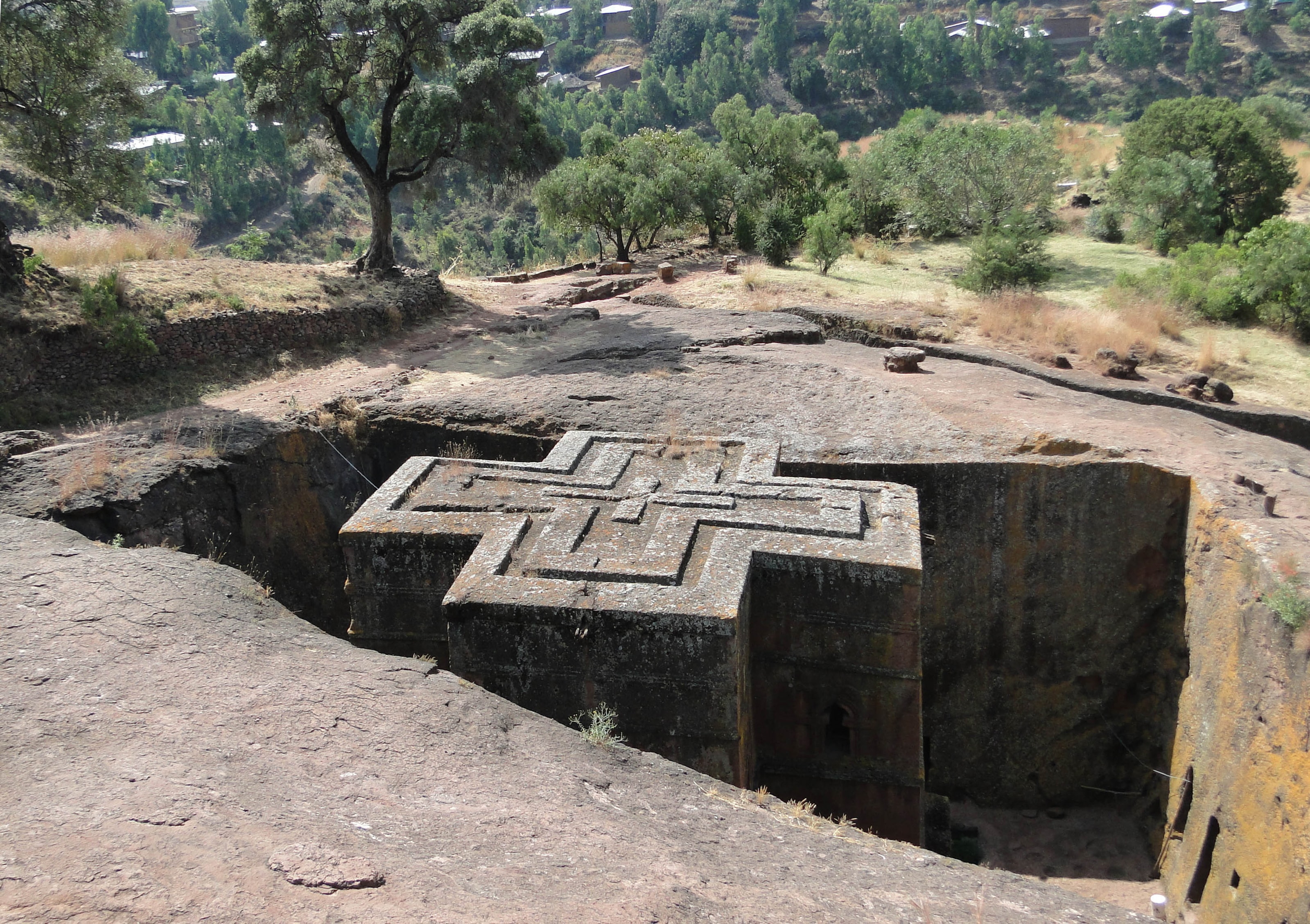 Bete Giyorgis, the Church of Saint George, cut down into the rock in the shape of a cross. Photo: Bernard Gagnon, CC BY-SA 3.0 (Wikimedia Commons), resized.

See this page's graph and discover linked topics
In full
The Rock-Hewn Churches of Lalibela are eleven monolithic and semi-monolithic churches excavated from volcanic tuff at Lalibela (formerly Roha) in the Lasta district of the Amhara Region, Ethiopia, inscribed by UNESCO as a World Heritage Site in 1978. They fall into a northern group (including Bete Medhane Alem, Bete Maryam, Bete Meskel, Bete Denagel and the Bete Golgotha-Mikael complex), an eastern group (including Bete Amanuel, Bete Merkorios, Bete Abba Libanos and Bete Gabriel-Rufael), and the isolated cruciform Bete Giyorgis to the west, linked by trenches, tunnels and ceremonial passages. The site's biblical place-names, above all the channel called Yordanos (Jordan), express its traditional identity as a New Jerusalem. Ethiopian tradition and the hagiography Gadla Lalibela credit the Zagwe king Lalibela (r. c. 1181-1221) with the whole complex. Modern scholarship accepts a major building programme associated with his era but disputes whether every church belongs to it: David Buxton's stylistic chronology extends work into the fourteenth century, and David Phillipson argues that some structures were first cut as secular buildings in the Aksumite or post-Aksumite period, about 600-800, and later converted. Excavations have also found pottery and animal remains from about 900-1100, suggesting a secular settlement before the religious complex took its final shape. The first European description is by the Portuguese priest Francisco Álvares, who visited in the 1520s.
What the site is
| Feature | Detail |
|---|---|
| Location | Lalibela town, North Wollo, Amhara Region, Ethiopia, at roughly 2,500 m altitude |
| Material | Volcanic tuff, cut from the top down |
| Number | Eleven churches, in three groups |
| Best known | Bete Giyorgis (cruciform, isolated in its own pit); Bete Medhane Alem (often called the largest monolithic church) |
| Status | Living churches of the Ethiopian Orthodox Church; UNESCO World Heritage Site since 1978 |
| Protection | Several churches stand under large modern shelters against rain erosion, a measure that has been criticized as well as defended |
Inside a Lalibela church
- Three-part plan. Like other Ethiopian churches, each has an inner sanctuary (the maqdas) where the tabot, a consecrated altar tablet representing the tablets of the covenant, is kept. See Kebra Nagast for the wider Ark tradition.
- Aksumite forms. Window frames and friezes copy the "monkey-head" timber-and-stone style of Aksumite architecture, and some church plans follow older built churches such as Debre Damo. This is part of Buxton's evidence for a long architectural tradition.
- Paintings. Several churches keep medieval and later wall paintings of saints, Mary and Christ.
How the churches are dated
- Tradition: one king, one great programme, aided by angels. Álvares reports that local priests told him the work took twenty-four years.
- Style: Buxton placed the churches in a sequence of development from Aksumite-style buildings, implying work over more than one reign.
- Archaeology: Phillipson's re-reading of the cuttings argues for at least two or three phases, with some structures (Bete Merkorios, Bete Gabriel-Rufael and Bete Danagel) older than Lalibela. Pottery and faunal finds from about 900-1100 point to an earlier secular settlement.
- Documents: the land grants of Lalibela's reign and a Coptic embassy around 1210 confirm a Christian court in Lasta at the time, but no contemporary text describes the cutting of the churches.
History of the site
- Twelfth and thirteenth centuries: royal centre of the Zagwe kings; tradition links its Jerusalem layout to Saladin's capture of Jerusalem in 1187.
- 1450s: appears on the Fra Mauro world map, made in Venice, as "Lalabeda."
- 1520s: Álvares describes the churches and swears that he is telling the truth because he expects readers will not believe him.
- 1530s: the Adal campaign of Ahmad ibn Ibrahim al-Ghazi swept through the region. The chronicle of the war, Futuh al-Habasha, describes burning a rock-cut church; Richard Pankhurst noted that the Ethiopian royal chronicles do not record damage at Lalibela, and suggested the church may have been another rock church nearby.
- 1936: Emperor Haile Selassie made a pilgrimage to Lalibela during the Italian invasion.
- 1978: UNESCO World Heritage listing.
- 2021: the town changed hands during the Tigray War, raising international concern for the churches; it was retaken by Ethiopian forces in December 2021.
Why it matters for the history of African Christianity
- African Christian architecture of world rank. The churches are an African achievement in engineering and sacred design, built for an African church in its own idiom.
- A Jerusalem-centred faith. The site shows how deeply Ethiopian Christianity identified with the biblical land and story. It is a theological statement in stone: the holy city is wherever Christ is worshipped.
- Continuity. Worship has continued at Lalibela for centuries, through invasion, foreign missionary pressure, Marxist rule and civil war.
- An answer to the "imported religion" charge. Nothing about Lalibela is colonial. It was carved centuries before European colonial rule, for a church that had already been Christian for some nine hundred years. See Christianity Is the White Mans Religion Objection Defeater.
Tensions
- One king or many generations? Tradition and much popular writing credit Lalibela alone; Buxton and Phillipson argue for a longer process. The codex presents both and does not decide.
- Angels and engineers. The tradition of angelic help is a statement of faith about God's hand in the work; it is not offered here as a historical claim, nor dismissed as worthless. The physical record shows human tool-work.
Scholarship
Published academic works this page draws on, each matched to a publisher, index or library catalog record.
- David Roden Buxton, The Abyssinians (1970). Open Library
- Taddesse Tamrat, Church and state in Ethiopia, 1270-1527 (1972). Open Library
See also
- Lalibela, the Zagwe king credited with the churches
- Ethiopian Orthodox Church, the church that worships there
- Kingdom of Aksum, the architectural tradition the churches draw on
- Kebra Nagast, the Ark and tabot tradition
- Garima Gospels, another treasure of Ethiopian Christian art
- Biblical Archaeology, the codex's archaeology hub
- Christian Pre-Colonial African Heritage Argument, the argument this site strengthens
- Africa and Christianity, master hub
Common questions this page answers
Q: How were the churches of Lalibela built?
They were carved downward from solid volcanic rock. Workers cut trenches to free a block of stone, then hollowed it out into rooms, pillars, doors and windows. Nothing was assembled from separate blocks.
Q: How old are the rock-hewn churches of Lalibela?
Tradition dates them to King Lalibela's reign, about 1181-1221. Some scholars think the work extended into the fourteenth century, and others argue that parts were cut as early as 600-800 and later converted to churches.
Q: Why is Lalibela called the New Jerusalem?
Its layout and names copy the Holy Land, including a channel named the Jordan. Tradition says King Lalibela was commanded in a vision to build a second Jerusalem, and many historians connect this to the loss of Jerusalem to Saladin in 1187.
Q: Are the Lalibela churches still used?
Yes. They are working churches of the Ethiopian Orthodox Tewahedo Church, served by priests, and draw huge crowds of pilgrims at Genna (Ethiopian Christmas) and Timkat (Epiphany).
Q: Did angels build the churches of Lalibela?
That is the tradition preserved in the king's hagiography, which says angels worked by night alongside the workmen by day. Historians study the human tool-work and building phases, and the codex records the tradition without treating it as a historical claim.
Q: Is Lalibela a UNESCO World Heritage Site?
Yes. The Rock-Hewn Churches, Lalibela were inscribed in 1978, among the first sites on the World Heritage List.