Person
Robert Merrihew Adams
Robert Adams, Robert M. Adams, R. M. AdamsAmerican analytic philosopher (b. 1937), long at UCLA and then Yale, and the most influential modern defender of a theistic account of moral obligation. His modified divine command theory holds that what makes an act wrong is its being contrary to the commands of a loving God, and his book Finite and Infinite Goods: A Framework for Ethics (Oxford, 1999) builds a full theory in which the good is grounded in God, the infinite Good, and obligation arises from God's commands within a relationship of love.
The 30-second version:
Robert Adams is a Christian philosopher whose work underlies most modern versions of the moral argument. He separates goodness from obligation: goodness is resemblance to God, who is the Good itself, and obligation comes from the commands of a God who loves us. That move answers the Euthyphro dilemma, because God's commands are tied to his goodness rather than to bare will, and it explains why a duty is owed to someone.
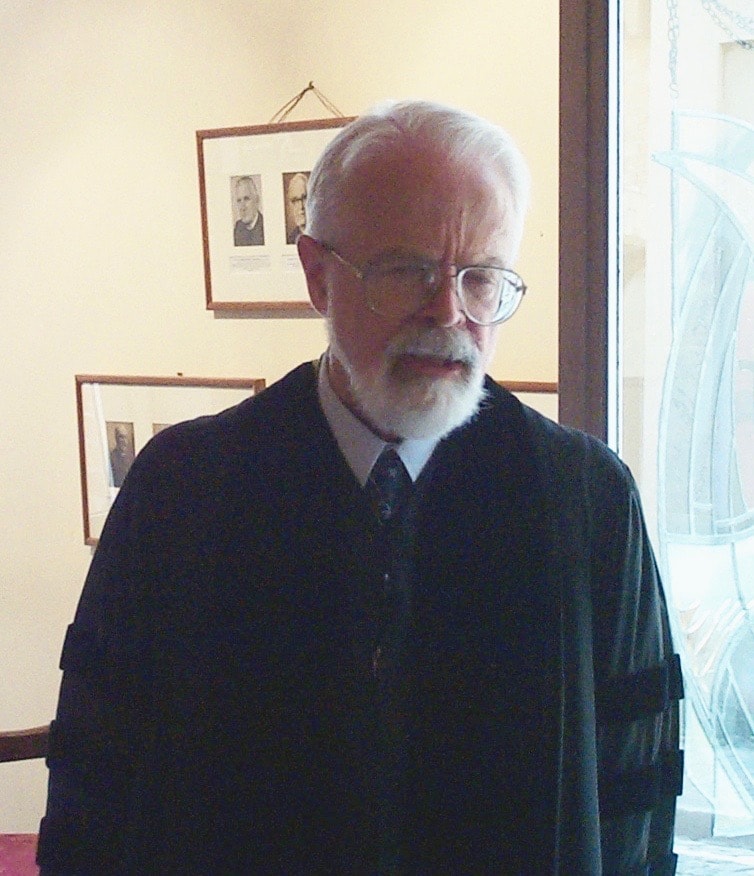 Robert Merrihew Adams in 2006. Photo: Kaihsu Tai, CC BY 2.5, via Wikimedia Commons.

Why he matters to the codex
The codex's Moral Argument, Divine Command Theory and Godless Normative Realism pages lean on Adams at their most contested step: the claim that obligation, unlike value, needs a personal source. His distinction between the good and the right lets a Christian grant that atheists can recognize value while pressing the question of what makes a duty owed. See Moral Motivation vs Moral Grounding.
See this page's graph and discover linked topics
Major ideas
1. The modified divine command theory
In "A Modified Divine Command Theory of Ethical Wrongness" (1973, in Gene Outka and John P. Reeder, eds., Religion and Morality), Adams proposed that ethical wrongness is the property of being contrary to the commands of a loving God. The qualifier "loving" carries the weight. A command to torture for its own sake could not come from the God Christians worship, so the theory does not make morality hostage to arbitrary will. He refined the view in "Divine Command Metaethics Modified Again" (Journal of Religious Ethics, 1979).
2. The good and the right, separated
Finite and Infinite Goods (1999) treats the two separately:
- The good. God is the Good itself. Finite things are excellent insofar as they resemble God, in the way a likeness resembles its original. Goodness is objective and does not depend on anyone's opinion.
- The right. Obligation is a kind of social requirement. Within human relationships, duties arise from the demands people can rightly make of one another; the supreme case is the demand of a loving God, which is why moral obligation has the authority it does.
This structure answers the Euthyphro Dilemma: God's commands are good because they flow from his good character, and acts are obligatory because a good God commands them. Neither goodness nor obligation floats free of God.
3. Moral arguments for theism
In "Moral Arguments for Theistic Belief" (1979, reprinted in The Virtue of Faith, Oxford, 1987), Adams argued that a divine command account explains the objectivity and authority of obligation better than its rivals, and added a practical argument: a person committed to living morally has reason to hope the moral order is backed by a good God rather than to give way to moral discouragement. See Moral Arguments.
4. Other contributions
- "Must God Create the Best?" (Philosophical Review, 1972) argues that God does no wrong in creating a world less than the best possible, and that grace, love shown regardless of merit, is part of why. See Imperfect Universe Objection Defeater.
- "Middle Knowledge and the Problem of Evil" (American Philosophical Quarterly, 1977) pressed the "grounding objection" against Molinism: what could make the counterfactuals of freedom true before anyone chooses? See Counterfactuals of Freedom.
- Leibniz scholarship. Leibniz: Determinist, Theist, Idealist (Oxford, 1994) is a standard study of Leibniz's metaphysics and natural theology.
- Virtue. A Theory of Virtue: Excellence in Being for the Good (Oxford, 2006) develops an account of virtue as persisting excellence in being for what is good.
How the codex uses him
- Obligation needs a person. The Moral Argument (P1) and Grounding Argument from Cognitivism cite Adams for the claim that duties are owed. The codex reads this through his distinction between moral standing and moral authority: a tree or an infant can be the object of a duty without being the one who issues it.
- Answering Euthyphro. Euthyphro Dilemma Objection Defeater and Divine Command Theory use his "loving God" qualifier against the arbitrariness horn.
- Value versus obligation. Godless Normative Realism uses his split to concede that secular realists may account for some value while pressing them on obligation.
Critics and interlocutors
- Erik Wielenberg argues that basic moral truths, including truths about obligation, can be necessary and brute without a divine source, and that command theories make obligation depend on knowing the commander.
- Mark Murphy (God and Moral Law, Oxford, 2011) defends a natural-law alternative within theism, in which God explains the moral law without divine commands being the source of every obligation.
- William Lane Craig popularized a divine-nature-plus-command account close to Adams's in debate. See William Lane Craig.
Scholarship
Published academic works this page draws on, each matched to a publisher, index or library catalog record.
- Robert Merrihew Adams, "Must God Create the Best?" The Philosophical Review 81 (1972). doi:10.2307/2184329
- Robert Merrihew Adams, The virtue of faith and other essays in philosophical theology (1987). Open Library
- Robert Merrihew Adams, A Theory of Virtue: Excellence in Being for the Good (Oxford University Press, 2006). doi:10.1093/acprof:oso/9780199207510.001.0001
- Mark C. Murphy, God and Moral Law (2011). Open Library
See also
- Divine Command Theory, the theory he modified
- Moral Argument, where his account of obligation does its main work
- Godless Normative Realism, the secular rival his value-obligation split engages
- Euthyphro Dilemma, the dilemma his "loving God" qualifier answers
- Moral Motivation vs Moral Grounding, grounding, motivation and the place of a theistic account
- Desire Grounds Moral Obligation Objection Defeater, why desire cannot be the ground of obligation
- Erik Wielenberg, his most developed atheist critic
- Leibniz, the subject of his major historical study