Argument
Reverse Modal Ontological Argument Objection Defeater
reverse ontological argument, reverse modal ontological argument, modal ontological argument for atheism, if God possibly does not exist then God necessarily does not exist, possibly God does not exist, the symmetry problem for the ontological argument, ontological argument parody for atheismIntro
The modal ontological argument says: if it is even possible that God exists, then God exists. That works because of what "God" means here. God is a being who cannot fail to exist. If a being like that exists anywhere in the range of real possibilities, it exists everywhere, including in our world.
The skeptic's reply is clever. Run the same logic backwards. If it is even possible that God does not exist, then God cannot be the kind of being who exists necessarily, and since God would have to be that kind of being if He existed at all, God does not exist. Anywhere. The skeptic says: I can easily imagine a world without God, so God is impossible.
The logic of the reply is fine. The weak spot is the starting point. Both arguments start with "it is possible that..." and both are valid, so they cannot both have true starting points. Which one is true? Imagining is not enough to decide. People once could imagine water that was not H₂O, and it turned out no such water is possible. You can picture a world with no God in it; I can picture a world with a God who has to exist. Neither picture settles anything. What settles it is evidence from outside the two arguments, and the strongest evidence is the case that our world of things that might not have existed depends on something that could not fail to exist.
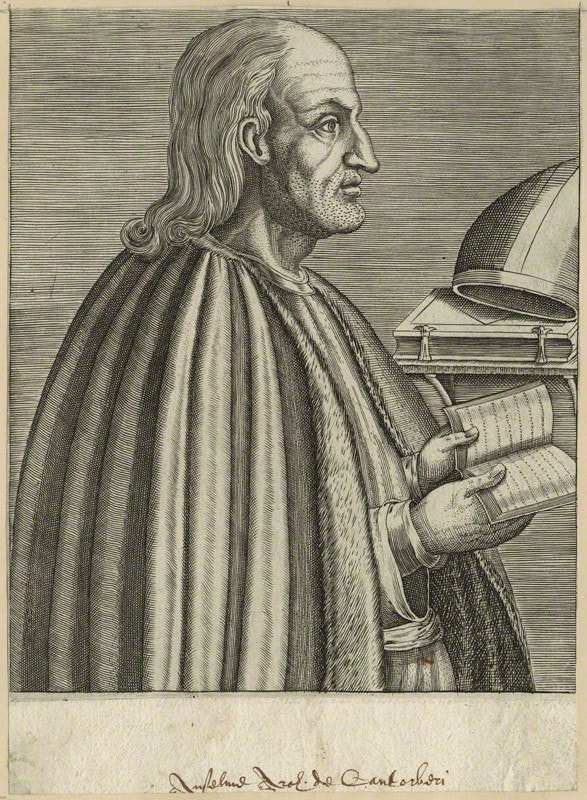
Anselm of Canterbury (c. 1033 to 1109), who first stated the ontological argument in the Proslogion. Engraved portrait. Image: public domain, via Wikimedia Commons.
The 30-second version: Yes, the reverse argument is valid. So is mine. That means the whole fight is over which "possibly" is true, and you cannot win it by imagining a world without God, because imagining is not the same as possibility. Water without hydrogen is imaginable and impossible. So we need independent evidence about whether a necessary being is possible, and the arguments from contingency supply it. Your argument does not refute God; it just restates the question.
See this page's graph and discover linked topics
In full
The reverse modal ontological argument (sometimes called the modal ontological argument for atheism) runs:
- R1. □(G → □G). Necessarily, if God exists, God exists necessarily. (This is part of the theist's own concept of God.)
- R2. ◇¬G. Possibly, God does not exist.
- C. □¬G. Necessarily, God does not exist. Hence ¬G: God does not exist.
The derivation in S5: R2 is equivalent to ¬□G. By the S5 axiom ◇p → □◇p, ¬□G holds necessarily: □¬□G. From R1, contraposing inside the box, □(¬□G → ¬G). Distribution of □ over → (axiom K) yields □¬G. The bare conclusion ¬G is reachable with even less: in the minimal normal logic K, if G held at our world then □G would hold, contradicting ◇¬G, so ¬G follows from R1 and R2 alone.
The theist's argument is the mirror image: from R1 and ◇G, S5 delivers □G. Since ◇G and ◇¬G jointly contradict R1 in S5 (one yields □G, the other □¬G), at most one possibility premise is true. This is the symmetry problem. Alvin Plantinga stated it himself in The Nature of Necessity (1974, ch. 10), with a counterpart premise that "no-maximality" (there being no maximally great being) is possibly exemplified, and conceded that the argument does not compel a rational person who rejects its key premise: what he claimed for it is that it "establishes, not the truth of theism, but its rational acceptability."
This defeater grants validity and argues five things: (1) conceivability alone cannot ground either possibility premise, because modal intuition about necessary beings is exactly where conceivability is least reliable; (2) given R1, the premise ◇¬G is logically equivalent to atheism itself, so the reverse argument carries the question-begging charge at least as heavily as the original; (3) the symmetry is broken by independent arguments, chiefly the contingency arguments for a necessary being; (4) the recent claim that the reverse argument wins on logical economy (Fritz, Lo and Schmid, 2025) shows something true about the logic and nothing about which premise is true; (5) the outcome is a draw on the ontological argument alone, which is no defeat for theism, since theism was never resting on that argument alone.
Argument structure
| Premise | Notes | |
|---|---|---|
| P1 | The reverse argument is valid, so the dispute is over which possibility premise is true | Plantinga 1974, ch. 10; Mackie 1982, ch. 3 |
| P2 | Conceivability cannot settle that dispute, because the imagined absence of a necessary being is the kind of case where conceivability is least reliable | Kripke on a posteriori necessity; Collin 2022 |
| P3 | Given R1, ◇¬G is equivalent to ¬G, so the reverse premise begs the question at least as much as ◇G does | the logic itself |
| P4 | Independent arguments for a necessary being break the symmetry in the theist's favour | Contingency Argument; Pruss and Rasmussen 2018 |
| P5 | The logical-economy asymmetry (the reverse argument needs a weaker logic) does not tell us which premise is true | Fritz, Lo and Schmid 2025 |
| C | The reverse argument does not show that God's existence is impossible; it shows that ontological arguments need support from outside themselves |
Form
Defensive, in the shape of a parity argument. The objection is a mirror image, so the reply grants every bit of logic the mirror image uses and then shows that the mirror reflects the same open question back. The positive work is done at P4, where the theist brings evidence that the atheist's mirror cannot reflect, because it comes from a different family of arguments.
Cheatsheet
The 30-second reply (read aloud). Your argument is valid, and I will not pretend otherwise. But mine is valid too, and they cannot both be sound. So we are not arguing about logic any more; we are arguing about whether "possibly, God does not exist" or "possibly, God exists" is true. You say you can imagine a world without God. People could imagine water that was not made of hydrogen and oxygen, and that turned out to be impossible. When the thing in question would exist necessarily if it existed at all, imagining its absence proves nothing. So let's look at evidence that does not come from imagining. Everything around us could have failed to exist. Something has to explain why anything exists at all, and that something cannot be another thing that might not have existed.
The 5 fast facts:
- Plantinga raised the symmetry himself. In The Nature of Necessity (1974, ch. 10) he gave the counterpart premise ("no-maximality is possibly exemplified") and said the argument shows theism's rational acceptability, not its truth. The reverse argument is not a gotcha he missed.
- Both arguments are valid in S5. From □(G → □G), the premise ◇G yields □G and the premise ◇¬G yields □¬G. Exactly one of the two possibility premises is true.
- Given the theist's concept of God, "possibly not" just means "not." With R1 in place, ◇¬G entails ¬G in the most basic modal logic. Asserting R2 is asserting atheism, which is why it cannot be the uncontroversial starting point the objection presents it as.
- The debate is live in the journals. James Henry Collin, "The Reverse Ontological Argument" (Analysis, 2022), argued that facts about necessary a posteriori truths break the symmetry in the theist's favour. Joseph Schmid, "Symmetry's Revenge" (Analysis, 2023), replied that the symmetry returns. Peter Fritz, Tien-Chun Lo and Joseph Schmid, "Symmetry Lost" (Noûs, 2025), argued that the reverse argument actually has the advantage, because it needs a weaker modal logic.
- The contingency arguments are the symmetry breaker. Alexander Pruss and Joshua Rasmussen's Necessary Existence (Oxford, 2018) defends a concrete necessary being through a traditional contingency argument and five newer possibility-based arguments, none of which starts from the concept of God.
The 3 strongest counter-moves:
- "How do you know it is possible?" Ask what evidence supports R2 beyond the fact that the objector can picture a godless world. Then ask whether conceivability is a reliable guide when the subject is a being whose nonexistence, if possible at all, would have to be necessary.
- "Which modal logic are you using?" If the objector leans on S5, they owe the same respect to the theist's S5 derivation. If they lean on a weaker logic, point out that it makes R2 even more plainly equivalent to their conclusion.
- "What explains why there is anything at all?" Move the conversation from imagined worlds to the actual one. If the objector's answer is "nothing," the debate is now about the Principle of Sufficient Reason, which is where the symmetry gets broken.
Reciprocal concessions (grant the small point, then collect a bigger one):
- Grant: the reverse argument is valid. Now collect: then the atheist's argument is only as strong as its possibility premise, which is a substantive metaphysical claim the objector now has to defend, not a default.
- Grant: the ontological argument on its own does not compel a skeptic. Plantinga said so. Now collect: the reverse argument on its own does not compel a theist either, for exactly the same reason. A draw on this board leaves the cosmological, moral and historical cases untouched.
- Grant: Fritz, Lo and Schmid are right that the reverse argument runs in weaker logics. Now collect: in those logics the reverse premise is still equivalent to "God does not exist," so the advantage is in the bookkeeping, not in the evidence.
The closing line. You have shown that if God is impossible, God does not exist. I agree. Now show me God is impossible, without just imagining it.
P1, The reverse argument is valid, so the dispute is over the possibility premise
Affirmative case
- Concede the logic at once. In S5, from □(G → □G) and ◇¬G it follows that □¬G. Denying this costs credibility and wins nothing, because the same rules carry the theist's own argument.
- The two arguments share R1. Both sides agree that if God exists, God exists necessarily. That is not a concession to the atheist; it is the classical doctrine of divine aseity, that God's existence does not depend on anything else. See Aseity and Necessary vs Contingent Being.
- Exactly one possibility premise is true. Given R1, ◇G and ◇¬G cannot both hold in S5. The argument has therefore located the real question rather than answered it.
- This was always the shape of the debate. Plantinga built the counterpart premise into his own presentation (The Nature of Necessity, 1974, ch. 10), and J. L. Mackie pressed the parity in The Miracle of Theism (1982, ch. 3). The reverse argument is the standard objection, not a new refutation.
Anticipated objections
- "If both arguments are valid and symmetrical, the rational thing is to suspend judgment on God."
- "The burden is on the person making the existence claim, so the theist must break the tie."
Rebuttals
- Suspending judgment is the right response to the ontological argument taken alone, not to the question of God. Symmetry between two premises tells you not to rest your view on either premise by itself. It says nothing about the evidence that bears on them from elsewhere, which is where P4 goes. A tie between two premises is a reason to look for more evidence, not a verdict.
- Both are existence claims, and both are modal claims. "God is impossible" is as strong a claim as "God is necessary." The objector who runs the reverse argument is not resting on a default; he is asserting that a necessary being is impossible, which carries its own burden. That said, the theist should accept a share of the burden willingly and meet it at P4.
P2, Conceivability cannot settle which premise is true
Affirmative case
- Conceivability is fallible evidence of possibility. Before chemistry, it seemed conceivable that water could be something other than H₂O. Saul Kripke argued in Naming and Necessity (1980) that such identities are necessary truths known only a posteriori, so the imagined scenario was impossible all along. What we can picture is not a safe map of what could be.
- The case at issue is the worst case for conceivability. If a necessary being exists, its existence is a necessary truth, and its absence is no more possible than water without hydrogen. Picturing the world without God is picturing the world's physical and moral furniture with nothing behind it, which tells us about our powers of imagination, not about the modal facts. James Henry Collin's 2022 paper in Analysis, "The Reverse Ontological Argument," develops a symmetry breaker along these lines, appealing to the way necessary a posteriori truths undercut intuitions of possibility.
- The theist's intuition is at least as respectable. Defenders of the original argument point out that a maximally great being has no internal contradiction anyone has demonstrated (see God is Impossible Paradox Cluster), and that the concept has been held coherent across traditions. That does not prove ◇G, but it means the atheist's ◇¬G is not the only premise with intuitive support.
Anticipated objections
- "Then the theist's premise ◇G is undercut by the same point. You can conceive of God, but that proves nothing either." (This is the heart of Joseph Schmid's reply to Collin, "Symmetry's Revenge," Analysis, 2023.)
- "I am not merely imagining. There is no contradiction in a world containing only contingent things."
Rebuttals
- Granted, and that is the point. If conceivability fails on both sides, then neither possibility premise can be established by conceivability, and the reverse argument loses all the force the objector claimed for it. The theist does not need Collin's breaker to win; it is enough that the atheist's premise is no better off than the theist's. Schmid's reply restores symmetry, and symmetry is all this defeater needs at P2.
- "No contradiction we can detect" is not "no contradiction." Absence of a detectable formal contradiction is the same evidence the theist has for ◇G. Whether a world of only contingent things is possible is exactly what the contingency arguments dispute, by arguing that such a world would contain facts with no possible explanation. The objector has restated R2, not supported it.
P3, Given R1, the reverse premise is just atheism in modal dress
Affirmative case
- The logic is short. Suppose R1, □(G → □G). If God existed in our world, God would exist necessarily, so there would be no possible world without God. Hence ◇¬G entails ¬G, in the most basic normal modal logic, K. Conversely, if God does not exist then, given R1, God's existence is not merely absent but impossible in S5. So for anyone who accepts R1, ◇¬G, ¬G and □¬G stand or fall together.
- The common charge against the theist rebounds. Critics of the original argument often say ◇G is just a disguised assertion of □G, so granting it is granting theism. True, given S5. But the parity holds: ◇¬G is a disguised assertion of ¬G. Whoever says "surely it is at least possible that there is no God" is not offering a modest premise. He is asserting atheism and calling it a possibility.
- So the reverse argument cannot carry a neutral listener anywhere. A neutral listener who has no view on God has, for that very reason, no view on ◇¬G either, once R1 is understood.
Anticipated objections
- "Everyone has the intuition that God might not have existed. That is common ground, not atheism."
Rebuttals
- That intuition is ambiguous between two kinds of possibility. "For all I know, there might be no God" is epistemic possibility, a report about what our evidence leaves open, and it is true for many people. R2 needs metaphysical possibility, a claim about how reality could have been. The slide from one to the other is the equivocation catalogued at Metaphysical vs Logical Modality. Epistemic possibility of ¬G is compatible with God's existing necessarily.
P4, Independent arguments for a necessary being break the symmetry
Affirmative case
- The tiebreaker comes from outside the ontological argument. Since neither possibility premise is self-evident, the rational move is to ask which one is supported by arguments that do not start from the concept of God. The contingency arguments do this: they start from the existence of things that could have failed to exist and argue to a being that could not. See Contingency Argument and Third Way - Contingency.
- A sound contingency argument settles the possibility question. If there actually is a necessary being, then ◇¬N (it is possible there is no necessary being) is false. If that necessary being is shown to have the attributes of God (see Necessary Being is an Intelligent Mind), then ◇¬G is false, and the reverse argument has a false premise.
- Even weak, possibility-based premises do the work. Alexander Pruss and Joshua Rasmussen's Necessary Existence (Oxford University Press, 2018) presents a traditional contingency argument and then five newer arguments built from modest claims about what is possible, using the tools of contemporary modal logic. Those premises do not mention God, and from them the authors argue to a concrete necessary being. That is a principled reason to prefer ◇□N over ◇¬N, and so, once the being is identified, ◇G over ◇¬G.
- The symmetry is therefore broken asymmetrically. There is no matching family of arguments that starts from ordinary facts and concludes that a necessary being is impossible. The atheist's case for R2 rests on conceivability; the theist's case for ◇G can rest on arguments from contingency, from the Principle of Sufficient Reason, and from the coherence of the divine attributes.
Anticipated objections
- "The contingency argument is itself contested. You have only moved the dispute."
- "A necessary being might be impersonal, or might be the universe. That does not give you G."
Rebuttals
- Moving the dispute to evidence is the point. The reverse argument claimed to settle the question of God by logic. Showing that the question has to be settled by the cosmological evidence instead is a defeat for that claim. And on that ground the theist has developed arguments with defenders across the literature, while the atheist has R2.
- That is a further step, and the codex takes it elsewhere. Arguments that a necessary ground must be an intelligent, personal, non-physical cause are set out at Necessary Being is an Intelligent Mind and Causal Adequacy Argument for a Mind Behind the Universe. Note too that even an impersonal necessary being falsifies the strong reading of the atheist's premise, that there could be nothing necessary at all.
P5, The logical-economy asymmetry does not decide the question
Affirmative case
- The 2025 argument, fairly stated. Peter Fritz, Tien-Chun Lo and Joseph C. Schmid, "Symmetry Lost: A Modal Ontological Argument for Atheism?" (Noûs, published online July 2025), argue that the symmetry between the two arguments breaks in the atheist's favour: the theistic argument needs a strong modal logic such as S5 (or at least the Brouwerian principle that ◇□p → p), while the reverse argument goes through in weaker systems. A Christian should take this seriously; it is a careful result by competent logicians, not a slogan.
- What it shows is true and limited. It is correct that from □(G → □G) and ◇¬G one reaches ¬G in very weak logics, while from □(G → □G) and ◇G one needs B or S5 to reach G. That is a fact about how many logical principles each argument uses.
- Logical economy is not evidence for a premise. An argument that uses fewer rules is more robust against doubts about the rules. It is not more likely to have a true premise. The reverse argument still needs ◇¬G, and as P3 showed, in exactly those weaker logics ◇¬G is still equivalent, given R1, to ¬G.
- Metaphysical modality is widely held to be S5. Most philosophers who think about metaphysical (as opposed to epistemic or physical) possibility take S5 to be its logic; Timothy Williamson's Modal Logic as Metaphysics (Oxford, 2013) is a prominent defense of a strong modal logic. In S5 the two arguments are symmetrical again, and the dispute returns to P2 and P4.
Anticipated objections
- "If the theist's argument depends on a contested logic and the atheist's does not, that is an asymmetry in the atheist's favour, full stop."
Rebuttals
- It is an asymmetry about logical cost, paid in a currency the theist can afford. A theist who accepts S5 for metaphysical modality, as many non-theists also do, pays nothing extra. And the asymmetry never touches the content of R2. If the contingency arguments are sound, R2 is false in every logic, weak or strong.
Master objections to the defeater
MO1: "You are just refusing to accept a valid argument."
- No. The validity is conceded at P1. What is refused is the claim that ◇¬G is known, and that refusal is reasoned (P2, P3) and backed by independent evidence (P4).
MO2: "By your standards, the original ontological argument is useless."
- Useless as a standalone proof against a hostile listener, yes, as Plantinga said. Useful in two ways: it shows that if God is so much as possible, God exists, so the atheist must hold that God is impossible; and it combines with the contingency arguments, which supply independent support for the possibility premise.
MO3: "Possibility claims are always easier to defend than necessity claims, so ◇¬G is the safe bet."
- Given R1, ◇¬G is a necessity claim in disguise: it entails □¬G in S5. There is no safe bet here; both possibility premises carry the full weight of their conclusions.
Tactical opening / closing
- Opening. "Your argument is valid. So is the one you are parodying. Let's talk about the only thing that is actually in dispute: whether God's nonexistence is possible."
- Closing. "Imagining a world without God tells me about your imagination. Whether there could be a world without a necessary being is a question about why anything exists, and that is a question I am glad to argue."
Connection to Scripture
- And God said unto Moses, I AM THAT I AM: and he said, Thus shalt thou say unto the children of Israel, I AM hath sent me unto you (Exodus 3:14, ASV). Classical theologians read the divine name as expressing aseity, existence that does not come from another. That is the content of R1, which both arguments share.
- Before the mountains were brought forth, Or ever thou hadst formed the earth and the world, Even from everlasting to everlasting, thou art God (Psalm 90:2, ASV). The psalm sets the existence of God before and apart from everything formed.
- These texts state the Christian concept of God; they do not by themselves establish the modal possibility premise for a skeptic. The case for that premise is philosophical, at P4.
Live-cite kit
Scholarly:
- Alvin Plantinga, The Nature of Necessity (Oxford: Clarendon Press, 1974), ch. 10
- J. L. Mackie, The Miracle of Theism (Oxford, 1982), ch. 3
- Graham Oppy, Ontological Arguments and Belief in God (Cambridge University Press, 1995)
- James Henry Collin, "The Reverse Ontological Argument," Analysis 82.3 (2022), 410-416
- Joseph C. Schmid, "Symmetry's Revenge," Analysis 83.4 (2023), 723-731
- Peter Fritz, Tien-Chun Lo and Joseph C. Schmid, "Symmetry Lost: A Modal Ontological Argument for Atheism?" Noûs (online 25 July 2025; vol. 60.2, 313-327)
- Alexander R. Pruss and Joshua L. Rasmussen, Necessary Existence (Oxford University Press, 2018)
- Saul Kripke, Naming and Necessity (Harvard University Press, 1980)
- Timothy Williamson, Modal Logic as Metaphysics (Oxford University Press, 2013)
Scripture:
- Exodus 3:14, the divine name and aseity
- Psalm 90:2, God before all that was formed
Aphorism:
- "Possibly no God, given what God would be, just means no God. Calling it a possibility does not make it modest."
- "Water without hydrogen was conceivable too."
- "A mirror shows you the same question. It does not answer it."
Scholarship
Published academic works this page draws on, each matched to a publisher, index or library catalog record.
- James Henry Collin, "The reverse ontological argument," Analysis 82 (2022). doi:10.1093/analys/anab077
- Peter Fritz, Tien-Chun Lo and Joseph C. Schmid, "Symmetry lost: A modal ontological argument for atheism?" Noûs 60 (2026). doi:10.1111/nous.70009
- Saul A. Kripke, Naming and necessity (Harvard University Press, 1980). Open Library
- J. L. Mackie, The Miracle of theism (1982). Open Library
- Graham Oppy, Ontological Arguments and Belief in God (Cambridge University Press, 1996). doi:10.1017/cbo9780511663840
- Alvin Plantinga, The Nature of Necessity (Clarendon Press, 1974). Open Library
- Alexander R. Pruss and Joshua L. Rasmussen, Necessary Existence (Oxford University Press, 2018). doi:10.1093/oso/9780198746898.001.0001
- Timothy Williamson, Modal Logic as Metaphysics (Oxford University Press, 2013). doi:10.1093/acprof:oso/9780199552078.001.0001
See also
- Modal Ontological Argument, the argument this objection reverses
- Ontological Arguments, the family hub
- Metaphysical vs Logical Modality, why "possibly" must mean metaphysical possibility, and the equivocation at P3
- Modal Logic, the S5 framework and the axioms each argument uses
- Necessary vs Contingent Being, what necessary existence means
- Contingency Argument, the main symmetry breaker
- Third Way - Contingency, Aquinas's version of the contingency route
- Principle of Sufficient Reason, the principle the contingency arguments rest on
- Necessary Being is an Intelligent Mind, from a necessary ground to a personal God
- God is Impossible Paradox Cluster, answers to claims that the divine attributes are incoherent
- Aseity, the doctrine behind R1
- Alvin Plantinga, who formulated the modal argument and its counterpart
- Arguments, the master index
Common questions this page answers
Q: What is the reverse ontological argument?
It runs the modal ontological argument backwards. If God would exist necessarily if He existed at all, and if it is possible that God does not exist, then in S5 modal logic God necessarily does not exist. It is valid, and it is the standard objection to Plantinga's version of the ontological argument.
Q: Does the reverse ontological argument disprove God?
No. It is only as strong as its premise that God's nonexistence is possible, and that premise is no more established than the theist's premise that God's existence is possible. Given what God would be, "possibly no God" is equivalent to "no God," so the argument assumes what it sets out to prove.
Q: Isn't it obviously possible that God doesn't exist?
It is epistemically possible for many people, meaning their evidence does not rule it out. The argument needs metaphysical possibility, a claim about how reality could have been. If a necessary being exists, its absence is no more possible than water without hydrogen, however easy it is to imagine.
Q: What is the symmetry problem for the ontological argument?
The theist's premise (possibly God exists) and the atheist's premise (possibly God does not exist) each lead, by valid S5 reasoning, to opposite conclusions, so they cannot both be true. Since both seem conceivable, conceivability alone cannot tell us which to accept. Plantinga acknowledged this in The Nature of Necessity (1974).
Q: How do you break the symmetry between the two arguments?
With evidence from outside the ontological argument. Contingency arguments start from things that could have failed to exist and argue to a being that could not, without starting from the concept of God. If they succeed, the atheist's possibility premise is false. Pruss and Rasmussen's Necessary Existence (2018) is a major recent defense of that route.
Q: Doesn't the 2025 Noûs paper show the reverse argument is stronger?
Fritz, Lo and Schmid argue that the reverse argument needs a weaker modal logic than the original. That is a real point about logical cost. It does not show that its premise is true, and in those weaker logics the premise is still equivalent to atheism. In S5, which many philosophers take to be the logic of metaphysical possibility, the two arguments are symmetrical again.
Q: Did Plantinga think the ontological argument proves God?
Not to someone who rejects its key premise. He said it establishes not the truth of theism but its rational acceptability. The same limit applies to the reverse argument, which is why the question has to be settled by other evidence.