Argument
Religious Experience Is Just Brain Chemistry Objection Defeater
religious experience is just dopamine, God is just chemicals in the brain, spiritual experiences are just brain chemistry, worship is like a drug, religion is an addiction, neuroscience explains away God, same chemicals as drugs and musicIntro
"The same chemicals released in spiritual encounters are released by music and by drugs. Religion is just a dopamine hit, and people get addicted to it."
Part of this is true, and a Christian should say so. Brain scans show that strong spiritual feelings light up the same reward areas of the brain that respond to music, food, love and drugs. Nobody needs to deny that.
But notice what follows and what does not. Every experience you have runs through your brain. Seeing your mother's face, tasting food, falling in love and working out a math problem all involve brain chemistry. That does not make your mother, the food or the answer imaginary. Finding the part of the brain that lights up tells you how you experience something. It does not tell you whether the thing you experienced is real.
And the argument cuts the person making it. Their reasoning, their doubt and their confidence that religion is false are brain chemistry too. If brain chemistry makes an experience worthless, it makes the atheist's thinking worthless as well. The philosopher William James pointed this out in 1902.
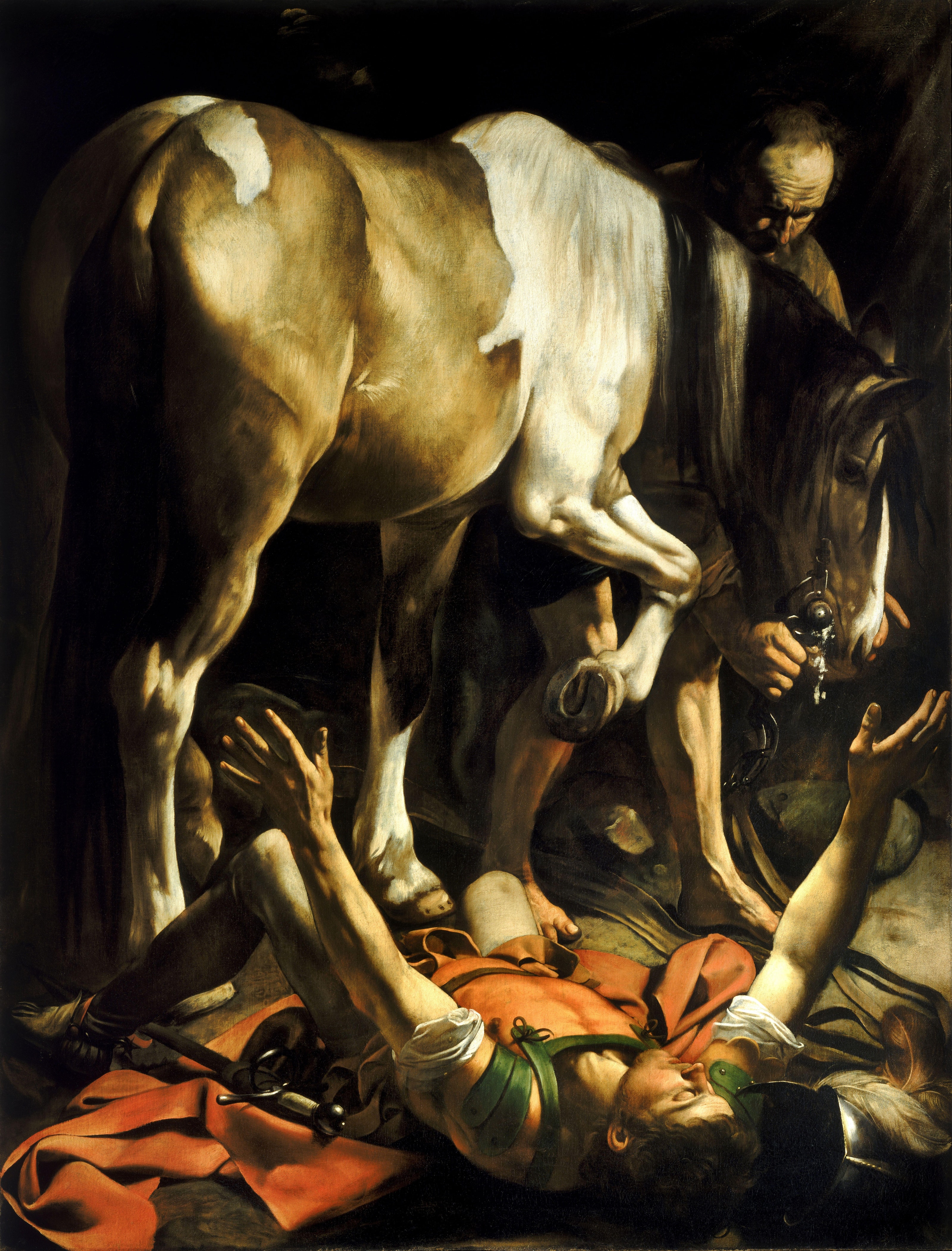
Caravaggio, The Conversion on the Way to Damascus (1601), Cerasi Chapel, Santa Maria del Popolo, Rome. William James's example of "medical materialism" was the attempt to explain away Paul's vision on this road as a seizure. Image: public domain, via Wikimedia Commons.
See this page's graph and discover linked topics
Cheatsheet
30-second reply. "You're right that worship lights up the brain's reward system, and so does music, and so does love. But when you fall in love, your brain releases oxytocin and dopamine. Does that mean the person you love doesn't exist? Finding the brain activity tells you how someone experiences something, not whether it's real. And your reasoning right now is brain chemistry too. If chemistry makes an experience worthless, it makes your argument worthless. So let's talk about whether God is real, not about which neurons fire."
Fast facts.
- Music and dopamine: Valorie Salimpoor and colleagues (Nature Neuroscience, 2011) used PET scanning to show dopamine release in the striatum both while listeners anticipated and while they felt the peak of their favorite music.
- Spiritual feeling and reward circuits: Michael Ferguson and colleagues (Social Neuroscience, published online 2016) scanned 19 devout Latter-day Saints and found that feeling "the Spirit" activated the nucleus accumbens, a reward region, along with attention areas. They measured blood flow, not dopamine directly, and cautioned that other faiths may differ.
- Neurotheology: Andrew Newberg's imaging studies of meditating Buddhists, praying Franciscan nuns and Pentecostals speaking in tongues found distinct patterns of brain activity in each.
- William James, 1902: "Scientific theories are organically conditioned just as much as religious emotions are."
Counter-moves.
- "It's just dopamine." So is your enjoyment of a good argument. "Just" is doing all the work, and nothing in the science supports it.
- "It's an addiction." Addiction means compulsion and continued use despite harm. A habit that makes people more generous, more stable and more forgiving is not what the word means.
- "Drugs produce the same experiences." A drug can also make you see a face that isn't there. That does not mean every face you see is a hallucination.
Concessions, and what each one collects.
- Grant: religious experience involves the brain's reward circuitry, the same circuitry music and drugs engage. Collect: then every experience, including the experience of reasoning to atheism, involves brain chemistry, so the mere presence of chemistry cannot be what disqualifies an experience.
- Grant: drugs and brain stimulation can produce experiences that feel spiritual. Collect: then the question is how to tell a true experience from a false one, which is exactly the question Scripture tells believers to ask (1 John 4:1). Counterfeits imply a genuine article.
- Grant: some people use religion compulsively or harmfully. Collect: then the problem is the compulsion and the harm, which is a problem with any good thing misused, not evidence that its object is unreal.
Closing line. "You've shown that the brain is involved when people meet God. You haven't shown that there's no God to meet. Those are different claims, and the science only supports the first one."
In full
The objection runs:
- Spiritual experiences activate dopamine-related reward circuits.
- Music and addictive drugs activate the same circuits.
- Therefore spiritual experiences are chemically produced illusions, and religion is a kind of addiction.
Premises 1 and 2 are broadly supported by research, with care about what was measured. The conclusion does not follow. It needs a hidden premise: if an experience has a neural mechanism, it has no real object. That premise is false for perception, memory, love and reasoning, and if it were true it would destroy the objector's own beliefs along with the believer's. This is the move William James called medical materialism in The Varieties of Religious Experience (1902): explaining away a religious state by naming its bodily condition, as if that settled its truth.
The defeater therefore makes four claims. Correlation is not reduction: identifying the brain activity that accompanies an experience does not show the experience is nothing but that activity, or that it has no external cause. The argument defeats itself: if neural causation discredits a belief, it discredits every belief. "Addiction" is misused: addiction is defined by compulsion and continued use despite harm, not by the presence of dopamine. The real question is evidential: whether religious experience is good evidence for God is a live philosophical debate, answered on its own terms (see Argument from Religious Experience), not settled by a brain scan.
Argument structure
| # | Premise |
|---|---|
| P1 | Every conscious experience, true or false, has neural correlates. |
| P2 | So the presence of neural correlates cannot by itself show that an experience is false or has no object. |
| P3 | If neural causation did discredit a belief, it would discredit the objector's own reasoning as well. |
| P4 | Addiction is defined by compulsion and continued use despite harm, not by the involvement of reward chemistry. |
| C | Therefore the brain chemistry of religious experience does not show that God is unreal or that faith is an addiction. Whether such experiences are evidence for God has to be argued on other grounds. |
Form
Defensive. P1 and P2 form a straightforward argument from the universality of neural correlates: a feature shared by true and false experiences cannot by itself sort them. P3 is a reductio of the hidden premise (it proves too much). P4 corrects an equivocation on "addiction." The argument does not prove that any religious experience is genuine. It removes a popular shortcut that claims to settle the question without examining it.
P1, Every experience has neural correlates
Affirmative case (second-order arguments)
- Perception. Seeing a real tree activates the visual cortex. So does dreaming of one, and so does hallucinating one. The brain activity is present in all three cases; what distinguishes them is whether there is a tree.
- Love and bonding. Bonding with a newborn or a spouse involves oxytocin and dopamine. Nobody concludes that the child or the spouse is imaginary because the brain's chemistry is involved in the relationship.
- Music, the objection's own example. Salimpoor and colleagues (2011) showed dopamine release during anticipation of and at the emotional peak of favorite music. The music was real. The dopamine is how the listener's brain registered it.
- Spiritual experience. Ferguson and colleagues found reward and attention regions active when devout participants reported feeling the Spirit. That establishes that the brain participates. It is silent on whether anything is being encountered.
Anticipated objections
- "But religious experiences come from inside the brain, not from outside like a tree."
- "Drugs can produce the same experiences, so no outside cause is needed."
Rebuttals
- That is the conclusion, not evidence for it. Whether a religious experience has an external cause is exactly what is in dispute. Brain imaging shows activity in the brain, which is where it would appear whether the experience was caused from outside or not.
- A drug can also make you see a person who is not there. That shows perception can be counterfeited, not that every perception is counterfeit. The existence of induced experiences raises the question of discernment; it does not answer it. See DMT Explains Near-Death Experiences Objection Defeater for the same reasoning applied to near-death experiences.
Live-cite kit
- Scripture: Psalm 34:8, "Oh taste and see that Jehovah is good": Scripture itself describes knowing God in the language of experience.
- Scholarly: Salimpoor et al., Nature Neuroscience 14 (2011); Ferguson et al., Social Neuroscience (2016 online).
- Aphorism: "Your brain lights up when you see your mother too."
Tactical notes
- Use the love example first. Everyone grants it, and it carries the whole point.
- Be precise about the Ferguson study: it measured reward-region activity, not dopamine itself. Overstating it hands the objector an easy correction.
P2 and P3, Correlation is not reduction, and the argument proves too much
Affirmative case (second-order arguments)
- The hidden premise is false. "If an experience has a neural mechanism, it has no real object" fails for every case in P1. Mechanism explains how an experience happens, not whether its object exists.
- William James named the error in 1902. In The Varieties of Religious Experience he called it "medical materialism," which "finishes up Saint Paul by calling his vision on the road to Damascus a discharging lesion of the occipital cortex, he being an epileptic." His answer was that "scientific theories are organically conditioned just as much as religious emotions are," so pointing to bodily causes cannot discredit religious states without discrediting everything else too.
- The atheist's reasoning is brain chemistry too. The conviction that religion is false, the satisfaction of a winning argument and the doubt that led someone out of church all have neural correlates. If neural causation discredits belief, it discredits unbelief equally. This is the same point the Argument from Reason presses against naturalism: if thought is nothing but chemistry, it is hard to see why we should trust any conclusion it reaches, including that one.
- James's own test looked at fruits. James proposed judging religious states "by their fruits ... not by their roots," echoing Jesus' words, "By their fruits ye shall know them" (Matthew 7:16, ASV). The question is what an experience produces in a life and whether it fits with the rest of what we know, not which neurons fired.
Anticipated objections
- "I'm not saying chemistry makes beliefs false, only that it explains religious experience without God."
- "Your reasoning is reliable because it's tested against the world. Religious experience isn't."
Rebuttals
- Then the chemistry has done no work. Explaining the mechanism of an experience is compatible with God being its cause and with God not being its cause. To get "without God" you need a separate argument that God does not exist. The brain scan cannot supply it.
- That moves the debate to the right place. Whether religious experience is checked against anything, whether it is consistent across believers, and whether it bears fruit are the real questions, and the Argument from Religious Experience engages them. They are questions of evidence, not of neurochemistry.
Live-cite kit
- Scripture: Matthew 7:16, "By their fruits ye shall know them."
- Scholarly: William James, The Varieties of Religious Experience (1902), Lecture I, on "medical materialism."
- Aphorism: "If chemistry makes my faith false, it makes your doubt false too."
Tactical notes
- Quote James. He was not a Christian apologist, and the point is stronger from a pragmatist psychologist.
- Do not claim the science proves the soul. The claim is narrower: the science leaves the question open.
P4, Dopamine is not addiction
Affirmative case (second-order arguments)
- What addiction means. Clinical definitions, such as the diagnostic criteria for substance use disorders and the American Society of Addiction Medicine's definition, center on compulsive use, loss of control and continued use despite harmful consequences. Activation of reward circuitry is not the definition; it happens when you eat a meal or hear good news.
- Drugs act differently. Many addictive drugs act on the brain's chemistry directly, often far more strongly than ordinary pleasures, and can change the circuits that govern self-control. Music, conversation and prayer are ordinary experiences that the brain responds to; they do not bypass it the same way.
- The fruits test applies again. Addiction is recognized by what it does: it narrows a life and damages relationships. Christian faith, at its best, aims at "love, joy, peace, longsuffering, kindness, goodness, faithfulness" (Galatians 5:22, ASV). Where religion produces compulsion and harm, that is a corruption the faith itself condemns.
Anticipated objections
- "People do get obsessed with religion, and it does harm them."
Rebuttals
- Granted, and the same is true of exercise, work, love and politics. Some people pursue good things compulsively. That shows good things can be misused, not that the people who pursue them are chasing something unreal.
Live-cite kit
- Scripture: Galatians 5:22-23, the fruit of the Spirit.
- Aphorism: "Dopamine shows up at dinner too. That doesn't make you addicted to your family."
Tactical notes
- Ask the objector to define addiction. The definition will not be "anything that releases dopamine."
Conclusion
The brain is involved in religious experience, as it is in every experience. That is a real finding, and Christians lose nothing by granting it. What does not follow is that the experience has no object, that God is a chemical, or that faith is an addiction. Those conclusions rest on a hidden premise that would also dissolve the objector's own reasoning, and on a misuse of the word "addiction." Whether religious experience is evidence for God is a serious question, and it is answered by examining the experiences, their consistency and their fruits, not by locating them in the brain.
Master objections to the whole argument
- "Science has explained everything else naturally, so it will explain this too." Science explains mechanisms. A complete account of the mechanism of perception has never shown that the things we perceive are unreal, and a complete account of the mechanism of worship would not show that God is unreal. See Argument from Consciousness for why the existence of experience itself is not explained by mechanism.
- "You're just appealing to a God of the gaps." No gap is claimed. The argument grants that the brain mechanisms may be fully understood one day and points out that this would not settle the question of God either way.
- "Different religions produce the same brain patterns, so they can't all be true." The same patterns accompany true and false perceptions too. Similar brain activity across traditions shows that humans share a nervous system, not that none of them has encountered anything real.
Tactical opening / closing
Opening: "Can we agree your brain is involved in everything you experience, including your belief that God doesn't exist?"
Closing: "You've located where the experience happens. You haven't shown what it was an experience of. That question is still open, and it's the one worth talking about."
Connection to Scripture
- Psalm 34:8, "taste and see": knowledge of God described as experience
- Matthew 7:16, judged by fruits
- Galatians 5:22-23, the fruit of the Spirit
- 1 John 4:1, test the spirits, which assumes counterfeit experiences exist
- Acts 9:3-6, Paul's experience on the Damascus road, the example "medical materialism" tried to explain away
Patristic / scholarly note
Modern:
- William James (The Varieties of Religious Experience, 1902), the critique of "medical materialism" and the test of fruits rather than roots
- Valorie Salimpoor et al. ("Anatomically distinct dopamine release during anticipation and experience of peak emotion to music," Nature Neuroscience 14, 2011)
- Michael Ferguson et al. ("Reward, salience, and attentional networks are activated by religious experience in devout Mormons," Social Neuroscience, published online 2016)
- Andrew Newberg, imaging studies of meditation, prayer and speaking in tongues
- C.S. Lewis and Victor Reppert, the argument from reason
Scholarship
Published academic works this page draws on, each matched to a publisher, index or library catalog record.
- Michael A. Ferguson et al., "Reward, salience, and attentional networks are activated by religious experience in devout Mormons," Social Neuroscience 13 (2018). doi:10.1080/17470919.2016.1257437 PubMed 27834117
- William James, The varieties of religious experience: A study in human nature (Longmans, Green and Co, 1902). doi:10.1037/10004-000 open access
- Valorie N Salimpoor et al., "Anatomically distinct dopamine release during anticipation and experience of peak emotion to music," Nature Neuroscience 14 (2011). doi:10.1038/nn.2726 PubMed 21217764
See also
- Argument from Religious Experience, the positive argument this objection tries to cut off
- DMT Explains Near-Death Experiences Objection Defeater, the same reasoning applied to near-death experiences
- Argument from Consciousness, why experience itself is not explained by mechanism
- Argument from Reason, why reducing thought to chemistry undercuts all reasoning
- William James, the psychologist who named "medical materialism"
- Genetic Fallacy, judging a belief by its cause rather than its evidence
- Religion Was Invented to Control People Objection Defeater, the social version of the same dismissal
- Religion Is a Crutch Objection Defeater, the psychological version
- Arguments, master index
Common questions this page answers
Q: Is religious experience just dopamine?
Religious experience does involve the brain's reward circuits, as music, food and love do. But every experience has brain activity behind it, including true perceptions and the atheist's own reasoning. Finding the brain activity shows how someone experiences something, not whether what they experienced is real.
Q: Is religion an addiction?
Addiction is defined by compulsion, loss of control and continued use despite harm, not by the involvement of dopamine. Reward chemistry is involved in eating, friendship and music as well. Religion can be practiced compulsively, like many good things, but that is misuse, not proof that its object is unreal.
Q: Don't drugs produce the same experiences as religious encounters?
Drugs can produce experiences that feel spiritual, just as they can produce visions of people who are not there. That shows experiences can be counterfeited, not that every experience is counterfeit. Scripture itself tells believers to test spiritual experiences (1 John 4:1).
Q: Did William James think religion was just brain chemistry?
No. In The Varieties of Religious Experience (1902) James criticized "medical materialism," which tried to dismiss Paul's conversion as an epileptic seizure. He pointed out that scientific theories are as much conditioned by the body as religious emotions are, so bodily causes cannot discredit one without discrediting the other, and he proposed judging religious states by their fruits.