Argument
Religion Was Invented to Control People Objection Defeater
religion was made to control populations, religion is a tool of control, religion hijacked spirituality, religion was invented to control the masses, religion is just control, spiritual but not religious objection, how did Yahweh spread without controlling peopleIntro
"Religion was made to control populations." A softer version says "religion hijacked spirituality": people had real spiritual experiences, and institutions took them over to keep people in line.
The honest place to start is with what is true. Rulers have used religion to control people. Kings have claimed divine backing, priests have sold favor, and Christian governments have punished dissent. None of that should be denied.
But used is not invented. A hammer can be used to break a window; that does not mean hammers were invented for burglary. To show that religion was invented for control, someone has to show who invented it, when, and how we know their motive. The objection almost never does that.
And Christianity is the worst possible example for the theory. For nearly three hundred years it had no army, no state, no tax power and no legal standing. Joining it could cost your property, your family or your life. It grew anyway. A control system that controls nobody and costs its members everything is not much of a control system.
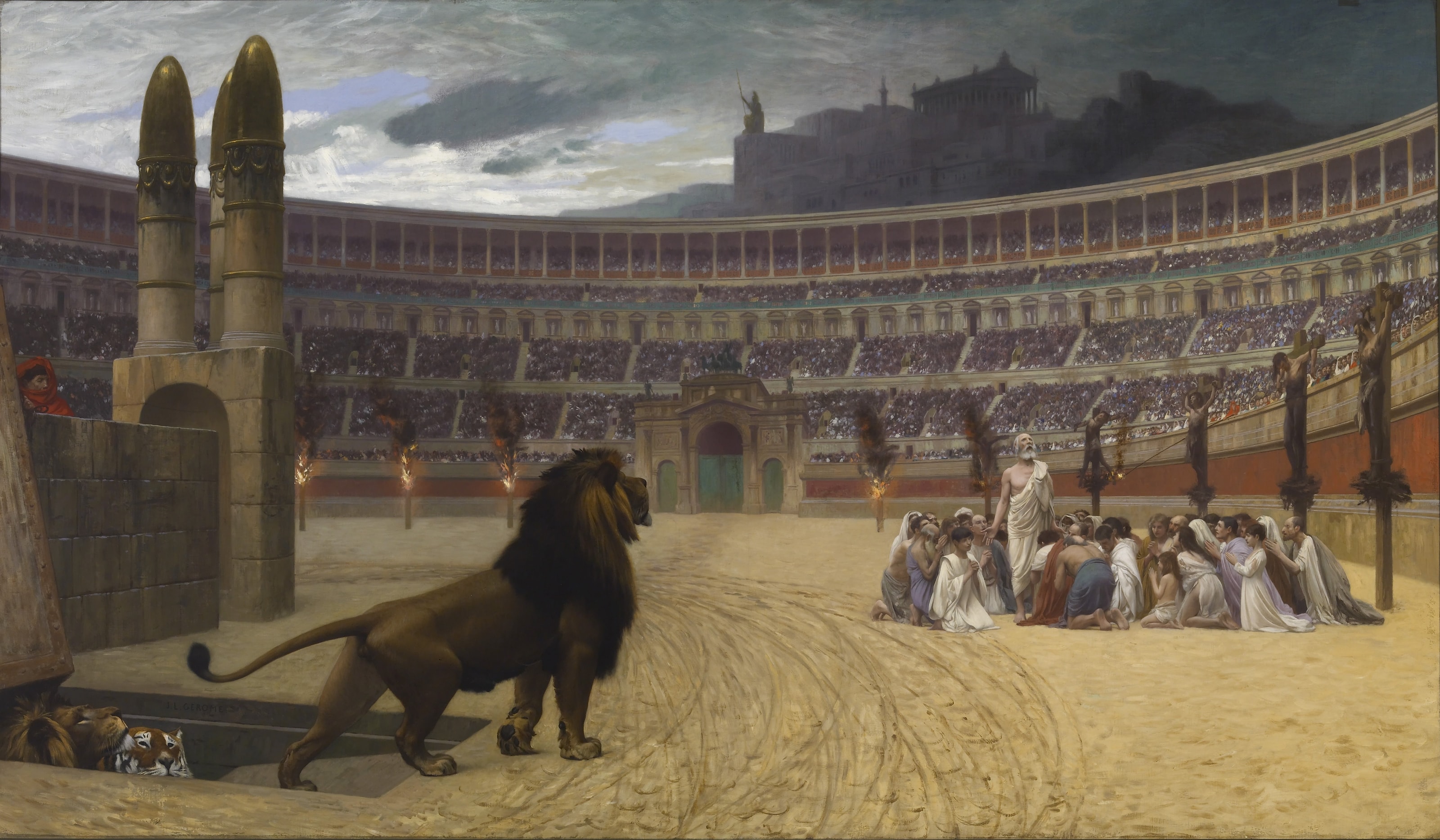
Jean-Léon Gérôme, The Christian Martyrs' Last Prayer (1863-1883), Walters Art Museum, Baltimore. The painting is a nineteenth-century imagining, but the point it dramatizes is historical: for its first three centuries the church was on the receiving end of state power. Image: public domain, via Wikimedia Commons.
See this page's graph and discover linked topics
Cheatsheet
30-second reply. "I agree religion has been used to control people. But you said it was invented for that. Who invented it, and when, and how do you know their motive? Christianity spent three centuries with no state power, being arrested and executed by Rome, and it kept growing. A Roman governor in AD 112 was executing Christians for refusing to worship the emperor's image. If religion is a tool of control, why were the people with all the power using it against Christians instead of Christians using it on anybody?"
Fast facts.
- Pliny the Younger, governor of Bithynia, wrote to the emperor Trajan around AD 112 that he executed Christians who would not recant, and that they met before dawn to sing "to Christ as to a god" (Letters 10.96).
- Christianity was legal across the empire only from the Edict of Milan (313), and became the favored imperial religion only under Theodosius (380).
- Sociologist Rodney Stark estimated in The Rise of Christianity (1996) that the church grew at about 40 percent per decade, from roughly a thousand believers around AD 40 to several million by AD 300, almost entirely by personal networks, not by force.
- The Hebrew prophets and Jesus aim their sharpest words at kings, priests and religious leaders who exploit people (2 Samuel 12:7; Amos 5:21-24; Matthew 23:4; Mark 10:42-45).
Counter-moves.
- "Religion is a tool of control." So is government, education, medicine and the media. Misuse shows the tool can be misused, not what it was made for.
- "Christianity spread by the sword." Not for its first three centuries. Its later entanglement with state power is real, and its own founder condemned it in advance.
- "I'm spiritual, not religious." Then you already believe there is a spiritual reality worth seeking. The question is which account of it is true, not whether institutions are annoying.
Concessions, and what each one collects.
- Grant: religion has been used to control people, including by Christians. Collect: then the objection has proved misuse, not origin, and it now needs separate evidence for the claim that religion was invented for control.
- Grant: after 380 the Roman state enforced Christian orthodoxy and punished dissent. Collect: that is three and a half centuries after the movement began, and it reverses the pattern of the first three. The founding period is the test of what a movement was for.
- Grant: institutions can smother real spiritual experience. Collect: that is exactly what Jesus said about the religious leaders of his day (Matthew 23:13), so the Christian can agree with the complaint and still hold that the faith itself is true.
Closing line. "Religion can be used to control people, just like money, schools and governments. You haven't shown it was invented for that. And the one religion that spent three centuries being controlled, arrested and executed, and grew anyway, is the hardest case your theory has."
In full
The objection makes two claims that are usually run together:
- A functional claim: religion has been used, and is used, to keep populations obedient.
- An origin claim: religion was created for that purpose, so its spiritual content is a cover story.
The first claim is true in many cases and should be granted. The second does not follow from the first. Inferring an institution's origin and purpose from its later misuse is a form of the Genetic Fallacy run backwards: instead of judging a belief by where it came from, it invents a source for the belief from what people later did with it. The origin claim is a historical thesis, and it needs historical evidence: the inventors, the date, and documentation of their motive.
Even if the origin claim were proved for some religion, it would not settle whether any particular religion's claims are true. The truth of "Jesus rose from the dead" does not depend on how bishops behaved in the fifth century, any more than the truth of physics depends on how physicists have behaved.
Christianity also cuts directly against the control thesis. Its founding period, roughly AD 30 to 313, is the clearest test case in history of a faith spreading without state power. And its founding documents attack the very thing the objection describes: rulers and religious leaders who use God's name to burden and exploit ordinary people.
Argument structure
| # | Premise |
|---|---|
| P1 | That an institution has been used for control does not show it was created for control. |
| P2 | Christianity's founding period is a test case of a faith spreading without state power and at real cost to its members. |
| P3 | Christianity's own Scriptures condemn rulers and religious leaders who use God's name to exploit people. |
| P4 | "Spirituality without religion" still has to answer what spiritual reality is, which is a question about truth, not about institutions. |
| C | Therefore the claim that religion, and Christianity in particular, was invented to control people is unsupported, and its strongest evidence (later misuse) is something Christianity itself condemns. |
Form
Defensive. The core move separates function from origin and then tests the origin claim against the best-documented case, early Christianity. P3 adds an internal critique: the objection's complaint is already made, more sharply, inside the Christian Scriptures. The argument does not prove Christianity true. It removes a popular reason for dismissing it without examination.
P1, Used is not invented
Affirmative case (second-order arguments)
- Every powerful human institution has been used for control. Governments, schools, medicine, science, journalism and money have all been used to manipulate populations. In each case we judge the abuse, not the institution's existence. Eugenics programs misused science; nobody concludes science was invented to sterilize people.
- Origin claims need origin evidence. "Religion was invented to control people" is a claim about the past. It needs named inventors, a date and evidence of motive. The broad versions of the claim, such as the Enlightenment charge of "priestcraft" and Karl Marx's description of religion as "the opium of the people," are interpretations offered many centuries after the religions they describe began.
- Religion often binds groups without coercion. Sociologists Richard Sosis and Eric Bressler (2003) studied nineteenth-century American communes and found that religious communes, especially those demanding more of their members, tended to last longer than secular ones. Religion can create cooperation and loyalty among people who join freely, which is the opposite of control from above.
Anticipated objections
- "Kings claimed divine right. That proves religion exists to prop up power."
- "Whoever invented it, religion functions as control today, so the origin doesn't matter."
Rebuttals
- Kings also claimed descent from heroes, rights of conquest and popular consent. Rulers dress their power in whatever their people already believe. That shows rulers exploiting belief, not belief being created by rulers. And Israel's prophets denied that kings stood above God's law (P3).
- Then the argument is about misuse, and misuse has a remedy. If the complaint is that religion can be weaponized, the answer is accountability, which Christianity itself demands. It is no longer an argument that religious claims are false.
Live-cite kit
- Scripture: Mark 12:17, Caesar is owed taxes, not what belongs to God; Acts 5:29, "We must obey God rather than men."
- Scholarly: Sosis and Bressler (2003), religious commitment and the longevity of communes.
- Aphorism: "Used is not invented."
Tactical notes
- Ask for the inventors by name. The objection rarely survives the request.
- Do not deny religious abuse. Granting it costs nothing and makes the distinction land.
P2, Christianity spread with no state power and at real cost
Affirmative case (second-order arguments)
- The state was against it. Around AD 112 Pliny the Younger, Roman governor of Bithynia, wrote to the emperor Trajan asking how to handle Christians. He had executed those who refused to recant, and he tested suspects by asking them to offer incense to the emperor's image and curse Christ. Trajan replied that Christians were not to be hunted down, but those accused and convicted were to be punished (Letters 10.96-97). The control was being exercised on Christians.
- It grew anyway. Rodney Stark, a sociologist, estimated in The Rise of Christianity (1996) a growth rate of about 40 percent per decade, from roughly a thousand believers around AD 40 to several million by AD 300, spreading mainly through families, friendships and care for the sick during epidemics. Christianity became legal only with the Edict of Milan in 313 and the favored religion of the state only in 380.
- Joining cost something. Converts could lose property, standing and family ties, and in periods of persecution their lives. Hebrews describes believers who "were stoned, they were sawn asunder" (Hebrews 11:37, ASV), and the early church honored its martyrs precisely because the cost was real. People do not usually join a control scheme by volunteering to be controlled to death.
- The Jewish faith before it survived the same way. The worship of Yahweh outlived the destruction of the kingdoms of Israel (722 BC) and Judah (586 BC), the Babylonian exile and centuries of foreign rule. A faith that survives the loss of its state, its king and its temple is not held together by state control.
Anticipated objections
- "How does a god from the southern Levant end up worshiped across the world without someone controlling people?"
- "After Constantine, Christianity did spread by force."
Rebuttals
- By the ordinary means every widespread belief uses, before any state backed it. Jewish communities carried their faith through exile and diaspora across the Mediterranean; Christianity then spread through those synagogue networks and through households, for three centuries, against state power. Later political sponsorship is real, but the movement was already large before it had any. Languages spread by trade and migration as well as by conquest; that some people were forced does not mean everyone was. See Yahweh Borrowed From the Canaanites Objection Defeater for the separate question of Yahweh's origins.
- Granted for parts of later history, and condemned by Christianity's founder. Forced conversions and enforced orthodoxy happened. They came long after the founding, they reversed the founding pattern, and they violate the teaching recorded in Mark 10:42-45. That is a charge against Christians who disobeyed Christ, not evidence of why the faith began. See Religion Causes Violence Objection Defeater.
Live-cite kit
- Scripture: Acts 4:19-20, the apostles refusing the authorities' order to stop preaching; Hebrews 11:36-38.
- Scholarly: Pliny, Letters 10.96-97; Rodney Stark, The Rise of Christianity (1996).
- Aphorism: "The people with all the power were using it against the Christians."
Tactical notes
- Lead with Pliny. A hostile Roman official, writing to an emperor, is the strongest witness available.
- Treat Stark's numbers as an estimate and say so. The point does not depend on the exact rate.
P3, Christianity's own Scriptures condemn religious exploitation
Affirmative case (second-order arguments)
- The prophets confront kings. Nathan tells King David to his face, "Thou art the man" (2 Samuel 12:7, ASV). Elijah condemns King Ahab for killing Naboth to take his vineyard (1 Kings 21:19). Jeremiah pronounces woe on the king "that buildeth his house by unrighteousness ... that useth his neighbor's service without wages" (Jeremiah 22:13, ASV). A religion designed to prop up rulers would not preserve these texts as Scripture.
- The prophets confront religion itself. Through Amos, God says of Israel's own worship, "I hate, I despise your feasts" and demands instead, "let justice roll down as waters, and righteousness as a mighty stream" (Amos 5:21, 24, ASV). Micah condemns priests who "teach for hire" and prophets who "divine for money" while claiming God is with them (Micah 3:11, ASV).
- Jesus confronts religious leaders and redefines power. He condemns the scribes and Pharisees who "bind heavy burdens and grievous to be borne, and lay them on men's shoulders" (Matthew 23:4, ASV). And he tells his disciples that the rulers of the nations "lord it over them," but "it is not so among you: but whosoever would become great among you, shall be your minister" (Mark 10:42-43, ASV).
- Augustine named the problem. In The City of God Augustine contrasted the earthly city, driven by the lust for domination, with the city of God, ordered by love of God. Professing Christianity does not make a ruler part of the second.
Anticipated objections
- "Those texts are just how the priests kept the kings in line. It's still control, just a different group."
- "Churches ignored those texts for centuries."
Rebuttals
- The same texts condemn priests. Amos rejects the temple's worship, Micah condemns its priests, Jeremiah was beaten and imprisoned by temple officials, and Jesus was handed over by the high priests. A priestly control text does not attack priests this consistently.
- Then the texts stand in judgment over the churches, which is the point. A standard that condemns its own followers' abuses is the opposite of a tool designed to excuse them. The reformers who resisted church corruption appealed to these same Scriptures.
Live-cite kit
- Scripture: 2 Samuel 12:7; Amos 5:21-24; Matthew 23:4; Mark 10:42-45.
- Patristic: Augustine, The City of God, the two cities.
- Aphorism: "The Bible got to your objection first, and aimed it at the priests."
Tactical notes
- Read Mark 10:42-43 aloud. It describes the objection's picture of religion and forbids it.
P4, "Spiritual but not religious" still needs a ground
Affirmative case (second-order arguments)
- The softer objection concedes the main point. "Religion hijacked spirituality" assumes there was a real spirituality to hijack. That is already a claim that the spiritual is real and worth seeking.
- The question then becomes which account is true. If there is a spiritual reality, it has some character. It is either personal or impersonal, good or indifferent, knowable or not. Those are questions of truth, and they cannot be answered by disliking institutions.
- Christianity itself tests spiritual claims. "Believe not every spirit, but prove the spirits, whether they are of God" (1 John 4:1, ASV); "prove all things; hold fast that which is good" (1 Thessalonians 5:21, ASV). It invites scrutiny of experience rather than demanding blind submission.
Anticipated objections
- "I don't need any account. I just experience what I experience."
Rebuttals
- Then you have no way to tell a true experience from a false one. Experiences can be mistaken, induced or manipulated. Without some account of what is real, "spiritual" becomes a word for whatever feels meaningful, which is far easier to exploit than a faith with public texts and testable claims. See Religious Experience Is Just Brain Chemistry Objection Defeater.
Live-cite kit
- Scripture: 1 John 4:1; 1 Thessalonians 5:21.
- Aphorism: "If religion hijacked spirituality, there was something real to hijack."
Tactical notes
- Ask: "What do you think the spiritual reality is?" The conversation then moves to the claims of Jesus, where it belongs.
Conclusion
Religion has been used to control people, and Christianity has not been exempt. But "used" is not "invented." The origin claim has no named inventors and no evidence of motive. Christianity's founding centuries show a faith growing under state persecution, at real cost, with no coercive power of its own. Its Scriptures condemn the very abuses the objection describes, aimed first at kings and priests. And the softer "spiritual but not religious" version already concedes a spiritual reality, which turns the question to what that reality is.
Master objections to the whole argument
- "You're just doing a No True Scotsman: the abusers weren't real Christians." No. The argument grants that real Christians abused power. Its claim is that they broke Christianity's own standard, which is a judgment the standard makes possible. See No True Scotsman Charge Defeater.
- "The growth figures are speculative." They are estimates, and the argument does not depend on them. Pliny's letter, the Edict of Milan and the Edict of Thessalonica are not estimates.
- "Even if Christianity started innocently, it became a control system." Parts of its later history did, and the history should be faced. That is a claim about what some Christians did, not evidence about whether Christ rose. See Theocracy and Salem Witch Trials Objection Defeater.
Tactical opening / closing
Opening: "I agree religion has been used to control people. Can we separate that from the claim that it was invented for control? Because those need different evidence."
Closing: "You've shown religion can be misused, which Jesus said first. You haven't shown who invented it to control people, and the first Christians were the ones being controlled. So the real question is still whether what they died saying was true."
Connection to Scripture
- 2 Samuel 12:7, Nathan confronts King David
- 1 Kings 21:19, Elijah condemns Ahab over Naboth's vineyard
- Jeremiah 22:13, woe to the king who builds by injustice
- Amos 5:21-24, God rejects worship without justice
- Matthew 23:4, heavy burdens on men's shoulders
- Mark 10:42-45, not so among you
- Acts 4:19-20 and Acts 5:29, obeying God rather than the authorities
- 1 John 4:1, test the spirits
Patristic / scholarly note
Classical / patristic:
- Augustine (The City of God), the earthly city's lust for domination against the city of God
Modern:
- Rodney Stark (The Rise of Christianity, 1996), growth of the early church through networks rather than force
- Richard Sosis and Eric Bressler (2003), religious communes and their longevity
Primary sources:
- Pliny the Younger (Letters 10.96) and Trajan (Letters 10.97), Roman policy toward Christians around AD 112
Scholarship
Published academic works this page draws on, each matched to a publisher, index or library catalog record.
- Richard Sosis and Eric R. Bressler, "Cooperation and Commune Longevity: A Test of the Costly Signaling Theory of Religion," Cross-Cultural Research 37 (2003). doi:10.1177/1069397103037002003
- Rodney Stark, The Rise of Christianity: A Sociologist Reconsiders History (Princeton University Press, 1996). doi:10.1515/9780691214290
See also
- Christianity Is Brainwashing Objection Defeater, the related charge that belief is installed rather than chosen
- Religion Is a Crutch Objection Defeater, the psychological version of the same dismissal
- Religion Causes Violence Objection Defeater, the companion charge about religious violence
- Theocracy, the history of religion and state power, faced honestly
- Salem Witch Trials Objection Defeater, the most cited case of religious authority abused
- Religious Experience Is Just Brain Chemistry Objection Defeater, the "it's all in the brain" version of the dismissal
- Edict of Milan, the legalization of Christianity in 313
- Karl Marx, religion as "the opium of the people"
- Arguments, master index
Common questions this page answers
Q: Was religion invented to control people?
Religion has often been used to control people, but that does not show it was invented for that purpose. An origin claim needs evidence of who invented it, when and why, and the popular versions of this claim do not supply it. Christianity, in particular, spent its first three centuries with no state power and was itself persecuted by Rome.
Q: Didn't Christianity spread by force?
Not at first. From about AD 30 to 313 Christianity was an illegal or barely tolerated minority, and a Roman governor around AD 112 was executing Christians who would not recant. It became legal in 313 and the favored state religion in 380. Later forced conversions happened, but they came centuries after the founding and contradict Jesus' teaching in Mark 10:42-45.
Q: Did religion hijack spirituality?
Institutions can smother real spiritual life, and Jesus said as much about the religious leaders of his day (Matthew 23:13). But the claim assumes there is a real spirituality to hijack, which raises the question of what that spiritual reality is. That is a question about truth, which Christianity answers with public, testable claims about Jesus.
Q: How did the God of a small Levantine people come to be worshiped worldwide?
By the ordinary means beliefs spread: families, exile and diaspora communities, trade networks and personal conversion. Jewish faith survived the loss of its kingdoms and temple, and Christianity spread for three centuries against state power before any emperor supported it. Political sponsorship came later and does not explain the earlier growth.