Argument
Reality Is Only What We See Objection Defeater
Reality Is Only What We Can See Objection, Only What We Can See Is Real, If I cannot see it it does not exist, If you can't see it, it isn't real, Seeing is believing objection, I only believe what I can see, Reality is only what we see, Is reality only what we can see, Only visible things are real, Show me and I will believeIntro
Some people say it plainly: "Reality is only what we can see. If I can't see it, it isn't real, and I can't see God."
It sounds like common sense. It falls apart quickly.
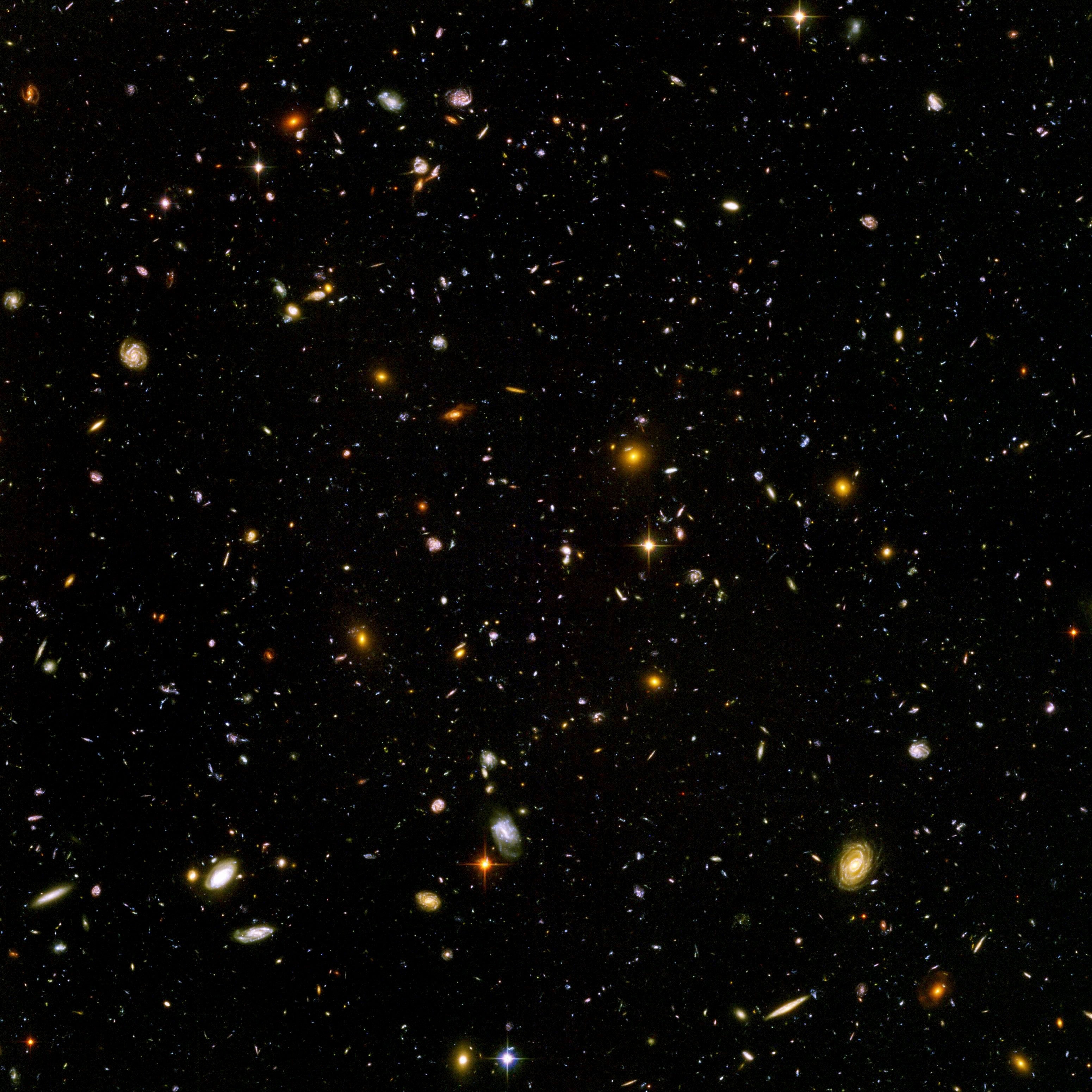
The Hubble Ultra Deep Field (2004). Almost every point of light here is a galaxy, about 10,000 of them in a patch of sky smaller than a tenth of the full Moon's width, and none of them can be seen by the naked eye. Image: NASA, ESA, S. Beckwith (STScI) and the HUDF Team, public domain, via Wikimedia Commons.
First, the claim fails its own test. Nobody has ever seen the sentence "only what we see is real" being true. It is an idea about reality, and ideas are not visible. If only visible things are real, this rule is not real either.
Second, plenty of real things are invisible. Gravity. Magnetic fields. Radio waves. Your own thoughts. Another person's feelings. The number seven. The rule that a statement and its opposite cannot both be true. We know all of these through their effects or through reasoning, and the person making the objection relies on several of them to make it.
Third, how we know something is a separate question from whether it exists. Galaxies existed long before anyone had a telescope. Ultraviolet light was shining on the earth long before anyone measured it in 1801. Our eyes catch only a thin slice of the light in the universe, roughly the band from 380 to 750 nanometers. Everything outside that slice is real and invisible to us.
Fourth, philosophers already tried this idea, and it failed. In the twentieth century a movement called logical positivism said that only statements you could check by observation had any meaning. Its most famous English champion, A. J. Ayer, later looked back and said that "nearly all of it was false."
Fifth, an honest limit. Showing that unseen things exist clears the road and stops there. The case for God then rests on other arguments, such as the beginning of the universe, the order of nature, the reality of moral truth, and the resurrection of Jesus.
Quick reply: "Can you see the rule 'only what we can see is real'? If not, your rule says to throw it away."
See this page's graph and discover linked topics
Cheatsheet
The 30-second reply:
"Only what we see is real" is a philosophical claim, and no one has ever seen it. By its own standard it should be discarded. Meanwhile we all believe in things we cannot see: gravity, fields, other people's minds, numbers and the laws of logic. We know them by their effects or by reason. What exists and how we find out about it are two different questions. Galaxies did not wait for telescopes to start existing. The philosophers who turned this idea into a formal rule, the logical positivists, could never state it in a way that worked, and A. J. Ayer later said nearly all of it was false. All of this clears away a bad filter, and the case for God still has to be made from the evidence itself.
The 5 fast facts:
- Self-reference. The claim is not an observation. It is a rule about observations, and the rule cannot pass its own test. See Self-refutation.
- The visible band is narrow. The human eye responds to roughly 380 to 750 nanometers. Infrared (William Herschel, 1800) and ultraviolet (Johann Wilhelm Ritter, 1801) were found just outside it, and radio, X-rays and gamma rays lie far beyond.
- Science runs on the unseen. Fields, forces, electrons and dark matter are inferred from their effects. Fritz Zwicky inferred unseen mass in the Coma galaxy cluster in 1933 from how fast its galaxies were moving.
- The verification principle collapsed. Ayer (Language, Truth and Logic, 1936) made it famous. Carl Hempel (1950) traced how each version was either too strict or too loose. Ayer later said of the movement, "nearly all of it was false" (Magee, Men of Ideas, 1978, p. 130).
- Other minds. Nobody sees another person's thoughts. Alvin Plantinga argued that belief in God and belief in other minds stand or fall together on their evidence (God and Other Minds, 1967).
The 3 strongest counter-moves:
- "Can you see the truth of the rule you just stated?"
- "Did galaxies exist before telescopes, and did ultraviolet light exist before 1801?"
- "Are you telling me what exists, or how you find out what exists?"
Concessions to make freely:
- Yes, observation is a powerful way to know things, and Christians should honor it. Now collect: a powerful way of knowing is still one way among several, and the objector already uses the others (logic, memory, testimony, inference).
- Yes, many claims about invisible things are false: ghosts in the attic, auras, conspiracy theories. Now collect: that shows invisible claims need evidence, which is the standard the theist accepts, and it leaves the existence of invisible things an open question.
- Yes, showing that invisible things exist does not prove God. Now collect: it removes the only reason the objection gave for refusing to look at the evidence.
What NOT to defend:
- Do not argue that God is "just like gravity" or "just like a field." God is not a physical force inside the universe. The analogy is about how things are known, from effects, and should stop there.
- Do not claim the objector "really believes in God." Make the narrower point: his own rule excludes things he plainly believes in.
- Do not oversell the verificationist history. A few philosophers still defend weaker empiricist criteria. The strict principle is what failed.
The closing line: "If reality is only what you can see, then close your eyes and explain where the universe went."
In full
Defeater for the ontological restriction "reality consists only of what can be seen" and its more careful cousins: "only what can be empirically observed exists" and "only empirically verifiable statements are meaningful." The first is naive empiricism stated as ontology; the second is the verification principle of logical positivism.
The objection fails on five counts. (1) Self-referential incoherence. The restriction is a universal, general claim about what exists; it is neither itself an object of sight nor derivable from any finite set of observations. If it is true, it excludes itself. (2) Counterexamples. The objector's own working ontology includes fields, forces, unobservable particles, other minds, his own mental states, numbers and logical laws. Each is known by inference from effects, by introspection or by rational insight. A criterion that excludes them is refuted by the beliefs of the person proposing it. (3) Category confusion. The objection runs together ontology, the question of what exists, and epistemology, the question of how existence is known. The limits of a detector set the limits of what that detector reports, and reality is under no obligation to match them. The history of astronomy and the discovery of infrared and ultraviolet radiation show reality outrunning human perception again and again. (4) Historical failure. The most rigorous attempt to turn the intuition into a principle, the verificationism of the Vienna Circle and of A. J. Ayer, could not be formulated without admitting too much or excluding too much, as Carl Hempel documented in 1950, and Ayer himself later judged that nearly all of the program was false. (5) Scope. Defeating the restriction establishes only that the existence of unseen realities, God included, is an open question to be settled by argument. The Christian then owes the argument, and has one: see Kalam Cosmological Argument, Contingency Argument, Argument from Consciousness and No Empirical Evidence for God Objection Defeater.
Groundwork, four distinctions that settle most of the dispute
- Ontology and epistemology. Ontology asks what exists. Epistemology asks how we know what exists. "I cannot see X" is an epistemological report. "X does not exist" is an ontological claim. Moving from the first to the second needs a bridge premise, and that bridge premise is the very thing in dispute.
- Seeing and detecting. Sight is one sense among five, and the senses are one route to knowledge among several. Instruments extend the senses, and inference extends instruments. A person who says "I meant detectable" has already moved off the original claim. See the master objections below.
- Effects and causes. Most of what science knows, it knows as the cause of observed effects. That is how gravity, magnetic fields and dark matter entered physics. The same pattern of reasoning, from effect to cause, is the shape of the classical arguments for God (Aquinas, Summa Theologiae I, q. 2, a. 2).
- Physical and real. "Invisible" and "non-physical" are different properties. Radio waves are invisible and physical. Numbers and logical laws are invisible and, on most accounts, non-physical. The objector's restriction has to deal with both groups.
Argument structure
| Premise | Notes | |
|---|---|---|
| P1 | The restriction fails its own test. "Only what is seen is real" is not itself seen, so on its own terms it is not real. | Self-reference |
| P2 | Real things exist that cannot be seen. Fields, forces, other minds, thoughts, numbers and logical laws are real and invisible. | Counterexamples |
| P3 | Knowing and being are distinct. The limits of human perception set the limits of human seeing, and leave the limits of reality untouched. | Ontology and epistemology |
| P4 | Reality has repeatedly outrun the eye. Galaxies, infrared and ultraviolet light, and microbes all existed before they were detected. | Historical and physical cases |
| P5 | The formal version failed. The verification principle could not be stated coherently, and its leading advocate abandoned it. | Logical positivism |
| C | Reality is not limited to what we can see, so "I cannot see God" gives no reason to conclude that God does not exist. Whether God exists must be settled by evidence and argument. | Hand-off to the positive case |
Form
Defensive, with two deductive cores. P1 is a self-referential reductio; P2 is a modus tollens from counterexamples. P3 to P5 explain why the restriction is attractive and why it fails, and the conclusion is deliberately modest: it reopens the question rather than answering it.
Syllogism 1, self-reference
- If only what is seen is real, then any claim that is not seen is not real.
- The claim "only what is seen is real" is not seen.
- Therefore, if only what is seen is real, the claim "only what is seen is real" is not real (that is, not true).
- A claim that implies its own falsehood cannot be true.
- Therefore, the claim "only what is seen is real" is false.
Syllogism 2, counterexample
- If reality consists only of what can be seen, then nothing invisible is real.
- Some invisible things are real (for example, magnetic fields, other people's thoughts, and the law of non-contradiction).
- Therefore, reality does not consist only of what can be seen.
Both arguments are valid. Syllogism 1 depends on reading "real" as applying to truths as well as objects, which is how the objector uses it ("God isn't real"). Syllogism 2 depends only on premise 2, and premise 2 is something the objector believes.
P1, The restriction fails its own test
Affirmative case (second-order arguments)
- The rule is general, and sight is particular. Every act of seeing is of a particular thing at a particular time. "Only what is seen is real" is about everything at every time. No number of particular sightings adds up to a claim about all of reality, so the rule could not have been learned by seeing.
- The rule is invisible in principle. It has no color, shape or location. It is a proposition, and propositions are grasped by understanding. The objector's own act of believing it is a mental act no one else can see.
- The same structure sank the verification principle. The principle "a statement is meaningful only if it is empirically verifiable" is itself not empirically verifiable. This is the standard objection in the literature, and it is why the principle was usually recast as a proposal or definition. See Self-refutation.
Anticipated objections
- "It's a rule of thumb, not a claim about everything."
- "Self-refutation arguments are word games."
Rebuttals
- Then it cannot carry the conclusion. A rule of thumb ("most real things I deal with are visible") cannot deliver "God is not real." Only the universal version reaches that conclusion, and the universal version refutes itself. Failure mode: motte and bailey.
- Self-refutation is a test any serious claim must pass. "I cannot speak a word of English," said in English, is false for a non-verbal reason: the act refutes the content. The same is true here. Logic is the tool the objector uses to reach his conclusion; he cannot set it aside when it turns on him. See Laws of Logic.
P2, Real things exist that cannot be seen
Affirmative case (second-order arguments)
- Physical but invisible. Gravity, magnetic and electric fields, radio waves, air, and the wind are known by what they do. Jesus used exactly this example: "The wind bloweth where it will, and thou hearest the voice thereof, but knowest not whence it cometh, and whither it goeth" (John 3:8, ASV).
- Mental and invisible to others. No one has ever seen another person's pain, intention or belief. We infer them from behavior and speech. Plantinga built his early case for theism on the parallel: the evidence for other minds and the evidence for God share the same structure (God and Other Minds, 1967). See Argument from Consciousness.
- Abstract and invisible to everyone. The number seven, the truth that 2 + 2 = 4, and the law of non-contradiction have no location and reflect no light. Science cannot function without them, and the objector uses them in the act of objecting. See Laws of Logic and Argument from Mathematical Truth.
- Moral and invisible. The wrongness of torturing a child for fun is not an object in the visual field. Most objectors treat it as real all the same. See Moral Argument.
Anticipated objections
- "Gravity is visible in its effects, so it counts as seen."
- "Thoughts are just brain states, and brain states can be scanned."
Rebuttals
- Then "seen" now means "known by its effects," and God qualifies for consideration. Once the objector allows things known through their effects, he has adopted the reasoning pattern of the classical arguments for God, which argue from the existence, order and moral shape of the world to its cause (Romans 1:20). The question becomes whether the effects point to God, which is the right question. Failure mode: equivocation on "see."
- A scan shows the brain, and the thought remains unseen. A scan shows blood flow and electrical activity; it does not show what the thought is about, or what it is like to have it. The identity of mind and brain is a disputed philosophical thesis, and even if it were true, the scan would not show the content of the thought. See Argument from Consciousness and Argument from Reason.
P3, Knowing and being are distinct
Affirmative case (second-order arguments)
- Detectors have limits; reality does not inherit them. A metal detector does not find plastic. No one concludes plastic does not exist. Human eyes are detectors with a range, and the range describes eyes.
- The objection reverses the order of explanation. Things exist first and are detected second, so reality sets what can be observed.
- Mature empiricism already concedes this. Careful empiricists distinguish between what we can know and what there is. The objection, in its popular form, collapses that distinction.
Anticipated objections
- "But I'm only entitled to believe in what I can observe."
- "Unobservable things are idle. Why posit them?"
Rebuttals
- That is a different claim, and it still fails. "I am entitled to believe only what I observe" rules out memory, testimony, inference and logic, and so rules out nearly everything the objector believes, including history and most of science. It is also not observed. It moves the problem from ontology to epistemology without solving it. See Burden of Proof.
- Unobservables earn their place by explaining what we do observe. Electrons, fields and dark matter are posited because they explain observations. The theist argues God is posited for the same reason. The fair test is explanatory power. See Epistemology.
P4, Reality has repeatedly outrun the eye
Affirmative case (second-order arguments)
- The narrow window. The eye responds to roughly 380 to 750 nanometers of the electromagnetic spectrum. In 1800 William Herschel placed a thermometer beyond the red end of a prism's spectrum and found heating from light no one could see, infrared. In 1801 Johann Wilhelm Ritter found that silver chloride darkened beyond the violet end, ultraviolet. Radio waves, microwaves, X-rays and gamma rays lie farther out still.
- Galaxies before telescopes. Before telescopes, almost every galaxy was invisible to everyone who ever lived; only a few appeared as faint smudges. Edwin Hubble's 1925 measurements of variable stars in the Andromeda nebula showed it lay far outside the Milky Way. The Hubble Ultra Deep Field (2004) records about 10,000 galaxies in a patch of sky a tenth of the Moon's width. They existed before they were seen.
- The microscopic world. Bacteria caused disease for all of human history before anyone saw one. Their existence did not depend on Antonie van Leeuwenhoek's lenses.
- Dark matter. Fritz Zwicky's 1933 study of the Coma cluster concluded that its galaxies moved too fast to be held together by visible matter alone. Physicists still accept unseen mass on the strength of its gravitational effects.
Anticipated objections
- "Those things were always detectable in principle. God isn't."
- "These are physical things. You're smuggling in the supernatural."
Rebuttals
- That is a new objection, and it is answered below (master objection 3). The original claim was about seeing, and it has now been given up.
- The cases establish a principle about knowledge. They show that existence does not depend on human detection. Whether non-physical realities exist is a further question, answered by P2 (minds, numbers, logic) and by the positive arguments for God.
P5, The formal version failed
Affirmative case (second-order arguments)
- What the principle said. In Language, Truth and Logic (1936), A. J. Ayer argued that a statement is literally meaningful only if it is either true by definition or empirically verifiable. Statements about God, ethics and metaphysics were classed as neither true nor false, simply meaningless.
- No working formulation. Every attempt to state the principle precisely either excluded scientific laws (which no finite observation fully verifies) or admitted nonsense. Carl Hempel's survey, "Problems and Changes in the Empiricist Criterion of Meaning" (1950), traced these successive failures. W. V. O. Quine's "Two Dogmas of Empiricism" (1951) undermined the reductionism the program depended on.
- Ayer's own verdict. Asked by Bryan Magee in the BBC series Men of Ideas (1978) what the main defects of logical positivism were, Ayer answered: "Well, I suppose the most important of the defects was that nearly all of it was false." He added that "the verification principle never got itself properly formulated. I tried several times, but always let in either too little or too much" (Magee, Men of Ideas, pp. 130-131).
- The return of the excluded questions. In the decades that followed, philosophy of religion revived as a technical field in analytic philosophy, with Plantinga's 1967 book an early landmark.
Anticipated objections
- "Ayer still kept the general empiricist attitude."
- "I'm not a logical positivist, so this history is irrelevant."
Rebuttals
- Granted, and the attitude is compatible with theism. In the same conversation Ayer said he still thought the movement was right in spirit, in asking how a claim could be tested. The theist accepts the question and offers evidence. What did not survive was the principle that rules theistic claims out in advance.
- The history shows where the popular version leads. The objection is the popular form of verificationism. Its most rigorous defenders tried to make it work and could not. That is strong evidence that the popular form will not do better.
Conclusion
Reality is not limited to what we can see. The restriction refutes itself, conflicts with the objector's own beliefs about physics, minds and logic, confuses the question of what exists with the question of how we know it, and failed in its most rigorous historical form. The defeater stops here on purpose: it establishes that "I cannot see God" is no reason to deny Him, and leaves the evidence to be weighed on its merits. Christians claim God is spirit (John 4:24) and "invisible" (1 Timothy 1:17, ASV), and point to His effects in creation, conscience and history.
Master objections to the defeater as a whole
These are the strongest replies, stated as their best defenders would put them.
- "I meant what can be empirically detected, by any instrument, not just my eyes." This is the serious version of the objection.
- "Invisible things like fields and forces are still physical. So the real rule is: only physical things are real."
- "God is undetectable in principle. Fields and galaxies were detectable eventually. A being that can never show up in any measurement is indistinguishable from nothing."
- "Burden of proof: you claim the invisible being exists, so you have to show it."
Rebuttals
- Detection is wider than sight, and still too narrow. "Empirically detectable" admits instruments, so the original claim is withdrawn. The new claim still faces P1 (the rule "only the detectable exists" is not detectable) and P2 (numbers, logical laws and the contents of other minds are not detected by instruments). It also runs detection together with inference: dark matter is known by inference from its gravitational effects. Inference from effects is the very route the theist takes. See No Empirical Evidence for God Objection Defeater.
- Physicalism is a separate thesis, and it needs its own case. Moving from "visible" to "physical" concedes the original point. Physicalism then has to account for logic, mathematics, consciousness and moral truth, which is the central contested question in philosophy of mind and metaphysics, and it cannot be assumed. See Materialism, Naturalism, Argument from Consciousness and Reality Is Just Motion Objection Defeater.
- God is known through effects, as many unseen causes are. Christians claim that God is the cause of the universe's existence, order and moral structure, and that He acted in history. The relevant evidence is the effects: "the invisible things of him since the creation of the world are clearly seen, being perceived through the things that are made" (Romans 1:20, ASV). If the effects are real and God is their best explanation, God is distinguishable from nothing in the way that matters. See Kalam Cosmological Argument, Contingency Argument and Divine Hiddenness.
- Agreed, and the burden is shared. The theist who claims God exists should give reasons. The objector who claims reality is only what we see must also give reasons, and his claim is the one that refutes itself. See Burden of Proof.
Cross-examination sequence
Use these in order. Each answer sets up the next question.
- "When you say reality is only what we can see, is that a claim about what exists, or about what you are willing to believe?"
- "Have you ever seen that claim? Where is it, and what color is it?"
- "Do you believe in gravity? Magnetic fields? Radio waves? How did you see them?"
- "Do you believe I have thoughts right now? Can you see them?"
- "Is it true that a statement and its opposite cannot both be true? What does that law look like?"
- "Did galaxies exist before telescopes were invented? Did ultraviolet light exist before 1801?"
- "If yes, then something can exist before anyone sees it. So 'I can't see God' tells us about your eyes. What would count as evidence for an unseen cause?"
- "If the answer is 'effects that need a cause,' are you willing to look at the beginning of the universe and the order of nature with me?"
Live-cite kit
Scripture (ASV):
- "By faith we understand that the worlds have been framed by the word of God, so that what is seen hath not been made out of things which appear." (Hebrews 11:3, ASV)
- "while we look not at the things which are seen, but at the things which are not seen: for the things which are seen are temporal; but the things which are not seen are eternal." (2 Corinthians 4:18, ASV)
- "for in him were all things created, in the heavens and upon the earth, things visible and things invisible, whether thrones or dominions or principalities or powers; all things have been created through him, and unto him;" (Colossians 1:16, ASV)
- "For the invisible things of him since the creation of the world are clearly seen, being perceived through the things that are made, even his everlasting power and divinity; that they may be without excuse:" (Romans 1:20, ASV)
- "The wind bloweth where it will, and thou hearest the voice thereof, but knowest not whence it cometh, and whither it goeth: so is every one that is born of the Spirit." (John 3:8, ASV)
Scholarly:
- A. J. Ayer, Language, Truth and Logic (Gollancz, 1936; 2nd ed. 1946): the classic statement of the verification principle.
- Bryan Magee, Men of Ideas (BBC, 1978), pp. 130-131: Ayer's verdict that "nearly all of it was false."
- Carl Hempel, "Problems and Changes in the Empiricist Criterion of Meaning," Revue Internationale de Philosophie (1950): the successive failures of the criterion.
- W. V. O. Quine, "Two Dogmas of Empiricism," Philosophical Review (1951): against the reductionism verificationism relied on.
- Alvin Plantinga, God and Other Minds (Cornell, 1967): belief in God and belief in other minds compared.
- Thomas Aquinas, Summa Theologiae I, q. 2, a. 2: God's existence can be demonstrated from His effects.
Aphorism:
- "If reality is only what you can see, then close your eyes and explain where the universe went."
- "Partner, just because you can't see the rattlesnake in the grass don't mean he ain't there."
- "Just because you can't see the wind don't mean it ain't blowing."
Tactical notes
- Deployment order. Lead with the self-reference question (P1). If the objector shifts to "detectable," go straight to master objection 1. If he shifts to "physical," go to master objection 2. Keep the history of logical positivism (P5) in reserve for a listener who thinks the objection is scientific.
- Use the room. Ask the audience how many believe their friends have thoughts. Every hand is a counterexample.
- Force the commit. "Are you saying God doesn't exist, or that you haven't seen enough evidence yet?" The first is the self-refuting claim. The second is an invitation to look at evidence.
- What NOT to defend. Do not claim God is a physical force, and do not claim the defeater proves God. Hand off to Kalam Cosmological Argument, Contingency Argument, Argument from Consciousness or the resurrection.
- Tone. The objection is often a reaction to unsupported religious claims. Agree that claims need evidence, then show what the evidence is.
Tactical opening / closing
Opening line: "I'm happy to talk about evidence. First, let's check the rule you're using to judge it, because if the rule can't pass its own test, we need a better one."
Closing landing strip: "We've agreed that gravity, your thoughts, the laws of logic and ten thousand galaxies in a speck of sky are all real and all invisible to your eyes. So not seeing God settles nothing. The question is whether the things we can see, a universe that began, a world ordered for life, a moral law and an empty tomb, point to Someone we can't. That's the conversation worth having."
Connection to Scripture
- Hebrews 11:3: the visible world was framed by the word of God and did not come from things that appear.
- 2 Corinthians 4:18: the things that are not seen are eternal.
- Colossians 1:16: Christ created all things, "visible and things invisible."
- Romans 1:20: God's invisible attributes are perceived through the things that are made, which is reasoning from effect to cause.
- John 3:8: the wind is heard and not seen, and the Spirit works the same way.
- John 4:24 and 1 Timothy 1:17: God is spirit, the King "eternal, immortal, invisible" (ASV).
- John 20:29 and 2 Corinthians 5:7: blessed are those who believe without seeing, and "we walk by faith, not by sight" (ASV). Faith in this sense is trust grounded in evidence and testimony, the same way we trust that other minds exist.
Patristic / scholarly note
Classical:
- Thomas Aquinas (Summa Theologiae I, q. 2, a. 2) distinguishes demonstration from cause to effect and from effect to cause, and holds that God's existence, though not self-evident to us, can be demonstrated from His effects. This is the classical form of the reasoning the objection rules out in advance.
Modern:
- A. J. Ayer (Language, Truth and Logic, 1936) gave the verification principle its most influential English statement, and later judged nearly all of logical positivism false (Magee, Men of Ideas, 1978).
- Carl Hempel (1950) and W. V. O. Quine (1951) are the standard references for the collapse of the empiricist criterion of meaning.
- Alvin Plantinga (God and Other Minds, 1967) argued that belief in God is as rational as belief in other minds, which no one observes directly.
Scholarship
Published academic works this page draws on, each matched to a publisher, index or library catalog record.
- A. J. Ayer, Language, truth and logic (1936). Open Library
- Bryan Magee, Men of ideas (1978). Open Library
- Alvin Plantinga, God and other minds (1967). Open Library
See also
- No Empirical Evidence for God Objection Defeater, the companion reply to "there is no physical evidence for God"
- Reality Is Just Motion Objection Defeater, the companion reply to process-only views of reality
- Self-refutation, the logical tool at the center of P1
- Empiricism, the theory of knowledge the objection overstates
- Scientism, the view that science is the only route to knowledge
- Laws of Logic, real, universal and invisible
- Argument from Consciousness, minds as unseen realities that need explaining
- Argument from Mathematical Truth, numbers and necessary truths
- God Has No Image Objection Defeater, the related charge that an unseen God cannot be pictured
- Divine Hiddenness, why God is not seen the way objects are
- Burden of Proof, who has to show what
- Kalam Cosmological Argument, one place the positive case begins
Common questions this page answers
Q: Is reality only what we can see?
No. Many real things are invisible: gravity, magnetic fields, radio waves, other people's thoughts, numbers and the laws of logic. The claim "only what we can see is real" cannot be seen either, so it fails its own test.
Q: If you can't see God, how can you know He exists?
The same way we know about many unseen causes: through their effects. Christians argue from the beginning of the universe, its order, the reality of moral truth and the resurrection of Jesus to God as their best explanation. Romans 1:20 describes God's invisible attributes as perceived through the things that are made.
Q: Is "only what can be observed is real" self-refuting?
Yes. It is a general claim about all of reality, and no observation can show it is true. If it were true, it would rule out itself. The same problem undermined the verification principle of logical positivism.
Q: What happened to logical positivism and the verification principle?
Its defenders could never state the principle in a form that kept science in and kept nonsense out, as Carl Hempel showed in 1950. A. J. Ayer, its best-known English advocate, later said that the most important defect of the movement "was that nearly all of it was false."
Q: How much of the light spectrum can humans see?
Only a thin band, roughly 380 to 750 nanometers. Infrared, found by William Herschel in 1800, and ultraviolet, found by Johann Wilhelm Ritter in 1801, lie just outside it, and radio waves, X-rays and gamma rays lie much farther out. All of it is real, and almost all of it is invisible to us.
Q: Does proving invisible things exist prove that God exists?
By itself, no. It shows only that "I can't see God" is no reason to deny Him. Whether God exists has to be settled by positive arguments, such as the cosmological, moral and historical cases.