Person
Quirinius
Publius Sulpicius Quirinius, Cyrenius, Quirinius governor of Syria, Sulpicius Quirinius, P. Sulpicius QuiriniusIntro
Quirinius was a Roman senator and general who governed the province of Syria. Luke names him in the Christmas story: the enrollment that brought Joseph and Mary to Bethlehem was "the first enrolment made when Quirinius was governor of Syria" (Luke 2:2).
He is well documented outside the Bible. The Jewish historian Josephus describes the census he took in Judea in AD 6, the Roman historian Tacitus records his career and death, and a tombstone in Venice records an officer who carried out a census "by order of Quirinius". How Luke's reference fits with Herod's reign is one of the most discussed questions in Gospel chronology, and it has its own page: Quirinius Census Contradiction Objection Defeater.
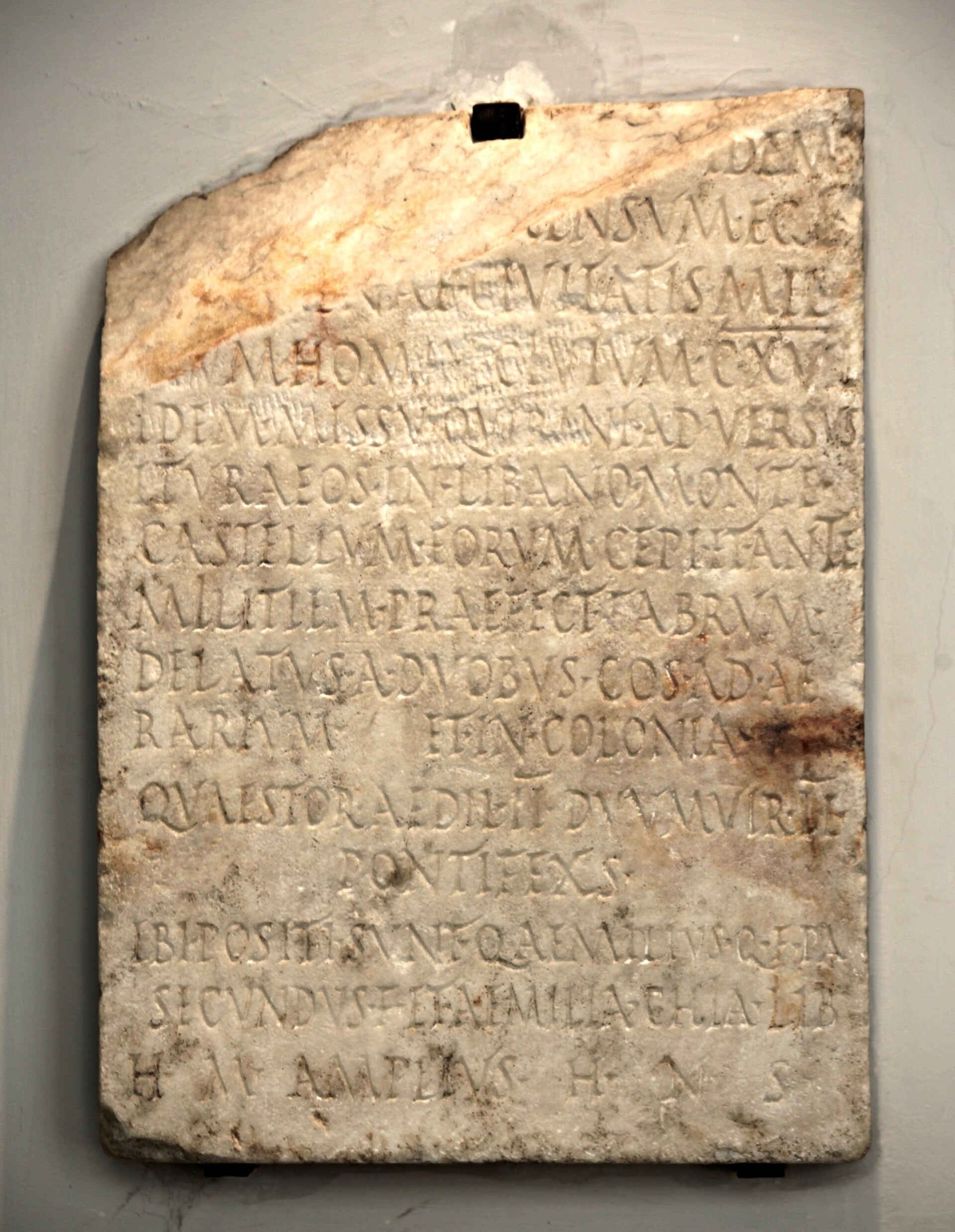
The Lapis Venetus, the funerary inscription of Quintus Aemilius Secundus (CIL III 6687), who records that on the orders of Quirinius he conducted a census of Apamea in Syria; Museo Archeologico, Venice. Photo: Mongolo1984, CC BY-SA 3.0, via Wikimedia Commons, resized.

See this page's graph and discover linked topics
In full
Publius Sulpicius Quirinius rose from an undistinguished family of the town of Lanuvium to the highest offices of the Roman state through military service under Augustus (Tacitus, Annals 3.48).
- Consul, 12 BC.
- Eastern commands. He campaigned against the Marmaridae in north Africa (Florus 2.31) and against the Homonadenses, a mountain people of Cilicia and Galatia, and won triumphal honors for it. Tacitus places the Homonadensian war before his service as adviser (rector) to Augustus' grandson Gaius Caesar in Armenia, about AD 2-4 (Annals 3.48). The war is usually dated between about 12 BC and 1 BC; its exact date and the office he held during it are debated, and they bear on whether he had an eastern command during Herod's reign.
- Legate of Syria, AD 6. When Augustus deposed Herod Archelaus, he sent Quirinius as legate of Syria, with Coponius as the first prefect of Judea, to take a census of property in the new province and to dispose of Archelaus' estate (Josephus, Antiquities 17.355; 18.1-2). Josephus dates its completion to the thirty-seventh year after Actium, AD 6/7 (Antiquities 18.26). The assessment provoked the revolt of Judas the Galilean (Antiquities 18.4-10; Jewish War 2.117-118).
- Later life. He married Aemilia Lepida and later divorced her, prosecuting her in AD 20 in a trial that turned public opinion against him (Tacitus, Annals 3.22-23). He died in AD 21 and was given a public funeral at Tiberius' request (Annals 3.48).
In the Bible
Now it came to pass in those days, there went out a decree from Cæsar Augustus, that all the world should be enrolled. This was the first enrolment made when Quirinius was governor of Syria. (Luke 2:1-2, ASV)
- The name. The Greek form is Kyrēnios, rendered "Cyrenius" in the KJV and "Quirinius" in the ASV and modern versions.
- "Governor." Luke uses the participle hēgemoneuontos, "while governing", a general term for exercising command, not the technical Latin title legatus.
- The later census. Gamaliel refers to "Judas of Galilee in the days of the enrolment" (Acts 5:37, ASV), the AD 6 census Josephus describes. The same author therefore knew of that census, and calls the earlier one "the first".
The question of how Luke's census relates to Herod's reign (Luke 1:5; Matthew 2:1), and the readings of Luke 2:2 proposed to resolve it, are set out in full in the Quirinius Census Contradiction Objection Defeater and are not repeated here.
Family and lineage
- Origin: a family of no prior distinction from Lanuvium in Latium, unrelated to the old patrician Sulpicii (Tacitus, Annals 3.48).
- Wife: Aemilia Lepida, whom he divorced and later prosecuted (Tacitus, Annals 3.22-23).
- Children: none known.
Historical and archaeological evidence
- The Lapis Venetus (CIL III 6687). The funerary inscription of Quintus Aemilius Secundus, an officer who served under Quirinius, records: "by order of Quirinius I carried out a census of the city of Apamea, 117,000 citizens" (iussu Quirini censum egi Apamenae civitatis millium hominum civium CXVII). The stone came from Beirut, was taken to Venice, and was long thought to be a forgery until its lower part was rediscovered in 1880 on the Giudecca. It is now in the National Archaeological Museum, Venice (inv. 376). It is usually dated to the census of AD 6/7. Grade: direct, a contemporary record of Quirinius ordering a census in Syria.
- The Lapis Tiburtinus (CIL XIV 3613). A fragmentary inscription from Tibur records an unnamed senator who governed Syria "again". Its identification with Quirinius, argued by W. M. Ramsay and others, is debated; it is discussed in the defeater page.
- Josephus, Antiquities 17.355, 18.1-2, 18.26; Jewish War 2.117-118. See Josephus.
- Tacitus, Annals 3.22-23, 3.48; Suetonius, Tiberius 49; Strabo, Geography 12.6.5, on the Homonadensian war. See Tacitus.
- Mykytiuk lists him among the thirty New Testament figures confirmed outside the Bible, citing Josephus and the Lapis Venetus. See Biblical Figures Confirmed by Archaeology.
Scholarly consensus
- Existence and career: uncontested. His consulship, eastern wars, governorship of Syria and the AD 6 census are firmly documented.
- Luke 2:2. This is contested. Many critical scholars, including Emil Schürer, Raymond Brown and Bart Ehrman, conclude that Luke has associated the birth of Jesus with the AD 6 census in error. Others, including W. M. Ramsay, F. F. Bruce, Darrell Bock, Ben Witherington and Paul L. Maier, defend Luke's accuracy by an earlier enrollment, an earlier eastern command for Quirinius, or a comparative reading of prōtē ("before Quirinius was governor"). The Quirinius Census Contradiction Objection Defeater sets out the evidence, the grammar and the objections on both sides.
Theological significance
Luke ties the birth of Jesus to a named emperor and a named governor because his Gospel claims to be an orderly account of things that happened (Luke 1:1-4). The census of Quirinius is part of that claim: the birth of the Messiah is placed inside Roman administrative history, open to inquiry, and the story of how a decree from Rome brought the son of David to David's town is told as history, not myth.
Church Fathers
- Justin Martyr, First Apology 34 (c. AD 155), tells the emperor that Jesus' birth at Bethlehem can be confirmed "from the registers of the taxing made under Cyrenius, your first procurator in Judæa". See Justin Martyr.
- Tertullian, Against Marcion 4.19, states that "a census had been taken in Judæa by Sentius Saturninus", the legate of Syria about 9-6 BC, which could have answered questions about Christ's family and descent. See Tertullian.
Both passages are discussed for their bearing on the census question in the Quirinius Census Contradiction Objection Defeater.
See also
- People of the Bible, the full list of biblical people by book of first mention
- Quirinius Census Contradiction Objection Defeater, the full treatment of Luke 2:2
- Augustus, who issued the decree of Luke 2:1
- Herod Archelaus, whose deposition led to the AD 6 census
- Herod the Great, in whose reign Luke and Matthew place the birth
- Matthew-Luke Birth Narrative Timeline, the nativity sequence
- New Testament Archaeology Evidence Catalog, the graded catalog of NT evidence
- Biblical Figures Confirmed by Archaeology, Mykytiuk's list
Common questions this page answers
Q: Who was Quirinius in Luke 2:2?
Publius Sulpicius Quirinius was a Roman senator, consul in 12 BC, and legate (governor) of Syria from AD 6. Luke says the enrollment at the time of Jesus' birth was "the first enrolment made when Quirinius was governor of Syria".
Q: Is there archaeological evidence for Quirinius?
Yes. The tombstone of Quintus Aemilius Secundus, now in Venice (CIL III 6687), records that he took a census of Apamea in Syria "by order of Quirinius". Josephus and Tacitus also describe his career.
Q: Does the census of Quirinius contradict Matthew's date for Jesus' birth?
The well-known census of Quirinius was in AD 6, while Matthew and Luke both place the birth under Herod the Great, who died about 4 BC. Whether this is a contradiction depends on the reading of Luke 2:2 and on Quirinius' earlier career; the arguments are set out on the codex's Quirinius census defeater page.
Q: Why does the King James Version say Cyrenius?
Cyrenius is the English form of the Greek spelling of his name, Kyrēnios. Modern translations use the Latin form, Quirinius.