Person
Queen of Sheba
Queen of the South, Makeda, Bilqis, Queen Makeda, ShebaIntro
The Queen of Sheba is the ruler from the far south who heard about King Solomon's wisdom and came to Jerusalem to test him with hard questions. She arrived with a huge caravan of spices, gold and jewels. After talking with Solomon she praised the LORD, the God of Israel, and went home (1 Kings 10:1-13).
Jesus later held her up as an example: she travelled from the ends of the earth to hear Solomon, and "a greater than Solomon is here" (Matthew 12:42, KJV). Where she came from is debated. Sheba (Saba) was a kingdom in what is now Yemen, but it had strong ties across the Red Sea to Ethiopia, and the Ethiopian church and royal house have honoured her for centuries as their queen, Makeda.
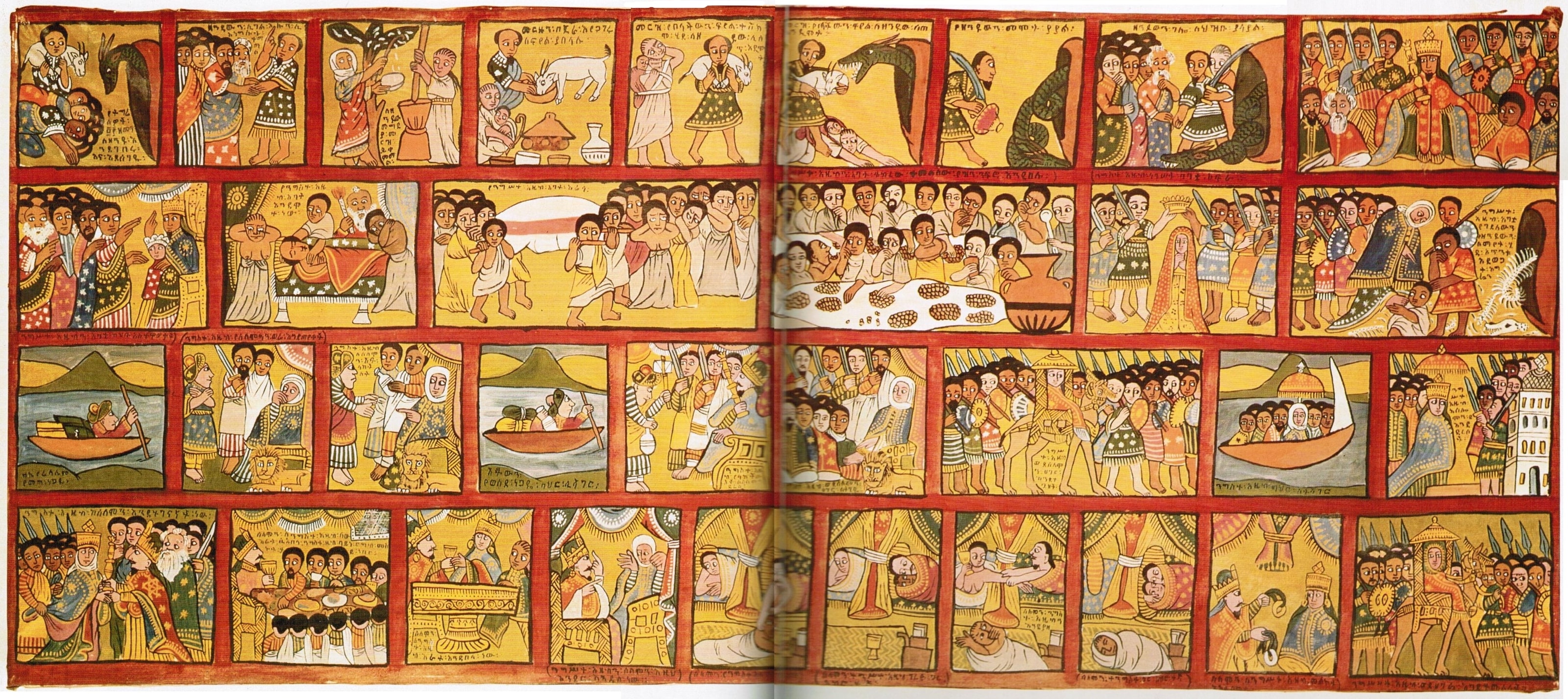 The story of the Queen of Sheba and Solomon in the traditional Ethiopian style, anonymous Ethiopian painter. Public domain (Wikimedia Commons), resized.

See this page's graph and discover linked topics
In full
The biblical account appears twice, in 1 Kings 10:1-13 and 2 Chronicles 9:1-12. The queen hears of Solomon's fame "concerning the name of the LORD" (1 Kings 10:1, KJV), comes "to prove him with hard questions" (Hebrew ḥidot, riddles or enigmas), and brings spices, a large quantity of gold, and precious stones. Solomon answers all her questions. She confesses that the report was less than the reality, pronounces a blessing on the LORD who set Solomon on Israel's throne (1 Kings 10:9), exchanges gifts, and returns to her land.
In the Gospels Jesus names her "the queen of the south" (Matthew 12:42; Luke 11:31) and says she will rise in the judgment and condemn his generation, because she travelled from the edge of the known world to hear wisdom while his hearers ignored one greater than Solomon. She is one of a small group of Gentiles, with the people of Nineveh, whom Jesus sets above Israel's own unbelief.
Three questions surround her: where Sheba was, whether she is historical, and how the Ethiopian, Jewish and Islamic traditions grew from the brief biblical story.
Where was Sheba?
The South Arabian kingdom of Saba. Most historians identify biblical Sheba with Saba, the kingdom of the Sabaeans in what is now Yemen, centred on the city of Marib. Saba grew rich on the incense trade (frankincense and myrrh) carried north by camel caravan to the Mediterranean. Assyrian inscriptions name Sabaean rulers: Sargon II records tribute from "It'amar the Sabaean" in the late eighth century BC, and Sennacherib mentions a Sabaean ruler as well. Sabaean monumental inscriptions in Yemen begin around the same period. The cargo the queen brings (spices, gold, precious stones) is exactly the trade Saba was known for.
The African side of the Red Sea. Saba's influence crossed the water. In the highlands of Eritrea and northern Ethiopia, the temple at Yeha and the inscriptions of the early kingdom scholars call D'mt (first millennium BC) use Sabaean script, Sabaean gods and Sabaean building styles. Scholars debate whether this reflects colonists from Arabia or local African elites adopting South Arabian culture; recent work tends to stress local development with strong Arabian contact. Either way, "Sheba" was a Red Sea civilization with a foot on both shores.
Sheba in the genealogies. Genesis lists a Sheba among the sons of Cush (Genesis 10:7), among the sons of Joktan (Genesis 10:28), and among Abraham's descendants through Keturah (Genesis 25:3). The Bible itself places Sheba in more than one family, which fits a trading people with ties in several directions. See Africa in the Table of Nations.
Sheba and Seba. The Bible also names "Seba," linked with Egypt and Cush (Isaiah 43:3; 45:14), and pairs "the kings of Sheba and Seba" in Psalm 72:10. Many scholars place Seba on the African side and Sheba on the Arabian side, though the two are easily confused.
Josephus. The Jewish historian Josephus, writing his Antiquities in the 90s AD, calls her the queen "of Egypt and Ethiopia" (Antiquities 8.165, Whiston 8.6.5). This is the earliest surviving source to place her in Africa.
Is she historical?
No inscription names her, and no Sabaean text mentions Solomon. That is not surprising: South Arabian royal inscriptions are sparse for the tenth century BC, and diplomatic visits rarely leave records on both sides. What can be said:
- Queens are attested. Assyrian annals of the eighth century BC name Arabian queens, Zabibe and Samsi, who paid tribute to Tiglath-pileser III, so a ruling queen in Arabia is plausible.
- The trade is real. The incense route from South Arabia to the Levant is well documented, and a mission to secure trade with a powerful Levantine king makes historical sense of the visit.
- The dating is debated. Some archaeologists think the Sabaean state reached its power only in the eighth century BC, later than Solomon; others argue for earlier roots. The question is open, and the absence of evidence for a tenth-century queen is not evidence of her absence.
The biblical account is brief, plausible in its setting and economic detail, and not contradicted by any known evidence.
The Ethiopian tradition: Makeda and Menelik
The fullest development of her story is Ethiopian. The Kebra Nagast ("Glory of the Kings"), a Ge'ez work compiled in its present form in the fourteenth century, tells how Makeda, queen of Ethiopia, visited Solomon, returned home bearing his son Menelik, and how Menelik later brought the Ark of the Covenant to Aksum. The work became the charter of the Solomonic dynasty, which claimed power from 1270, and the claim was written into Ethiopia's constitutions of 1931 and 1955, which traced Emperor Haile Selassie's line to Menelik, son of Solomon and the Queen of Sheba.
Historians treat the Makeda narrative as national epic rather than tenth-century history, and the Ark claim cannot be examined. The tradition is still significant evidence of how deeply Ethiopian Christianity identified itself with the biblical story, centuries before European missions. See Kebra Nagast and Ethiopian Orthodox Church.
Other traditions
- Early Christian. Origen, in his commentary on the Song of Songs, read the queen, whom he took to be Ethiopian, as a figure of the Gentile church coming to Christ, the true Solomon, and connected her with the bride who says she is "black, but comely" (Song of Solomon 1:5, KJV).
- Islamic. The Quran (Surah 27:20-44) tells of a queen of Saba whom Solomon summons; she visits, is tested, and submits with Solomon to God. Later Islamic tradition names her Bilqis. See Islam.
- Jewish. Later rabbinic and folk literature expanded the riddles she posed and sometimes cast her negatively. These are much later than the biblical text.
- European art. Medieval and Renaissance painters often paired her visit with the coming of the Magi, both images of Gentiles bringing gifts to the king.
Why she matters
- A Gentile seeker of Israel's God. She comes for wisdom and leaves blessing the LORD, an early picture of the nations drawn to Israel's God (compare Isaiah 60:6, where gold and incense come "from Sheba").
- Commended by Christ. Jesus uses her, a foreign queen, to rebuke the unbelief of his own people.
- A shared Red Sea heritage. Whether Arabian, African or both, her story belongs to the world where Africa and Arabia met, and the African church has claimed her for centuries.
Tensions
- The Africans in Scripture Argument calls Josephus's identification of Sheba with Ethiopia "contemporary" and "Second Temple." Josephus wrote the Antiquities around AD 93-94, after the Temple's destruction, and about a thousand years after Solomon. His testimony is early for the tradition but not contemporary with the queen.
- The same page says the Aksumite kingdom is "partly descended from Sabaean migrations." Older scholarship held this; much recent archaeology (for example the work of Rodolfo Fattovich) emphasizes local African development with strong South Arabian influence. The cultural link is certain; migration as the explanation is disputed.
- That page treats her as an African queen. The majority historical view places Saba in Yemen. This page presents the Arabian identification as the majority view and the Ethiopian identification as an ancient tradition with real cross-Red-Sea grounding.
See also
- Africans in Scripture Argument, the cumulative case she features in
- Solomon, the king she came to test
- Kebra Nagast, the Ethiopian epic of Makeda and Menelik
- Ethiopian Orthodox Church, which honours her tradition
- Kingdom of Aksum, the Christian kingdom that claimed her line
- Africa in the Table of Nations, where Sheba first appears
- Ethiopian Eunuch, the other African royal court in Scripture
- Jesus, who commended her
- Africa and Christianity
Common questions this page answers
Q: Who was the Queen of Sheba in the Bible?
She was a foreign queen who travelled to Jerusalem to test King Solomon's wisdom with hard questions, brought great gifts, and praised the LORD before returning home (1 Kings 10:1-13; 2 Chronicles 9:1-12).
Q: Was the Queen of Sheba African?
It is debated. Most historians place Sheba (Saba) in Yemen, but Saba had strong cultural ties to Ethiopia and Eritrea across the Red Sea. Josephus called her queen of Egypt and Ethiopia, and the Ethiopian tradition honours her as Queen Makeda.
Q: What did Jesus say about the Queen of Sheba?
He called her "the queen of the south" and said she would rise in the judgment and condemn his generation, because she came from the ends of the earth to hear Solomon, and "a greater than Solomon is here" (Matthew 12:42; Luke 11:31).
Q: What was the Queen of Sheba's name?
The Bible does not name her. Ethiopian tradition calls her Makeda, and Islamic tradition calls her Bilqis. Josephus connects her with a queen of Egypt and Ethiopia called Nicaule.
Q: Did the Queen of Sheba have a son with Solomon?
The Bible does not say so. The Ethiopian Kebra Nagast, compiled in the fourteenth century, says she bore Solomon a son, Menelik I, founder of the Ethiopian royal line. Historians treat this as national tradition rather than verifiable history.
Q: Is there archaeological evidence for the Queen of Sheba?
No inscription names her. The kingdom of Saba, its incense trade, and ruling Arabian queens in the following centuries are all well documented, so the setting of the story is historically plausible.
Q: What is the difference between Sheba and Seba?
Sheba is usually identified with Saba in South Arabia; Seba is linked in the Bible with Egypt and Cush and is often placed in Africa. Psalm 72:10 names both.