Person
Queen Njinga
Njinga, Nzinga, Queen Nzinga, Njinga Mbande, Nzinga Mbande, Ana de Sousa, Ana de Sousa Nzinga, Nzinga of Ndongo and Matamba, GingaIntro
Njinga Mbande was a queen in what is now Angola in the 1600s. She ruled the Mbundu kingdoms of Ndongo and later Matamba for nearly forty years, and spent most of that time fighting the Portuguese, who were trying to conquer her lands from their base at Luanda. She is a national heroine in Angola today, remembered for her diplomacy, her courage and her refusal to submit.
Her religious life is complicated, which is exactly why she matters for this subject. She was baptized a Catholic in Luanda in 1622, during a diplomatic mission, taking the name Ana de Sousa. She then broke with the Portuguese, allied with the Imbangala warrior bands and took part in their rites. In the 1650s, through Italian Capuchin missionaries living at her court, she returned to Catholic practice, built churches, married in a Christian ceremony, and died in 1663 with a Catholic burial. Historians still argue about how much of her faith was conviction and how much was politics. The honest answer is that the sources show both.
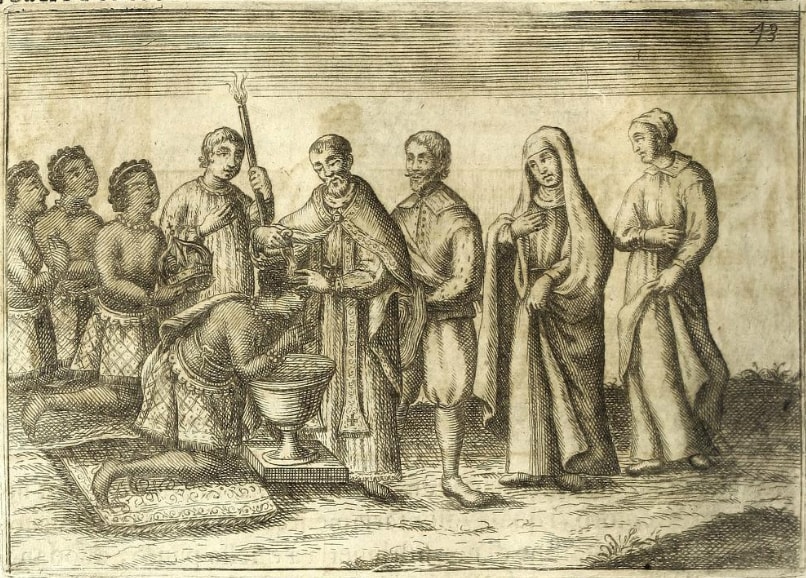 The baptism of Njinga in Luanda, seventeenth-century engraving attributed to the account of the Capuchin missionary Giovanni Antonio Cavazzi. Public domain, via Wikimedia Commons.

See this page's graph and discover linked topics
In full
Njinga (Nzinga) Mbande (c. 1583-1663) was born into the ruling family of Ndongo, a Kimbundu-speaking kingdom between the Kwanza and Lukala rivers, whose king bore the title ngola (the root of the name Angola). In 1621-1622 her brother, King Ngola Mbandi, sent her to Luanda to negotiate with the Portuguese governor João Correia de Sousa; there she was publicly baptized as Dona Ana de Sousa, taking the names of the governor and of her godmother, the governor's wife. On her brother's death in 1624 she seized power. When the Portuguese declared war (1626) and drove her from Ndongo, she allied with the Imbangala leader Kasanje, adopted Imbangala law and initiation, and conquered the kingdom of Matamba (1631-1635), which became her base. She allied with the Dutch during their occupation of Luanda (1641-1648) and fought the Portuguese until a peace treaty in 1656. From 1648, captured and then invited Capuchin missionaries lived at her court; in the 1650s she restored public Catholic worship, built churches, promoted Christian councillors, suppressed some traditional cults, and married in a church ceremony. She died on 17 December 1663 and was buried with both Catholic and Mbundu rites. She is one of the best-documented African rulers of the early modern period, through about a dozen of her own letters, the correspondence of Governor Fernão de Sousa (1624-1631), the chronicler António de Oliveira de Cadornega, and the Capuchins Antonio da Gaeta (biography published 1669) and Giovanni Antonio Cavazzi, both of whom lived at her court.
Faith across a lifetime
| Period | Religious posture | Evidence |
|---|---|---|
| Before 1621 | Raised in Mbundu royal religion | Later biographies; Heywood's reconstruction |
| 1622 | Baptized in Luanda as Dona Ana de Sousa, as part of a diplomatic settlement | Portuguese sources; Cavazzi's illustration |
| 1624-1640s | Seizes power; allies with the Imbangala; adopts their initiation and laws; keeps relics of her brother for consultation | Fernão de Sousa's correspondence; Cavazzi |
| 1644-1648 | Captures a Portuguese priest, then two Spanish Capuchins, and grants them unusual freedom at court | Capuchin reports |
| 1650s | Restores Catholic worship publicly, builds churches, ends concubinage, marries in a church ceremony; sells some traditional priests who resisted | Gaeta and Cavazzi |
| 1663 | Dies; buried with Catholic and Mbundu rites; memorial services held in Matamba and Luanda | Capuchin accounts |
How to read her conversion
Historians read the same evidence in different ways.
- Political baptism, then sincere return. Linda Heywood, her leading modern biographer, treats the 1622 baptism as a diplomatic tool and the 1650s turn as a deliberate, and probably genuine, reshaping of her court around Christianity, alongside the political benefits it brought in the peace with Portugal.
- Missionary hagiography. Gaeta's biography presents her as a sinner won by providence. Cavazzi's later account is more critical. Both wrote as missionaries with reasons to tell a conversion story.
- Strategic syncretism. Some scholars stress that she used Christianity much as she had used Imbangala law: as a source of legitimacy for a female ruler in a contested kingdom.
The codex does not adjudicate her heart. It records that her Catholic practice in her final decade is well documented, that it cost her something with traditionalists at court, and that her motives were mixed in ways that are common among rulers of every continent.
The hard parts of her record
- The slave trade. Njinga controlled key slave-supplying routes and traded captives to the Dutch and, under the 1656 treaty, through a market at her capital. Heywood notes Dutch purchases running to thousands a year.
- Imbangala practice. Sources describe her participation in Imbangala initiation rites, including practices that missionaries reported as cannibalistic. The sources are hostile and contested, but they are not ignored here.
- Coercion of traditionalists. In the 1650s she had some traditional shrines burned and some of their priests sold.
None of this is softened. The point for this subject is that she was an African sovereign who negotiated with Christianity on her own terms, not a passive recipient of European religion. See African Participation in the Atlantic Slave Trade and Black Christian Agency.
Significance
1. African agency in Christian encounter
Njinga accepted baptism to gain diplomatic standing, held the faith at arm's length for decades, and then made Christianity part of her own state. The initiative stayed with her throughout.
2. Resistance by a Christian ruler to a Christian colonial power
She fought Catholic Portugal for thirty years and ended the war as a practising Catholic queen. Her life cuts against the idea that becoming Christian meant submitting to colonial rule. See Christianity and Colonialism in Africa.
3. A woman ruler in a male office
She took the title ngola and, at times, male dress and roles to hold power. Her female successors faced fewer obstacles.
Tensions
- Baptism year. Most sources date the Luanda baptism to 1622; some give 1623.
- Spelling. Njinga, Nzinga, Ginga, Zinga and other forms appear in the sources; her own letters use several.
Scholarship
Published academic works this page draws on, each matched to a publisher, index or library catalog record.
- Giovanni Antonio Cavazzi, Istorica descrizione de' tre' regni Congo, Matamba et Angola (1687). Open Library
- Linda M. Heywood, Njinga of Angola: Africa’s Warrior Queen (Harvard University Press, 2017). doi:10.4159/9780674979055
- John K. Thornton, "Legitimacy and Political Power: Queen Njinga, 1624-1663," The Journal of African History 32 (1991). doi:10.1017/s0021853700025329
See also
- Kingdom of Kongo Christianity, the Christian kingdom on her northern border
- Afonso I of Kongo, the earlier Kongolese Christian king
- Kimpa Vita, the Kongolese prophetess of the next generation
- Christianity and Colonialism in Africa, the wider question of missions and empire
- African Participation in the Atlantic Slave Trade, the trade in which her kingdom was entangled
- Black Christian Agency, African Christians as actors
- Africa and Christianity, master hub
Common questions this page answers
Q: Was Queen Nzinga a Christian?
She was baptized a Catholic in Luanda in 1622 as Ana de Sousa, then for decades followed Imbangala and Mbundu practice, and in the 1650s returned to public Catholic worship with Capuchin missionaries at her court. She died in 1663 and received a Catholic burial.
Q: Why did Queen Njinga get baptized?
Her baptism took place during peace negotiations with the Portuguese in Luanda and strengthened her diplomatic position. Her later return to Catholicism in the 1650s is better documented as a personal and political commitment.
Q: Who was Queen Njinga of Angola?
Njinga Mbande ruled the Mbundu kingdoms of Ndongo and Matamba from 1624 to 1663 and resisted Portuguese conquest for most of that time, ending the war by treaty in 1656. She is a national heroine in Angola.
Q: Did Queen Nzinga take part in the slave trade?
Yes. Like many rulers of the region, she controlled routes that supplied captives and traded with the Dutch and later the Portuguese. Her resistance to Portugal and her role in the slave trade are both part of the historical record.
Q: How do we know about Queen Njinga's life?
From about a dozen of her own letters, the correspondence of Portuguese governors, the chronicler Cadornega, and two Capuchin missionaries, Antonio da Gaeta and Giovanni Antonio Cavazzi, who lived at her court and wrote about her.