Concept
Quantum Entanglement and God
Quantum Entanglement, Entanglement and God, Does Quantum Entanglement Prove God, Bell's Theorem and God, Quantum Nonlocality and Theism, Spooky Action at a Distance, Quantum Physics and GodIntro
Quantum entanglement is one of the strangest things physics has ever found. Two particles can be prepared so that they share one joint state. Measure one of them and you learn something about the other at once, even if it is on the far side of the galaxy. Einstein called it "spooky action at a distance," and he hoped it would turn out to be a mistake. It did not. Experiments have confirmed it again and again, and the 2022 Nobel Prize in Physics went to three of the people who proved it.
Because it sounds so mysterious, entanglement gets drafted into all kinds of arguments, including "entanglement proves God." It does not, and saying so is a liability. But entanglement does show something real: the world is not a heap of separate little marbles that only touch when they bump. It runs on deep, precise mathematical order that no one had to put there for the universe to "work" and that physics itself does not explain. That is where the real conversation about God begins.
Think of two gloves packed in separate boxes. Open one box, find a left glove, and you know the other is a right glove. Entanglement is like that, only stranger: the experiments show the gloves were not simply packed left and right ahead of time. The pairing is real, but it is not a secret message sent from one box to the other.
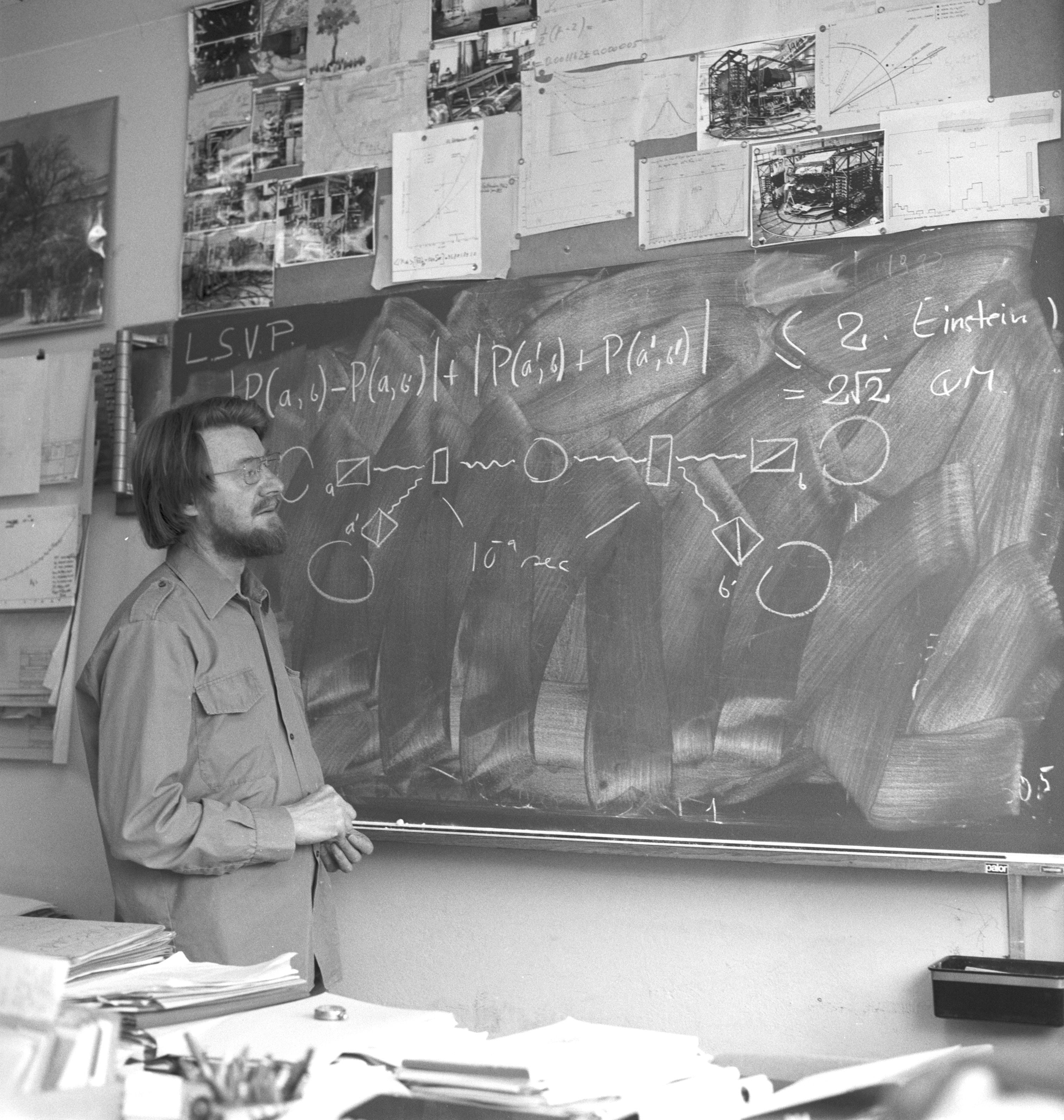
John Stewart Bell at CERN in June 1982, beside a blackboard showing his inequality and the layout of a two-photon Bell test. Photo: CERN, CC BY 4.0, via Wikimedia Commons, re-encoded.

See this page's graph and discover linked topics
In full
Entanglement is a property of composite quantum systems whose joint state cannot be written as a product of independent states of the parts. Measurements on the separated parts then show correlations that, by Bell's theorem (John Stewart Bell, 1964), no theory of locally determined properties can reproduce. Beginning with Stuart Freedman and John Clauser (1972), continuing with Alain Aspect's group at Orsay (1982, with analyser settings switched while the photons were in flight) and Anton Zeilinger's group in Innsbruck and Vienna, and culminating in the loophole-free tests of 2015 (Delft, Vienna, and NIST), experiment has confirmed the quantum predictions and ruled out local hidden-variable models. Clauser, Aspect and Zeilinger shared the 2022 Nobel Prize in Physics "for experiments with entangled photons, establishing the violation of Bell inequalities and pioneering quantum information science."
Three qualifications govern every responsible use of the result:
- Correlation, not signalling. The no-communication theorem shows that nothing done to one particle changes the statistics of measurements on the other. The correlation appears only when the two records are brought together over an ordinary, light-speed-limited channel. Entanglement transmits no message, energy or influence that could be used to send one.
- Entanglement is fragile. A complete measurement of one particle, in a given basis, leaves the pair in a product state, so the entanglement is used up, though the correlation already recorded remains. Uncontrolled interaction with the environment does the same thing gradually; this is decoherence, and it is why entanglement is easy to destroy and hard to keep at large scales.
- The interpretation is open. Bell's theorem forces a choice: give up locality, give up the assumption that measurements reveal pre-existing values, give up single definite outcomes, or give up the independence of the experimenter's settings. The major interpretations of quantum mechanics make different choices, and the experiments do not decide between them.
The theistic payoff therefore does not run through entanglement as a mechanism. It runs through what entanglement shows about the kind of world this is: holistic rather than atomistic, governed by exact mathematics, and contingent in its laws. Those are the premises of the Argument from Intelligibility and the Contingency Argument, and entanglement sharpens them without replacing them.
What entanglement is
- A shared state. Two particles can be prepared so that, measured along the same axis, their spins always come out opposite. Neither individual result can be predicted in advance, yet the relation between the results is certain. One knows something definite about the pair while knowing nothing definite about either member.
- Not pre-packed gloves. If the outcomes were fixed in advance, like gloves in boxes, the correlations across different measurement angles would obey limits (Bell inequalities). Quantum mechanics predicts, and experiment finds, that those limits are broken.
- Distance does not weaken it. Entanglement has been demonstrated between photons separated by more than a thousand kilometres, using the Chinese Micius satellite (2017). Separation is not the problem; disturbance is.
- Measurement can also create it. Entanglement swapping lets two particles that never interacted become entangled through a joint measurement on their partners. "Observing ends entanglement" is true of some measurements, not of measurement as such.
The claim "entanglement proves God"
The slogan usually arrives in one of four forms. None survives, and each is worth refusing by name.
- "Instant connection across the universe is God holding things together." The theorem forbids using the correlation to send anything, and quantum mechanics predicts it with no further cause. Inserting God as the link between the particles is a God of the Gaps move inside a theory with no gap at that point.
- "Everything is connected, so we are all one with God." Entanglement is a precise relation between specific prepared systems, and decoherence destroys it almost instantly at human scales. It gives no support to pantheism and no physics to monism.
- "Entanglement explains prayer, telepathy or healing." No signal means no channel. This is the territory of popular "quantum healing" literature, such as Deepak Chopra's Quantum Healing (1989) and the film What the Bleep Do We Know!? (2004), and physicists rightly call it quantum woo.
- "Consciousness creates reality." This mixes entanglement with one minority interpretation of measurement (see below) and then treats the interpretation as a finding.
Why woo is a liability. Augustine warned that when a Christian talks nonsense about the natural world in the name of Scripture, unbelievers who know the subject laugh, and the Scriptures are discredited along with the speaker (De Genesi ad litteram I.19.39). A physicist who hears "entanglement proves God" stops listening, and the argument that would have reached him, the one from intelligibility and contingency, never gets heard.
The legitimate philosophical uses
1. Nonlocality and naive local materialism
The picture of the world inherited from nineteenth-century mechanism treats reality as small, separately existing bits whose properties are fixed locally and which influence one another only by contact or by signals moving through space. Bell's theorem and its tests show that picture is false: whatever the correct interpretation, the world cannot be fully described by locally held properties. Bohmian mechanics embraces explicit nonlocality; many-worlds keeps locality only by denying that a measurement has one outcome; Copenhagen-style views deny that the properties existed before measurement.
Calibration. This refutes a picture of matter, not physicalism as such; physicalists accept quantum mechanics. Its apologetic value is that it removes the intuitive, common-sense materialism ("it is all just little particles bumping") that often stands behind popular atheism. The world is stranger, more unified and more mathematical than that picture allowed. See Materialism and Naturalism.
2. The intelligibility and mathematical order of nature
Entangled correlations are predicted to many decimal places by a theory built from abstract mathematics: complex vector spaces, tensor products, operators. Eugene Wigner called this "the unreasonable effectiveness of mathematics in the natural sciences" (1960). The theist explains it directly: the world is the work of a rational Mind, and finite minds made in that Mind's image can read it. On naturalism there was no particular reason to expect the deepest layer of matter to be both lawful and humanly decipherable. See Mathematical Intelligibility of Nature and Argument from Intelligibility.
The Christian framing is the Logos: "All things were made through him; and without him was not anything made that hath been made" (John 1:3, ASV); "in him all things consist" (Colossians 1:17, ASV). See Logos Christology.
3. Contingency of the laws
Quantum mechanics is not a truth of logic. It could have been otherwise: classical, or quantum with different constants, or nothing at all. An atheist can fairly reply, "Entanglement is simply how quantum mechanics works; why bring in God?" The answer is to separate two questions. Physics explains how entangled systems behave given the laws. It does not explain why there are these laws rather than others, or why there is a lawful world at all. Describing how a law operates is not explaining why the law obtains. That question belongs to the Contingency Argument and the Principle of Sufficient Reason, and it is where the case for a necessary, rational ground of reality is actually argued. Scripture puts the laws on the side of God's appointment: "If my covenant of day and night stand not, if I have not appointed the ordinances of heaven and earth" (Jeremiah 33:25, ASV); compare Job 38:33. See also Laws of the Universe as Witness to Design.
4. The interpretations, and why none settles theism
| Interpretation | Core idea | What it gives up after Bell | Bearing on theism |
|---|---|---|---|
| Copenhagen (Bohr, Heisenberg, 1920s) | The wavefunction encodes what can be predicted; measurement yields a definite result | Pre-existing values for unmeasured quantities | Compatible; theism needs no particular view of what is real between measurements |
| Many-worlds (Hugh Everett, 1957) | The wavefunction never collapses; every outcome occurs in a branching reality | Single definite outcomes | Compatible; sometimes enlisted for a Multiverse, which still needs lawful structure and a ground |
| Bohmian / pilot-wave (de Broglie 1927, David Bohm 1952) | Particles always have positions, guided by the wavefunction | Locality, explicitly | Compatible; fully deterministic, so "quantum indeterminism refutes causation" fails here |
| Objective collapse (Ghirardi, Rimini, Weber, 1986) | Collapse is a real physical process, rare for single particles and swift for large systems | Exact linear evolution | Compatible |
The pattern is the point. Each interpretation fits the experimental record, and each is compatible with a God who creates and sustains a lawful world, whether that world is deterministic or chancy. Classical theism has never held that God is one physical cause among others competing for the same explanatory slot; He is the primary cause on whom every secondary cause depends. See Divine Conservationism and Concurrentism. A theist who stakes the argument on one interpretation has staked it on a question physicists have not settled.
"Nothing happens until we observe"
A common intuition runs: if we do not look, the particles are not doing anything; they hang as unresolved probability until an observer arrives. Three corrections:
- Unobserved systems evolve. The joint quantum state changes over time by exact law whether or not anyone measures it. "Nothing happens" is false on every interpretation.
- "Observation" means interaction, not awareness. In physics a measurement is any interaction that records which outcome occurred: a detector, a photographic plate, a stray air molecule. No conscious observer is required, and decoherence happens constantly in nature with no one watching.
- Whether properties are definite before measurement is interpretation-dependent. On Bohmian mechanics positions are always definite; on Copenhagen-style views certain quantities have no value until measured. The experiments establish the correlations; they do not settle this.
The genuinely open question is the measurement problem: why a measurement yields one definite result when the equations, applied to the whole apparatus, seem to predict a superposition. That problem is real and unsolved, and it is a legitimate subject for philosophy.
Consciousness-causes-collapse, stated fairly
John von Neumann (Mathematical Foundations of Quantum Mechanics, 1932) showed that the boundary between the measured system and the measuring apparatus can be placed anywhere along the chain from particle to detector to eye to brain without changing the predictions. Fritz London and Edmond Bauer (1939), and later Eugene Wigner ("Remarks on the Mind-Body Question," 1961), suggested that the chain ends only in a conscious mind. Henry Stapp has defended a version in recent decades.
- Its appeal: it takes the measurement problem seriously and gives mind a real place in nature, which some theists find congenial.
- Its difficulties: it gives no physical account of which systems count as conscious; it implies the universe had no definite outcomes before minds evolved; and decoherence explains the appearance of definite outcomes without it. Wigner himself later moved away from the view.
- Its standing: a minority position among physicists and philosophers of physics. It should be presented as one interpretation, never as what quantum mechanics shows. Christian theism does not need it: God's knowledge of the world does not depend on any human observer, and the argument from mind is better made directly. See Consciousness and Idealism.
Using the topic honestly in apologetics
Do:
- Lead with the question physics cannot answer from inside: why these laws, and why a lawful world at all?
- Use entanglement as an illustration of a world more unified, more mathematical and less "common-sense material" than popular materialism assumes.
- Cite the real names and dates: Bell 1964, Aspect 1982, the 2022 Nobel. Accuracy earns the hearing.
- Pair it with the Quantum Fluctuations Are Uncaused Objection Defeater: quantum chance is unpredictability under exact law, not causation from nothing.
- Pair it with the Quantum Physics Reverses Entropy Objection Defeater when someone uses quantum effects to dodge the universe's beginning.
Do not:
- Say entanglement sends signals, connects all things, explains prayer, or proves that consciousness creates reality.
- Rest the case on one interpretation of quantum mechanics.
- Put God in the gap between the particles. He is the ground of the whole lawful order, not a hidden wire inside it.
A usable line: "Quantum mechanics tells me how entangled particles behave. It does not tell me why reality runs on mathematics this precise, or why there are any laws at all. That is the question I think points to God."
Scholarship
Published academic works this page draws on, each matched to a publisher, index or library catalog record.
- John Von Neumann, Mathematical foundations of quantum mechanics (1932). Open Library
See also
- Quantum Fluctuations Are Uncaused Objection Defeater, quantum events are unpredictable, not uncaused, and the vacuum is not nothing
- Quantum Physics Reverses Entropy Objection Defeater, quantum effects do not undo the thermodynamic case for a beginning
- Mathematical Intelligibility of Nature, Wigner's "unreasonable effectiveness" and the Logos
- Argument from Intelligibility, the formal argument this topic feeds
- Contingency Argument, why there are laws at all
- Laws of the Universe as Witness to Design, the lawful order as evidence of a Lawgiver
- It from Bit, information-based readings of physical reality
- Consciousness, where the argument from mind is made directly
- God of the Gaps, the trap the slogan "entanglement proves God" walks into
- Divine Conservationism, God as sustaining cause of every physical process
Common questions this page answers
Q: Does quantum entanglement prove God exists?
No. Entanglement is fully predicted by quantum mechanics and does not need God as a link between the particles. What it does is sharpen the deeper questions, why nature runs on such precise mathematics and why these laws hold at all, and those questions point to a rational ground of reality.
Q: Does quantum entanglement allow faster-than-light communication?
No. The no-communication theorem shows that nothing done to one particle changes the measurement statistics of the other. The correlation shows up only when the two sets of results are compared over an ordinary channel.
Q: What is Bell's theorem in simple terms?
John Bell proved in 1964 that if particles carried pre-set answers determined locally, certain measured correlations could never exceed a fixed limit. Quantum mechanics predicts that the limit is broken, and experiments from the 1970s through the loophole-free tests of 2015 confirm that it is.
Q: Who won the 2022 Nobel Prize for quantum entanglement?
John Clauser, Alain Aspect and Anton Zeilinger, for experiments with entangled photons that established the violation of Bell inequalities and pioneered quantum information science.
Q: Does observing a particle break entanglement?
A complete measurement of one particle in a given basis leaves the pair unentangled, though the correlation already recorded stays. Interaction with the environment destroys entanglement gradually through decoherence. Some measurements, however, preserve or even create entanglement.
Q: Does quantum physics say nothing exists until a conscious observer looks?
No. In physics an "observation" is any interaction that records an outcome, such as a detector or a stray molecule, and unobserved systems still evolve by exact law. The view that consciousness causes collapse, associated with von Neumann's analysis and Wigner, is a minority interpretation, not a result.
Q: Which interpretation of quantum mechanics fits Christianity best?
None is required. Copenhagen, many-worlds, Bohmian mechanics and objective-collapse theories are all compatible with a God who creates and sustains a lawful world, because classical theism treats God as the primary cause of the whole order rather than one physical cause inside it.