Concept
Problem of Induction
Hume's problem of induction, Humes problem of induction, the problem of induction, induction problem, justification of induction, will the future resemble the past, uniformity of nature, principle of uniformity of nature, new riddle of induction, grue paradox, ontological regularity vs epistemic justificationIntro
Every day you bet that the world will behave tomorrow the way it did yesterday. You expect water to quench thirst, bread to feed you, and the floor to hold you up. That kind of reasoning, from what has happened to what will happen, is called induction. Science runs on it.
The problem of induction, made famous by the Scottish philosopher David Hume in the 1700s, asks a simple question: what justifies that bet? You cannot prove it by pure logic, because there is no contradiction in imagining that the sun does not rise tomorrow. And you cannot prove it by pointing out that induction has always worked before, because that argument is itself an induction. You would be using induction to defend induction, which goes in a circle.
Everyone uses induction, Hume included. The trouble is that the usual ways of justifying it fail. That makes it one of the most important questions in philosophy, and one where Christianity has something to say: the world is regular because a faithful God made it and keeps it, and he has promised that "seedtime and harvest" will not cease while the earth remains.
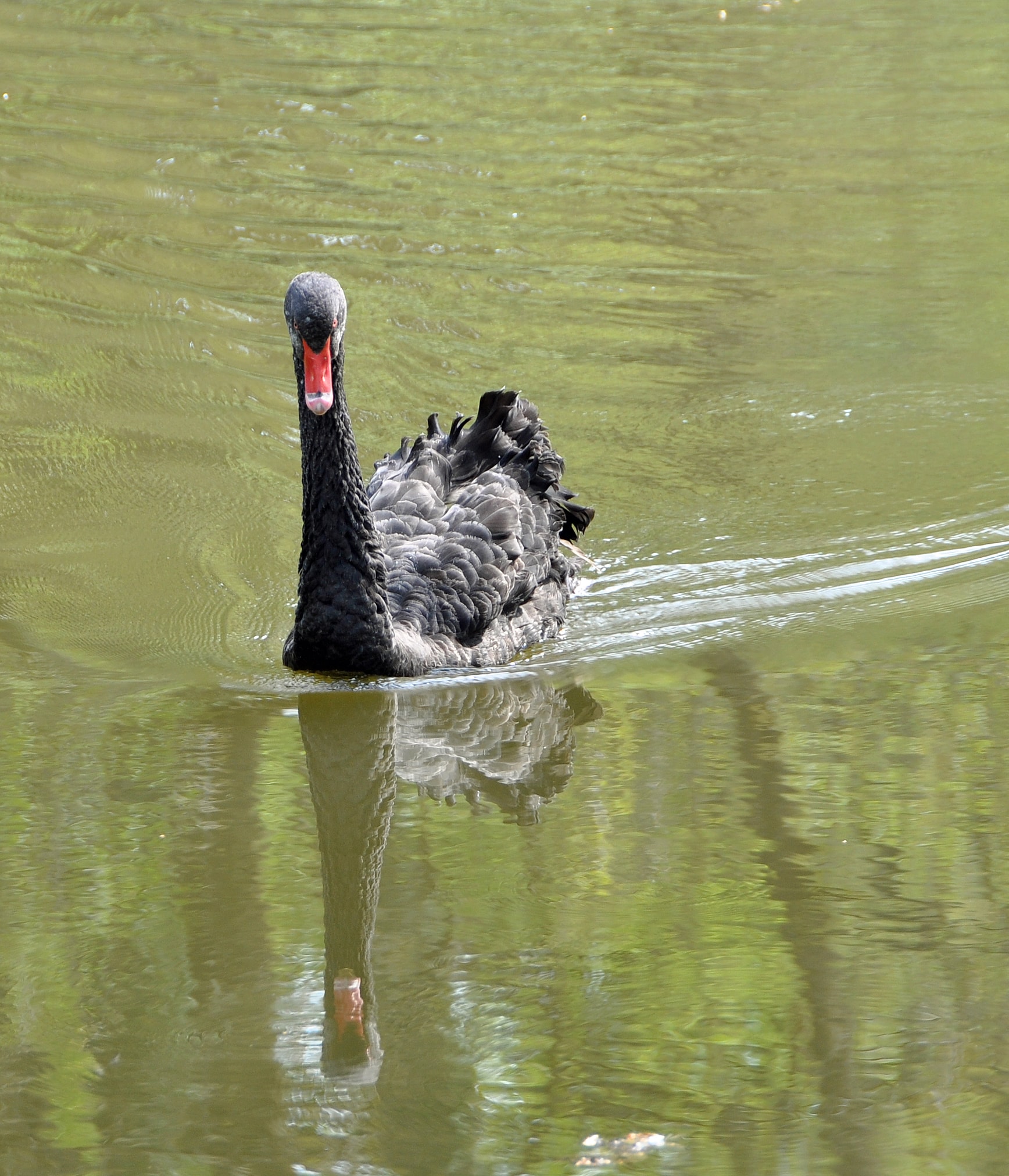
A black swan, Cygnus atratus. Europeans long treated "all swans are white" as settled by experience, until Dutch sailors recorded black swans in Western Australia in 1697. The bird became the standard picture of how a long run of observations can still fail. Photo: Marc Ryckaert, CC BY 3.0, via Wikimedia Commons.
See this page's graph and discover linked topics
In full
The problem of induction is the problem of justifying ampliative inference: inference whose conclusion goes beyond its premises, from observed to unobserved cases, from past to future, from sample to population. Hume's argument (Treatise of Human Nature I.iii.6, 1739; Enquiry Concerning Human Understanding IV-V, 1748) runs:
- Every inductive inference presupposes a principle of uniformity: unobserved cases resemble observed ones.
- That principle is not demonstrable a priori, since its denial implies no contradiction.
- It is not establishable a posteriori without circularity, since any argument from experience for it is itself an inductive inference that presupposes it.
- Therefore inductive inference has no non-circular rational justification.
Hume's own conclusion was that we infer by custom or habit, a natural disposition that reason cannot ground but that we cannot do without.
The problem separates two questions that are easy to run together:
- Ontological regularity: does reality in fact have stable patterns or laws?
- Epistemic justification: what entitles a finite knower to believe those patterns will hold in cases not yet observed?
Establishing the first does not settle the second. A universe can be perfectly regular while its inhabitants lack any non-circular argument that it is. The theistic answer addresses both: God's faithful governance explains why nature is uniform, and a creaturely mind made by the same God to know his world gives a reason to trust the expectation of uniformity.
The problem in Hume's words
Hume put the deductive half plainly:
That the sun will not rise to-morrow is no less intelligible a proposition, and implies no more contradiction than the affirmation, that it will rise. (Hume, Enquiry Concerning Human Understanding IV.i)
And the inductive half:
For all inferences from experience suppose, as their foundation, that the future will resemble the past, and that similar powers will be conjoined with similar sensible qualities. (Hume, Enquiry IV.ii)
His practical resolution comes in section V: "Custom, then, is the great guide of human life." Custom explains why we expect the future to be like the past. It does not show the expectation is rational.
Bertrand Russell gave the problem its most memorable picture in The Problems of Philosophy (1912), chapter 6: "The man who has fed the chicken every day throughout its life at last wrings its neck instead, showing that more refined views as to the uniformity of nature would have been useful to the chicken." The chicken's induction was excellent, right up until it was not.
What the problem is and is not
- It is about justification, not use. Nobody, Hume included, stops using induction. The question is whether the practice can be given a rational ground.
- It is not a demand for certainty. Even probabilistic induction ("the sun will probably rise") needs the uniformity principle, since past frequencies only bear on future ones if the future resembles the past.
- It is not only about the future. It covers any projection from observed to unobserved: the far side of the moon, the interior of the Earth, the next sample of water.
- It is sharpest for strict empiricism. If all knowledge comes from experience, and experience cannot justify the uniformity principle, then by the empiricist's own standard the principle is not known, and neither is any scientific law. See Empiricism.
The main responses
1. Falsificationism (Karl Popper)
Popper (The Logic of Scientific Discovery, 1934, English 1959) argued that science does not need induction. Scientists propose bold conjectures and try to refute them; a theory that survives testing is corroborated, not proved. One black swan refutes "all swans are white," and that refutation is purely deductive.
Assessment. Falsification is a real insight into scientific method. But relying on a well-corroborated theory to build a bridge tomorrow still assumes that what survived testing in the past will keep working, which is the inductive step Popper wanted to avoid.
2. Pragmatic vindication (Hans Reichenbach)
Reichenbach (Experience and Prediction, 1938) conceded that induction cannot be shown to succeed, and argued instead that if any method of prediction succeeds, induction will. If nature has stable frequencies, following observed frequencies will find them in the long run; if it does not, no method works. So we lose nothing by using induction.
Assessment. The argument vindicates a policy for the long run, and says little about any particular prediction. It also shows only that induction is no worse than its rivals, which is weaker than showing it is reliable.
3. Dissolution (P. F. Strawson)
Strawson (Introduction to Logical Theory, 1952, chapter 9) argued that the demand is confused. Being "reasonable" about matters of fact means, in part, proportioning belief to inductive evidence. Asking whether induction is reasonable is like asking whether the law is legal.
Assessment. It is true that inductive standards are built into our concept of reasonableness. But that only describes the standards we use. The skeptic's question was whether standards like ours are truth-conducive, and a definition cannot settle that.
4. Bayesian confirmation
Bayesians treat induction as updating degrees of belief by Bayes's theorem. Evidence raises or lowers the probability of hypotheses, and no certainty is claimed. See Bayesian Probability.
Assessment. Bayesianism is the dominant formal framework for confirmation and handles much of inductive practice well. But updating only yields inductive conclusions if one starts with prior probabilities that favour uniform worlds over erratic ones. Colin Howson (Hume's Problem, 2000), himself a leading Bayesian, argued that Bayesianism does not solve Hume's problem but relocates it into the choice of priors.
5. Inference to the best explanation and laws of nature
Some philosophers argue that the best explanation of observed regularity is that there are real laws of nature (David Armstrong, What Is a Law of Nature?, 1983, treats laws as relations of necessitation between properties). If laws explain past regularity, they license expecting future regularity. See Abductive Reasoning.
Assessment. This is the strongest naturalistic route. Its weak point is that a brute law could in principle change or fail tomorrow unless something makes it hold. Explaining regularity by laws still leaves the question of what grounds the laws and their persistence.
6. Theistic grounding
The theistic response is that nature is uniform because a rational and faithful God made and sustains it.
- After the flood God promised: "While the earth remaineth, seedtime and harvest, and cold and heat, and summer and winter, and day and night shall not cease" (Genesis 8:22, ASV).
- Jeremiah ties the covenant to "the ordinances of heaven and earth" (Jeremiah 33:25, ASV), and the psalmist says the earth abides "according to thine ordinances" (Psalm 119:91, ASV).
- Christ "is before all things, and in him all things consist" (Colossians 1:17, ASV), "upholding all things by the word of his power" (Hebrews 1:3, ASV).
John Foster (The Divine Lawmaker, 2004) gave the philosophical version: the regularities of nature are best explained as imposed by God, and only an explanation of that kind makes it rational to expect them to continue. Presuppositional apologists (Greg Bahnsen, Cornelius Van Til) press a transcendental form: the uniformity of nature is a precondition of science, and only the Christian worldview supplies it. The braided form of this case, with the physics of constant constants and the developmental psychology of infant expectation, is The Seedtime Argument.
Goodman's new riddle
Nelson Goodman (Fact, Fiction, and Forecast, 1955) showed that the problem is worse than Hume thought. Define "grue" as: green if first examined before some future date, blue otherwise. Every emerald observed so far is green, and every one is also grue. The same evidence supports "all emeralds are green" and "all emeralds are grue," yet the two predict different colours after the date.
So induction needs more than a general principle that the future resembles the past. It needs a way to tell which patterns are the real ones to project. Goodman's answer was "entrenchment," roughly, projecting the predicates we have used successfully before. Critics point out that this is another appeal to past success. For the theist, the riddle sharpens the point: the world has a privileged set of real kinds and laws, which is what we would expect if it was made according to an intelligible plan.
The theistic angle, honestly stated
The theistic answer is strong but has limits a careful apologist should know.
- What it explains. Theism gives a reason why nature should be uniform: it is governed by a faithful, rational person who has purposes for it. Naturalism takes uniformity as a brute fact, or grounds it in laws that are themselves brute.
- The objection. "You know God is faithful by reading Scripture and observing his works. That is induction too, so you are also arguing in a circle."
- The reply. The theist does not need to derive the reliability of induction from premises that avoid it. The claim is that, given theism, inductive faculties are designed for a world that matches them, so trusting them is rational in a way it is not on a worldview where both the world's order and our faculties are accidents. This is the same structure as Alvin Plantinga's argument that naturalism undercuts trust in our cognitive faculties (Argument from the Reliability of Reason). The theist offers a worldview in which the practice everyone already uses makes sense.
- What it does not do. Divine faithfulness grounds the general expectation of order. It does not by itself settle any particular prediction, and it leaves room for miracles, which on this view are God acting for his own reasons within a world he normally governs by regular means. Genesis 8:22 promises the cycles of seasons, not that no event will ever be unusual.
Regularity and the structure of reality
Metaphysical frameworks that list regularity as a fundamental feature of reality (alongside structure and actual existence, as in triadic accounts such as Triadic Meta-Ontological Realism) meet the problem of induction directly. Granting that reality is regular does not yet show that we are entitled to project its regularities. The useful question to put to any such framework:
Is regularity logically necessary, metaphysically necessary, or merely an observed feature of our universe?
- Logically necessary: then its absence should imply a contradiction. Hume's sunrise example suggests it does not.
- Metaphysically necessary: then something grounds that necessity, and the next question is what.
- Merely observed: then projecting it to unobserved cases is exactly the step Hume challenged.
Theism takes the second option and names the ground: God's nature and will. See Metaphysical vs Logical Modality.
Cross-examination questions
For an objector who says "science, not God, explains the world":
- "Does every scientific law depend on the assumption that nature will be uniform tomorrow?"
- "How do you justify that assumption without using it?"
- "If you say it has always worked, isn't that an inductive argument for induction?"
- "Is the uniformity of nature a law of logic, a brute fact, or something with a ground?"
- "If it is a brute fact, what reason do you have to expect it to continue?"
For an objector who is a strict empiricist:
- "Have you observed the future?"
- "If all knowledge comes from experience, and experience cannot justify the principle of uniformity, do you know any scientific law?"
Scholarship
Published academic works this page draws on, each matched to a publisher, index or library catalog record.
- D. M. Armstrong, What is a Law of Nature? (Cambridge University Press, 1983). doi:10.1017/cbo9781139171700
- John Foster, The Divine Lawmaker: Lectures on Induction, Laws of Nature, and the Existence of God (Oxford University Press, 2004). doi:10.1093/0199250596.001.0001
- Nelson Goodman, Fact, fiction and forecast (1954). Open Library
- Colin Howson, Hume's Problem: Induction and the Justification of Belief (Oxford University Press, 2000). doi:10.1093/0198250371.001.0001
- David Hume, A treatise of human nature (A treatise of human nature, 1739). Open Library
- Hans Reichenbach, Experience and prediction (University of Chicago Press, 1938). Open Library
- P. F. Strawson, Introduction to logical theory (1952). Open Library
See also
- Inductive Reasoning, what induction is and how it differs from deduction and abduction
- The Seedtime Argument, the full braided argument from induction to a faithful Creator
- David Hume, who framed the problem
- Empiricism, the theory of knowledge the problem presses hardest
- Bayesian Probability, the formal framework of most modern responses
- Abductive Reasoning, inference to the best explanation and laws of nature
- Argument from the Reliability of Reason, why naturalism struggles to trust our faculties
- Argument from Intelligibility, the rational order that makes induction possible
- Transcendental Argument for God, uniformity as a precondition of science
- Laws of Logic Do Not Exist Objection Defeater, why observation cannot deliver logical necessity either
- Triadic Meta-Ontological Realism, a framework that lists regularity as fundamental
Common questions this page answers
Q: What is the problem of induction in simple terms?
It is the question of how we can justify believing that the future will be like the past. Logic cannot prove it, since there is no contradiction in nature changing tomorrow, and pointing out that induction has always worked is itself an inductive argument, so it goes in a circle. David Hume stated the problem in the 1700s.
Q: Has the problem of induction been solved?
There is no agreed solution. Popper tried to do without induction, Reichenbach argued it is the best policy if anything works, Strawson argued the question is confused, and Bayesians treat it as probability updating, but each response has been criticized for assuming some version of what it set out to justify.
Q: How does Christianity answer the problem of induction?
Christianity holds that nature is regular because a faithful, rational God made it and sustains it, and that he made human minds to know his world. Genesis 8:22 promises that seedtime and harvest will not cease while the earth remains. That gives a reason to expect uniformity that naturalism, which treats it as a brute fact, does not.
Q: Isn't the Christian answer circular too?
The Christian does not claim to derive induction from premises that avoid it. The claim is that on theism our inductive faculties were designed for a world that matches them, so trusting them is rational, while on naturalism both the order of the world and the faculties that detect it are unexplained.
Q: What is Goodman's new riddle of induction?
Nelson Goodman showed that the same evidence supports incompatible predictions. Every emerald seen so far is green, and also "grue" (green if examined before some future date, blue after). Induction therefore needs a way to pick out which patterns are real, not just a general rule that the future will resemble the past.
Q: What is the difference between regularity and the justification of induction?
Regularity is a fact about the world: it has stable patterns. Justification is a fact about knowers: whether we are entitled to believe the patterns will continue. A world can be regular without its inhabitants having a non-circular argument that it is, which is why the problem of induction concerns the second question.