Concept
Pray Codex
Hungarian Pray Manuscript, Codex Pray, Pray ManuscriptIntro
The Pray Codex is a Hungarian manuscript from the 1190s. One of its pictures shows Jesus being laid in the tomb and the women finding the tomb empty. Supporters of the Shroud of Turin say the picture copies details that only the Shroud has. The most striking is a set of small holes drawn in an L shape. The Shroud has burn holes in the same L-shaped pattern, and those holes are older than the famous fire of 1532.
Why does that matter? The 1988 carbon-14 test dated the Shroud to 1260-1390. The Pray Codex was made around 1192-1195. If its artist was drawing the Shroud, then the Shroud already existed at least 65 years before the earliest date the lab allowed, and about 160 years before it shows up in France.
Critics answer that the picture follows ordinary medieval art habits. In their view the object with the holes is a stone tomb lid, the zigzag lines are a normal way to draw stone, and the circles are decoration. The question is open, and this page sets out both sides.
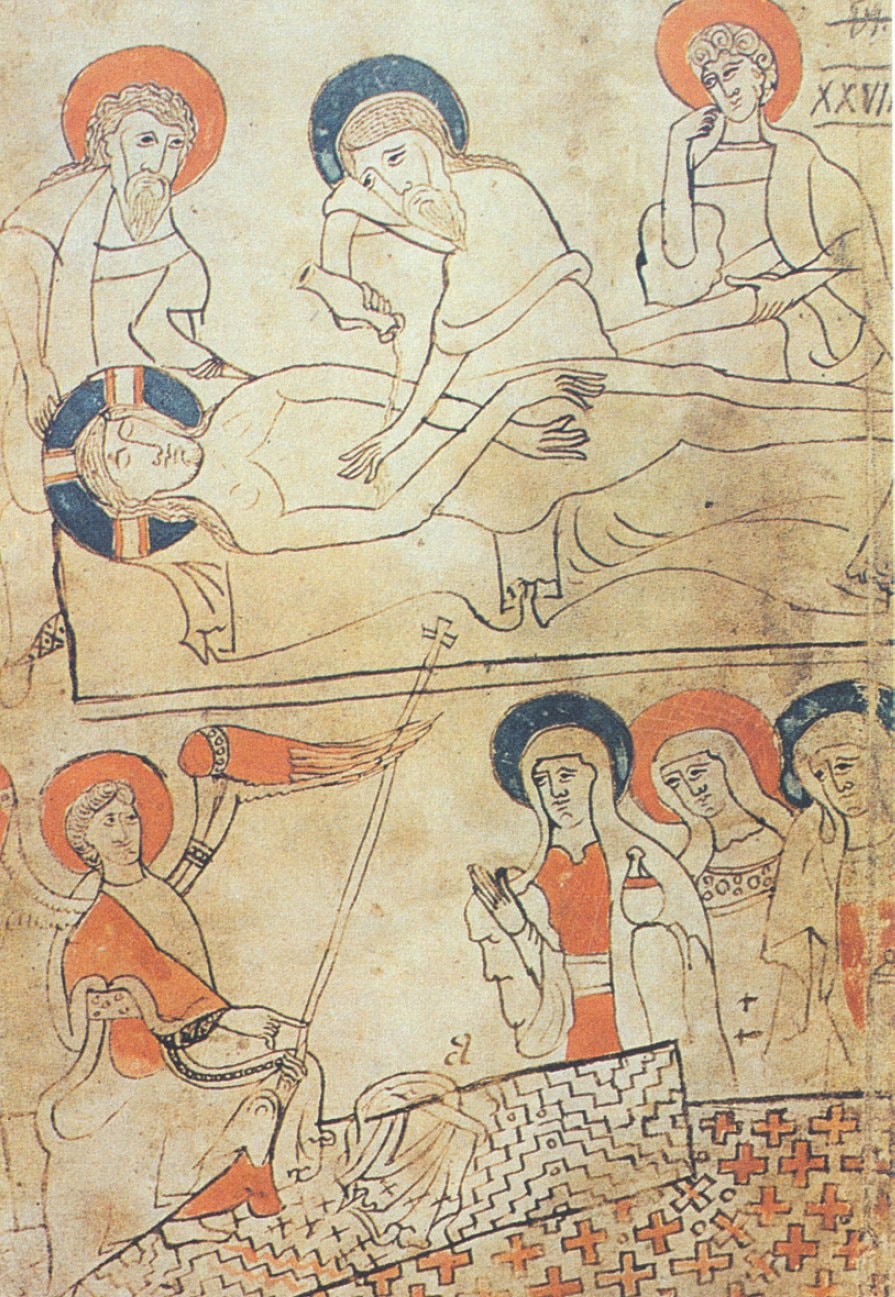
The Pray Codex burial page, Hungary, about 1192-1195, National Széchényi Library, Budapest. Above: the anointing of Christ's body. Below: the angel shows the women the empty tomb. Image: public domain, via Wikimedia Commons.
See this page's graph and discover linked topics
In full
The Pray Codex (also the Hungarian Pray Manuscript or Codex Pray) is a late 12th-century manuscript kept in the National Széchényi Library in Budapest. It is named for the Jesuit historian György Pray, who studied it in 1770. It is best known as the home of the Funeral Sermon and Prayer, the earliest continuous prose text in the Hungarian language, which is dated to 1192-1195. One of its illuminations shows the burial of Christ (upper register) and the Marys at the empty tomb with the angel (lower register). Shroud researchers argue the illumination reproduces several features peculiar to the Shroud of Turin:
- The body is fully nude with the hands crossed over the pelvis.
- The hands show four fingers and no thumbs.
- The cloth (or object) in the lower register carries a stepped zigzag pattern that resembles the Shroud's herringbone weave.
- It also carries small circles arranged in an L shape, matching the Shroud's pre-1532 "poker holes."
Andrea Nicolotti and other critics read the same features as standard Romanesque and Byzantine iconography with no relation to the Shroud. The dispute matters because a positive identification would place the Shroud in existence before 1195, earlier than the 1260-1390 range reported by the 1988 radiocarbon study (see Carbon-14 Dating Critique (Shroud)).
The burn marks: what is on the Shroud
The Shroud carries two separate sets of fire damage.
- The 1532 fire at Chambéry. This damage is the large set of scorch lines and triangular patches running down both sides of the image, repaired by Poor Clare nuns in 1534. It is the damage everyone sees in photographs.
- The older "poker holes." These are four groups of small burn holes, each group arranged in an L shape, repeated across the layers of the cloth as it was folded. They are not from 1532. A painted copy of the Shroud dated 1516, sixteen years before the fire, already shows them.
What made the L-shaped holes is unknown. Ian Wilson's name "poker holes" reflects one proposal, a deliberate test by fire. Others have proposed hot incense or another burning substance dripping through the folded cloth. Before the Pray Codex entered the discussion, nothing fixed when they were made, beyond "before 1516."
The match proponents point to
- The L-shaped holes. In the lower register, the object beneath the angel carries small circles drawn in an L-shaped arrangement. Proponents say these reproduce the poker-hole pattern. If so, the holes existed by about 1195, and so did the cloth.
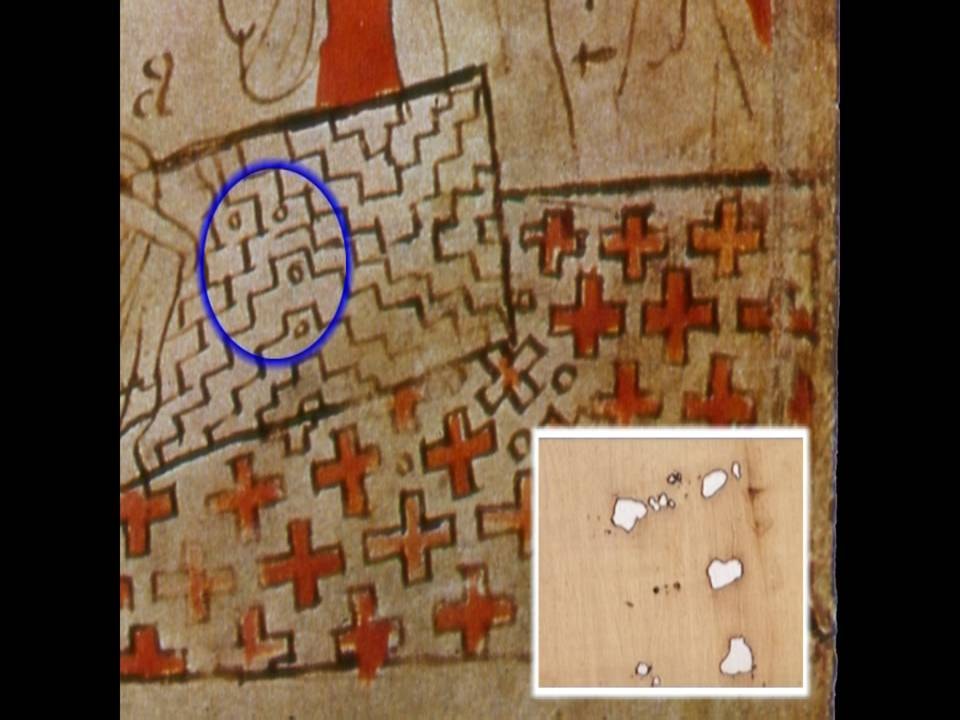
Left: the zigzag-patterned object in the Pray Codex, with the four small circles ringed. Inset: one set of the Shroud's L-shaped "poker holes." Proponents read the match as the artist copying the cloth; critics read the circles as ornament on a tomb lid. Image: public domain, via Wikimedia Commons.
- The four-fingered hands. The Shroud image shows four fingers on each hand with no visible thumb. Textile conservator Mechthild Flury-Lemberg, who led the 2002 restoration of the Shroud, is among those who note that the Pray figure's hands show the same thing. The usual explanation on the Shroud side is that a nail through the wrist contracts the thumb into the palm.
- Full nudity and crossed hands. The Shroud man is naked with his hands crossed over the groin. Proponents argue this was unusual for burial scenes of the period.
- The weave-like pattern. The lower-register object is drawn with stepped zigzag bands, which proponents read as the Shroud's herringbone twill.
- The historical setting. Hungary had close ties with Constantinople in the late 12th century, where a cloth bearing Christ's image (see Mandylion) was kept until 1204. On this view a Hungarian artist could have seen the cloth, or a copy of it.
The critics' reading
- It is a tomb, not a cloth. The lower register follows the standard "Marys at the tomb" layout of the period: a sarcophagus, an angel seated on the lid, and a folded grave cloth. The zigzag is a common way of drawing a decorated stone lid, not a weave.
- The circles are ornament. Small circles and L-shaped clusters are ordinary decorative motifs in manuscript art of the period. Similar dots appear elsewhere in the same image, on clothing and on the angel's wing.
- Nudity and crossed arms were not unique. Comparable nude, cross-armed Christ figures appear in other works of the period, such as the Ingeborg Psalter and the Sacramentary of Robert of Jumièges.
- No image on the cloth. The cloth in the picture shows no figure of a man, which is the Shroud's single most distinctive feature.
- Andrea Nicolotti, a historian of the Shroud's documentary history, concludes that the manuscript has no relation to the Shroud and that the claimed links come from misreading medieval artistic conventions.
How to weigh it
- Strongest point for identification: the L-shaped holes. A tomb-lid reading explains the zigzag and the nudity can be paralleled, but a match to an unusual, specific damage pattern is harder to dismiss as coincidence. Even a cautious reading on the Shroud side claims only that the artist probably had some direct or indirect knowledge of the Shroud, not that the picture is a portrait of it.
- Strongest point against: every individual feature has a parallel in ordinary medieval art, and the drawn cloth carries no image.
- What it does not do: the codex does not by itself date the Shroud to the 1st century. At most it pushes the Shroud's existence back to before 1195. That is still enough to conflict with the 1988 radiocarbon range, and it lines up with the other evidence summarized in Shroud of Turin Evidence.
Tensions
- Proponents and critics disagree on the most basic question, whether the lower-register object is a cloth or a stone lid. Everything else follows from that reading.
- The L-shaped "holes" are drawn as small circles. Whether an artist depicting burn holes would draw them that way is itself contested.
- The 1516 copy proves only that the poker holes predate the 1532 fire. Only the Pray Codex, if accepted, carries them back to the 12th century.
See also
- Shroud of Turin, the artifact the codex is claimed to depict
- Shroud of Turin Evidence, the cumulative case where the codex is one historical line
- Carbon-14 Dating Critique (Shroud), the 1260-1390 date the codex would contradict
- Mandylion, the cloth kept in Constantinople until 1204, the proposed route for a Hungarian artist's knowledge
- Sudarium of Oviedo, the other cloth claimed to predate the Shroud's 1355 appearance
- Crucifixion Forensics, the wrist-nail explanation for the thumbless hands
Common questions this page answers
Q: What is the Pray Codex?
The Pray Codex, or Hungarian Pray Manuscript, is a late 12th-century manuscript in the National Széchényi Library in Budapest. It contains the oldest continuous prose text in Hungarian, dated 1192-1195, and an illustration of Christ's burial and empty tomb that some researchers believe depicts the Shroud of Turin.
Q: Does the Pray Codex show the same burn holes as the Shroud of Turin?
Proponents say yes. The illustration shows small circles in an L shape that match the Shroud's "poker holes," a set of burn holes older than the 1532 fire. Critics say the circles are ordinary decoration on a stone tomb lid. The identification is disputed.
Q: What are the poker holes on the Shroud of Turin?
They are four groups of small L-shaped burn holes repeated through the folded cloth. A painted copy dated 1516 already shows them, so they predate the 1532 Chambéry fire. Their cause and date are unknown.
Q: Does the Pray Codex disprove the carbon-14 dating of the Shroud?
Only if it really depicts the Shroud. The codex dates to about 1192-1195, while the 1988 test dated the Shroud to 1260-1390. A genuine depiction would mean the cloth existed at least 65 years before the earliest lab date. See Carbon-14 Dating Critique (Shroud).
Q: Why does the figure in the Pray Codex have no thumbs?
The Shroud image shows four fingers and no thumbs, and so does the Pray figure. Shroud researchers explain the Shroud feature by a nail through the wrist, which pulls the thumb into the palm. Critics treat the drawing's hands as an artistic convention.