Person
Porcius Festus
Festus, Porcius Festus, Governor Festus, Procurator Festus, most excellent FestusIntro
Porcius Festus was the Roman governor of Judea who took over Paul's case from Felix. When Festus suggested a trial in Jerusalem, Paul used his right as a Roman citizen and said, "I appeal unto Cæsar." That appeal is why Paul went to Rome.
Festus also arranged the famous hearing before King Agrippa, where he shouted that Paul was mad. He governed only about two years and died in office. The Jewish historian Josephus describes his short rule, and bronze coins struck under him have been found by the hundreds at Masada.
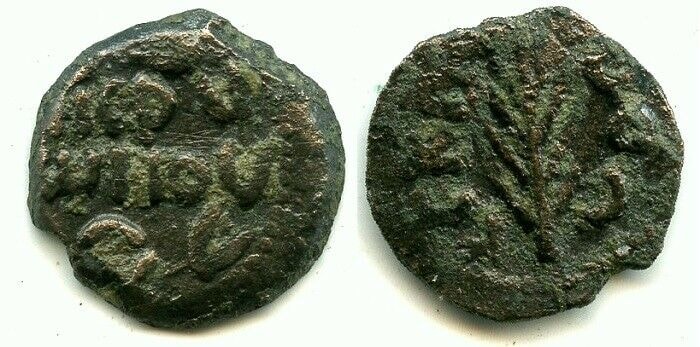
Bronze prutah struck in Judea under Porcius Festus in Nero's fifth year (AD 58/59). Public domain, via Wikimedia Commons.

See this page's graph and discover linked topics
In full
Festus was sent by Nero to succeed Antonius Felix as procurator of Judea, usually dated AD 59 or 60 (Josephus, Antiquities 20.182; Jewish War 2.271). Josephus presents him as a more active and more honest governor than his predecessor or his successors. His brief term is marked by four episodes in Josephus:
- The Sicarii. He found the countryside overrun by brigands and by the Sicarii, the "dagger men," and moved against them (Antiquities 20.185-187; Jewish War 2.271).
- A wilderness prophet. He sent troops against an impostor who "promised them deliverance, and freedom from the miseries they were under" if they followed him into the wilderness; the man and his followers were destroyed (Antiquities 20.188).
- The temple wall. When the priests raised a wall to block King Agrippa's view into the temple courts from his palace, "Festus ordered them to pull the wall down again." The Jews appealed to Nero, who let the wall stand "in order to gratify Poppea, Nero's wife" (Antiquities 20.189-196).
- Death in office. Festus died in Judea around AD 62. Before his successor Albinus arrived, the high priest Ananus son of Ananus convened the Sanhedrin and brought before it "the brother of Jesus, who was called Christ, whose name was James," who was then stoned (Antiquities 20.197-203). See James the Brother of Jesus.
In the Bible
Festus appears in Acts 24:27 to 26:32.
- Succession. "But when two years were fulfilled, Felix was succeeded by Porcius Festus" (Acts 24:27, ASV).
- Jerusalem and Caesarea. Three days after arriving he goes up to Jerusalem, where the chief priests ask him to bring Paul there; they plan an ambush. Festus refuses and hears the case at Caesarea (Acts 25:1-7).
- The appeal. "But Festus, desiring to gain favor with the Jews, answered Paul and said, Wilt thou go up to Jerusalem, and there be judged of these things before me?" Paul answers, "I am standing before Cæsar's judgment-seat, where I ought to be judged... I appeal unto Cæsar." Festus confers with his council: "Thou hast appealed unto Cæsar: unto Cæsar shalt thou go" (Acts 25:9-12, ASV).
- Consulting Agrippa. When King Agrippa and Bernice arrive, Festus lays out the case, admitting that the charges concerned "certain questions... of their own religion, and of one Jesus, who was dead, whom Paul affirmed to be alive" (Acts 25:13-21, ASV), and that he has nothing definite to write to the emperor (Acts 25:26-27).
- "Paul, thou art mad." As Paul speaks of the resurrection, "Festus saith with a loud voice, Paul, thou art mad; thy much learning is turning thee mad. But Paul saith, I am not mad, most excellent Festus; but speak forth words of truth and soberness" (Acts 26:24-25, ASV).
- The verdict. Agrippa tells Festus, "This man might have been set at liberty, if he had not appealed unto Cæsar" (Acts 26:32, ASV).
Family and lineage
Nothing certain is known of his family. The name Porcius belongs to a Roman gens that included the Catos, but no ancient source connects Festus to them.
Historical and archaeological evidence
| Source | What it says | Date | Where it is now | Grade |
|---|---|---|---|---|
| Josephus, Antiquities 20.182-203 | Nero sends Festus to succeed Felix; the Sicarii; the wilderness impostor; the temple wall and the appeal to Nero; his death and the interval in which James was killed | written c. AD 93-94 | manuscript tradition | contemporary witness, strong |
| Josephus, Jewish War 2.271 | "Festus succeeded Felix, as procurator, and made his business to correct those that made disturbances in the country" | written c. AD 75 | manuscript tradition | contemporary witness, strong |
| Bronze prutot of Nero's fifth year | Coins struck in Judea in AD 58/59: obverse the name of Nero in a wreath; reverse the word "of Caesar" (Kaisaros) with a palm branch and the date. They carry no governor's name and are assigned to Festus by date | AD 58/59 | 184 found at Masada; many in collections | material evidence of his administration |
Lawrence Mykytiuk counts Festus as confirmed, citing Josephus and the Masada coins ("New Testament Political Figures Confirmed," Biblical Archaeology Review 43:5, 2017). Eusebius, writing later, repeats that "Festus was sent by Nero to be Felix's successor" (Church History 2.22.1).
Scholarly consensus
- Existence and office are secure. Josephus names him twice and the sequence Felix, Festus, Albinus matches Acts.
- The date of his arrival is debated. The majority date it to AD 59 or 60. A minority argue for 55 or 56, partly because the coins dated to Nero's fifth year (58/59) could belong to either Felix or Festus. Since the coins carry no governor's name, the assignment to Festus depends on the chronology adopted.
- Acts and Josephus agree on character. Both present Festus as a governor who acted quickly (he heard Paul the day after returning to Caesarea, Acts 25:6) and who tried to keep the Jerusalem leadership on side.
- Roman legal procedure. Historians of Roman law, notably A. N. Sherwin-White (Roman Society and Roman Law in the New Testament, 1963), have judged Luke's account of the appeal and of Festus's need to send a written report to the emperor consistent with Roman practice in the period. See Acts as History (Ramsay's Verification).
Theological significance
- Paul's road to Rome. The appeal before Festus fulfils what the Lord told Paul in Jerusalem: "as thou hast testified concerning me at Jerusalem, so must thou bear witness also at Rome" (Acts 23:11, ASV).
- The resurrection at the center. Festus's summary, "one Jesus, who was dead, whom Paul affirmed to be alive" (Acts 25:19, ASV), is an outsider's statement of the core Christian claim. See Resurrection of Jesus.
- "Not done in a corner." Paul's reply to Festus, that the events of Jesus' death and resurrection were public and known to the king (Acts 26:26), is one of the New Testament's own appeals to checkable history.
Church Fathers
- John Chrysostom, Homilies on Acts 52, reads Festus's report to Agrippa as a virtual acquittal ("Festus himself acquits him from the charges") and defends Paul's appeal: "It shows that he did right in appealing to Cæsar."
- Eusebius, Church History 2.22.1: "Festus was sent by Nero to be Felix's successor. Under him Paul, having made his defense, was sent bound to Rome."
Scholarship
Published academic works this page draws on, each matched to a publisher, index or library catalog record.
- A. N. Sherwin-White, Roman society and Roman law in the New Testament (1963). Open Library
See also
- Paul the Apostle, whose appeal to Caesar Festus granted
- Antonius Felix, his predecessor
- Herod Agrippa II and Bernice, the royal visitors at Paul's hearing
- Nero, the emperor to whom Paul appealed
- James the Brother of Jesus, executed in the interval after Festus's death
- Josephus, the historian who records his term
- Biblical Figures Confirmed by Archaeology, Mykytiuk's list of confirmed persons
- People of the Bible, the hub of attested biblical people by book
Common questions this page answers
Q: Who was Festus in the book of Acts?
Porcius Festus was the Roman governor of Judea who followed Felix, around AD 59 or 60. He heard Paul's case at Caesarea, granted Paul's appeal to Caesar, and arranged the hearing before King Agrippa in Acts 26.
Q: Why did Paul appeal to Caesar before Festus?
Festus proposed moving the trial to Jerusalem, where Paul's enemies had already plotted to kill him. As a Roman citizen Paul had the right to have his case heard by the emperor, and he used it: "I appeal unto Cæsar" (Acts 25:11).
Q: Is Porcius Festus mentioned outside the Bible?
Yes. Josephus describes his governorship, his fight against the Sicarii, a dispute over a temple wall that went to Nero, and his death in office around AD 62. Coins struck in Judea in Nero's fifth year, usually assigned to him, have been found at Masada.
Q: Why did Festus say Paul was mad?
When Paul spoke about Christ rising from the dead and bringing light to the Gentiles, Festus interrupted: "Paul, thou art mad; thy much learning is turning thee mad" (Acts 26:24). Paul answered that he spoke "words of truth and soberness."