Argument
Polygamy Is Not a Sin Objection Defeater
Polygamy Is Not a Sin, Polygyny Permitted for Christians Objection, Second Wife Is Not Adultery Objection, Biblical Polygamy Today Objection, Christian Polygamy Defeater, Divine Marriage DefeaterIntro
Some people say: "A man marrying another woman isn't adultery. Abraham, Jacob, David and Solomon all had more than one wife. The Law of Moses made rules for men with two wives and never told them to send one away. So polygamy is not a sin, and I can do it today." You hear this from some Hebrew Israelite communities, from some professing Christians, and from Mormon fundamentalists who kept plural marriage after their church dropped it.
Part of that is true, and it is worth saying so plainly. Under the Law of Moses, adultery meant sleeping with another man's wife. A married Israelite who took a second wife was not charged with adultery for it. The Law did regulate households with two wives.
But that is not where the Bible stops. When Jesus was asked about marriage, he went back past Moses to the beginning: God made one man and one woman, and "they twain shall be one flesh." He said the things Moses allowed were allowed "because of the hardness of your hearts," and "from the beginning it was not so." Then he said something no Israelite law had said: a man who puts away his wife and marries another commits adultery against her, against his own wife. That changes who can be wronged. If a second union is adultery against the first wife when he divorces her, it cannot become innocent because he keeps her.
The apostles build on that. Every man is to have his own wife and every woman her own husband. Church leaders must be the husband of one wife. Marriage pictures Christ and his one church. And the Old Testament stories of men with many wives read like warnings, not models: rival wives, a "hated" wife, sons at war, and Solomon whose wives turned his heart to idols.
So the honest answer is this. The Bible records polygamy and the Law put limits on it. Jesus restored the original design, and for a follower of Jesus a second wife is not an open option.
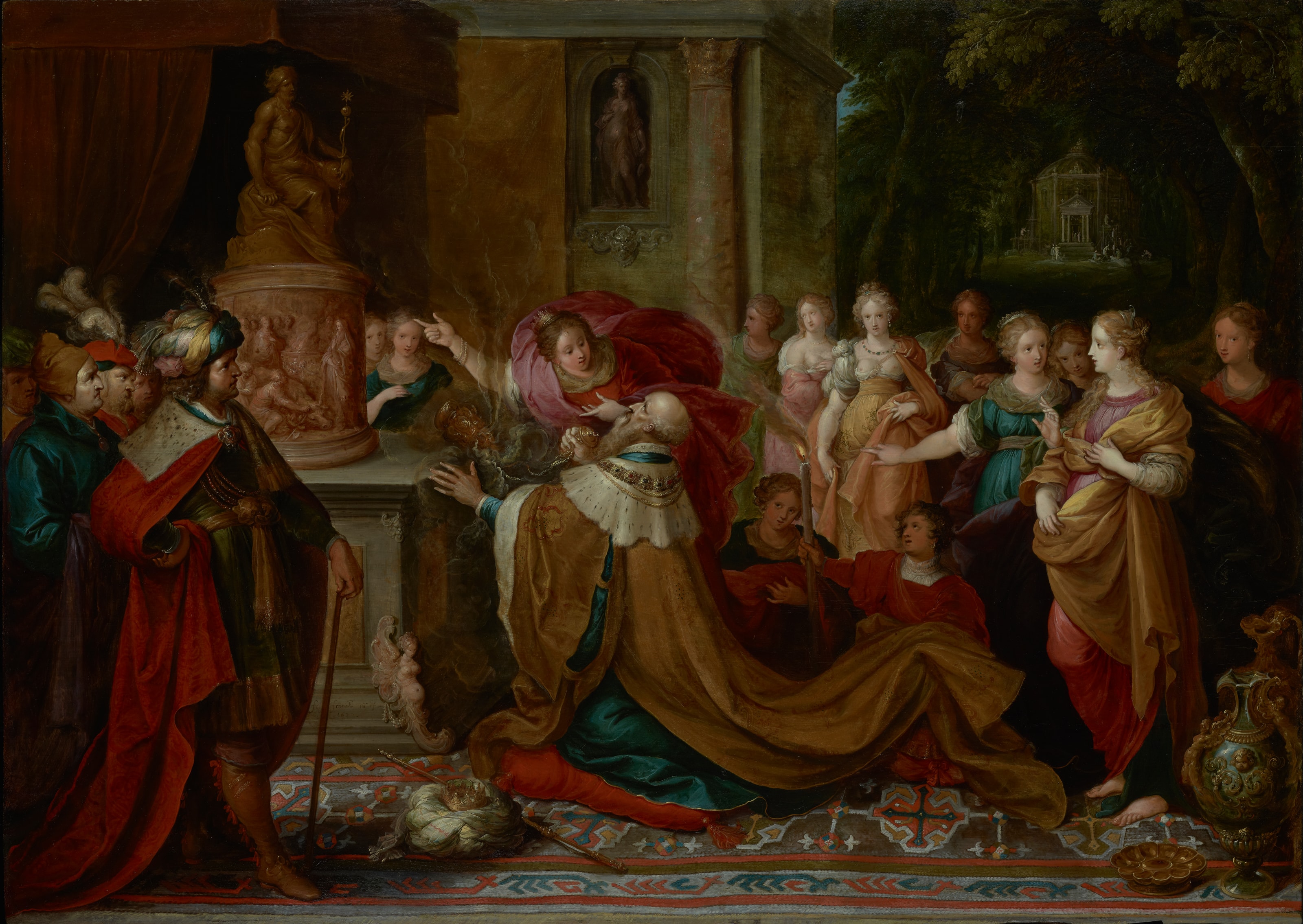
The Idolatry of Solomon, Frans Francken the Younger, 1622, J. Paul Getty Museum. "His wives turned away his heart after other gods" (1 Kings 11:4, KJV). Image: public domain, via Wikimedia Commons, resized.

See this page's graph and discover linked topics
In full
The objection is intra-biblical and practical. It does not say the Bible is immoral for containing polygamy; that atheist version is answered at OT Polygamy Objection Defeater. It says the Bible permits polygamy, and therefore a believer may enter a polygynous marriage now. Its standard form:
- Under the Mosaic Law, adultery is intercourse with another man's wife (Leviticus 20:10). A man taking an unmarried woman as a second wife does not fall under it.
- The Law regulates polygyny without condemning it: the first wife's food, clothing and marital rights are protected (Exodus 21:10), and the firstborn of the less-loved wife keeps his double portion (Deuteronomy 21:15-17).
- God himself says he gave David his master's wives (2 Samuel 12:8).
- Deuteronomy 17:17 limits only the king, and only from multiplying wives.
- Therefore polygyny is not sin, and nothing forbids a believer from practicing it today.
Premises 1 and 2 are substantially correct as descriptions of the Mosaic code, and this page grants them. The conclusion still fails, because it treats the Mosaic code as the final word on marriage for a follower of Jesus. Jesus explicitly reached behind that code to the creation pattern (Matthew 19:4-8; Mark 10:6-9), named its marital permissions as concessions to hardness of heart, and widened adultery so that a husband can commit it against his own wife (Mark 10:11). The apostolic household ethic assumes a pair (1 Corinthians 7:2-4), the qualifications for overseers and deacons require one wife (1 Timothy 3:2, 12; Titus 1:6), and the Christ-and-church typology requires one bride (Ephesians 5:31-32). Every Christian tradition, East and West, Catholic and Protestant, has read the texts this way, with only rare and short-lived exceptions that their own communities repudiated.
The precise conclusion matters, because overstating it hands the objector an easy win. This page does not argue that the patriarchs were adulterers under the law they lived under, or that the Law of Moses called a second marriage adultery. It argues that the creation design was always monogamous, that Mosaic regulation was accommodation rather than endorsement, and that under the New Covenant a believer who takes a second wife sins against the first. For why the Mosaic code as such does not bind believers today, see Christians Not Under Mosaic Law and Mosaic Law Binding for True Israelites Objection Defeater.
Cheatsheet
The 30-second reply:
You are right that the Law of Moses regulated two-wife households and did not call them adultery. But Jesus went behind Moses to the beginning: God made them male and female, "they twain shall be one flesh," and what Moses allowed was for hardness of heart. Then he said a man who leaves his wife and marries another commits adultery against her. If marrying a second woman is adultery against the first when you divorce her, it does not become righteous because you keep her. Paul says every man should have his own wife and every woman her own husband, and an elder must be the husband of one wife. The patriarchs lived under accommodation. You live under Christ.
The fast facts:
- The design is two. Genesis 2:24 has a man cleave to "his wife," singular, and Jesus quotes it as "they twain shall be one flesh" (Matthew 19:5, KJV): "they are no more twain, but one flesh."
- Jesus overrules the concession. "Moses because of the hardness of your hearts suffered you... but from the beginning it was not so" (Matthew 19:8, KJV).
- Jesus moves the injured party. Under Leviticus 20:10 adultery wrongs another husband. In Mark 10:11 a husband "committeth adultery against her," his own wife.
- The apostles assume a pair. "Let every man have his own wife, and let every woman have her own husband" (1 Corinthians 7:2, KJV), and each has authority over the other's body (7:4).
- Leaders: one wife. "The husband of one wife" (1 Timothy 3:2, 12; Titus 1:6). Its exact scope is debated; on every reading, a polygamist is excluded.
- Even the king was limited. "Neither shall he multiply wives to himself, that his heart turn not away" (Deuteronomy 17:17, KJV), and Solomon's "wives turned away his heart" (1 Kings 11:3).
- Ancient Jews read Genesis this way too. The Damascus Document from the Dead Sea Scrolls (CD 4:20-5:2) condemns taking two wives in one's lifetime, citing "male and female he created them" and Deuteronomy 17:17, generations before the New Testament.
- The church has never allowed it. Justin Martyr, Augustine, Trent (Session XXIV canon 2) and the Westminster Confession (24.1) all exclude it.
The 3 strongest counter-moves:
- "Do you follow Jesus or Moses on marriage?" Jesus' own answer to a Mosaic-law question was to go back to Genesis. A believer cannot appeal to Moses against the one who said "but I say unto you."
- "Read Mark 10:11 out loud." "Committeth adultery against her." The wife can be wronged by her husband's second union. That sentence does not exist anywhere in the Mosaic code.
- "Name the polygamous household in Scripture that went well." Lamech, Abraham, Jacob, Elkanah, David, Solomon. Rivalry, a wife called "hated," a "rival" who provokes, sons at war, and a king drawn into idolatry.
Reciprocal concessions (grant the small point, then collect a bigger one):
- Grant: the Mosaic Law did not classify a second marriage as adultery. Now collect: the Mosaic Law also permitted divorce by bill (Deuteronomy 24:1), and Jesus overruled that permission on the same Genesis grounds in the same breath. If the divorce permission does not bind a Christian, neither does the polygamy accommodation.
- Grant: the Law never ordered a man to send away extra wives. Now collect: it also never ordered him to stop divorcing, and Jesus still called remarriage after divorce adultery. Absence of a Mosaic command is not presence of Christ's permission.
- Grant: God worked through polygamous families, and the twelve tribes came from Jacob's four women. Now collect: God also worked through Joseph's brothers' betrayal. Grace that redeems a broken arrangement does not authorise you to repeat it.
- Grant: "husband of one wife" is debated. Now collect: every interpretation of it, fidelity, no remarriage, or no polygamy, excludes a man with two living wives. The debate is about what else it excludes.
The closing line:
Moses regulated what hard hearts were already doing. Jesus told us what God made in the beginning: one man, one woman, one flesh. A Christian does not get to choose the concession over the Creator.
Grammar and hermeneutics
The claim turns on biblical texts, so it can be settled first on grammar and genre, before any wider theology.
- Descriptive narrative is not prescriptive law. Every polygamous marriage in Scripture is reported in narrative, by the ordinary past-tense narrative verbs ("and Lamech took unto him two wives," Genesis 4:19). No imperative anywhere in the canon instructs a man to take a second wife. A practice that appears only in the descriptive register has been recorded, not commanded. The same reader who sees that Jacob's deception of Isaac is not a model must apply the same rule to Jacob's marriages.
- Case law is conditional, not commendatory. Exodus 21:10 and Deuteronomy 21:15 are casuistic laws in "if... then" form: "If he take him another wife," "If a man have two wives." Casuistic law states what must happen when a situation arises; it does not approve the situation. Deuteronomy 24:1-4 is cast in the same conditional form for divorce, and Jesus treats it as a permission granted for hardness of heart (Matthew 19:8). In Exodus 21:10 the Hebrew has no word for "wife" in the conditional clause; it reads literally "if another he takes for himself," and the protection that follows is for the first woman.
- The law's own vocabulary carries the verdict. Deuteronomy 21:15 calls the two wives "beloved" and "hated" (sane', H8130), the same verb used of Leah: "the LORD saw that Leah was hated" (Genesis 29:31, KJV). Leviticus 18:18 forbids taking a wife's sister "to vex her" (tsarar, H6887), and Hannah's co-wife Peninnah is called "her adversary" (tsarah, H6869, 1 Samuel 1:6); later rabbinic Hebrew uses tsarah as the ordinary word for a co-wife. The language the Bible uses for polygamy is the language of rivalry.
- The founding sentence is singular. Genesis 2:24 joins "a man" to "his wife" (ishto, singular noun with singular suffix), and they become basar echad, "one flesh," with the cardinal echad. The Septuagint renders the clause "and the two shall become one flesh," and Jesus and Paul both quote it in that form (Matthew 19:5; Mark 10:8; Ephesians 5:31). Jesus then draws the consequence himself: "they are no more twain, but one flesh" (Matthew 19:6). The count is explicit in the form the New Testament treats as authoritative.
- Jesus' argument is from creation, not culture. "Have ye not read, that he which made them at the beginning made them male and female" (Matthew 19:4). The phrase "from the beginning" appears twice in the exchange (19:4, 8). An argument from the beginning is an argument from the design, which is why it outranks a later permission.
- "Against her" moves the offended party. In Mark 10:11, "committeth adultery against her" translates moichatai ep' autēn, with epi (G1909) plus the accusative pronoun. The nearest antecedent is "his wife," the woman put away. Some interpreters take "her" as the new woman, but most commentators read it as the first wife, and the parallel in Matthew 19:9 places the adultery in the act of marrying "another" while the first bond stands in God's sight. Either way, Jesus describes a husband committing adultery by a second marriage, which the Levitical definition never did.
- "Each his own" is distributive. 1 Corinthians 7:2 reads hekastos tēn heautou gynaika echetō, kai hekastē ton idion andra echetō: "let every man have his own wife, and let every woman have her own husband" (KJV). Each man, one wife of his own; each woman, one husband of her own. Verse 4 then makes the claims symmetrical: the wife has authority over the husband's body exactly as he has over hers. That symmetry cannot be divided among several wives.
- "Husband of one wife" uses the numeral. 1 Timothy 3:2 has mias gynaikos andra, literally "a one-woman man," with mias, the feminine genitive of the numeral heis ("one," Strong's G3391), placed first for emphasis; 3:12 and Titus 1:6 repeat it. 1 Timothy 5:9 uses the mirror phrase for an enrolled widow, henos andros gynē, "a one-man woman." Because polyandry was not a live practice, that parallel shows the phrase is about the character of a faithful spouse and not only about polygamy. That is exactly why it does not help the objector: a man with two living wives is not a one-woman man on any reading.
- Deuteronomy 17:17 is a negative command with a purpose clause. "Neither shall he multiply wives to himself, that his heart turn not away" (KJV) is lo' plus the imperfect, the form of the Decalogue's prohibitions, and the verb rabah (H7235) is the same one used for horses in 17:16 and silver and gold in 17:17. Whether it forbids any plurality or only excess is debated (Premise 4); either way it is a brake, not a licence, and 1 Kings 11:3-4 records the exact outcome its purpose clause warned of.
On genre (narrative and casuistic law describe and contain; they do not commend), on number (the founding sentence and its New Testament citations count two), and on Jesus' own syntax ("against her"), the claim that Scripture leaves polygyny open to a believer does not survive a plain reading.
Argument structure
| Premise | Notes | |
|---|---|---|
| P1 | God's design for marriage, stated before any polygamous episode, is one man and one woman as one flesh (Genesis 2:24; Genesis 1:27). | Creation norm |
| P2 | Jesus made that creation design the binding standard for his followers and named Mosaic marital permissions as concessions to hardness of heart (Matthew 19:4-8; Mark 10:6-9). | Restoration |
| P3 | Jesus extended adultery so that a husband can commit it against his own wife by a second union (Mark 10:11-12; Matthew 19:9). | Redefinition of the wronged party |
| P4 | The Mosaic texts the objector cites regulate and restrain polygyny; they do not commend it (Exodus 21:10; Deuteronomy 21:15-17; Deuteronomy 17:17; Leviticus 18:18), and the narratives show its fruit. | Regulation is not endorsement |
| P5 | The apostolic church assumed and required monogamy (1 Corinthians 7:2-4; 1 Timothy 3:2, 12; Titus 1:6; Ephesians 5:31-32), and the whole church has read it so. | Apostolic and historic witness |
| C | Polygyny is not an open option for a follower of Jesus; a believer who takes a second wife sins against the first. |
Master objections to the whole argument
MO1: "Jesus was talking about divorce, not polygamy. You are stretching his words."
- The question put to him was about divorce, and his answer was about what marriage is. He did not answer with a rule about certificates; he answered with Genesis: two become one flesh, "no more twain." A definition of marriage as the union of two answers every question about how many.
- His conclusion about adultery depends on the first bond still standing. The man who divorces and remarries commits adultery because, in God's sight, he is still joined to his first wife. In polygyny the first bond is not even claimed to be dissolved. The polygamist is in the position Jesus describes, without the paperwork.
- The Qumran community, reading the same Genesis text before Jesus, drew the same consequence for polygyny (CD 4:20-5:2). Applying "male and female he made them" to the number of wives was a live Jewish reading in Jesus' own century, not a later Christian invention.
MO2: "If polygyny were sin, the Law would have commanded men to put away the extra wives. It never did."
- This is the objector's best question and it deserves a direct answer. The Law also never commanded men to stop divorcing; it regulated divorce (Deuteronomy 24:1-4). Jesus said that permission existed "because of the hardness of your hearts" (Matthew 19:8). The same category explains the absence of a command to dismiss wives: the Law contained the damage of a practice it did not create.
- Commanding a mass dismissal would also have thrown the secondary wives and their children out of the only household that supported them. Exodus 21:10 points the other way: once she is taken, her food, clothing and marital rights may not be reduced. The Law protected the woman from the consequences of the man's choice.
- Churches in mission settings have faced the same question, and many have answered it the same way: a man who comes to Christ with several wives is not to cast them off, but no believer may enter a new plural marriage (see Tensions below). The concession covers what hard hearts already did; it never licenses what a renewed heart chooses next.
MO3: "God said he gave David his master's wives (2 Samuel 12:8). God handed out a plural household."
- The verse lists what came with Saul's throne: "thy master's house, and thy master's wives... and the house of Israel and of Judah" (KJV). In Samuel and Kings, the former king's women pass with the crown (2 Samuel 3:7-10; 16:21-22; 1 Kings 2:22). It names a royal succession, and its function is to convict David of ingratitude for taking Uriah's one wife.
- Full treatment of this verse is at OT Polygamy Objection Defeater (MO5). Even read at its strongest, it describes how God governed within the old order, which Jesus explicitly set aside on marriage.
MO4: "Paul only restricted overseers. That implies ordinary believers could have more than one wife."
- A qualification for leaders sets out what the church holds up as the model to follow; it does not create a second, laxer ethic for everyone else. Most of the list (sober, not violent, not greedy, hospitable) applies to every believer.
- Paul gave the general rule separately and without restriction to leaders: "let every man have his own wife, and let every woman have her own husband" (1 Corinthians 7:2). The overseer list repeats for leaders what was already the household rule for all.
- One common explanation is that the qualification fits a church receiving converts who already had complicated households. Such a man could be baptised, but he could not be held up as the example to the flock. That is accommodation of a past, not permission for a future.
MO5: "This is just Roman culture. Greeks and Romans were monogamous, so the New Testament reflected its setting."
- The observation about Roman law is true and does not explain the argument used. Jesus and Paul do not appeal to custom; both reach past every culture to Genesis. A writer reflecting his setting would cite the setting.
- The Jewish world of the first century still permitted polygyny. Josephus reports it as ancestral custom (Antiquities 17.1.2), and Justin Martyr in the second century complained that some Jewish teachers allowed four or five wives (Dialogue with Trypho 134). The New Testament's monogamy is therefore not simply the default of its environment; it chose the Genesis reading over a live alternative.
MO6: "Polygamy is African and biblical. Monogamy is a European imposition."
- Monogamy as the Christian rule was taught by Africans and Asians long before Europe was Christian. Augustine of Hippo, a North African, wrote the classic treatment (De Bono Coniugali), and the North African Tertullian took one wife at a time as the uncontested starting point while arguing for an even stricter discipline.
- The argument here is from Genesis and from Jesus, a Jew of Galilee, not from any European custom. The same standard binds a European Christian who wants a second wife.
- Modern African church leaders have debated the pastoral care of polygamous converts precisely because they accept the norm. The debate is about mercy for those already inside such households, not about whether a believer may start one.
Premise 1, The creation design is one man and one woman
Affirmative case
- The founding text is singular throughout. Genesis 2:24 has "a man" leave father and mother and "cleave unto his wife," and "they shall be one flesh" (KJV). There is no plural in the norm-setting sentence.
- The creation pair comes first. Genesis 1:27, "male and female created he them," and Genesis 2:18-24 both precede every polygamous episode in the canon. Later practice is measured against a standard already given.
- The first polygamist is a bad omen. Lamech, in Cain's line, "took unto him two wives" (Genesis 4:19), and his next recorded words boast of killing a man and avenging himself seventy-sevenfold (4:23-24). The text's first association of the practice is violence.
- The prophets read marriage as one covenant. Malachi 2:14 calls the wife "thy companion, and the wife of thy covenant," and the LORD is "witness between thee and the wife of thy youth." Malachi 2:15 then asks, "And did not he make one?... And wherefore one? That he might seek a godly seed" (KJV). The Hebrew of 2:15 is among the hardest in the prophets and is translated in several ways, so it should support the case rather than carry it; but the common thread of the readings is that God made the marriage one and seeks faithfulness within it.
Anticipated objections
- "Genesis 2 explains why marriage exists; it does not legislate how many wives."
- "Malachi is about divorce and marrying pagans, not polygamy."
Rebuttals
- The canon itself uses Genesis 2:24 as a rule. Jesus cites it to settle a disputed question of marriage practice (Matthew 19:4-6), and Paul cites it to instruct Christian husbands (Ephesians 5:31). Whatever its genre, the Bible's own use of the verse is normative. Failure mode: assigning a genre in order to exclude the use Scripture itself makes of the text.
- Agreed, and the point still holds. Malachi's immediate target is a husband who deals treacherously with the wife of his youth. Its contribution here is the covenant category: the first wife is a covenant partner with God as witness. A man who adds a rival to that covenant is not keeping faith with it. Failure mode: treating a supporting text as if the case rested on it.
Premise 2, Jesus restored the creation design for his followers
Affirmative case
- Jesus answered a Mosaic question with Genesis. Asked whether a man may put away his wife "for every cause," he answered: "Have ye not read, that he which made them at the beginning made them male and female" (Matthew 19:4, KJV).
- He drew the numerical consequence. "Wherefore they are no more twain, but one flesh. What therefore God hath joined together, let not man put asunder" (Matthew 19:6). Mark 10:8 repeats it.
- He named Mosaic permission as concession. "Moses because of the hardness of your hearts suffered you to put away your wives: but from the beginning it was not so" (Matthew 19:8). The principle is general: the Mosaic code contains some marital permissions that are not God's design.
- His disciples heard it as a raised standard. Their reply, "If the case of the man be so with his wife, it is not good to marry" (Matthew 19:10), shows they understood Jesus to be tightening, not loosening, the rules of the day.
Anticipated objections
- "Jesus said he came not to destroy the law (Matthew 5:17). He would not overturn Moses."
- "Hardness of heart refers only to divorce."
Rebuttals
- Fulfilling the law is exactly what Matthew 19 shows. In the same sermon as Matthew 5:17, Jesus says "It hath been said, Whosoever shall put away his wife, let him give her a writing of divorcement: but I say unto you" (Matthew 5:31-32). Fulfilment, in Jesus' usage, carries the law to its intended end, and the end of the marriage laws is the Genesis design. Failure mode: quoting Matthew 5:17 while skipping the "but I say unto you" sayings that immediately apply it.
- The reasoning is broader than the example. Jesus' argument is: (a) God's design is the one-flesh pair; (b) a Mosaic permission that departs from it was a concession; (c) the design now governs. That reasoning applies to any Mosaic accommodation of departures from the one-flesh pair. Polygyny departs from the pair more obviously than divorce does, because it adds a third party while the first bond is intact. Failure mode: restricting a principle to its first application.
Premise 3, Jesus moved the injured party in adultery
Affirmative case
- The Levitical definition protects another husband. "The man that committeth adultery with another man's wife... the adulterer and the adulteress shall surely be put to death" (Leviticus 20:10, KJV). On this definition, the wronged party is the other woman's husband, and a man's own wife has no claim.
- Jesus names the wife as the wronged party. "Whosoever shall put away his wife, and marry another, committeth adultery against her" (Mark 10:11, KJV). The husband sins against his own wife by his second union.
- He makes the obligation mutual. Mark 10:12 applies the same rule to a woman who leaves her husband and marries another. Fidelity runs both ways.
- The a fortiori follows. If a man who divorces his wife and marries another commits adultery against her, a man who keeps his wife and marries another does at least the same: the first bond is not even claimed to be dissolved. Jesus' reasoning depends on the first marriage still standing, and in polygyny it stands by definition.
Anticipated objections
- "Mark 10:11 condemns divorce-and-remarriage, not simultaneous marriage. Do not import a case Jesus did not address."
- "'Against her' may mean against the new woman, not the first wife."
Rebuttals
- The verse condemns the second union, and the divorce is what makes it look legitimate. The adultery Jesus names is "marry another." Divorce is the step that, in the hearers' minds, cleared the way for the second marriage. Jesus denies that it does. Remove the divorce and the second marriage has even less cover. Failure mode: treating the aggravating condition as if it were the only condition.
- The grammar points to the first wife, and the argument does not need it to. The nearest antecedent of "her" is "his wife." But on any reading, Jesus calls a man's second marriage adultery while the first bond holds in God's sight, which the Levitical definition never did. Failure mode: winning a pronoun while losing the sentence.
Premise 4, Regulation is not endorsement, and the narratives show the fruit
Affirmative case
- Exodus 21:10 protects the first woman. "If he take him another wife; her food, her raiment, and her duty of marriage, shall he not diminish" (KJV). The context is a slave-woman taken as a wife (21:7-11), and the law's whole concern is that she not be degraded when he adds another. It restrains the man.
- Deuteronomy 21:15-17 protects the disfavoured son. "If a man have two wives, one beloved, and another hated" (KJV), he may not transfer the firstborn's double portion to the favourite's son. The law assumes polygyny produces favouritism and blocks its worst result.
- Deuteronomy 17:17 brakes the king. "Neither shall he multiply wives to himself, that his heart turn not away." Two readings exist, and both are old. The Mishnah (Sanhedrin 2:4) allows a king up to eighteen, with Rabbi Judah permitting more if they do not turn his heart and Rabbi Simeon forbidding even one who would. The Temple Scroll from Qumran (11QT 57:17-18) reads it strictly: the king shall take no other wife beside her, for she alone shall be with him all the days of her life. On either reading the verse limits, and it never licenses.
- Leviticus 18:18 forbids the exact arrangement Jacob had, taking a wife's sister "to vex her" while the first lives.
- The narratives show what happened every time.
- Abraham: Sarah's plan with Hagar ends in contempt, harsh treatment and Hagar's flight (Genesis 16:4-6), then expulsion (21:9-14).
- Jacob: "Leah was hated" (Genesis 29:31), Rachel cries "Give me children, or else I die" (30:1), the sons of the rival wives sell the favourite's son (37).
- Elkanah: Peninnah is Hannah's "adversary" who "provoked her sore, for to make her fret" year after year (1 Samuel 1:6-7).
- David: Amnon rapes his half-sister Tamar, Absalom kills Amnon and later rebels (2 Samuel 13-18).
- Solomon: "seven hundred wives, princesses, and three hundred concubines: and his wives turned away his heart" (1 Kings 11:3, KJV), and "the LORD was angry with Solomon" (11:9).
Anticipated objections
- "Regulation implies legitimacy. You do not regulate what is sinful."
- "The narratives show sin in polygamous families, not that polygamy is the sin. Monogamous families sin too."
Rebuttals
- The Law regulates divorce, slavery and blood vengeance too. Deuteronomy 24:1-4 regulates divorce, and Jesus says it was not so from the beginning. Exodus 21 regulates debt-slavery; Numbers 35 regulates the avenger of blood with cities of refuge. Regulation in the Mosaic code routinely contains harm without approving the practice. Failure mode: inferring approval from a law whose purpose is protection.
- The pattern is the point, and the text supplies the causation. No narrative proves a rule by itself, but a consistent pattern across every polygamous household, with the law's own vocabulary of "hated" and "adversary," is how Hebrew narrative teaches. In Solomon's case the narrator states the cause outright: "his wives turned away his heart." Failure mode: demanding an editorial aside from a narrative that has already stated its verdict.
Premise 5, The apostles assumed and required monogamy, and the church has always read it so
Affirmative case
- The household rule for all believers. "Let every man have his own wife, and let every woman have her own husband" (1 Corinthians 7:2, KJV), with mutual authority over each other's bodies (7:3-4).
- The leadership rule. "A bishop then must be blameless, the husband of one wife" (1 Timothy 3:2); deacons likewise (3:12); elders likewise (Titus 1:6).
- The typology. Paul quotes Genesis 2:24 and says, "This is a great mystery: but I speak concerning Christ and the church" (Ephesians 5:31-32). Christ has one bride. A marriage that pictures him with several brides misrepresents the gospel it is meant to display.
- The historic witness is unbroken in principle.
- Justin Martyr rebuked teachers who allowed four or five wives (Dialogue with Trypho 134, c. 160).
- Augustine held that the patriarchs' plural marriages were not sin under their circumstances, but that a Christian may not take a second wife now (De Bono Coniugali, c. 401).
- Thomas Aquinas argued that plurality of wives is contrary to the goods of marriage and that the patriarchs were permitted it by divine dispensation only (Summa Theologiae Suppl. q. 65).
- The Council of Trent anathematised the claim that Christians may lawfully have several wives at once and that no divine law forbids it (Session XXIV, canon 2, 1563).
- The Westminster Confession: "neither is it lawful for any man to have more than one wife... at the same time" (24.1, 1646).
Anticipated objections
- "'Husband of one wife' may mean 'faithful husband' or 'married only once.' It may not be about polygamy at all."
- "Luther approved a bigamy, and the Münster Anabaptists practised polygamy. The tradition is not unanimous."
Rebuttals
- Present the options honestly, because the conclusion survives all of them. The main readings are: (a) no polygamy; (b) no remarriage after divorce; (c) no remarriage even after a spouse's death; (d) "a one-woman man," a husband faithful to his wife. The mirror phrase for widows in 1 Timothy 5:9 favours a character reading such as (d). But every one of these readings excludes a man with two living wives. Failure mode: citing an interpretive debate as if it opened a door that every side of the debate keeps shut.
- The exceptions prove how strong the rule is. In 1539 Martin Luther, Philip Melanchthon and Martin Bucer gave Landgrave Philip of Hesse a secret confessional opinion allowing a second wife; the marriage (March 1540) became a public scandal, the reformers' attempts to conceal it damaged their reputations, and no Lutheran or Reformed confession ever adopted it. The radical Anabaptists at Münster imposed polygamy in 1534-35, and the episode was repudiated by the peaceable Anabaptist mainstream. Both cases are remembered precisely as departures. Failure mode: treating a scandal as a precedent.
Tensions
- What the Mosaic Law called adultery. This page grants that the Mosaic Law did not classify a man's second marriage as adultery (Leviticus 20:10). Some Christian writers state flatly that polygamy was always adultery. The stronger and more defensible claim is narrower: it was always a departure from the creation design, and under Christ's teaching a second union is adultery against the first wife. Augustine's position (no sin for the patriarchs in their circumstances, sin for a Christian now) is the classical form of this distinction.
- Deuteronomy 17:17. Jewish tradition is divided between a limit on number (Mishnah Sanhedrin 2:4) and a one-wife rule for the king (Temple Scroll 11QT 57:17-18). This page does not decide between them, because neither reading supports the objection.
- "Husband of one wife." Commentators disagree on the scope of the phrase, as set out under Premise 5.
- Polygamous converts. Christian traditions differ on how to receive a man who already has several wives when he comes to faith, whether he must dismiss all but one or may keep and provide for them without ordination. The Anglican Lambeth Conference of 1888 barred polygamists from baptism; the 1988 Conference (Resolution 26) reversed this, affirming monogamy as God's plan while allowing baptism if the convert promises not to marry again while any of his existing wives live. All traditions agree a believer may not enter a new plural marriage.
Live-cite kit
Scripture (KJV for Hebrew Israelite engagement)
- Genesis 2:24: "Therefore shall a man leave his father and his mother, and shall cleave unto his wife: and they shall be one flesh."
- Matthew 19:6, 8: "Wherefore they are no more twain, but one flesh... Moses because of the hardness of your hearts suffered you to put away your wives: but from the beginning it was not so."
- Mark 10:11: "Whosoever shall put away his wife, and marry another, committeth adultery against her."
- 1 Corinthians 7:2: "Let every man have his own wife, and let every woman have her own husband."
- 1 Timothy 3:2: "A bishop then must be blameless, the husband of one wife."
- Deuteronomy 17:17: "Neither shall he multiply wives to himself, that his heart turn not away."
- 1 Kings 11:4: "His wives turned away his heart after other gods."
Scholarly and historical
- Damascus Document, CD 4:20-5:2: condemns taking two wives in one's lifetime, grounding it in "male and female he created them" and in Deuteronomy 17:17.
- Augustine, De Bono Coniugali: the patriarchs' plural marriages belonged to their time; a Christian now may not take another wife while his wife lives.
- Council of Trent, Session XXIV canon 2: anathema on the claim that Christians may have several wives at once.
- Westminster Confession 24.1: one man and one woman; not lawful for any man to have more than one wife at the same time.
Aphorism
- "Moses regulated hard hearts. Jesus restored the beginning."
- "If a second wife is adultery when you divorce the first, it is not holiness when you keep her."
- "Name one polygamous household in the Bible that went well."
Tactical notes
- Concede the true premise early. Say plainly that the Mosaic Law did not call a second marriage adultery. It disarms the objector, who usually expects you to deny it, and moves the debate to the ground where it is decided: what Jesus did with the Mosaic marriage permissions.
- Order. Matthew 19:4-8 (Jesus goes back to the beginning), Mark 10:11 (adultery against her), 1 Corinthians 7:2 (each his own), then the narratives. Leave "husband of one wife" until last; it is the most debated text and the least needed.
- With Hebrew Israelite hearers. Use the KJV. Point out that the Messiah they honour by the name Yahawashi is the one who said "from the beginning it was not so." If they hold the whole Mosaic code binding, the deeper disagreement is covenantal; move to Mosaic Law Binding for True Israelites Objection Defeater.
- What not to say. Do not call Abraham, Jacob or David adulterers for their marriages; the text does not, and it costs credibility. Do not tell a polygamous convert to abandon wives and children. Do not claim the Old Testament explicitly forbids every ordinary Israelite from taking a second wife; it does not.
- Pastoral pivot. Ask the wife. In every biblical account the first wife's grief is recorded: Sarah, Leah, Hannah. "Would she call it righteous?" is a question Scripture itself keeps asking.
See also
- OT Polygamy Objection Defeater, the atheist version: "the Bible endorses polygamy"
- OT Polygamy Objection, concept hub on Old Testament polygamy
- Marriage, the Christian doctrine of marriage this page defends
- Divorce, the companion case Jesus answered with the same Genesis argument
- Mosaic Law Binding for True Israelites Objection Defeater, whether the Mosaic code binds believers today
- Christians Not Under Mosaic Law, the New Covenant frame
- Black Hebrew Israelite Doctrine, the wider doctrinal system
- Mormonism, where plural marriage was practised and later officially abandoned
- David Did What Was Right Except Uriah Objection Defeater, on David's household and 1 Kings 15:5
- Solomon, the king whose wives turned his heart
Common questions this page answers
Q: Is polygamy a sin for Christians?
Yes. Jesus restored the creation design of one man and one woman as one flesh (Matthew 19:4-8) and said a man who leaves his wife and marries another commits adultery against her (Mark 10:11). Paul teaches that every man should have his own wife and every woman her own husband (1 Corinthians 7:2). A believer who takes a second wife sins against the first.
Q: Is a man marrying a second wife adultery in the Bible?
Under the Law of Moses it was not classified as adultery, which was defined as relations with another man's wife (Leviticus 20:10). Jesus changed that: he said a husband can commit adultery "against her," his own wife, by marrying another (Mark 10:11). Under Christ's teaching, a second union while the first wife lives is adultery against her.
Q: Does Deuteronomy 17:17 forbid polygamy?
It forbids the king to "multiply wives to himself, that his heart turn not away" (KJV). Jewish tradition read it two ways: a limit on number (the Mishnah allowed a king eighteen) or a one-wife rule (the Temple Scroll from Qumran). It applies directly to Israel's king, and Solomon's 700 wives turning his heart is the outcome it warned of.
Q: Why did God allow polygamy in the Old Testament?
Jesus gives the principle: Moses permitted some departures from God's design "because of the hardness of your hearts: but from the beginning it was not so" (Matthew 19:8). The Law contained and restrained polygyny, protecting the first wife and the unloved wife's son (Exodus 21:10; Deuteronomy 21:15-17), without commending it, and every polygamous family in the narratives suffers for it.
Q: What does "husband of one wife" mean in 1 Timothy 3:2?
The Greek is literally "a one-woman man." Interpreters read it as forbidding polygamy, remarriage after divorce, remarriage after a spouse's death, or, most commonly today, as describing a husband faithful to his wife. On every reading, a man with two living wives does not qualify.
Q: Do Hebrew Israelites practice polygamy?
Some do. The African Hebrew Israelites of Jerusalem, based in Dimona, Israel, have practised a form of polygyny they call divine marriage, defending it as biblical and African. Other Hebrew Israelite groups differ. The biblical answer is the same for any group: Jesus restored the one-flesh pair as the standard for his followers.
Q: What should a church do if a polygamist becomes a Christian?
Traditions differ. Some have refused baptism until a convert kept only one wife; the Anglican Lambeth Conference of 1988 instead allowed baptism if he promises not to marry again while any of his existing wives live. All agree that no believer may enter a new plural marriage, and the wider witness of Scripture forbids abandoning wives and children to destitution.
Q: Did Jesus ever talk about polygamy?
Not by name, but he defined marriage in a way that settles it. Asked about divorce, he quoted Genesis: "they twain shall be one flesh... no more twain, but one flesh" (Matthew 19:5-6), and said Mosaic permissions were concessions to hardness of heart. A union defined as two becoming one does not admit a third.