Concept
Philosophical
Philosophical Objections to God, Philosophical Objections, Philosophical Objections to Christianity, Philosophical Atheist Objections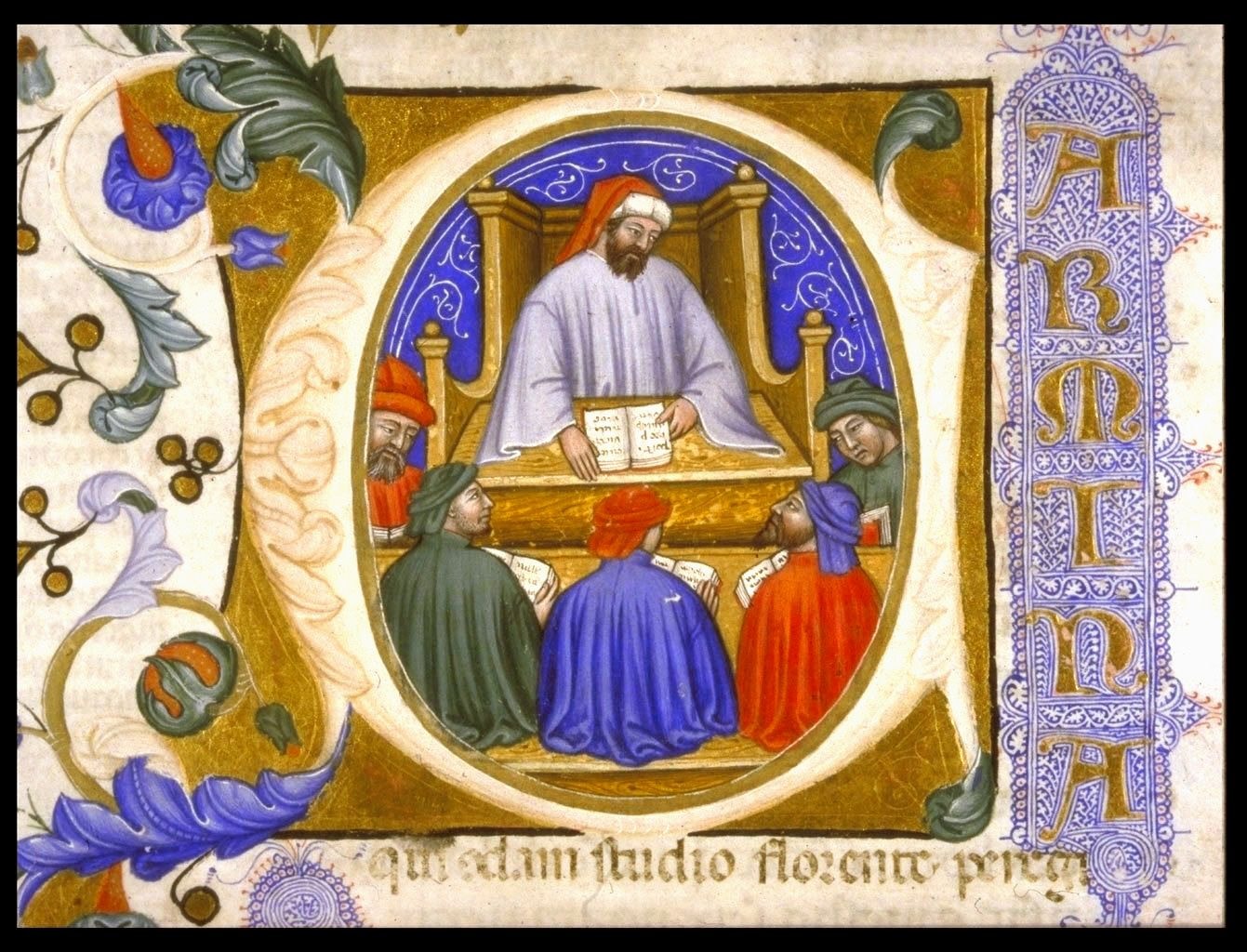
Boethius teaching his students, initial from folio 4r of a manuscript of the Consolation of Philosophy, probably Italy, 1385, Glasgow University Library. Written in prison while awaiting execution, the Consolation takes up the questions this section covers: evil, suffering, providence and freedom. Image: public domain, via Wikimedia Commons.
Intro
Some objections to Christianity never open a Bible. They reason about God directly. If God is good and all-powerful, why is there evil? If God wants to be known, why is He hidden? Is faith just believing without evidence? Can I be good without God? Are all religions the same?
These are serious questions, and some of them have occupied the best philosophers for centuries. This page gathers every philosophical objection in this section of the codex, grouped by the question it raises, with the full defeater beside each one.
Most answers in this section use one of a few tools:
- Check the hidden premise. Many objections depend on an unstated rule, such as "if I cannot see a reason, there is none" or "only physical things are real." Stated openly, the rule often fails.
- Apply the objection to itself. Several of these claims, run consistently, undercut the person making them.
- Separate the questions. Whether a belief is true is a different question from how someone came to hold it.
- Follow the moral standard. An objection that calls God unjust is using a real standard of justice, and that standard needs a foundation.
The 30-second version:
Philosophical objections reason about God without opening the Bible: evil, hiddenness, faith, morality, and the many religions. Most of them rest on a hidden premise, such as "if I can't see a reason for this suffering, there isn't one," or "only what science measures is real." Bring the premise into the open and test it. Some fail their own test, and some assume the very moral standard that points back to God.
See this page's graph and discover linked topics
In full
Section hub for philosophical objections to theism and to Christianity: arguments from evil and suffering, from divine hiddenness and the alleged incoherence of God, from the nature of faith and belief, from morality, and from religious diversity. It sits under Atheist Objections, beside the objections from biblical texts (OT and Biblical Texts) and the Bible-reliability, Christian-conduct and Zeitgeist families.
The section also holds four positive treatments that answer the problem of evil directly: Theodicy, Free Will Defense, Soul-Making Theodicy and Skeptical Theism. They are listed with the objection they answer. Where a structured debate-prep page exists in the argument layer, it is linked beside the entry.
Two distinctions carry much of the weight across the section:
- Logical versus evidential. A logical objection claims a strict contradiction (God and evil cannot both exist). An evidential one claims improbability. The first is answered by showing consistency, the second by examining the probabilities and what we are positioned to know.
- Defense versus theodicy. A defense shows only that God and evil are compatible. A theodicy offers a positive account of God's possible reasons. Theodicy explains the difference.
Evil, suffering, and hell
- Problem of Evil: the most famous challenge to belief, why an all-powerful, all-good God permits evil and suffering, in its logical and evidential forms. Defeaters: Evidential Problem of Evil Defeater, Evil as Privation of Good.
- Theodicy: what a theodicy is, how it differs from a defense, and the main accounts Christians have offered.
- Free Will Defense: Alvin Plantinga's 1974 answer to J. L. Mackie, which most philosophers on both sides now accept as closing the logical problem of evil. Argument page: Problem of Evil, Free Will Defense.
- Soul-Making Theodicy: John Hick's development of Irenaeus, that real virtue such as courage and forgiveness can only grow where hardship exists. Argument page: Problem of Evil, Soul-Making Theodicy.
- Skeptical Theism: the reply to the evidential argument that God's reasons may lie beyond our range of detection, so failing to see them is what we should expect.
- Hell as Eternal Torment Objection: the charge that infinite punishment for finite sin is monstrous, taken seriously and answered. Defeater: Hell as Eternal Torment Objection Defeater.
- Why Doesn't God Heal Amputees Objection: the claim that the absence of regrown limbs settles whether God heals. Defeater: Why Doesn't God Heal Amputees Objection Defeater.
God's existence, hiddenness, and coherence
- Divine Hiddenness: J. L. Schellenberg's argument from "non-resistant non-believers," the second pillar of academic atheism. Defeater: Divine Hiddenness Objection Defeater.
- God is Impossible Paradox Cluster: the family of arguments that two divine attributes contradict each other, so God is a square circle. Defeater: God Is Metaphysically Absurd Objection Defeater.
- God of the Gaps: the charge that theists invoke God for whatever science has not yet explained; the page grants the real failure mode and shows the major theistic arguments reason from what is known. Defeater: God of the Gaps Objection Defeater.
- Kantian Critique of Natural Theology: Kant's claim that causation is a category of the mind and cannot reach past experience to God. Defeater: Kantian Critique of Natural Theology Defeater.
- Boltzmann Brain: the thought experiment showing that a multiverse built to explain fine-tuning predicts lone fluctuating brains, which undermines trust in the observations behind the multiverse itself. See also Fine-Tuning Argument.
Related defeaters in the argument layer: Who Created God Objection Defeater, No Empirical Evidence for God Objection Defeater, Reality Is Only What We See Objection Defeater, Laws of Logic Do Not Exist Objection Defeater, Reality Is Just Motion Objection Defeater.
Faith, belief, and knowledge
- Faith is Belief Without Evidence Objection: the Dawkins, Harris and Hitchens definition of faith, and the two different things the English word faith covers. Defeater: Faith is Belief Without Evidence Objection Defeater.
- Belief-Choice Objection: "you can't choose what you believe, so God can't hold me responsible." Defeater: Belief-Choice Objection Defeater. See also You Cant Choose Your Beliefs (Doxastic Involuntarism Objection).
- Accident of Birth Objection: "you're a Christian because of where you were born," which confuses how a belief was acquired with whether it is true. Defeater: Accident of Birth Objection Defeater.
- Atheism as Escapism: the escapism charge turned around, that rejecting God can also be a relief someone was looking for. Argument page: Atheism Is Escapism (Reverse-Crutch Argument). See also Religion Is a Crutch Objection Defeater.
Morality and God's character
- Atheist Moral Realism Objection: the sophisticated atheist view that objective moral facts can exist as brute features of a godless world. Defeater: Atheist Moral Realism Defeater.
- I Can Do Good Without God Objection: Christianity already teaches that unbelievers can do good; the real question is what grounds goodness. Related defeaters: I Can Live Fine Without Christ Objection Defeater, Subjective Morality Defeater.
- Cosmic Dictator Objection: Hitchens's "celestial North Korea," and the difference between a needy human tyrant and a God who gains nothing from praise. Defeater: Cosmic Dictator Objection Defeater.
Many religions
- Religious Pluralism Objection: "all paths lead up the same mountain," tested against what the religions actually teach. Defeater: Religious Pluralism Objection Defeater.
- Omnism Objection: the claim that every religion sees one facet of the same truth, and why the claim defeats itself. Related defeater: Religious Pluralism Objection Defeater.
Apologetic deployment
Step 1, name the form. Is the objection claiming a contradiction, an improbability, or a moral failing? Each needs a different reply.
Step 2, surface the hidden premise. Ask what rule the conclusion depends on, and test that rule on its own terms.
Step 3, honor the person. The problem of evil and the hiddenness argument are often voiced by people in real pain. Listen first; see Listening Tools.
Step 4, move to the positive case. A defeated objection clears ground. The positive arguments in Theist Arguments and the Moral Argument build on it.
See also
- Atheist Objections, the parent hub for every family of objection
- OT and Biblical Texts, the sister section on objections from Bible passages
- Theist Arguments, the positive arguments for God that these objections are set against
- Logic, the reasoning tools used throughout these replies
- Natural Theology, the tradition of reasoning to God from nature and reason
- Quick Objection Responses, 30-second replies for live conversation
- Euthyphro Dilemma, the classic objection to grounding morality in God
Common questions this page answers
Q: What are the main philosophical objections to God?
The problem of evil, divine hiddenness, the claim that God's attributes contradict each other, the charge that faith is belief without evidence, the claim that morality needs no God, and the argument from religious diversity. Each has its own page above, grouped by the question it raises.
Q: Has the problem of evil been answered?
The logical form, which claims God and evil cannot both exist, is widely regarded as answered by Alvin Plantinga's Free Will Defense. The evidential form is still debated, and Skeptical Theism, Soul-Making Theodicy and the Evidential Problem of Evil Defeater give the main replies.
Q: If God exists, why doesn't He make Himself obvious?
That is the divine hiddenness argument. The reply argues that overwhelming proof could produce compliance in place of love, that God preserves room to seek Him freely, and that God did make Himself known in Jesus. See Divine Hiddenness.
Q: Is faith just believing without evidence?
The Christian word for faith means trust based on what a person has good reason to believe. Faith is Belief Without Evidence Objection shows how the objection merges two different meanings of the word.
Q: Can atheists be good without God?
Yes, and Christianity teaches that they can. The question is whether goodness has a real foundation if there is no God. See I Can Do Good Without God Objection and Atheist Moral Realism Objection.
Q: Aren't all religions basically the same?
The religions make contradictory claims about God, Jesus, and salvation, so they cannot all be true in the same sense. See Religious Pluralism Objection and Omnism Objection.