Concept
Personhood
what is a person, definition of a person, person vs human being, what makes someone a person, individual substance of a rational nature, nature and person, is a newborn a personIntro
A person is a someone, not a something. A rock, a tree or a computer is a thing you can describe. A person is a "who" you can speak to, love, wrong or forgive. Philosophers have spent centuries trying to say exactly what makes the difference.
The most influential definition in Christian history comes from the Roman philosopher Boethius, writing around AD 520: a person is "an individual substance of a rational nature." In plain words, a person is a single, real being whose kind of nature is the kind that can think and understand. Notice the wording. It is about what kind of being you are, not about how well your mind is working today.
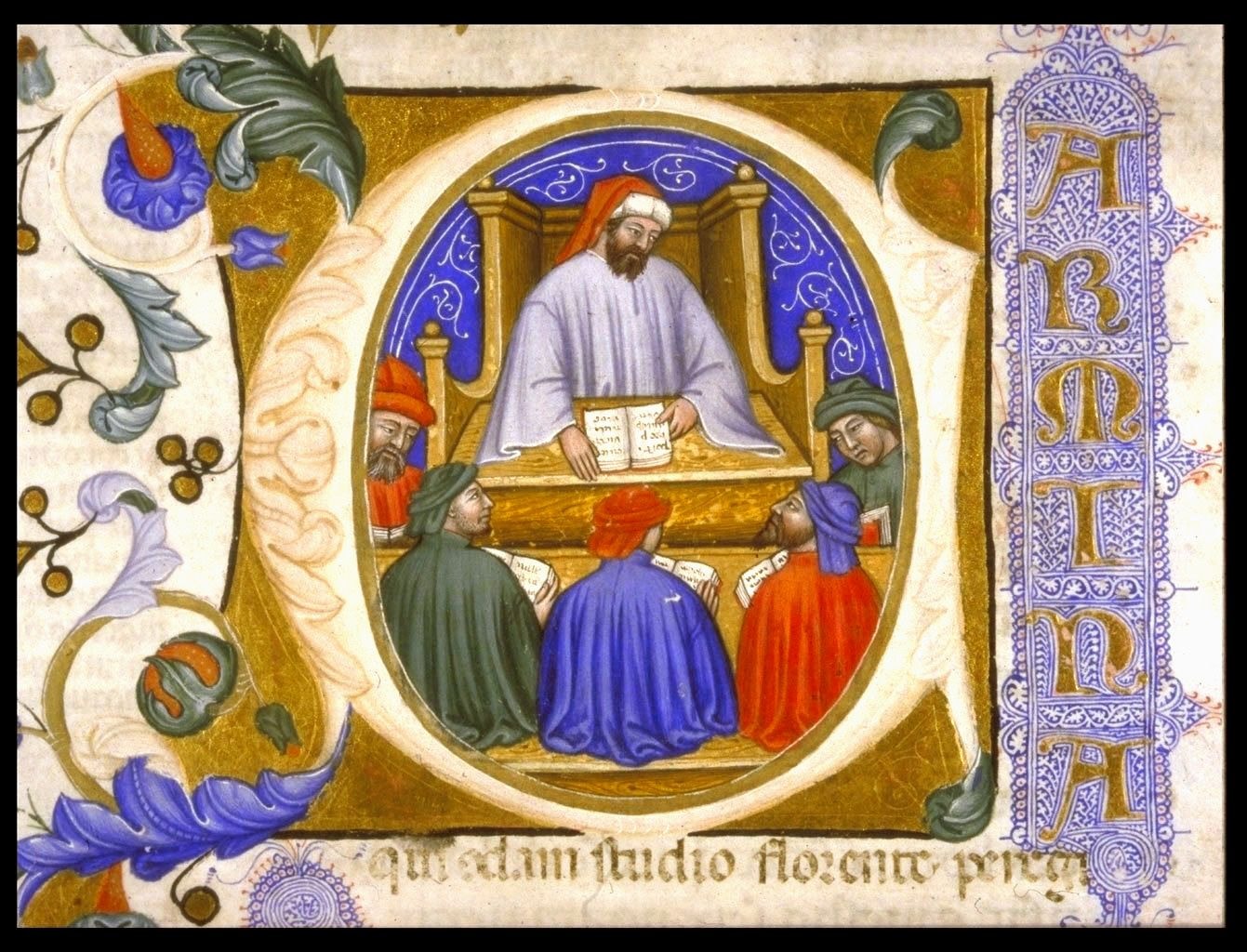
Boethius teaching his students, initial from folio 4r of a manuscript of the Consolation of Philosophy, probably Italy, 1385, Glasgow University Library. Image: public domain, via Wikimedia Commons.
That detail matters. A newborn baby cannot yet reason like an adult, and a sleeping adult is not reasoning at all, yet almost everyone agrees both are persons. So personhood cannot depend on what your mind is doing at the moment. Christianity adds the deepest reason: every human being is made in the image of God, so human worth does not rise and fall with intelligence, ability, age or usefulness.
Christian theology also uses "person" for God. God is one divine being in three persons, Father, Son and Holy Spirit. That shows personhood is bigger than human biology, and it gave the church a key distinction: your nature answers "what are you?", while your person answers "who are you?"
See this page's graph and discover linked topics
In full
The classical definition is Boethius's naturae rationalis individua substantia, "an individual substance of a rational nature" (Contra Eutychen et Nestorium, ch. 3), formulated in a Christological treatise to distinguish nature from person in the debates over Christ. It is a substance definition: personhood belongs to a kind of being (rational nature) instantiated in an individual, not to the occurrent exercise of rational capacities. Richard of St. Victor revised it for Trinitarian use as "an incommunicable existence of an intellectual nature" (De Trinitate IV), stressing that a person is unrepeatable. Modern philosophy, from Locke's psychological account ("a thinking intelligent being, that has reason and reflection, and can consider itself as itself," Essay II.27.9) to the functionalist criteria of Mary Anne Warren (1973), Michael Tooley (1972) and Peter Singer, relocated personhood in present psychological capacities, which detaches "person" from "human being" and generates the contemporary bioethical disputes about the unborn, newborns and the cognitively impaired. The substance view, defended by Patrick Lee, Robert P. George and Francis Beckwith, answers that the capacity-based criteria cannot explain why sleeping, comatose or newborn humans count, and that the being with a rational nature is the same individual from conception onward. Christian anthropology grounds the equal dignity of every human in the imago Dei (Genesis 1:26-27), while Trinitarian and Chalcedonian theology show that "person" is not coextensive with "human."
The classical definition
An individual substance of a rational nature. (Boethius, Contra Eutychen et Nestorium, ch. 3)
Each part does work:
- Individual. A person is a particular, not a type. "Humanity" is not a person; Peter is.
- Substance. A person is a real, self-standing being, not a property, a mood or a role.
- Of a rational nature. The kind of being it is, is a kind that reasons and understands. The definition names the nature, not a current level of performance.
Boethius wrote it to settle a question about Christ, and it became the standard definition for Aquinas and the whole medieval tradition. See Boethius.
Five marks philosophers discuss
Most accounts of personhood draw on some mix of these:
- Individuality, a distinct identity
- Rational nature, the capacity for reason and understanding
- Consciousness, the capacity for subjective experience
- Agency, the capacity to act on purpose
- Relationality, the capacity for real relationships
Philosophers disagree about which are necessary. The decisive question is whether personhood requires these capacities to be exercised now, or whether it belongs to the kind of being that has them by nature, whether or not they are active at the moment.
Capacity or performance? The newborn test
A short cross-examination exposes the issue.
- Is a newborn baby a person? Almost everyone says yes.
- Does a newborn have the developed reasoning of an adult? No.
- Then present reasoning ability cannot be the test of personhood. Agreed.
- So what grounds personhood: current mental performance, an underlying rational nature, membership in the human species, or something else?
That question is the fault line of modern bioethics.
| View | What makes you a person | The difficulty |
|---|---|---|
| Performance (functionalist) | Present capacities: self-awareness, reasoning, communication (Locke; Warren; Tooley; Singer) | Excludes newborns, sleeping adults and the comatose unless qualified; Tooley and Singer accept that it can exclude newborns |
| Nature (substance view) | Being an individual of a rational kind, from the start of its existence (Boethius; Aquinas; Lee and George; Beckwith) | Must explain why the nature, not the performance, is what matters, which it does by pointing to the same individual persisting from embryo to adult |
| Image of God (Christian) | Being made in God's image, a status conferred by God | Shares the substance view's conclusions and grounds them in God rather than in a capacity |
The performance view has a hard time stopping where its defenders want it to. If personhood depends on present capacity, it can be gained and lost by degrees, and some humans will fall below the line. That is exactly what Christian ethics refuses. See Abortion for how the question plays out in the debate over the unborn.
A person and a human being
In ordinary speech the two words mean the same. In philosophy they are often separated:
- Human being, a member of the species Homo sapiens.
- Person, a being with the moral standing and identity of a "who."
The Christian view keeps them together for us: every human being is a person, with inherent and equal dignity. "God created man in his own image, in the image of God created he him; male and female created he them" (Genesis 1:27, ASV). Human dignity does not depend on intelligence, physical ability, age or social status. See Imago Dei.
But Christianity does not limit personhood to humans. God is personal, and angels are personal. So the reason humans are persons is not biology as such; it is the kind of nature God gave them, a nature made for knowing and loving Him.
Nature answers "what," person answers "who"
The early church sharpened the vocabulary of person and nature because it needed to speak accurately about God and about Christ.
- The Trinity. One divine nature, three persons. The Father, the Son and the Holy Spirit are each fully God, and each is a distinct "who." See Trinity and G5287 - hypostasis.
- The incarnation. One person, two natures. The Council of Chalcedon (AD 451) confessed Christ as one person, truly God and truly man. The Son did not become a second person when He took a human nature; the one person of the Son now has two natures. See Hypostatic Union and Council of Chalcedon.
- Human beings. Each of us is one person with one human nature, made in the image of the God who is Himself personal.
Getting the distinction right protects all three doctrines. Confusing person with nature leads either to three gods or to a Christ split into two.
Why it matters for apologetics
- Grounding human rights. If personhood is a matter of present capacity, rights become a sliding scale. If it rests on the kind of being one is, and ultimately on the image of God, every human has equal standing.
- Answering the "persons are just brains" view. The unity and continuity of the self are hard to account for if a person is only a changing collection of brain states. See Argument from Personal Identity and Substance Dualism.
- Understanding God. Christianity's God is not an impersonal force but a personal being who knows and loves. Personhood in humans reflects personhood in God.
Key works
- Boethius, Contra Eutychen et Nestorium, ch. 3 (c. 520), the classical definition
- Richard of St. Victor, De Trinitate, book IV, the "incommunicable existence" revision
- John Locke, An Essay Concerning Human Understanding, II.27 (1694 edition), the psychological account
- Michael Tooley, "Abortion and Infanticide," Philosophy and Public Affairs (1972)
- Mary Anne Warren, "On the Moral and Legal Status of Abortion," The Monist (1973)
- Francis J. Beckwith, Defending Life: A Moral and Legal Case against Abortion Choice (2007)
- Patrick Lee and Robert P. George, Body-Self Dualism in Contemporary Ethics and Politics (2008)
Scholarship
Published academic works this page draws on, each matched to a publisher, index or library catalog record.
- Francis J. Beckwith, Defending Life: A Moral and Legal Case against Abortion Choice (Cambridge University Press, 2007). doi:10.1017/cbo9780511804885
- Patrick Lee and Robert P. George, Body-Self Dualism in Contemporary Ethics and Politics (Cambridge University Press, 2007). doi:10.1017/cbo9780511509643
- Mary Anne Warren and The Hegeler Institute, "On the Moral and Legal Status of Abortion," Monist 57 (1973). doi:10.5840/monist197357133 PubMed 11661013
See also
- Imago Dei, the biblical ground of human dignity
- Boethius, author of the classical definition
- Trinity, three persons in one divine nature
- Hypostatic Union, one person in two natures
- Council of Chalcedon, the creed of Christ's person and natures
- Abortion, the personhood debate over the unborn
- Argument from Personal Identity, the continuing self as evidence
- Substance Dualism, the soul and body view of the person
- Soul, the Christian doctrine of the soul
- Metaphysics, the parent field
Common questions this page answers
Q: What is a person?
The classic definition, from Boethius, is "an individual substance of a rational nature": a single, real being whose nature is the kind that can think and understand. A person is a "who," someone you can know and love, not merely a "what."
Q: What is the difference between a person and a human being?
"Human being" names a biological species; "person" names a being with personal identity and moral standing. Some modern philosophers say not every human is a person. Christianity teaches that every human being is a person made in God's image, and that God and angels are persons too.
Q: Is a newborn baby a person?
Almost everyone says yes, even though a newborn cannot yet reason like an adult. That shows personhood cannot depend on present mental performance. It belongs to the kind of being one is, which is why the classical and Christian views count every human as a person from the beginning.
Q: What does "nature" versus "person" mean in theology?
Nature answers "what is it?" and person answers "who is it?" God is one divine nature in three persons, and Christ is one person with two natures, divine and human. The distinction keeps the doctrines of the Trinity and the incarnation clear.
Q: Why does the Bible say humans have special dignity?
Because humans are made in the image of God (Genesis 1:26-27). That dignity is given by God, so it does not depend on intelligence, ability, age or social status.