Concept
Persecution of Christians in Africa
Christian Persecution in Africa, Persecution of Christians in Nigeria, Christian Persecution in Nigeria, 21 Coptic Martyrs, 21 Martyrs of Libya, Coptic Martyrs of Libya, Martyrs of Libya 2015, Persecution in the SahelIntro
Africa has more Christians than any other continent, and it is also where more Christians are killed for their faith than anywhere else on earth. In parts of Nigeria and the Sahel, armed groups attack villages and churches. In Somalia and Libya, turning to Christ can cost a person's life. In Eritrea, believers outside the few approved churches have been jailed for years. In February 2015 the world watched a video of twenty-one men, twenty Egyptian Copts and a Ghanaian, killed on a Libyan beach for being Christians.
This page gives the facts with their sources and dates, shows where the experts disagree about the numbers, especially in Nigeria, and explains how the church has understood suffering for Christ from the beginning.
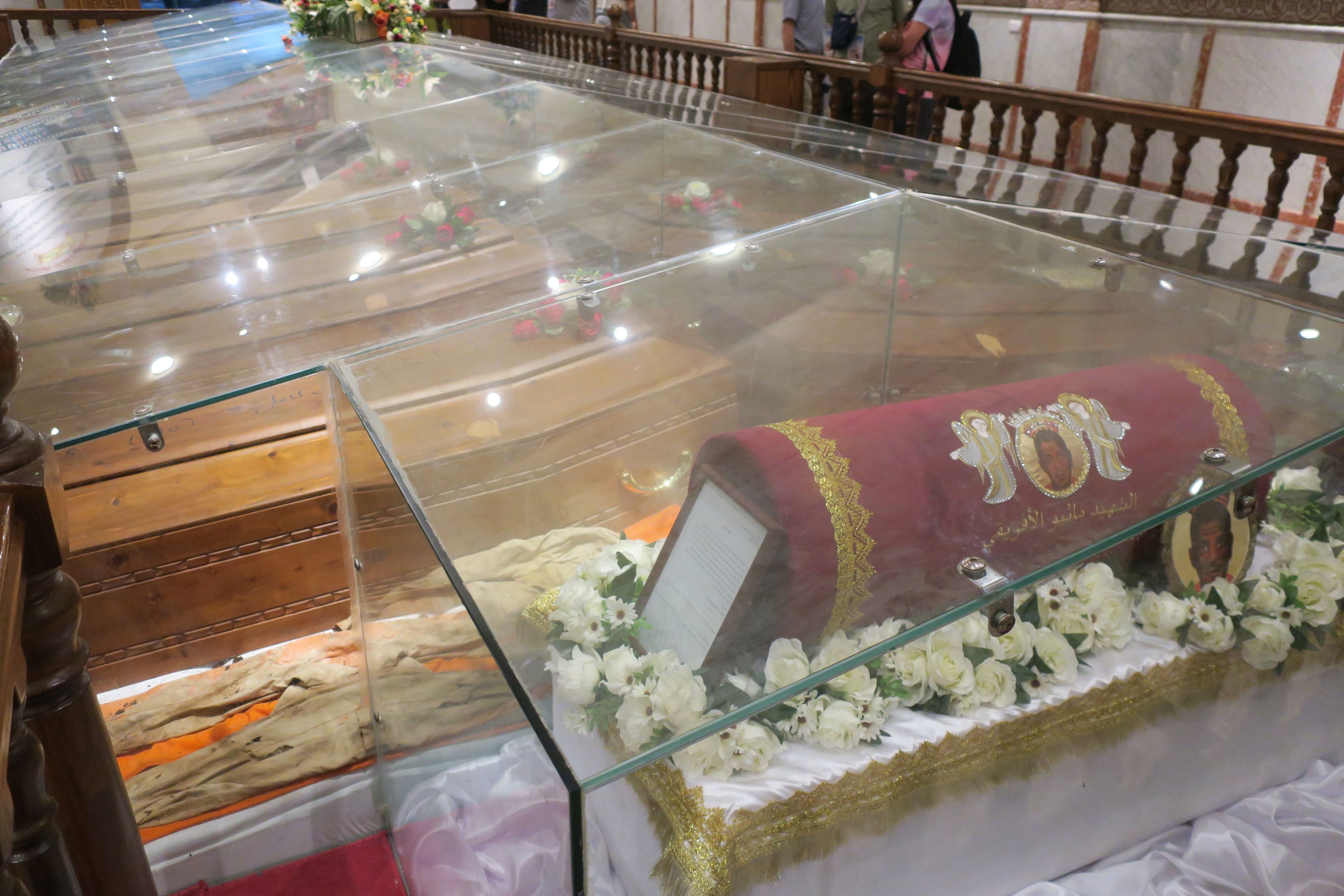 Relics of the Coptic martyrs of Libya in the Church of the Martyrs of Faith and Homeland, Minya governorate, Egypt. Photo: 松照庵, CC BY-SA 4.0 (Wikimedia Commons), resized.

See this page's graph and discover linked topics
In full
Persecution of Christians in Africa takes several distinct forms, and treating them as one obscures what is happening:
- Jihadist violence: armed Islamist groups (Boko Haram and Islamic State West Africa Province in Nigeria and the Lake Chad basin; JNIM and Islamic State in the Greater Sahara in Mali, Burkina Faso and Niger; al-Shabaab in Somalia; Islamic State affiliates in the Democratic Republic of the Congo and Mozambique) that attack Christians among other targets.
- Ethno-religious conflict: violence between largely Muslim Fulani herders and largely Christian farming communities in Nigeria's Middle Belt, in which land, ethnicity, climate pressure and religion are entangled.
- State repression: governments that restrict or punish unregistered worship, most severely in Eritrea.
- Legal and social pressure: apostasy and blasphemy accusations, family and community hostility toward converts from Islam, and restrictions on churches in North Africa.
- Collapse of order: civil war and state failure, as in Sudan and the Central African Republic, in which Christians are among many victims but are sometimes deliberately targeted.
The best-known annual measure is Open Doors' World Watch List. Its 2026 list, covering 1 October 2024 to 30 September 2025, reported 4,849 Christians killed for their faith worldwide, 4,490 of them in sub-Saharan Africa and 3,490 in Nigeria alone. Other monitors give different figures, and the meaning of the Nigerian numbers is disputed; both sides are set out below.
The World Watch List 2026: African countries
Open Doors ranks the fifty countries where Christians face the most severe persecution. Twenty of the fifty on its 2026 list are African:
| Rank | Country | Level | Main drivers (summary) |
|---|---|---|---|
| 2 | Somalia | Extreme | Al-Shabaab; clan and family hostility to converts |
| 4 | Sudan | Extreme | Civil war since April 2023; churches attacked by armed forces |
| 5 | Eritrea | Extreme | State control of religion; imprisonment of unregistered believers |
| 7 | Nigeria | Extreme | Jihadist groups; Fulani militia attacks; blasphemy violence |
| 9 | Libya | Extreme | Islamist militias; hostility to converts and migrant Christians |
| 15 | Mali | Extreme | JNIM and Islamic State in the Greater Sahara |
| 16 | Burkina Faso | Extreme | Jihadist insurgency |
| 20 | Algeria | Very high | Closure of Protestant churches |
| 21 | Mauritania | Very high | Apostasy laws and social pressure |
| 22 | Central African Republic | Very high | Armed conflict |
| 23 | Morocco | Very high | Pressure on converts |
| 26 | Niger | Very high | Jihadist insurgency |
| 29 | Democratic Republic of the Congo | Very high | Islamic State-linked ADF attacks in the east |
| 31 | Tunisia | Very high | Pressure on converts |
| 36 | Ethiopia | Very high | Regional conflict; local hostility |
| 37 | Cameroon | Very high | Boko Haram in the far north; Anglophone conflict |
| 39 | Mozambique | Very high | Islamic State-Mozambique in Cabo Delgado |
| 42 | Egypt | Very high | Mob violence, social discrimination |
| 43 | Comoros | Very high | Legal and social restrictions |
| 48 | Chad | Very high | Spillover from neighboring conflicts |
Ranks and levels: Open Doors UK and Ireland, World Watch List 2026 Advocacy Report. Driver summaries condensed from the same report.
Open Doors reports that the three countries on the 2026 list scoring the maximum for violence, Sudan, Nigeria and Mali, are all in sub-Saharan Africa, and that sub-Saharan countries hold 12 of the 20 highest violence scores. In Burkina Faso alone it counted at least 150 Christians killed and more than 100 churches or Christian properties destroyed or closed in the reporting period.
Nigeria
The record
Nigeria, Africa's most populous country and home to one of its two largest Christian populations, has been the deadliest country in the world for Christians in Open Doors' counts for several years. Notable attacks include:
- Christmas Day 2011: Boko Haram bombed St Theresa's Catholic Church at Madalla, near Abuja, killing dozens of worshippers.
- April 2014: Boko Haram abducted 276 schoolgirls from Chibok, Borno State, most of them Christians.
- February 2018: Leah Sharibu, a Christian schoolgirl abducted from Dapchi, was kept captive when her Muslim classmates were released, reportedly for refusing to renounce her faith.
- May 2022: Deborah Samuel Yakubu, a Christian student, was beaten and burned to death by a mob at her college in Sokoto over messages alleged to be blasphemous.
- June 2022: gunmen attacked St Francis Xavier Catholic Church in Owo, Ondo State, on Pentecost Sunday, killing about forty people.
- June 2025: in Yelwata, Benue State, a Christian farming community came under a four-hour attack by Fulani militants; Open Doors reports that more than 200 people were shot or burned to death, mostly women and children.
The numbers and the dispute
| Source | Figure | Period | Notes |
|---|---|---|---|
| Open Doors, World Watch List 2026 | 3,490 Christians killed for their faith in Nigeria | 1 Oct 2024 to 30 Sep 2025 | Counts civilian Christians whose deaths can be linked to their Christian identity; uses the lower figure where counts conflict |
| Open Doors, World Watch List 2025 | 3,100 Christians killed in Nigeria | 12 months from October 2023 | The same Open Doors research also recorded 2,320 Muslims killed in that period, as the BBC reported |
| Intersociety (Nigerian rights group) | At least 7,087 Christians killed | First 220 days of 2025 (report of August 2025) | Far higher than other sources |
| BBC investigation | Intersociety's methods "opaque," not independently verifiable | November 2025 | Security analysts told the BBC that Christians have suffered attacks but that there is no clear evidence of deliberate religious targeting, and that most victims of jihadist attacks in Nigeria have been Muslims |
How to read this honestly:
- Christians are being killed in very large numbers, and many attacks target churches, Christian villages and Christians specifically. That is documented by Open Doors' incident-level method and by named, dated attacks.
- Christians face disproportionate risk in the affected regions, according to Open Doors, which cites data from the Observatory for Religious Freedom in Africa to argue that, measured by civilian deaths and relative risk, Christians in the affected regions face disproportionate violence.
- Muslims are also killed in large numbers, especially by jihadist groups in the northeast and by bandits in the northwest. Open Doors' own researcher told the BBC that some Muslims are increasingly targeted by Fulani militants too.
- The highest figures in circulation are the least verifiable. Claims of 100,000 or more Christians killed since 2009 rest largely on sources the BBC could not verify.
- "Genocide" is a contested legal and political label. Some advocates and politicians use it; the Nigerian government and many analysts reject it, describing overlapping insurgency, banditry and land conflict. In late 2025 the United States again designated Nigeria a Country of Particular Concern for severe religious freedom violations, a step welcomed by the U.S. Commission on International Religious Freedom (statement of 3 November 2025); Nigeria had held the designation in 2020 and been removed in 2021.
The codex records both readings. What is not in dispute is that Christian communities in northern and central Nigeria live under severe and lethal threat.
The Sahel, the Horn and Central Africa
- Burkina Faso, Mali and Niger. Jihadist insurgencies linked to al-Qaeda (JNIM) and the Islamic State have spread since the 2010s. Churches have been closed, pastors and catechists killed, and Christian villages emptied. Open Doors now classes the persecution in Mali as "extreme."
- Somalia. Christianity is effectively illegal in practice; converts from Islam face death from al-Shabaab or their own clans and worship in secret.
- Eritrea. Since 2002 the government has recognized only four religious bodies (the Eritrean Orthodox, Catholic and Evangelical Lutheran churches and Sunni Islam). Members of other churches, especially Pentecostals, have been detained, some for many years. The state also deposed the Eritrean Orthodox Patriarch, Abune Antonios, who spent his remaining years under house arrest until his death in 2022.
- Sudan. The civil war that began in April 2023 has devastated the country; Open Doors reports churches attacked and bulldozed by armed forces.
- Democratic Republic of the Congo. In the east, the Islamic State-linked Allied Democratic Forces have repeatedly massacred villagers and attacked churches, including an attack on worshippers at a night vigil in a Catholic church in Komanda, Ituri, on 27 July 2025 that killed at least 38 people in the church by the Associated Press count.
- Mozambique. An Islamic State-affiliated insurgency in Cabo Delgado province since 2017 has killed and displaced many, with Christians explicitly targeted.
North Africa and the 21 martyrs of Libya
North Africa was once among the heartlands of Christianity (see Decline of North African Christianity). Today its Christian communities are small, and converts from Islam face the heaviest pressure.
The 21 martyrs (2015)
- What happened. In early 2015 militants of the Islamic State's Libyan affiliate kidnapped Egyptian Coptic laborers working in Libya. On 15 February 2015 the group released a video showing twenty-one men, dressed in orange, beheaded on a beach.
- Who they were. Twenty were Egyptian Copts, most of them from villages in Minya governorate in Upper Egypt. The twenty-first, Matthew Ayariga, was from Ghana; Coptic tradition holds that he chose to die with the others, declaring their God his God.
- Recognition. The Coptic Orthodox Church entered them in its calendar of saints within days, commemorated on 15 February. In May 2023 Pope Francis announced that they would be included in the Roman Martyrology, a rare recognition by the Catholic Church of martyrs from another communion.
- Return. Their remains were recovered in Libya in 2017 and returned to Egypt in 2018, where they rest in the Church of the Martyrs of Faith and Homeland in Minya governorate, built in their memory and pictured above.
Copts point out that several of the men can be seen praying as they died. Their families' public forgiveness of the killers drew wide attention in Egypt and abroad.
Egypt
Egypt's Coptic Christians, the largest Christian community in the Middle East and North Africa, have suffered repeated terrorist attacks: the New Year's bombing of the Two Saints Church in Alexandria (2011), the bombing of the Botroseya chapel in Cairo (December 2016), the Palm Sunday bombings of churches in Tanta and Alexandria (April 2017), and attacks on Christian pilgrims in Minya (2017 and 2018). Copts also report discrimination in church building and employment and periodic mob violence in Upper Egypt.
Algeria, Libya, Morocco, Tunisia and Mauritania
Open Doors reports the closure of Protestant churches in Algeria, pressure on converts throughout the region, and danger for African migrant Christians in Libya.
How the church has understood persecution
- It was promised. "If they have persecuted me, they will also persecute you" (John 15:20, KJV); "Yea, and all that will live godly in Christ Jesus shall suffer persecution" (2 Timothy 3:12, KJV).
- It is blessed. "Blessed are they which are persecuted for righteousness' sake: for theirs is the kingdom of heaven" (Matthew 5:10, KJV).
- It binds the church together. "Remember them that are in bonds, as bound with them" (Hebrews 13:3, KJV). Christians worldwide are called to pray, advocate and give.
- It does not end the church. Tertullian of Carthage, an African, told the persecutors of his day that the blood of Christians is seed (Apology 50). African church history, from Perpetua and Felicity in third-century Carthage to the Uganda Martyrs of 1885 to 1887 and the Copts of 2015, bears him out.
- It calls for forgiveness, not revenge. The families of the 21 martyrs and many Nigerian Christians have publicly forgiven their attackers, following Christ's prayer from the cross (Luke 23:34).
Apologetic relevance
- The witness of martyrs. People die for what they believe to be true, and the early martyrs died for what they claimed to have seen. Modern martyrs cannot verify the resurrection themselves, but their willingness to die rather than deny Christ shows the faith's power to hold people under the worst pressure. See Historical Evidence for the Martyrs.
- Against "Christianity is the oppressor's religion." In much of Africa today, Christians are the persecuted minority, not the powerful. See Christianity Is the White Mans Religion Objection Defeater.
- Honesty about data. Christians lose credibility when they repeat inflated or unverifiable figures. Citing the most careful sources with their dates, and acknowledging Muslim victims, strengthens rather than weakens the case for action.
Tensions
- The Nigerian figures. Open Doors (3,490 Christians killed, October 2024 to September 2025) and Intersociety (at least 7,087 in the first 220 days of 2025) differ by a factor of more than two. The BBC found Intersociety's figures unverifiable. Analysts disagree on whether the violence amounts to deliberate religious targeting. The codex reports each source with its period and method and does not adopt the highest figure.
- "Genocide." Advocacy groups and some politicians describe the killing of Christians in Nigeria as genocide; the Nigerian government and many researchers reject the term. The codex uses "persecution" and "killing," which all sources support.
See also
- Africa and Christianity, the master hub
- Historical Evidence for the Martyrs, what martyrdom shows and does not show
- Coptic Orthodox Church, the church of the 21 martyrs
- Perpetua and Felicity, the African martyrs of Carthage in 203
- Uganda Martyrs, the young converts killed in Buganda in the 1880s
- Decline of North African Christianity, how North Africa's churches were reduced
- Christianity in Africa Today, the numbers and the regions where persecution falls
- Ethiopian Orthodox Church, the ancient church of the Horn
- Islam, the religion of most of the armed groups named here, and of many of their victims
- Christianity Is the White Mans Religion Objection Defeater, Christians as Africa's persecuted
Common questions this page answers
Q: How many Christians are killed in Nigeria each year?
Open Doors' World Watch List 2026 counted 3,490 Christians killed for their faith in Nigeria from 1 October 2024 to 30 September 2025, up from 3,100 the year before. The Nigerian group Intersociety reported much higher figures, but a BBC investigation in November 2025 found its data could not be independently verified.
Q: Is there a Christian genocide in Nigeria?
It is disputed. Christians in northern and central Nigeria are killed in large numbers and many attacks target churches and Christian villages. But Muslims are also killed in large numbers, analysts disagree on whether the violence is deliberate religious targeting, and the Nigerian government rejects the genocide label. The codex reports the evidence on both sides.
Q: Who were the 21 Coptic martyrs of Libya?
They were twenty Egyptian Coptic Christian laborers and one man from Ghana, Matthew Ayariga, killed by the Islamic State's Libyan affiliate in a video released on 15 February 2015. The Coptic Church venerates them as saints, Pope Francis added them to the Roman Martyrology in 2023, and their remains rest in a church built for them in Minya, Egypt.
Q: Which African countries persecute Christians the most?
On Open Doors' World Watch List 2026, the highest-ranked African countries are Somalia (2nd worldwide), Sudan (4th), Eritrea (5th), Nigeria (7th), Libya (9th), Mali (15th) and Burkina Faso (16th). Twenty African countries appear in the top fifty.
Q: Why are Christians persecuted in Africa?
The main causes are jihadist insurgencies in Nigeria, the Sahel, Somalia, eastern Congo and Mozambique; ethnic and land conflict in Nigeria's Middle Belt; authoritarian control of religion in Eritrea; civil war in Sudan; and legal and family pressure on converts from Islam in North Africa.
Q: What does the Bible say about persecution?
Jesus warned that his followers would be persecuted (John 15:20) and called them blessed when they suffer for righteousness (Matthew 5:10). Paul wrote that "all that will live godly in Christ Jesus shall suffer persecution" (2 Timothy 3:12, KJV), and Hebrews 13:3 calls Christians to remember prisoners as if bound with them.