Person
Perpetua and Felicity
Perpetua, Felicity, Felicitas, Vibia Perpetua, Perpetua and Felicitas, Saints Perpetua and Felicity, Passion of Perpetua and Felicity, Passio PerpetuaeIntro
Perpetua and Felicity were two young African women executed for their faith in the arena at Carthage in AD 203. Perpetua was a 22-year-old noblewoman nursing a baby. Felicity was an enslaved woman, heavily pregnant when she was arrested. They died side by side with three men from their small group of new believers.
What makes them unforgettable is that Perpetua kept a prison diary. In her own words she describes her father begging her to give in, her fear for her baby, the dreams God gave her, and her calm refusal to deny Christ. It is one of the earliest surviving pieces of writing by a Christian woman, and it comes from Africa.
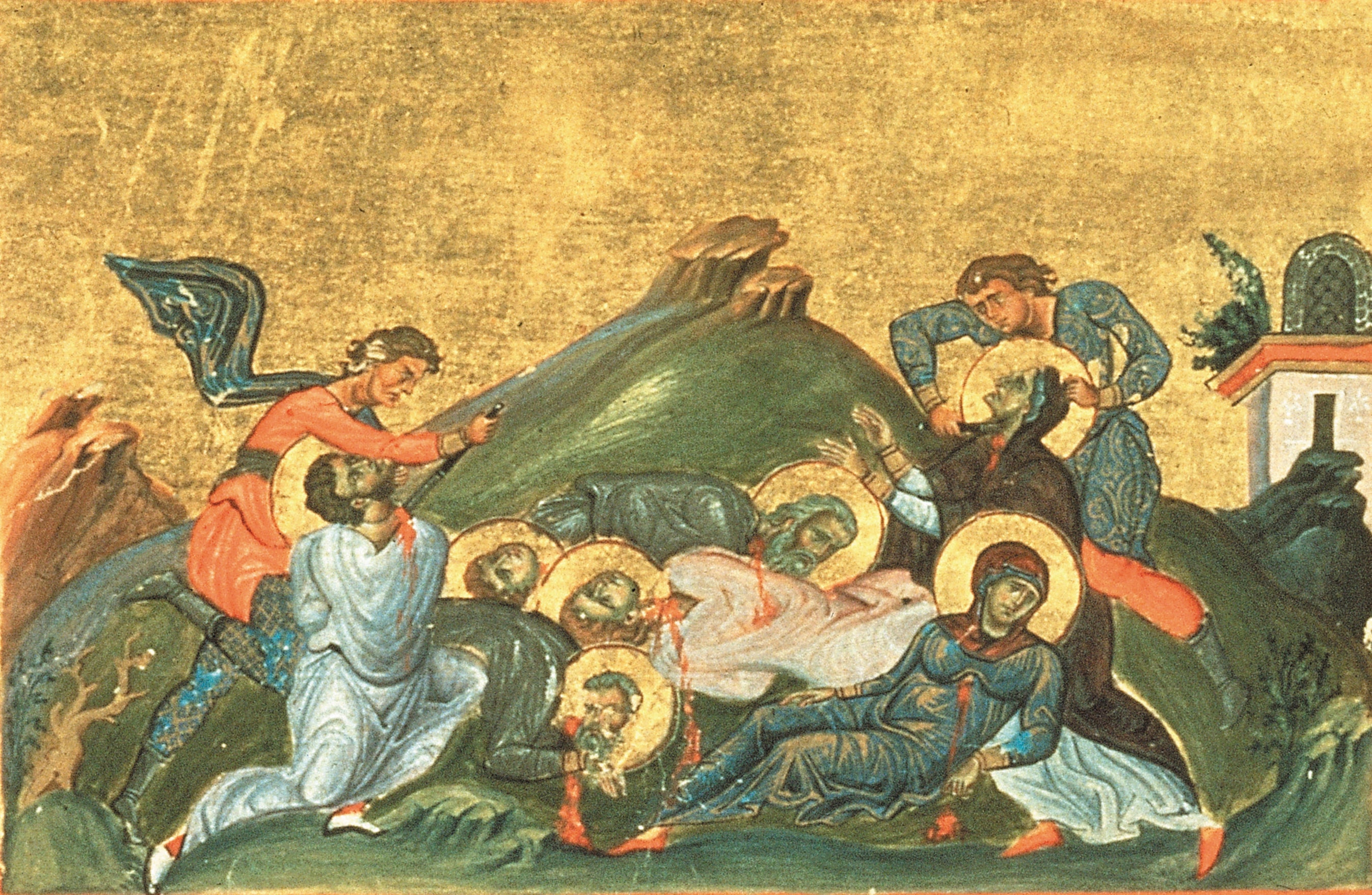 The martyrdom of Perpetua, Felicitas, Revocatus, Saturninus and Secundulus, Menologion of Basil II (Constantinople, c. 1000). Public domain (Wikimedia Commons), resized.

See this page's graph and discover linked topics
In full
Vibia Perpetua and Felicitas (Felicity) were catechumens of the church of Carthage, in the Roman province of Africa Proconsularis (modern Tunisia), arrested with Revocatus, Saturninus and Secundulus during the persecution under Septimius Severus and put to death in the amphitheatre on 7 March 203, at games held for the birthday of the emperor's son Geta. Their teacher Saturus, absent at the arrest, gave himself up and died with them; Secundulus died in prison. The account of their trial, visions and deaths, the Passio Sanctarum Perpetuae et Felicitatis, survives in Latin and Greek. Its core is a first-person prison narrative attributed to Perpetua herself (chapters 3 to 10), followed by a first-person vision of Saturus (11 to 13), all framed by an anonymous editor who wrote the introduction and the account of the deaths. The text is among the most important documents of early Christian martyrdom, the earliest substantial writing by a Christian woman to survive, and a primary witness to the faith of the North African church a full century before Constantine.
Who they were
| Name | Status | Fate |
|---|---|---|
| Vibia Perpetua | Well-born, educated, about 22, married, nursing an infant son | Died in the arena |
| Felicitas (Felicity) | Enslaved woman, eight months pregnant at arrest | Gave birth in prison two days before the games; died in the arena |
| Revocatus | Enslaved man, a fellow catechumen | Died in the arena |
| Saturninus | Catechumen | Died in the arena |
| Secundulus | Catechumen | Died in prison |
| Saturus | Their instructor in the faith | Surrendered voluntarily; died in the arena |
The group crossed every social line Roman Carthage drew: a noblewoman and an enslaved woman, free men and an enslaved man, all treated by the text as equals in Christ. They were baptized while under arrest.
The prison diary
Perpetua's narrative records, in her own voice:
- Her father's pleading. Her pagan father visits repeatedly, begging her to recant for his sake and her child's. In the most famous exchange she points to a water jug and asks whether it can be called by any other name than what it is; it cannot, and neither can she be called anything other than a Christian.
- Her baby. She is tormented by fear for her nursing son until she is allowed to keep him in prison, after which, she writes, the prison became to her like a palace. Later her father takes the child, and she records that God spared both of them distress from the weaning.
- The trial. Before the procurator Hilarianus, acting governor after the proconsul's death, she refuses to offer sacrifice for the welfare of the emperors and declares herself a Christian. The group is condemned to the beasts.
- Four visions.
- A narrow bronze ladder reaching to heaven, lined with blades, with a dragon at its foot. Saturus climbs first; Perpetua treads on the dragon's head and climbs to a garden where a white-haired shepherd gives her a mouthful of curds.
- and 3. Her younger brother Dinocrates, who had died at seven of a disfiguring disease, appears suffering and thirsty; after her prayers he appears healed and refreshed.
- On the eve of the games she sees herself fighting an Egyptian gladiator, transformed into a man for the contest, and winning. She wakes knowing she will fight not beasts but the devil, and that victory is hers.
Their deaths
The editor describes the march into the amphitheatre with Perpetua singing, the men sent against a leopard, a bear and a boar, and the women exposed to a wild cow. Felicity, who had feared her pregnancy would delay her and separate her from the group, gave birth to a daughter in prison and walked out with the others. When the wounded martyrs were brought to be killed by the sword, Perpetua, the editor says, guided the trembling hand of the young gladiator to her own throat.
Why they matter
- African Christianity before Constantine. The Passio shows a vigorous, organized, socially mixed Latin church in Carthage around 200, long before Christianity had any imperial favor. It answers the claim that Christianity reached Africa as a European import: Africa was producing martyrs for Christ while most of northern Europe had never heard the gospel. See Christianity Is the White Mans Religion Objection Defeater.
- A woman's own voice. Most ancient texts about women were written by men. Here a young mother speaks for herself about faith, family, fear and hope.
- Martyrdom as evidence of sincere belief. The group could have walked free by offering a pinch of incense. Their refusal shows how seriously early Christians took the exclusive lordship of Christ. See Historical Evidence for the Martyrs.
- Spiritual equality. Perpetua and Felicity, mistress-class and slave-class, die embracing each other. The early church's practice outran the social order around it.
Reception
- Augustine preached several sermons on their feast day (Sermons 280 to 282). In his treatise On the Nature and Origin of the Soul he discussed the Dinocrates vision while noting that the account was not canonical Scripture.
- The basilica. Their remains were venerated in the Basilica Maiorum at Carthage. In 1906 and 1907 the archaeologist Alfred-Louis Delattre reassembled fragments of an inscription from the site naming Saturus, Saturninus, Revocatus, Secundulus, Felicitas and Perpetua. Scholars accept the link to their cult, though whether it marked the actual grave is uncertain.
- The calendar. Their feast, 7 March, is kept across Catholic, Orthodox, Anglican and Lutheran calendars, and their names entered the Roman Canon of the Mass.
Tensions
- Was the text Montanist? The editor's preface praises "new prophecies" and new visions, language some scholars read as sympathy with the Montanist (New Prophecy) movement, which flourished in Carthage. Others read it as ordinary early-church openness to the gifts of the Spirit. The question is open; nothing in Perpetua's own narrative is heterodox.
- Who was the editor? Tertullian, Carthage's great writer of the same years, has often been proposed, partly on stylistic grounds. Many scholars now judge the attribution unproven.
- How much is Perpetua's own? Most scholars accept the diary section as substantially authentic first-person writing; a minority suspect heavier editing. The vivid, unpolished detail is usually taken as a mark of genuineness.
See also
- Africa and Christianity, the master hub for African Christian history
- Tertullian, Carthaginian contemporary and possible editor of the Passio
- Cyprian of Carthage, martyred bishop of the same city half a century later
- Augustine, who preached on their feast
- Historical Evidence for the Martyrs, how martyr accounts work as historical evidence
- Donatist Controversy, the later Carthaginian schism that claimed to be the true "church of the martyrs"
- Christianity Is the White Mans Religion Objection Defeater, African Christianity before Europe
Common questions this page answers
Q: Who were Perpetua and Felicity?
Two Christian women of Carthage in Roman North Africa, a young noblewoman and an enslaved woman, who were executed in the arena on 7 March 203 with three male companions for refusing to sacrifice to the Roman gods.
Q: Were Perpetua and Felicity African?
Yes. They lived and died in Carthage, in modern Tunisia, as members of the Latin-speaking North African church. Their account is one of the earliest Christian documents from the African continent.
Q: Did Perpetua really write a diary?
The Passion of Perpetua and Felicity contains a first-person prison narrative that most scholars accept as substantially Perpetua's own writing, framed by an anonymous editor's introduction and conclusion. It is among the earliest surviving texts by a Christian woman.
Q: What were Perpetua's visions?
She records four: a ladder to heaven guarded by a dragon whose head she treads on, two visions of her dead brother Dinocrates first suffering and then healed, and a final vision of defeating an Egyptian gladiator, which she understood as victory over the devil.
Q: Why were Perpetua and Felicity executed?
They were arrested as new converts during the persecution under Septimius Severus and refused to offer sacrifice for the emperors' welfare. Declaring themselves Christians was enough for the court to condemn them to the beasts.
Q: Was Felicity pregnant when she was martyred?
She was eight months pregnant at her arrest and feared she would be held back, since Roman law did not execute pregnant women. She gave birth to a daughter in prison two days before the games and died with the others.
Q: Was the Passion of Perpetua a Montanist text?
It is disputed. The editor's praise of new prophecies has led some scholars to see Montanist sympathies, while others see only the early church's general openness to spiritual gifts. Perpetua's own narrative contains nothing unorthodox.