Concept
Perichoresis
perichoresis, circumincession, circuminsession, circumincessio, mutual indwelling of the Trinity, coinherence, co-inherence, Trinitarian mutual indwelling, what is perichoresisIntro
Perichoresis is the Christian teaching that the Father, the Son and the Holy Spirit are in one another. Each Person is wholly present in the other two, yet the three never blur into one Person and never split into three gods. Jesus put it simply: "the Father is in me, and I in the Father" (John 10:38, ASV).
The word is Greek and means something like "going around" or "making room for one another." Christian writers took it up to describe a closeness deeper than any human friendship. Two friends can share a goal, but they are still two separate beings. The Father, Son and Spirit share one being and one life, and each lives in the others completely.
This matters because it answers a common objection. Critics say that three Persons must mean three gods. Perichoresis is part of the classical reply: the three are not separate individuals standing side by side, because none of them exists apart from the others, even in thought.
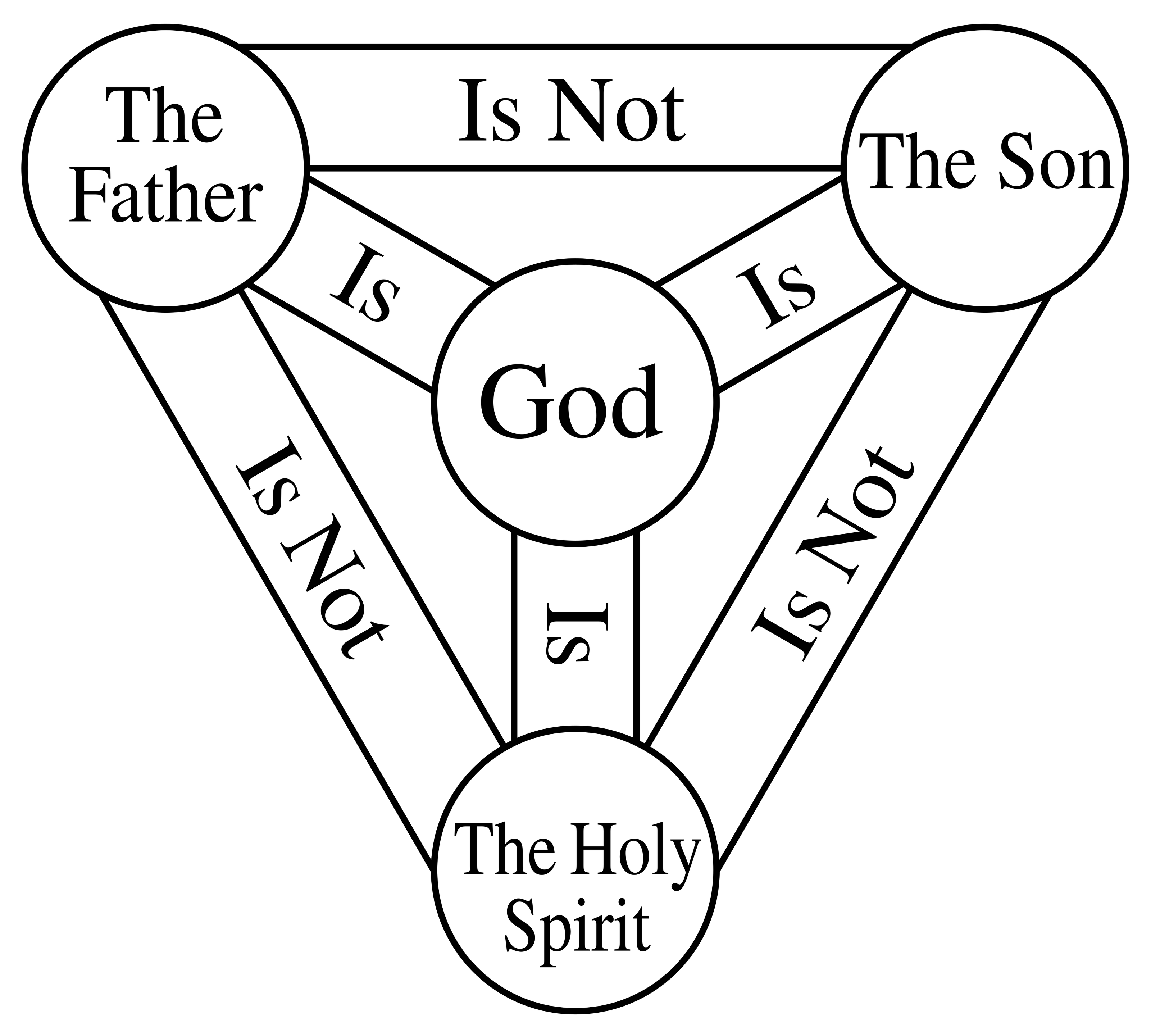
The Shield of the Trinity (Scutum Fidei), a medieval diagram of the doctrine: each Person "is" God, and no Person "is not" the other. English version redrawn from the traditional design. Image: public domain, via Wikimedia Commons.
See this page's graph and discover linked topics
In full
Perichoresis (Greek perichōrēsis, from perichōreō, "to go around, to encompass") names the mutual indwelling or coinherence of the divine Persons: each Person exists wholly in each of the others without confusion of Persons or division of the one essence. The term was first used theologically by Gregory of Nazianzus (Epistle 101) and developed by Maximus the Confessor for the relation of Christ's two natures. Its application to the Trinity is systematized in John of Damascus, An Exposition of the Orthodox Faith (De fide orthodoxa) 1.8 and 1.14, in the eighth century, drawing on an earlier treatise long attributed to Cyril of Alexandria. Burgundio of Pisa's twelfth-century Latin translation of the Damascene rendered it circumincessio, and Latin theology also used circuminsessio (mutual "sitting in" or abiding). The Council of Florence (1442) stated the doctrine in conciliar form: because of the unity of essence, the Father is wholly in the Son and wholly in the Holy Spirit, and likewise for each Person. Biblically it rests on the Johannine indwelling sayings (John 10:30, 38; 14:10-11; 17:21) and on Paul's statement that the Spirit searches "the deep things of God" as a man's spirit knows his own mind (1 Corinthians 2:10-11). In classical theology perichoresis follows from the one essence and the relations of origin; it is not what makes the Persons one. Since the 1980s, social Trinitarians (Jürgen Moltmann, Leonardo Boff, John Zizioulas in a related key) have made it central, and sometimes the very ground of divine unity, a move criticized by Randall Otto (2001) and Oliver Crisp (2005) as stretching the term beyond its patristic sense.
Where the word comes from
- The verb. Perichōreō means "to go around," "to encompass," or "to make way for." It is not related to choreuō, "to dance," although popular writing often says it means a "divine dance." That etymology is mistaken: the two words differ in their vowel (chōreō with omega, choreuō with omicron). The image of a dance can still illustrate the idea, but it is not what the word means.
- First theological use. Gregory of Nazianzus used the verb for the two natures of Christ, which "go around into one another" in the one Person (Epistle 101, to Cledonius).
- Christology first, then Trinity. Maximus the Confessor (seventh century) developed the noun for the union of natures in Christ. The application to the Trinity is clearest in John of Damascus (eighth century), who uses it for both, and distinguishes them carefully. In Christ the divine nature permeates the human, not the reverse. In the Trinity the indwelling is fully mutual.
- Latin. Burgundio of Pisa's translation of John of Damascus (c. 1150) gave the West circumincessio. Later Latin writers also used circuminsessio. Thomas Aquinas teaches the substance of the doctrine without the Greek word: the Father is in the Son by essence, by relation and by origin (Summa Theologiae I, q. 42, a. 5).
What it says, and what it does not
- It says each Person is wholly in the others. The Father does not have one part in the Son and another part elsewhere. God has no parts.
- It says the Persons are never apart, never acting alone, never even conceivable without each other. The Father is Father only as the Father of the Son.
- It does not say the Persons merge. The Son is in the Father and is still not the Father. The Shield of the Trinity diagram holds both truths at once.
- It does not say the three are three beings who choose to be close. That would be three gods in a perfect friendship, which is tritheism. Classically, the indwelling follows from their sharing one essence.
- It does not make the Persons interchangeable. The Father begets, the Son is begotten, the Spirit proceeds. These relations of origin are what distinguish them, and perichoresis does not erase them.
The biblical basis
- John 10:30, 38. "I and the Father are one" (John 10:30, ASV), and "the Father is in me, and I in the Father" (John 10:38, ASV). Jesus' hearers took the first saying as a claim to deity (John 10:33).
- John 14:10-11. "Believest thou not that I am in the Father, and the Father in me? the words that I say unto you I speak not from myself: but the Father abiding in me doeth his works" (John 14:10, ASV). The Father's indwelling is why seeing the Son is seeing the Father (John 14:9).
- John 17:21. "Even as thou, Father, art in me, and I in thee, that they also may be in us" (ASV). Believers are drawn into the communion, by grace and by analogy, not by sharing the divine essence.
- 1 Corinthians 2:10-11. The Spirit "searcheth all things, yea, the deep things of God," as a person's own spirit knows their own thoughts. The Spirit's knowledge of God is inside knowledge.
- John 1:18. The Son is "in the bosom of the Father" (ASV), a picture of the closest possible nearness.
Grammar and hermeneutics
- "In" is locative and relational, not spatial. Greek en with the dative ("in me," "in the Father") is the same construction Jesus uses for abiding: "abide in me, and I in you" (John 15:4). The Johannine idiom expresses shared life and presence, not one body located inside another.
- The reciprocity is the point. Every Trinitarian "in" saying runs both ways ("I in the Father, and the Father in me"). The believer-in-Christ sayings also run both ways, but John never says believers are in the Father the way the Son is: in John 17:21 believers are "in us" as a result of the Father-Son indwelling, which is prior and different in kind.
- "One," not "one person." In John 10:30 "one" is the neuter hen, not the masculine heis. Augustine and many since note that the neuter suits unity of being or action, not identity of person: Jesus does not say "I and the Father are one person." Interpreters dispute how much the neuter alone proves (unity of purpose is also a possible reading), so the argument rests on the context, where the hearers took the claim as equality with God.
Why it matters
- Against tritheism. The commonest objection to the Trinity is that three Persons means three gods. Perichoresis shows why the Persons are not three separate individuals: each exists only in and with the others, in one being. See Trinity Common Objections and Trinity Violates the Shema Objection Defeater.
- Against modalism. If the Father were only a mask the Son wears, there would be no one for the Son to be "in." Indwelling needs real distinction. See Trinity vs Oneness vs Modalism vs Arianism.
- For the one and the many. Perichoresis is the clearest picture of unity and distinction being equally basic: perfect unity without sameness, and real distinction without separation. See One and the Many Problem and Twenty Conundrums the Trinity Resolves.
- For the unity of God's works. Because the Persons indwell one another, every act of God toward the world is one act of all three (the classical rule that the external works of the Trinity are undivided), while each act is appropriated to one Person in a fitting way.
- For Christian life. The New Testament describes salvation as being brought into this communion: the Spirit dwelling in believers (Romans 8:9-11), the Son making His home with them along with the Father (John 14:23).
Modern uses and criticisms
- Social Trinitarianism. Jürgen Moltmann (The Trinity and the Kingdom, 1981) and Leonardo Boff (Trinity and Society, 1988) make perichoresis the very thing that unites the Persons, and use it as a model for a just society. See Social Trinitarianism.
- Relational ontology. John Zizioulas (Being as Communion, 1985) and Colin Gunton argue that persons-in-relation, not substances, are the basic reality.
- The criticisms. Randall Otto ("The Use and Abuse of Perichoresis in Recent Theology," Scottish Journal of Theology 54, 2001) argues that modern theology has stretched the term well beyond the Fathers, until it means almost any kind of relationship. Oliver Crisp ("Problems with Perichoresis," Tyndale Bulletin 56.1, 2005) argues that the doctrine is coherent only if it is kept tied to the one essence. Verna Harrison's study of the Greek usage ("Perichoresis in the Greek Fathers," St Vladimir's Theological Quarterly 35, 1991) is the standard reference for what the Fathers actually meant.
- The classical position. The indwelling follows from the one essence. It is a consequence of God's unity, not a replacement for it. This keeps the doctrine safe from tritheism, which is the danger of making relationship alone the glue.
Common misunderstandings
- "It means the divine dance." A popular image built on a mistaken etymology (see above). Fine as an illustration, wrong as a definition.
- "It is how three gods become one." No. On the classical view the three are one God first, and perichoresis describes how that one life is shared.
- "Believers share in it the same way." No. Believers are united to God by grace, as creatures; the Persons indwell one another by nature, as God.
Connection to Scripture
- John 10:30, "I and the Father are one"
- John 10:38, the Father in the Son and the Son in the Father
- John 14:10, the Father abiding in the Son does His works
- John 17:21, the indwelling believers are drawn into
- 1 Corinthians 2:10-11, the Spirit searches the deep things of God
Scholarship
Published academic works this page draws on, each matched to a publisher, index or library catalog record.
- Leonardo Boff, Trinity and society (1988). Open Library
- Oliver D. Crisp, "Problems with Perichoresis," Tyndale Bulletin 56 (2005). doi:10.53751/001c.29197 open access
- Randall E. Otto, "The Use and Abuse of Perichoresis in Recent Theology," Scottish Journal of Theology 54 (2001). doi:10.1017/s0036930600051656
- John D. Zizioulas, Being As Communion (1985). Open Library
See also
- Trinity, the doctrine perichoresis belongs to
- Trinitarian Models Compared, how social, Latin and monarchical models use it
- Social Trinitarianism, the model that leans on it most
- Monarchical Trinitarianism, the model that grounds unity in the Father
- Trinity Coherence Defense (Latin-Thomist), the coherence case it supports
- Twenty Conundrums the Trinity Resolves, where it answers the one and the many
- Theandric Activities, the Christological side of the same idea
- Trinity Common Objections, the three-gods objection answered
- Thomas Aquinas and Augustine, who taught the substance of the doctrine in Latin theology
Common questions this page answers
Q: What does perichoresis mean?
It is a Greek word for the way the Father, the Son and the Holy Spirit live in one another. Each Person is wholly in the other two without the three merging into one Person or separating into three gods.
Q: Does perichoresis mean "divine dance"?
No. That is a popular mistake. The word comes from perichōreō, "to go around" or "to encompass," not from choreuō, "to dance." A dance can illustrate the idea, but it is not the meaning of the word.
Q: Where is perichoresis in the Bible?
The word is not in the Bible, but the teaching is. Jesus says "the Father is in me, and I in the Father" (John 10:38) and "I am in the Father, and the Father in me" (John 14:10), and prays "even as thou, Father, art in me, and I in thee" (John 17:21).
Q: Who first taught perichoresis?
Gregory of Nazianzus first used the word in the fourth century, for the two natures of Christ. John of Damascus in the eighth century applied it systematically to the Trinity, and the Latin West took it up as circumincessio.
Q: How does perichoresis answer the charge that Christians worship three gods?
Three gods would be three separate beings. Perichoresis teaches that the Persons cannot exist apart from one another even in thought, because they share one being and each is wholly in the others. That is one God in three Persons, not three gods side by side.