Person
Pekah
Pekah son of Remaliah, Pekah the son of Remaliah, Remaliah's son, son of Remaliah, Pekah king of Israel, King Pekah, PaqahaIntro
Pekah son of Remaliah was an army officer who killed King Pekahiah, Menahem's son, and took the throne of Israel. He joined Rezin of Damascus in an alliance against Assyria and tried to force Judah to join them by attacking Jerusalem. That attack is the setting of Isaiah's famous sign of Immanuel. The alliance failed: Tiglath-Pileser III struck Damascus and Israel, took Galilee and Gilead, and deported their people. Pekah was then murdered by Hoshea, who became the last king of Israel.
Tiglath-Pileser III's own inscription records that the people of Israel overthrew "Pekah their king" and that he set Hoshea on the throne.
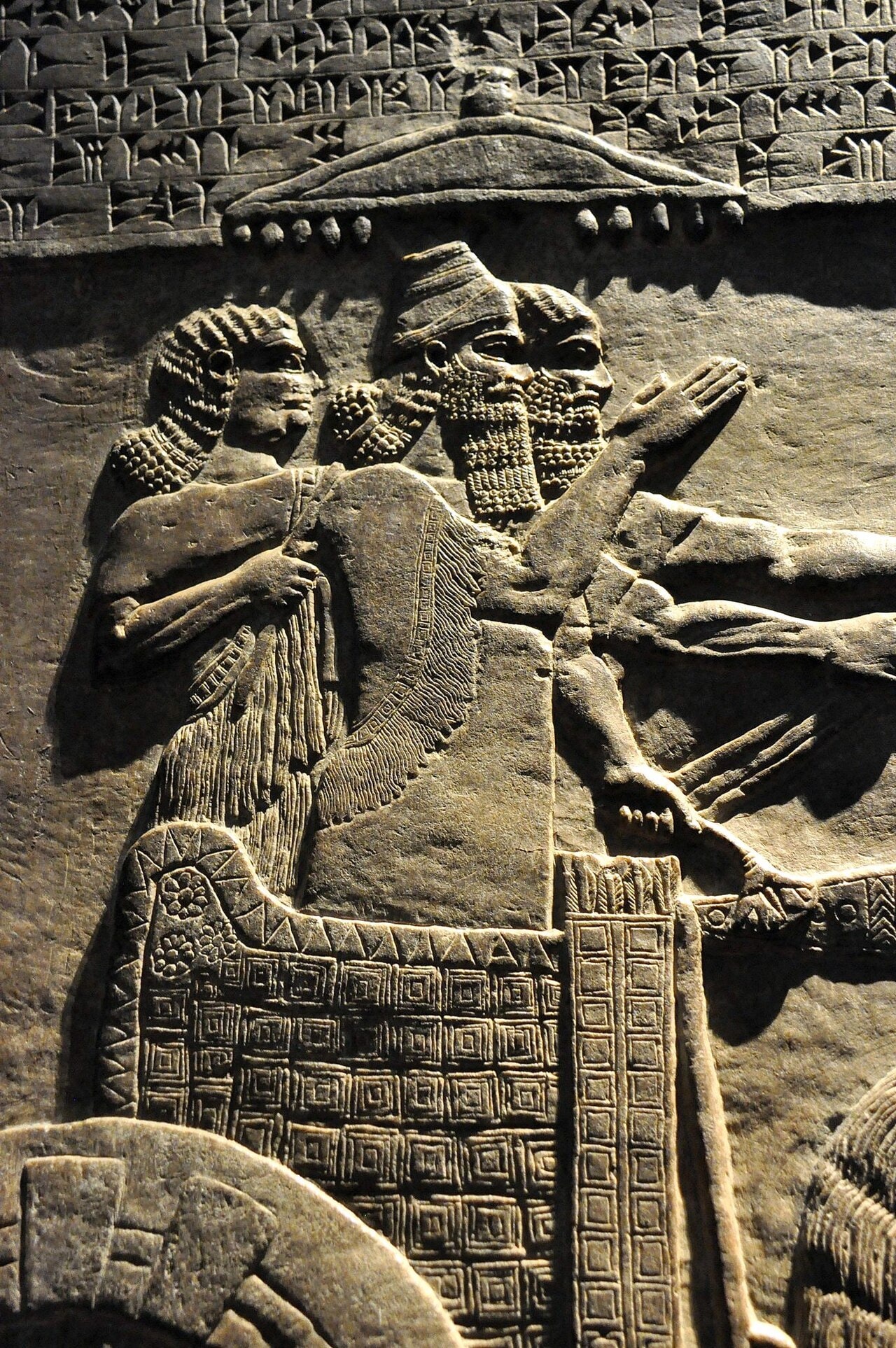
Tiglath-Pileser III in his chariot, from a relief of his campaign that shows the capture of the city of Astartu (biblical Ashtaroth, east of the Sea of Galilee), Central Palace at Nimrud, now in the British Museum. Photo: Osama Shukir Muhammed Amin FRCP(Glasg), CC BY-SA 4.0, via Wikimedia Commons, resized.

The 30-second version:
Pekah son of Remaliah murdered his king and took Israel's throne. He allied with Rezin of Damascus against Assyria and marched on Jerusalem to force Judah in, which is when Isaiah gave Ahaz the sign of Immanuel and called the two kings "two tails of smoking firebrands." Within a few years Tiglath-Pileser III took Galilee and Gilead, Pekah was killed by Hoshea, and the Assyrian king's own inscription says the people "overthrew Pekah their king" and that he made Hoshea king.
See this page's graph and discover linked topics
In full
Pekah was Pekahiah's "captain," an officer of the royal guard, and his coup was carried out with fifty Gileadites (2 Kings 15:25), pointing to a Transjordanian base. Kings gives him twenty years in Samaria (15:27). That figure is hard to fit into the time between Menahem's tribute (c. 738 BC) and Hoshea's accession (c. 732 BC), and Assyrian synchronisms rule out twenty years of sole rule. The most widely used solution, proposed by Edwin Thiele, is that Pekah had claimed the throne in Gilead as a rival to Menahem from about 752 BC and that Kings counts his years from that claim. Others propose textual error or different counting conventions. Mykytiuk's chart reflects the uncertainty with "750(?) to 732/731 BC."
The international setting is clear from Assyrian sources. An anti-Assyrian coalition led by Rezin of Damascus drew in Pekah; Judah under Ahaz refused, and Rezin and Pekah attacked Jerusalem to replace Ahaz with "the son of Tabeel" (Isaiah 7:6). Ahaz appealed to Tiglath-Pileser III, who campaigned west in 734 to 732 BC, destroyed Damascus, executed Rezin, and annexed the north of Israel.
In the Bible
- The coup. "Pekah the son of Remaliah, his captain, conspired against him, and smote him in Samaria, in the castle of the king's house... and with him were fifty men of the Gileadites: and he slew him, and reigned in his stead" (2 Kings 15:25, ASV).
- His reign. Twenty years in Samaria and the sins of Jeroboam son of Nebat (15:27-28).
- The Assyrian conquest. "In the days of Pekah king of Israel came Tiglath-pileser king of Assyria, and took Ijon, and Abel-beth-maacah, and Janoah, and Kedesh, and Hazor, and Gilead, and Galilee, all the land of Naphtali; and he carried them captive to Assyria" (15:29, ASV).
- His death. "Hoshea the son of Elah made a conspiracy against Pekah the son of Remaliah, and smote him, and slew him, and reigned in his stead" (15:30, ASV).
- War with Judah. Rezin and Pekah came against Jerusalem in the days of Jotham and Ahaz (2 Kings 15:37; 16:5). 2 Chronicles 28:5-15 records a heavy defeat of Judah by Pekah and the release of the captives at the word of the prophet Oded.
- Isaiah 7. "Rezin the king of Syria, and Pekah the son of Remaliah, king of Israel, went up to Jerusalem to war against it, but could not prevail against it" (Isaiah 7:1, ASV). Isaiah calls the two kings "two tails of smoking firebrands" (7:4) and refers to Pekah repeatedly and pointedly as "the son of Remaliah" (7:4-5, 9; 8:6), without his name.
Family and lineage
- Father: Remaliah, otherwise unknown. Isaiah's habit of naming Pekah only as "the son of Remaliah" is often read as a slight on an upstart with no royal pedigree.
- No dynasty. He followed Pekahiah, whom he murdered, and was followed by Hoshea, who murdered him.
Historical and archaeological evidence
- Tiglath-Pileser III, Summary Inscription 4. A summary text from Calah (Nimrud) that survives through a paper squeeze made in the nineteenth century. Speaking of the land of Israel ("the house of Omri"), it says that they overthrew Pekah (Paqaha) their king and that Tiglath-Pileser installed Hoshea (Ausi') as king over them, receiving tribute in gold and silver. The text is edited in Hayim Tadmor's The Inscriptions of Tiglath-Pileser III (1994) and in the RINAP series. Grade: direct.
- Other annal fragments of Tiglath-Pileser III describe the deportation of people from towns in Galilee and the Transjordan, matching 2 Kings 15:29 in kind. Several of the named towns are damaged in the text.
- Destruction layers. Excavations at Hazor (stratum V) and other northern sites show a violent destruction in the late eighth century, generally attributed to the Assyrian campaign of 732 BC.
- Mykytiuk's list. Lawrence Mykytiuk counts Pekah among the securely identified persons.
Scholarly consensus
That Pekah reigned, joined Rezin against Assyria, lost Galilee and Gilead, and died in a coup that put Hoshea on the throne is the common view of historians, because the biblical and Assyrian sources converge. The open questions are chronological: the twenty years of 2 Kings 15:27, and whether Tiglath-Pileser's "they overthrew Pekah" means he endorsed a coup already under way or engineered it. Many scholars, following Tadmor, read the Assyrian claim as taking credit for a change of king that served Assyria's interests.
Theological significance
- The setting of Immanuel. Pekah's march on Jerusalem is the occasion of Isaiah 7:14. The sign was given to the house of David when its survival seemed to hang on the plans of Rezin and Pekah, and Isaiah's word was that their plan "shall not stand" (7:7). See Ahaz and Isaiah 7-14 Was Mistranslated Objection Defeater.
- Prophecy against Ephraim. Isaiah said that "within threescore and five years shall Ephraim be broken in pieces, so that it shall not be a people" (7:8, ASV). Samaria fell about twelve years later, and the resettlement of foreign peoples in the land continued under Esarhaddon and Ashurbanipal (Ezra 4:2, 10), which many interpreters take as the completion of the sixty-five years.
- Brother against brother. 2 Chronicles 28:9-15 preserves a moment of mercy in the war: at Oded's rebuke the northern army clothed, fed and returned its Judahite captives, bringing them to Jericho (28:15). Several interpreters have compared the scene with the parable of the Good Samaritan, which is also set on the road to Jericho.
Church Fathers
No patristic comment centered on Pekah with a verified locator is cited here; the Fathers discuss him only as part of the Isaiah 7 setting.
See also
- People of the Bible, every person on the codex's list, by the book that first names them
- Biblical Figures Confirmed by Archaeology, Mykytiuk's list, where Pekah is number 18
- Tiglath-Pileser III, the Assyrian king whose inscription records his fall
- Menahem, whose son Pekah murdered
- Hoshea, who murdered Pekah and became Israel's last king
- Ahaz, the king of Judah he attacked
- Isaiah 7.14, the sign given during his war on Jerusalem
Common questions this page answers
Q: Who was Pekah son of Remaliah?
Pekah was an officer of King Pekahiah of Israel who murdered him and took the throne. He allied with Rezin of Damascus against Assyria, attacked Judah, lost Galilee and Gilead to Tiglath-Pileser III, and was killed by Hoshea (2 Kings 15:25-30).
Q: Is King Pekah mentioned in Assyrian records?
Yes. A summary inscription of Tiglath-Pileser III says the people of Israel overthrew Pekah their king and that the Assyrian king set Hoshea over them. Lawrence Mykytiuk counts Pekah among the persons in the Hebrew Bible securely identified in inscriptions.
Q: What does Pekah have to do with Isaiah 7:14?
Isaiah's sign of the virgin and Immanuel was given to King Ahaz while Pekah and Rezin were threatening Jerusalem (Isaiah 7:1-14). Isaiah told Ahaz not to fear these "two tails of smoking firebrands," because their plan would not stand.
Q: How could Pekah reign twenty years?
2 Kings 15:27 gives him twenty years, but Assyrian dates leave room for only a few years of sole rule in Samaria. Many scholars, following Edwin Thiele, think Pekah ruled a rival kingdom in Gilead from about 752 BC and that Kings counts from then. Others suggest a scribal error or a different counting method.