Concept
Paul's Damascus Road Encounter
Damascus Road Conversion, Damascus Road, Road to Damascus, Conversion of Paul, Paul's conversion, Paul's vision of Jesus, Did Paul see Jesus, What did Paul see on the road to Damascus, Damascus Road ChristophanyIntro
Saul of Tarsus was on his way to Damascus to arrest Christians. Around noon a light brighter than the sun blazed around him. He fell to the ground and heard a voice: "Saul, Saul, why persecutest thou me?" He asked who was speaking, and the answer came back: "I am Jesus whom thou persecutest." Saul got up blind, was led into the city, and three days later he was baptized. The man who had been hunting Christians became the apostle Paul.
So what did Paul actually see? Scripture is clear about who he met: Jesus, risen from the dead. It is careful about how Jesus appeared. The accounts describe blinding light and a voice, and they never describe Jesus's face or clothes. Paul himself later insisted, "Have I not seen Jesus our Lord?" and he listed this appearance right alongside the appearances to Peter, the Twelve, James and more than five hundred people at once. The one he met was the risen Son in glory, and Scripture never says he saw God the Father as a separate figure.
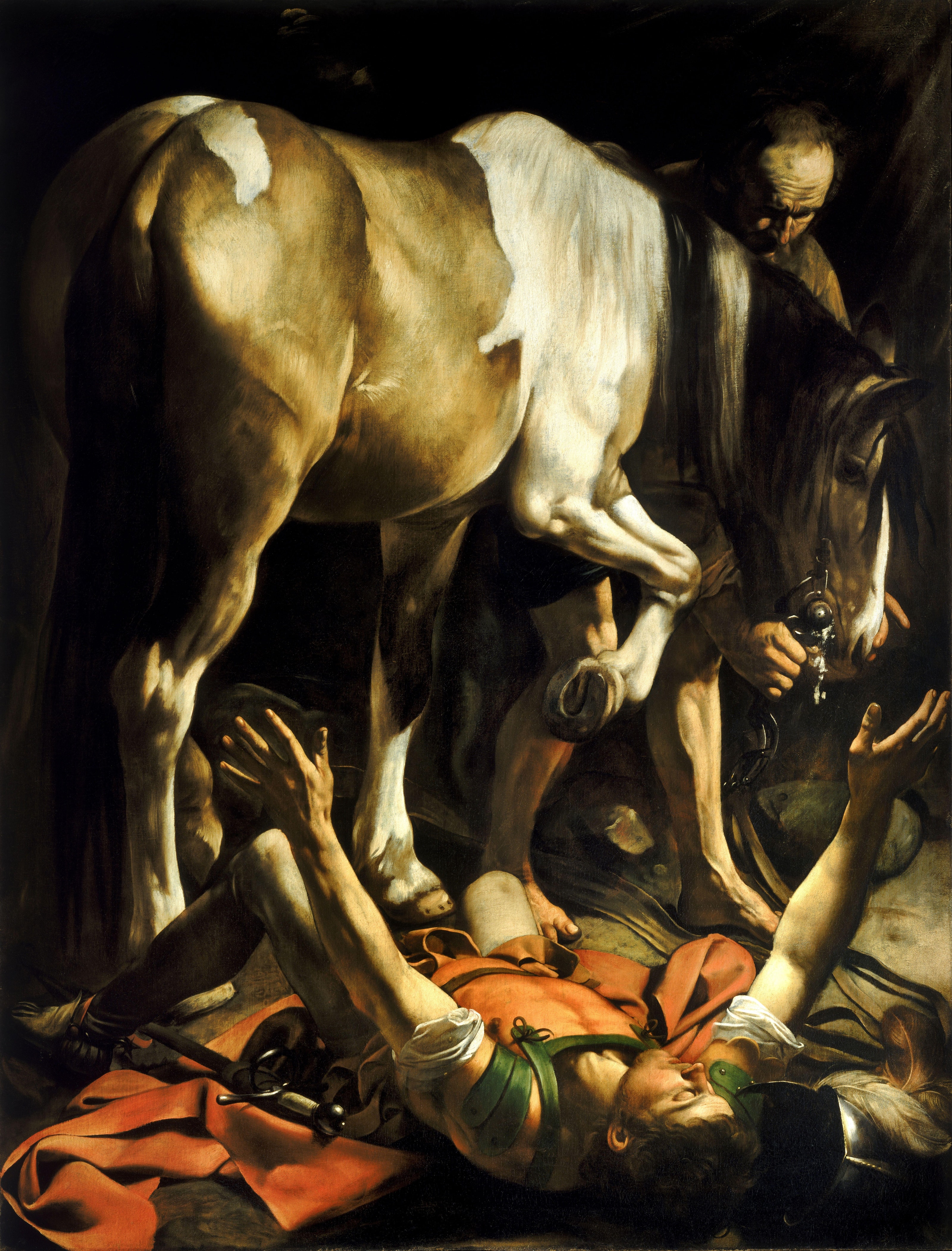
Caravaggio, Conversion on the Way to Damascus, 1601, Cerasi Chapel, Santa Maria del Popolo, Rome. The painter shows only Saul, the horse and a groom, with the light falling from above; Acts mentions no horse, which is the painter's addition. Image: public domain, via Wikimedia Commons.

See this page's graph and discover linked topics
In full
The Damascus road encounter is narrated three times in Acts (9:1-19 in Luke's narrative voice, 22:3-21 in Paul's defense before the Jerusalem crowd, 26:9-23 in his defense before Agrippa) and referred to by Paul himself in four undisputed letters (1 Corinthians 9:1; 15:8; Galatians 1:13-16; 2 Corinthians 4:6). The accounts agree on the core: a light from heaven at midday, Saul's fall, a voice addressing him in the second person and identifying itself as the Jesus he persecutes, his blindness, and his commission. The New Testament classifies the event as a resurrection appearance of the same kind as the others, using the same verb (ōphthē, "he appeared," aorist passive of horaō) for Cephas, the Twelve, the five hundred, James, the apostles and Paul (1 Corinthians 15:5-8). Paul calls it a "heavenly vision" (ouranios optasia, Acts 26:19) and an apocalypse or revelation of Jesus Christ (Galatians 1:12), while also claiming to have seen Jesus (1 Corinthians 9:1). The best reading holds both: an objective appearance of the risen and glorified Christ, accompanied by phenomena his companions perceived in part, which also carried revelatory content for Paul alone. Historically, Paul's conversion is one of the facts granted by most critical scholars (Gary Habermas's minimal facts), and every naturalistic account of it (hallucination, guilt projection, epilepsy, conversion disorder) has to explain a hostile witness, a public external phenomenon, and an experience Paul himself ranked with the group appearances.
The three accounts side by side
| Detail | Acts 9 (Luke narrating) | Acts 22 (Paul to the crowd) | Acts 26 (Paul to Agrippa) |
|---|---|---|---|
| Time | Not stated | "about noon" (22:6) | "at midday" (26:13) |
| The light | "a light out of heaven" (9:3) | "a great light" (22:6) | "above the brightness of the sun" (26:13) |
| Who fell | Saul (9:4) | Saul (22:7) | "we were all fallen to the earth" (26:14) |
| The voice | "Saul, Saul, why persecutest thou me?" (9:4) | Same words (22:7) | Same words, "in the Hebrew language," adding "it is hard for thee to kick against the goad" (26:14) |
| Self-identification | "I am Jesus whom thou persecutest" (9:5) | "I am Jesus of Nazareth, whom thou persecutest" (22:8) | "I am Jesus whom thou persecutest" (26:15) |
| Companions | "stood speechless, hearing the voice, but beholding no man" (9:7) | "beheld indeed the light, but they heard not the voice of him that spake to me" (22:9) | Saw the light shining around them (26:13) |
| Effect on Saul | Blind three days (9:8-9) | Could not see "for the glory of that light" (22:11) | Not narrated |
| Commission | Through Ananias (9:15) | Through Ananias (22:14-15) | Spoken by Jesus directly, compressed (26:16-18) |
All quotations ASV.
What Paul saw
- Light from heaven. Every account puts the light first. In the third telling it is "above the brightness of the sun" (Acts 26:13, ASV), and in the second Paul was blinded "for the glory of that light" (Acts 22:11, ASV). In Scripture, overwhelming light is the mark of God's glory (Exodus 34:29-35; Ezekiel 1:28) and of the glorified Christ (Matthew 17:2; Revelation 1:16).
- A person who spoke. The light carried a person. A voice addressed Saul by name, in Hebrew (or Aramaic), and answered his question.
- The identity: Jesus. Saul's question, "Who art thou, Lord?", gets the answer "I am Jesus whom thou persecutest" (Acts 9:5, ASV). Ananias later says "the Lord, even Jesus, who appeared unto thee in the way" (Acts 9:17, ASV), and Barnabas reports that Saul "had seen the Lord in the way" (Acts 9:27, ASV).
- The Righteous One, seen and heard. Ananias tells him God appointed him "to see the Righteous One, and to hear a voice from his mouth" (Acts 22:14, ASV), and to be a witness "of what thou hast seen and heard" (Acts 22:15, ASV). The texts present seeing and hearing together.
Did Paul see God the Father?
No. Every account identifies the one who appeared as Jesus. "No man hath seen God at any time; the only begotten Son, who is in the bosom of the Father, he hath declared him" (John 1:18, ASV). In Trinitarian theology the Son reveals the Father because He shares the Father's nature while remaining a distinct person: "he that hath seen me hath seen the Father" (John 14:9, ASV). Paul says the same in his own terms: God shined in our hearts "to give the light of the knowledge of the glory of God in the face of Jesus Christ" (2 Corinthians 4:6, ASV). The glory Paul saw on the road is the glory of God, seen in the face of the Son.
What form did Jesus take?
The texts allow a precise answer.
| Possibility | What the texts say |
|---|---|
| Jesus as He looked before the crucifixion | Not indicated. The appearance came after the ascension and in glory. |
| The risen, glorified Christ | Supported. Paul lists this appearance with the other resurrection appearances (1 Corinthians 15:5-8) and says he saw Jesus (1 Corinthians 9:1). |
| Brilliant heavenly light | Explicit in all three accounts. |
| A described human figure | Not described. No account mentions a face, clothing or posture. |
| God the Father appearing separately | Not indicated. |
Vision or appearance? Two lines of evidence need to be held together.
- Paul calls it a vision. He tells Agrippa, "I was not disobedient unto the heavenly vision" (Acts 26:19, ASV). The word optasia is also used of the angels at the tomb (Luke 24:23), so it does not by itself mean "something inside the head."
- Paul calls it an appearance like the others. In 1 Corinthians 15:3-8 he hands on an early creed that lists appearances to Cephas, the Twelve, more than five hundred at once, James and all the apostles, then adds: "and last of all, as to the child untimely born, he appeared to me also" (1 Corinthians 15:8, ASV). The same verb, ōphthē, is used for every name on the list. Paul deliberately places himself among the witnesses of the risen body and calls himself the last of them.
The resulting picture: Paul encountered the same risen Jesus the other apostles saw, now ascended and glorified. Paul's own teaching on the resurrection body fits this. The body "is sown a natural body; it is raised a spiritual body" (1 Corinthians 15:44, ASV), a body animated and glorified by the Spirit, which Paul elsewhere calls "the body of his glory" (Philippians 3:21). A glorified body seen in overwhelming light is what the accounts describe.
The companions: what they saw and heard
The accounts differ on the companions, and the differences are often raised as contradictions.
- Light and sound. Acts 9:7 says they heard "the voice" and saw no one. Acts 22:9 says they saw the light but "heard not the voice of him that spake to me" (ASV). The natural harmonization is that they heard a sound but did not understand the words spoken to Paul, and saw the light but not the person. That is how the phrase "the voice of him that spake to me" reads in 22:9: the words were for Paul.
- The Greek. In 9:7 "hearing" (akouontes) takes "voice" in the genitive case (tēs phōnēs); in 22:9 "they heard not" (ouk ēkousan) takes it in the accusative (tēn phōnēn). An older harmonization reads the genitive as hearing a sound and the accusative as hearing with understanding. Many grammarians caution that the two cases after this verb do not carry that distinction consistently across the New Testament, so the case difference supports the harmonization without proving it. The harmonization stands on the context either way.
- Standing and falling. Acts 9:7 says the men "stood speechless"; Acts 26:14 says "we were all fallen to the earth." A sequence explains both: all fell at the flash, and the companions stood while Saul remained on the ground.
- One author. Luke wrote all three accounts in the same book, within a few chapters. He plainly did not regard them as contradicting each other. The variation is what one expects when the same story is retold for different audiences with different emphases.
What matters most for apologetics: the companions perceived something. They saw light and heard sound. The event was not private to Saul's mind.
In Paul's own letters
- "Have I not seen Jesus our Lord?" (1 Corinthians 9:1, ASV). Paul grounds his apostleship on having seen the risen Jesus.
- "Last of all... he appeared to me also" (1 Corinthians 15:8, ASV). Paul as the last witness in the resurrection creed.
- "Through revelation of Jesus Christ" (Galatians 1:12, ASV), and God was pleased "to reveal his Son in me, that I might preach him among the Gentiles" (Galatians 1:15-16, ASV). Paul says he received his gospel from that encounter and from no human teacher.
- "The light of the knowledge of the glory of God in the face of Jesus Christ" (2 Corinthians 4:6, ASV). Often read as Paul's own echo of the Damascus light.
- The persecutor. "As touching zeal, persecuting the church" (Philippians 3:6, ASV); "I was before a blasphemer, and a persecutor, and injurious" (1 Timothy 1:13, ASV).
What the encounter shows about Jesus
- Jesus identifies with His people. Saul was persecuting Christians, and Jesus says "why persecutest thou me?" The church is Christ's body (see Paul the Apostle on Paul's body-of-Christ theology).
- Jesus speaks from heaven in divine glory. A crucified man answering from a light brighter than the sun, addressed as "Lord" (kyrios) by a Pharisee who knew the Scriptures, fits the larger New Testament case for Christ's deity, though that case rests on many more texts. See Christs Deity.
- The risen Jesus is the same Jesus. "Jesus of Nazareth" (Acts 22:8) is the man of Galilee, not a new heavenly figure.
Skeptical explanations, steel-manned and answered
1. Hallucination or guilt projection. Gerd Lüdemann (The Resurrection of Jesus: History, Experience, Theology, 1994) argued that Paul's experience was a psychological vision born of inner conflict: a secret attraction to the faith he was persecuting, resolved in a vision of Christ.
- No evidence of guilt. Paul describes his pre-Christian self as confident: "as touching the righteousness which is in the law, found blameless" (Philippians 3:6, ASV). Krister Stendahl's influential essay "The Apostle Paul and the Introspective Conscience of the West" (1963) argued that Paul had a "robust conscience," not a tormented one. The guilt theory supplies an inner life the sources do not show.
- Hallucinations are private. The companions saw light and heard sound. A hallucination does not blind the hallucinator for three days in a way others observe, and it does not knock his companions to the ground.
- It does not stand alone. Even if Paul's experience were explained away, the creed of 1 Corinthians 15:3-8 lists group appearances (the Twelve, the five hundred) and another hostile or skeptical witness, James. A hallucination theory has to explain all of them, which multiplies the improbabilities. See Resurrection of Jesus - Naturalistic Counter-Theories.
2. Epilepsy. D. Landsborough ("St Paul and Temporal Lobe Epilepsy," Journal of Neurology, Neurosurgery and Psychiatry 50, 1987, 659-664) proposed that the light, the fall and the blindness were a temporal lobe seizure.
- A seizure does not produce a shared perception for the people standing nearby, and it does not account for the content: a specific identification, a specific commission, and a life of coherent, demanding work that followed for three decades.
3. Conversion disorder and other psychiatric hypotheses. Joseph Bergeron and Gary Habermas ("The Resurrection of Jesus: A Clinical Review of Psychiatric Hypotheses for the Biblical Story of Easter," Irish Theological Quarterly 80, 2015, 157-172) reviewed hallucination, conversion disorder and bereavement explanations and concluded that they are inconsistent with current clinical understanding.
4. "It was just a vision, so it does not support a bodily resurrection." Steel-manned: if Paul's experience was visionary and Paul ranks it with the others, perhaps all the appearances were visions.
- Paul ranks the appearances together as appearances of the risen Jesus, the one who "was buried" and "hath been raised" (1 Corinthians 15:4). In a Jewish context, "raised" after "buried" means the body left the tomb.
- Paul distinguishes this appearance from his later visions and revelations (2 Corinthians 12:1-4), and calls it the last of the resurrection appearances. He did not count every later experience as one.
- The Gospels independently report the earlier appearances as bodily (eating, touching), and Luke, who records Paul's experience as light and voice, also records the bodily appearances. He saw no tension because the Damascus appearance came after the ascension.
5. Why the encounter is strong evidence. On Habermas's minimal-facts method, Paul's conversion is one of the facts granted by nearly all critical scholars, since it rests on Paul's own undisputed letters. The witness was an enemy of the movement. He had status, education and a career to lose, and he lost them. He staked his apostleship on having seen Jesus. A skeptic who became a witness is the kind of testimony historians weigh heavily. See Minimal Facts Argument and Resurrection of Jesus - Minimal Facts Case.
The answer in one paragraph
Paul saw the risen and glorified Jesus Christ. Scripture does not describe His appearance beyond overwhelming light and a voice that named itself "Jesus whom thou persecutest." Paul did not see God the Father as a separate figure, because the glory of God is seen in the face of the Son. Paul himself counted the encounter as a real appearance of the risen Lord, the last on the list that begins with Peter. "He is not here; for he is risen, even as he said" (Matthew 28:6, ASV), and on the road to Damascus He proved it to the man most determined to deny it.
Scholarship
Published academic works this page draws on, each matched to a publisher, index or library catalog record.
- Joseph W. Bergeron and Gary R. Habermas, "The Resurrection of Jesus: A Clinical Review of Psychiatric Hypotheses for the Biblical Story of Easter," Irish Theological Quarterly 80 (2015). doi:10.1177/0021140014564555
- Gary R. Habermas, Case for the Resurrection of Jesus (2004). Open Library
- D Landsborough, "St Paul and temporal lobe epilepsy," Journal of Neurology, Neurosurgery & Psychiatry 50 (1987). doi:10.1136/jnnp.50.6.659 PubMed 3302109 open access
- Krister Stendahl, "The Apostle Paul and the Introspective Conscience of the West," Harvard Theological Review 56 (1963). doi:10.1017/s0017816000024779
See also
- Paul the Apostle, the person, his life and letters
- Resurrection of Jesus, the master hub on the resurrection
- Resurrection of Jesus - Minimal Facts Case, where Paul's conversion counts as a granted fact
- Resurrection of Jesus - Naturalistic Counter-Theories, hallucination and the other alternatives
- Minimal Facts Argument, the argument built on the granted facts
- Gary Habermas, the scholar behind the minimal-facts method
- James the Brother of Jesus, the other skeptic who became a witness
- Christs Deity, the wider case for who Jesus is
- horaō, the verb behind "he appeared"
- The Unknown God, Paul at Athens proclaiming the risen Jesus to the philosophers
Common questions this page answers
Q: Did Paul actually see Jesus on the road to Damascus?
Yes. Paul says so directly: "Have I not seen Jesus our Lord?" (1 Corinthians 9:1), and he lists the Damascus appearance with the appearances to Peter, the Twelve, James and the five hundred (1 Corinthians 15:5-8). Acts describes a blinding light and a voice that said "I am Jesus whom thou persecutest."
Q: What did Jesus look like when He appeared to Paul?
The accounts do not describe His face or clothes. They describe a light from heaven "above the brightness of the sun" and a voice. Paul understood it as an appearance of the risen and glorified Jesus.
Q: Did Paul see God the Father or Jesus?
Jesus. Every account identifies the speaker as Jesus. "No man hath seen God at any time" (John 1:18), and the Son reveals the Father, so Paul speaks of "the glory of God in the face of Jesus Christ" (2 Corinthians 4:6).
Q: Do Acts 9 and Acts 22 contradict each other about what Paul's companions heard?
Acts 9:7 says they heard the voice; Acts 22:9 says they did not hear the voice of the one speaking to Paul. The natural reading is that they heard a sound but did not understand the words, and saw the light but not the person. Luke wrote both accounts in the same book and saw no contradiction.
Q: Was Paul's experience just a hallucination?
Hallucinations are private, but Paul's companions saw the light and heard the sound. Paul was a hostile witness with no recorded guilt over persecuting the church, and his experience is one of several appearances, including group appearances, listed in an early creed. Clinical reviews have found psychiatric explanations inconsistent with the evidence.
Q: Was the Damascus road experience a vision or a real appearance?
Paul calls it a "heavenly vision" (Acts 26:19), but he also ranks it as a resurrection appearance alongside the others, using the same word for "he appeared." The best reading is an objective appearance of the risen, glorified Jesus, the last of the resurrection appearances.