Concept
Parkinson Disease Healing (Kruijthoff 2021)
Parkinson Disease Healing, Parkinson's Healing After Prayer, Dutch Parkinson Healing, My Body Does Not Fit in Your Medical Textbooks, Kruijthoff Parkinson CaseIntro
A Dutch woman born in 1959 had Parkinson disease, the brain illness that slowly takes away a person's control of movement. By 2012 her case was advanced and getting worse quickly. She needed high doses of medicine, and her symptoms were disabling.
That year she was prayed for. Her healing came at once and was nearly complete. The old symptoms did not come back, and the ones that were left kept getting better. She went back to her job and to normal daily life.
A team of five medical specialists at a university hospital in Amsterdam studied her medical files and called her recovery "remarkable." In 2021 the researchers published her case in a peer-reviewed medical journal. That is why this entry sits in the top tier. As is normal for a medical case report, her name is withheld.
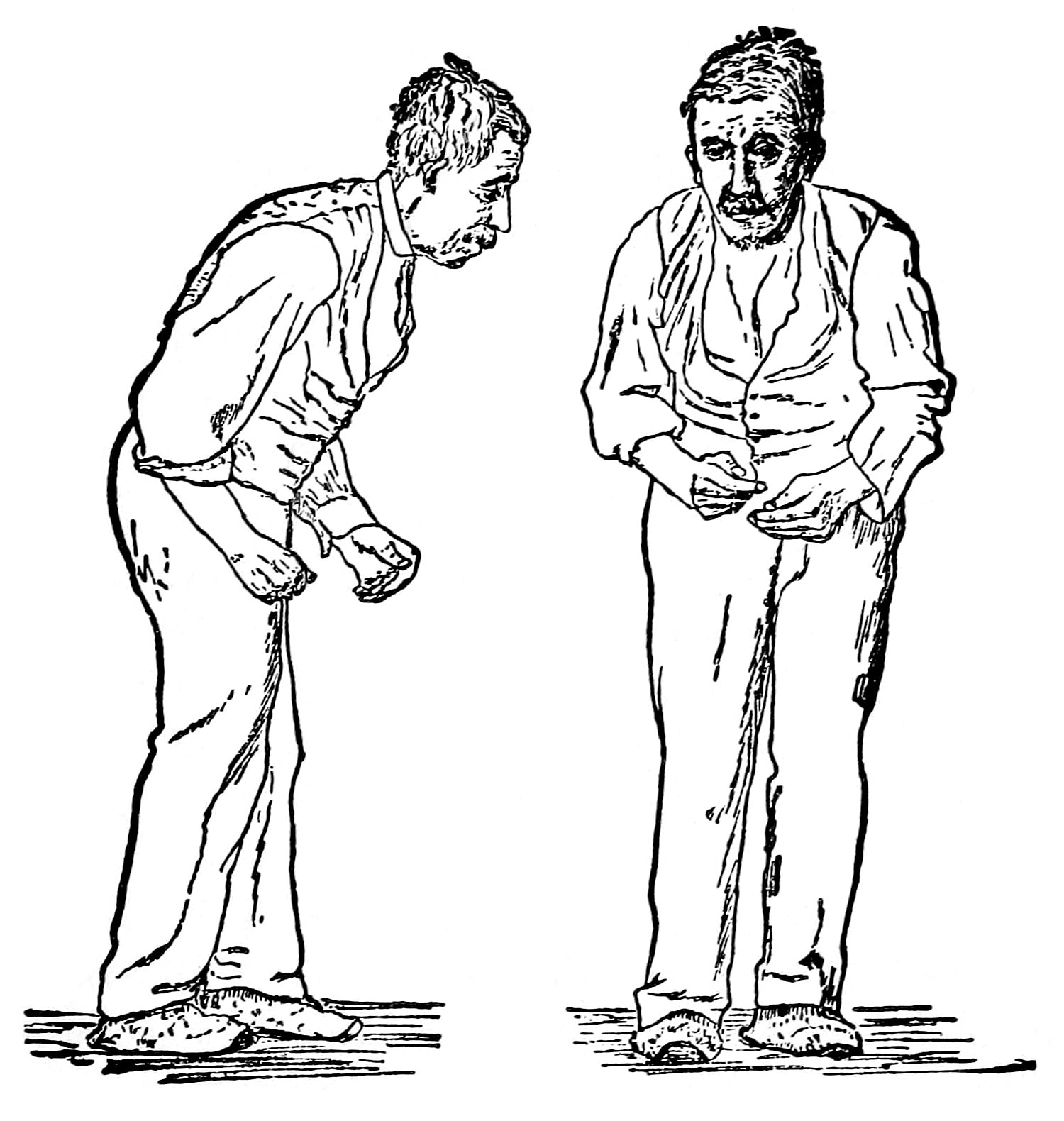
The stooped posture of advanced Parkinson disease, from William Richard Gowers, A Manual of Diseases of the Nervous System (1886), after an earlier French photograph. Illustration: public domain, via Wikimedia Commons.

The 30-second version: A Dutch woman born in 1959 had advanced, rapidly worsening Parkinson disease and needed high doses of medication. In 2012, after intercessory prayer, she experienced an instant, nearly complete healing. Her former symptoms never returned, the rest kept improving, and she regained all her abilities at work and at home. An independent medical assessment team at Amsterdam UMC judged the recovery "remarkable," and the case was published in Advances in Mind-Body Medicine in 2021. The same team declined to call it "unexplained," and that restraint is part of why the case is worth citing.
See this page's graph and discover linked topics
In full
Dirk J. Kruijthoff, a Dutch general practitioner, carried out a doctoral study of healing after prayer at the Vrije Universiteit (VU) Amsterdam, supervised by the theologian Cornelis van der Kooi and Gerrit Glas, a philosopher of neuroscience, and awarded on 24 April 2023. Its protocol was published in advance (Advances in Mind-Body Medicine, 2017). Medical data from before and after prayer were collected for each reported healing, and an independent medical assessment team then graded each case as "medically remarkable," "medically unexplained" or neither. The team had five specialists, in internal medicine, haematology, surgery, psychiatry and neurosurgery, chosen from both agnostic and religious backgrounds to limit bias.
This case was published separately: Kruijthoff, Bendien, Doodkorte, van der Kooi, Glas and Abma, "'My Body Does Not Fit in Your Medical Textbooks': A Physically Turbulent Life With an Unexpected Recovery From Advanced Parkinson Disease After Prayer," Advances in Mind-Body Medicine 35.2 (2021), 4-13 (PubMed 33620331). Per the abstract, the patient was a woman born in 1959 who experienced an "instantaneous, nearly complete healing in 2012 after intercessory prayer," when the disease was "at an advanced stage, rapidly progressive, with major debilitating symptoms" and "high doses of oral medication were required." There was no recurrence of her former symptoms; the remaining symptoms continued to improve; and she regained all of her capacities at work and in daily life. The assessment team described the recovery as "remarkable," and the authors write that "the clinical course was extraordinary, contradicting data from imaging studies, as well as the common understanding of this disease." The group's open-access companion paper (Journal of Religion and Health, 2023) lists her as a Baptist at the time of her healing.
Summary
An anonymous Dutch woman, born in 1959, with advanced and rapidly progressive Parkinson disease on high-dose medication, experienced an instantaneous, nearly complete healing after intercessory prayer in 2012. Her former symptoms did not return and she regained full function at work and at home. An independent five-specialist medical assessment team at Amsterdam UMC, location VUmc, judged the recovery "remarkable," and the case was published in the peer-reviewed, MEDLINE-indexed journal Advances in Mind-Body Medicine in 2021.
The event
The illness. Parkinson disease is a progressive degeneration of the brain cells that produce dopamine, and it is not known to be curable. Treatment eases symptoms; it does not halt the underlying loss. Per the published abstract, by 2012 her disease was at an advanced stage, rapidly progressive and severely disabling, and she needed high doses of oral medication.
The prayer. In 2012 she received intercessory prayer. The abstract does not say who prayed, where, or in what setting, and the open-access papers do not either. In the group's interview study she describes the moment as "a large warm cloud, and the feeling that something is happening now, as if a small net has been taken away from my brain," and adds, "It seems as if God has operated on my head."
Afterward. The abstract reports an instantaneous, nearly complete healing. Her former symptoms did not recur, the symptoms that remained continued to improve, and she regained all of her capacities at work and in daily life. The authors note that the recovery "did not make her immune to other illnesses and suffering, but it did strengthen her belief that God cares about human beings." She is quoted saying she had always "lived with God," and that when she had given up hope, "life was given back to her." In the companion study she was interviewed about six years after the healing.
Witnesses + documentation
- The patient, a woman born in 1959, anonymous as is standard in a medical case report, listed as a Baptist at the time of her healing.
- Her family and physicians, who, per the abstract, were "astonished" along with her. They are not named.
- The investigating team: Dirk J. Kruijthoff (Amsterdam UMC; Faculty of Theology, VU), Elena Bendien (Leyden Academy on Vitality and Ageing), C. Doodkorte, Cornelis van der Kooi (Faculty of Theology, VU), Gerrit Glas (VU; Amsterdam UMC) and Tineke A. Abma.
- The medical assessment team: five specialists in internal medicine, haematology, surgery, psychiatry and neurosurgery at Amsterdam UMC, location VUmc, who reviewed the medical files from before and after the prayer.
- Publication: Advances in Mind-Body Medicine 35.2 (Winter 2021), 4-13, indexed in MEDLINE, PubMed 33620331. The case is one of eleven graded "remarkable" in the wider study, reported in Explore 19.3 (2023), 376-382.
Verification
- A defined diagnosis with a medical record. The study's protocol admitted only cases with a well-documented medical history before and after the prayer, and the assessment team worked from the medical files, not from the patient's account alone.
- An independent and mixed panel. Five specialists from different fields, agnostic and religious, made the judgment. None of them, per the companion paper, regard healing prayer as a medical intervention.
- A conservative grading. Of 83 reports received, 27 were evaluated and 11 graded "remarkable." None was graded "unexplained." A panel this willing to withhold the stronger label is hard to dismiss as credulous.
- Durability. The recovery held: no return of the former symptoms, continuing improvement, and full working life, with the patient interviewed about six years later.
- Peer review. The case report and the three companion papers passed review at MEDLINE-indexed journals.
Naturalistic explanations considered:
- Spontaneous remission. Parkinson disease is progressive and is not known to remit. The authors state that the course contradicted "the common understanding of this disease."
- Placebo and expectation. Placebo responses in Parkinson disease are well known, but they are typically partial and short-lived. The case report describes a lasting, nearly complete recovery with no return of the former symptoms.
- Misdiagnosis. Some conditions mimic Parkinson disease, and a misdiagnosis is the strongest question a skeptic can put. The abstract does not describe the imaging studies or say whether the diagnosis was revisited. The authors do report that the clinical course contradicted the imaging data, which implies the imaging was consistent with the disease.
Caveats and remaining uncertainties:
- "Remarkable," not "unexplained." The assessment team, by its own criteria, did not label the recovery medically unexplained. The case should be presented at the grade the team gave it.
- Anonymity and access. The patient, her doctors and the place of the prayer are not named, and the full text of the case report is not open access. The details above come from the published abstract and the open-access Journal of Religion and Health paper.
- A labelling quirk in the companion paper. The Journal of Religion and Health paper's table lists the Parkinson participant as P8, and its text explicitly attributes the "small net" and "operated on my head" quotes to her. One other passage tagged P8 in that paper describes a different participant's MRI and appears to be a mislabel, so it is not used here.
- The authors' own framing. The research team presents the case as a challenge to a purely biomedical model and argues for dialogue between disciplines, not as proof of a miracle. Kruijthoff told Trouw in 2016 that "you will never be able to demonstrate a causal link," and that "by far most people who are prayed for see no significant change" (as reported by DutchNews.nl, 29 December 2016).
Apologetic value
- A Protestant case reviewed by a university hospital. Most bureau-reviewed healings in this collection come through Lourdes or the Vatican. This one was assessed by a secular academic medical centre in what the researchers' own protocol calls the "highly secularized Dutch society", and the woman healed was a Baptist.
- The Gospel pattern. Luke records a woman who "was bowed together, and could in no wise lift herself up" for eighteen years; Jesus "laid his hands upon her: and immediately she was made straight, and glorified God" (Luke 13:11-13, ASV). A stooped, rigid posture is typical of advanced Parkinson disease, and the recovery here was likewise immediate and met with praise to God. The practice of prayer for the sick follows James 5:14-16.
- An answer to Hume. David Hume argued that testimony to a miracle can never outweigh uniform experience. Here the before and after rest on medical files reviewed by specialists, not on the patient's word.
- Honesty as a strength. Concede up front that the panel said "remarkable," not "unexplained," and that the researchers themselves claim no proof of causation. A skeptic who expects overstatement meets a case stated at exactly its documented strength, and the documented strength is still an instant, lasting recovery from a progressive disease no one expects to reverse.
- How to deploy it. Lead with the facts: advanced, rapidly progressive Parkinson disease on high-dose medication; instant, nearly complete healing after prayer in 2012; no recurrence; full return to work; graded "remarkable" by five specialists at Amsterdam UMC; published 2021. Pair it with Gastroparesis Healing (Romez 2019) and Juvenile Macular Degeneration Healing (Romez 2020), two further peer-reviewed Protestant cases, and with STEPP Mozambique Study (Brown 2010) for the study side.
Scholarship
Published academic works this page draws on, each matched to a publisher, index or library catalog record.
- Elena Bendien et al., "A Dutch Study of Remarkable Recoveries After Prayer: How to Deal with Uncertainties of Explanation," Journal of Religion and Health 62 (2023). doi:10.1007/s10943-023-01750-6 PubMed 36738396 open access
- Dirk J. Kruijthoff et al., "Can you be cured if the doctor disagrees? A case study of 27 prayer healing reports evaluated by a medical assessment team in the Netherlands," Explore 19 (2023). doi:10.1016/j.explore.2022.07.008 PubMed 35987685 open access
- Dick Kruijthoff, Healing after Prayer, an interdisciplinary case study (2023). Open Library
See also
- Miracles, master hub
- _schema, the vetting standard this entry follows
- Gastroparesis Healing (Romez 2019), a peer-reviewed case report of healing after prayer at a Pentecostal meeting
- Juvenile Macular Degeneration Healing (Romez 2020), a peer-reviewed case report of sight restored after prayer
- STEPP Mozambique Study (Brown 2010), peer-reviewed study of proximal intercessory prayer
- Barbara Cummiskey Snyder (Wheaton 1981), another Protestant healing of a progressive neurological disease
- Argument from Miracles, the argument this case supports
- David Hume, whose argument against miracle testimony this case presses
- Naturalism, the worldview such cases press against
Common questions this page answers
Q: Has anyone been healed of Parkinson's disease after prayer?
A peer-reviewed case report published in Advances in Mind-Body Medicine in 2021 describes a Dutch woman, born in 1959, whose advanced and rapidly progressive Parkinson disease was instantly and almost completely healed after intercessory prayer in 2012. Her former symptoms never returned and she resumed full work and daily life.
Q: Did doctors confirm the Parkinson's healing after prayer in the Netherlands?
An independent team of five medical specialists at Amsterdam UMC reviewed her medical files and graded the recovery "medically remarkable." They did not grade it "medically unexplained," a stronger label the same team gave to none of the 27 cases it evaluated.
Q: Was the woman healed of Parkinson's a Protestant?
Yes. The research group's 2023 paper in the Journal of Religion and Health lists her as a Baptist at the time of her healing.
Q: Could the Parkinson's healing have been a placebo effect or a misdiagnosis?
Placebo responses in Parkinson disease are real but typically partial and temporary, while this recovery was nearly complete and lasting. Misdiagnosis is the strongest skeptical question; the published abstract does not detail the imaging, though the authors say the clinical course contradicted the imaging data and the common understanding of the disease.
Q: What did the researchers conclude about healing after prayer?
The team concluded that the remarkable healings did not fit well in a purely biomedical framework and called for an approach that weighs medical and experiential data together. Kruijthoff has also said a causal link between prayer and healing can never be demonstrated scientifically, and that most people who are prayed for see no significant change.