Person
Pachomius
Pachomius the Great, Saint Pachomius, Pakhom, Abba Pachomius, PachomiosIntro
Pachomius was an Egyptian soldier who became a Christian after strangers showed him kindness, and then invented a new way of following Christ: monks living together. Before him, most Christian ascetics lived alone as hermits. Pachomius gathered them into communities with shared meals, shared work, shared prayer and a written rule.
That model, the monastery as most people picture it, spread from the banks of the Nile across the whole Christian world. Every later monastic rule, including the Rule of Benedict that shaped medieval Europe, stands in his debt.
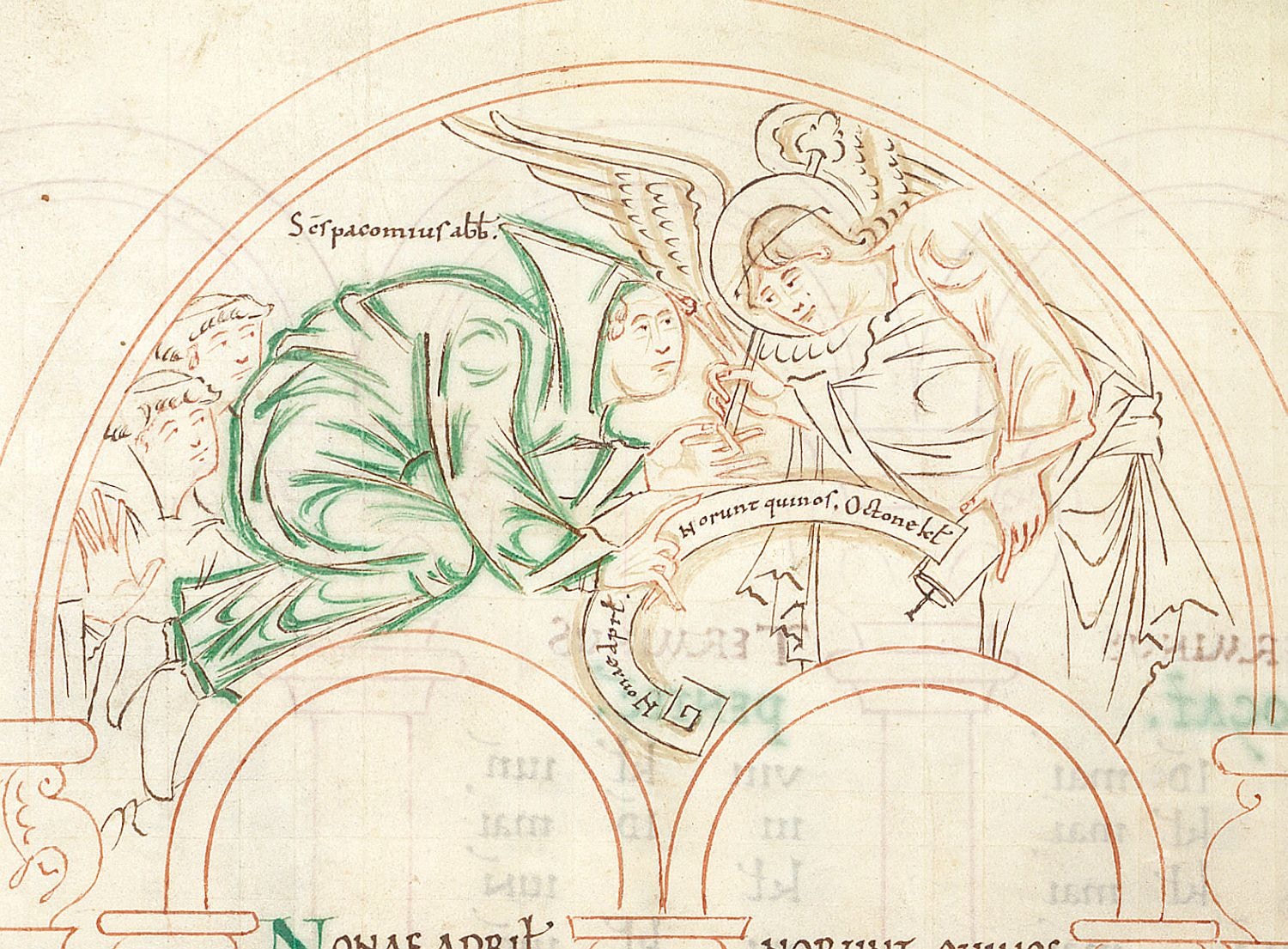 Pachomius receives the tablet of his rule from an angel, Arundel Psalter (Canterbury, 1012-1023), British Library MS Arundel 155. Public domain (Wikimedia Commons), resized.

See this page's graph and discover linked topics
In full
Pachomius (Coptic Pakhōm, c. 292-346 or 348) was a Coptic Egyptian of the Thebaid (Upper Egypt) who founded cenobitic, or communal, monasticism. Born to pagan parents near Esna, he was conscripted into the Roman army as a young man, was moved by the charity of local Christians who fed the recruits held at Thebes, and after discharge was baptized at Chenoboskion. He trained for several years under the hermit Palamon, then, around 320 to 325, founded a community at Tabennesi on the Nile. By his death in an epidemic, his federation (the koinōnia) numbered nine monasteries for men and two for women, centered on Pbow. His rule, the earliest Christian monastic rule to survive, was translated from Coptic into Greek and, by Jerome in 404, into Latin, and it influenced Basil the Great, John Cassian and Benedict of Nursia. The principal sources are the Coptic (Bohairic and Sahidic) and Greek Lives of Pachomius, the Paralipomena, his rules and letters, and the writings of his successors Theodore and Horsiesius.
Life
- Pagan youth. Born in Upper Egypt to non-Christian parents, around 292.
- Conscription and conversion (c. 312-313). Taken into the army during the civil wars that ended the Great Persecution, he and other recruits were held at Thebes. Christians of the town brought them food and drink. When he asked who these people were, he was told they were Christians, who do good to strangers for the sake of the God of heaven. He prayed that if he were released he would serve that God and serve humanity.
- Baptism. Discharged soon after, he settled at the village of Chenoboskion, was baptized, and served the villagers, including during an epidemic.
- Apprenticeship. He joined the old anchorite Palamon, whose regime of fasting, night vigils and manual work he shared for about seven years.
- Tabennesi (c. 320-325). The Lives say he heard a call, while praying at the deserted village of Tabennesi, to build a dwelling for those who would come to him. His first attempt at community failed when the men he gathered would not cooperate; he dismissed them and started again with clearer rules.
- Growth. Under his leadership the koinōnia grew rapidly. His sister Mary led a women's community nearby. Monks worked at farming, basket-weaving, rope-making and boat transport, and the federation became an economic force in the Nile valley.
- Death. He died during a plague in the late 340s, the sources and scholars dividing between 346 and 348.
The Pachomian system
| Feature | What it meant |
|---|---|
| Common life | Monks lived in houses within a walled compound, each house under a housemaster, the whole under the abbot |
| Shared work | Labor was organized by trade; income supported the community and the poor |
| Shared prayer | Common prayer and Scripture recitation at set times, morning and evening |
| Literacy | New monks who could not read were to be taught, so that every monk could read Scripture; memorizing large portions of the Bible was expected |
| Obedience and moderation | Fasting and sleep were regulated by the rule rather than left to individual heroics |
| Federation | Several monasteries under one superior general, with regular general assemblies |
The insistence that monks learn to read, so that every member could read the Scriptures, made Pachomian communities centers of Christian literacy in the Coptic language.
Influence
- The monastery as an institution. The walled community under a rule is Pachomius's design. Basil the Great visited Egyptian monks and his own rules reflect the communal model. John Cassian carried Egyptian practice to Gaul, and Benedict of Nursia drew on that tradition. See Monasticism.
- Coptic Christian culture. Pachomian houses produced and preserved Coptic manuscripts. The Nag Hammadi codices were found in 1945 near the Pachomian heartland; some scholars have suggested a Pachomian connection, which others reject (see Tensions).
- An African institution for the world. Together with Antony the Great, Pachomius makes Egypt the cradle of Christian monasticism, a point central to How Africa Shaped the Christian Mind.
Tensions
- The Nag Hammadi question. The Gnostic and other texts found at Nag Hammadi were buried near Pachomian sites, and some cartonnage in the bindings contains letters that may come from a monastic setting. Some scholars propose that Pachomian monks owned and later buried them; others argue the evidence for a Pachomian link is weak. The question is unresolved.
- The size of the federation. Later writers such as Palladius give figures in the thousands for Pachomian monks. Modern scholars generally treat high numbers as approximate or inflated, while agreeing the movement was large.
- Dates. His birth and death years are reconstructed from the Lives and differ by a few years across scholarly treatments.
See also
- Antony the Great, the father of solitary monasticism
- Desert Fathers and Mothers, the wider Egyptian desert movement
- Monasticism, the institution Pachomius shaped
- Basil the Great, who adapted the communal model in Cappadocia
- Jerome, who translated the Pachomian rule into Latin
- Coptic Orthodox Church, the church of the Pachomian monasteries today
- Africa and Christianity, the master hub
Common questions this page answers
Q: Who was Pachomius?
An Egyptian Christian (c. 292-346/348), formerly a Roman conscript, who founded the first Christian communal monasteries in Upper Egypt and wrote the earliest surviving monastic rule.
Q: What is the difference between Antony and Pachomius?
Antony is the model of the hermit who lives alone in the desert. Pachomius organized monks into communities with a shared rule, meals, work and prayer. The first is called eremitic monasticism, the second cenobitic.
Q: How did Pachomius become a Christian?
As a young conscript held at Thebes, he was fed by local Christians who cared for strangers. Moved by their kindness, he vowed to serve their God, and after his release he was baptized.
Q: Did Pachomius influence the Rule of Saint Benedict?
Indirectly, yes. Jerome translated the Pachomian rule into Latin in 404, John Cassian carried Egyptian monastic practice to the West, and Benedict drew on Cassian and that Egyptian tradition when he wrote his Rule.
Q: Did Pachomius's monks have to read?
Yes. The rule required new monks who could not read to be taught, so that every monk could read the Scriptures, and monks memorized large parts of the Bible.
Q: Were the Nag Hammadi texts hidden by Pachomian monks?
Some scholars think so, because the codices were found near Pachomian monasteries. Others argue the evidence is too thin. It remains an open question.